

Fire-Wise Herb Gardens: Placement and Maintenance
Some links in this guide are affiliate links. If you buy through them, Ambitious Harvest may earn a small commission at no extra cost to you. As an Amazon Associate, we earn from qualifying purchases. Read our full disclosure.
Keep an herb garden outside the first five feet around the house and attached decks, and make its placement, spacing, and maintenance part of your defensible-space plan. No herb is fireproof, including a well-watered pot of basil or a low mat of thyme.
That still leaves room for the pleasure of snipping something fresh for dinner. The useful question is where an herb can grow well without adding a path for fire to reach the home. A kitchen garden a little farther down the path can be convenient to harvest and easier to keep separate from siding, fences, and outdoor furniture.
This guide follows the conservative UC ANR recommendation to keep the first five feet around the house and attached decks free of plant fuel. That is a design recommendation, not a determination of the law for your address. Confirm current requirements and implementation dates with your responsible fire authority.
Look at the whole plant, not a safety label
Aromatic foliage, woody growth, and accumulated dead material deserve attention, but fragrance alone doesn't tell you how a planting will behave in a fire. Size, moisture, density, placement, and maintenance all contribute. A small plant can still hold dry leaves underneath its green surface.
UC fire-wise plant guidance emphasizes that fire-resistant does not mean fireproof. The UC ANR Fire Network also explains that even well-hydrated plants can burn. Choose herbs you can keep healthy and manageable, then give equal attention to what surrounds them.
For example, an herb bed that runs into a woody hedge and then a wooden fence creates a different exposure from a small, separated planting. Watering the herbs doesn't remove that connection.
Choose the location before the herbs
UC ANR recommends starting at the house and working outward, with the greatest effort directed at avoiding combustible vegetation and materials within five feet of the house and attached decks. Use that immediate area for an appropriately designed noncombustible surface, and keep it clear of accumulated leaves and debris.
Beyond that band, Zone 1 extends to 30 feet and Zone 2 generally extends from 30 to 100 feet, or to your property boundary if it is closer. Follow local fire-agency guidance for your site and coordinate any work beyond your boundary with the property owner. These zones guide treatment; they don't certify a particular herb as safe. Slope, neighboring vegetation, and the building itself can change what is appropriate. Use CAL FIRE Defensible Space and the Fire Safe Council of Santa Cruz County for the broader plan.
When choosing an herb-bed location, look for:
- Enough light for the herbs you want to grow.
- Access to water and room to reach the whole bed for harvesting and cleanup.
- Separation from combustible structures and other vegetation, maintained as the plants grow.
- A layout that leaves paths and exits clear.
Small, manageable plantings are easier to inspect than a continuous carpet of herbs. Leave room for mature growth rather than relying on frequent cutting to keep an overcrowded bed in bounds.
Herbs to consider for a maintained kitchen garden
The following herbs offer different flavors and growing habits. Consider them as gardening choices within your site plan, not as a ranked list of fire protection. Soft leaves and low growth can make maintenance easier, but every planting still needs attention.
Basil
Basil suits the warm part of the growing season. Wait until frost risk has passed and conditions are warm enough. A shaded canyon and a sunny coastal bed can warm up at different rates.
UC IPM recommends regular watering and moist, well-drained soil. Harvest the tips regularly for leafy growth, and remove exhausted plants rather than leaving dry stems in the bed. Our Growing Basil in Santa Cruz and Preventing Basil from Bolting guides cover the growing details.
Parsley and cilantro
Parsley gives you a useful supply of leaves to snip from the outside of the plant. Cilantro is more inclined to rush into flower as days lengthen and temperatures rise. Start small batches to spread the harvest, and choose the cooler parts of the season for the easiest crop in a hot garden.
The UC Alameda herb guide explains cilantro's response to warmth and the value of consistent soil moisture. A town name alone won't tell you when your crop will bolt. Use the Growing Parsley in Santa Cruz and Growing Cilantro in Santa Cruz guides to plan around your own conditions, and clear dry stalks when a planting is finished.
Chives
Chives offer a compact clump to harvest by the handful of stems. Give the clump room to grow, remove dried leaves and spent stalks, and divide it when it becomes crowded. The Growing Chives in Santa Cruz guide can help you keep it productive.
Its tidy habit is a convenience, not a fire rating. Chives still produce plant material that can dry out, and planting them around other crops isn't a substitute for identifying and managing pests.
Mint
Mint is useful for tea and cooking, but it can travel well beyond the space you intended. UC IPM recommends containers to manage its spread, with moist roots and good drainage. Check for shoots escaping the pot as part of regular care.
A container helps with garden boundaries. It doesn't make the plant noncombustible or suitable against the house. Give the pot a permanent location that fits your defensible-space plan, and see Growing Mint in Santa Cruz for growing advice.
Thyme and oregano
Creeping thyme can fit a low planting, while culinary thyme varieties have different forms. Oregano can become larger than a small edging plant: UC IPM notes plants may reach 24 inches high. Check the variety's mature dimensions before deciding where it belongs.
Give these herbs well-drained soil and water suited to their needs. Established oregano needs little to moderate water, so it shouldn't automatically share mint's watering schedule. Keep spreading growth out of paths, inspect beneath the foliage, and remove dry material. Our guides to growing thyme and growing oregano cover their care.
What about rosemary, lavender, and sage?
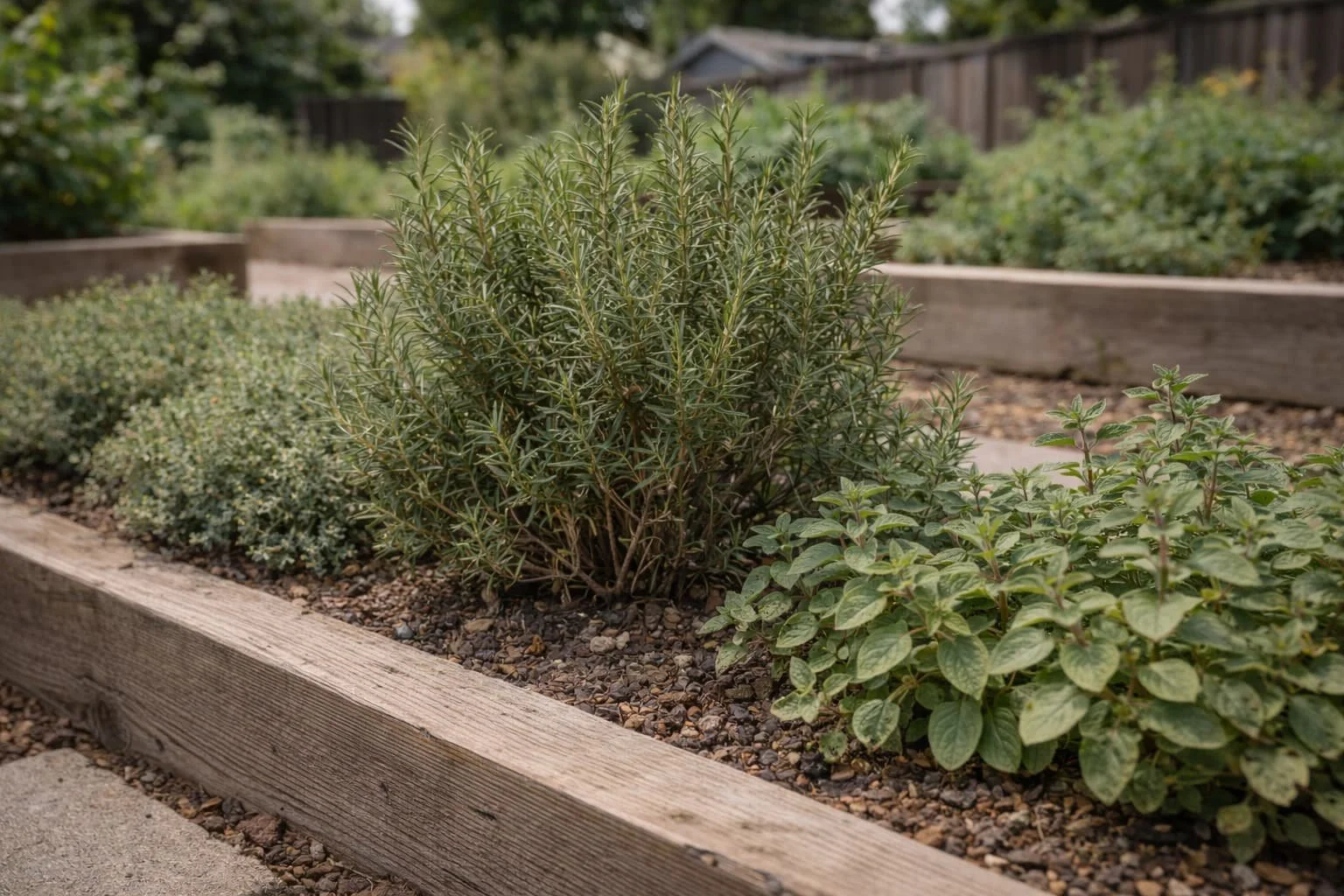
These familiar herbs can develop substantial woody growth. Look into the center of an established plant as well as at its green tips. Dead twigs, crowded branches, and contact with a structure are reasons to reassess the planting.
Plant lists vary, so don't use a blanket rule that every rosemary, lavender, or sage is safe once it is 30 feet from a building. Nor should a listing of one salvia be applied to every species and cultivar. Ask a local fire-safety assessor to help evaluate a large or woody planting near your home. Planting farther away may reduce an exposure, but the whole setting still matters.
If you want to keep growing these herbs, choose a suitable site before shopping or transplanting. Our Growing Rosemary in Santa Cruz, Growing Lavender in Santa Cruz, and Growing Sage in Santa Cruz guides address plant care. The linked perennial plant collection is a shopping resource, not a list of plants approved for defensible space.
Set up a garden you can maintain
Group plants by water needs
A pot of mint and an established oregano plant don't need identical care. Group herbs with similar requirements, check the root zone, and adjust watering for the soil, weather, and container size. Keep roots supplied with moisture without leaving them waterlogged.
The DIG raised-bed drip-watering kit is one equipment option. Check that its coverage, fittings, and water-supply requirements suit your bed before buying, and inspect the installed system for leaks or blocked emitters. Irrigation supports plant health. It cannot replace separation, removal of dead material, or home hardening.
Make cleanup part of harvesting
While you're cutting herbs for dinner, look for dry stems, weeds, and leaves caught underneath the plants. Remove that material and take the trimmings away from the bed. Don't pile herb cuttings against a wall or spread them in the immediate five-foot zone as mulch.
Use an appropriate compost location or local green-waste collection for the material you remove. Keep pathways and the spaces between planting areas clear enough to maintain. Gravel paths can separate vegetation, but windblown leaves need to be removed from gravel too.
Give containers a permanent place
A ceramic or metal pot avoids adding a combustible planter, but it still holds vegetation and growing media. Place containers as part of the year-round plan, including those near patios and doors. Hanging baskets under eaves or against siding can bring vegetation into exactly the area you are trying to keep clear.
Choose a workable location in advance. Don't build the plan around moving heavy rosemary pots or hanging baskets when a Red Flag Warning arrives. During an approaching wildfire, evacuation and official instructions take priority over rearranging the garden.
Common questions about herbs and wildfire
Is a low-growing herb a firebreak?
No. Low plants can still burn, and a dense mat can contain dry material. Use low growth to help keep a planting manageable, while maintaining separation and keeping the area near structures clear.
Can I keep an established rosemary beside the house?
Have its location assessed, especially if it sits within the immediate five-foot area or touches the building. Removal or replacement may be the appropriate choice. Occasional pruning doesn't make an unsuitable location safe, and a large established shrub may not transplant successfully.
Does irrigation make herbs fire-resistant?
Healthy plants are less likely to accumulate drought-related dieback, but watering doesn't prevent combustion. Water according to the herb's needs and soil conditions. Extra watering during a warning is not a substitute for preparation.
Can a burning herb ignite plants beside it?
Yes. The concern is the heat, flames, and embers from burning material, not oils somehow spreading into neighboring soil. Keep an herb bed from becoming a continuous connection between larger plants, fences, and the home.
Are dried herb bundles harmless indoors?
Dried plant material is combustible. Store it away from cooking flames, heaters, and other ignition sources. Treat dried herbs as ordinary combustible household material rather than assuming a culinary use removes the fire risk.
Should I choose herbs to repel pests?
Choose them for the cooking you enjoy and the conditions you can provide. A companion plant isn't a reliable general pest barrier. Identify the pest and use appropriate garden management instead of expecting mint or chives to protect the bed.
Plan the next planting
Start with the herbs you actually reach for in the kitchen. Find an appropriate place for them, then decide how much you can water, harvest, and keep clear of dry material. A few productive plants are a useful beginning.
Use your Garden Toolkit to organize the layout and seasonal tasks. For a broader starting point, see Growing Herbs in Santa Cruz County, with additional ideas in Growing Dill in Santa Cruz and Growing Herbs for Cocktails. When a harvest is larger than you can use fresh, Preserving Fresh Herbs covers ways to keep it for later.
For the landscape around that garden, keep Ready for Wildfire: Fire-Smart Landscaping alongside your local fire agency's guidance. Review the bed as it grows: the plant you brought home in a small nursery pot won't stay that size.
