

Growing Mint in Santa Cruz: Tips for Containing This Vigorous Herb
A few of the product links in this guide are affiliate links. If you buy through one, Ambitious Harvest may earn a small commission at no extra cost to you, which helps keep these guides free. We only point to gear we would use in our own Santa Cruz garden. As an Amazon Associate, we earn from qualifying purchases. Read our full disclosure.
Every gardener learns the mint lesson eventually. You plant one innocent little spearmint start in a corner of your herb garden, and two years later you're pulling mint runners out of your lawn, your flower beds, and the cracks in your patio. Mint's aggressive spreading habit has earned it a reputation as the herb you plant once and regret forever.
But mint is also delicious, versatile, and genuinely useful. Fresh mint transforms summer drinks, fruit salads, and Middle Eastern dishes. It makes soothing teas, fragrant additions to flower arrangements, and pleasant groundcover in the right situations. The question isn't whether to grow mint, but how to grow it without losing control.
Santa Cruz County's mild climate and regular moisture (whether from winter rains, summer fog, or irrigation) create ideal mint-growing conditions. That's great news for harvests but challenging news for containment. This guide will help you enjoy all the benefits of homegrown mint while keeping it from staging a hostile takeover of your garden.
What Is Mint's Spreading Habit?
Before discussing containment, it helps to understand how mint spreads. This knowledge makes control strategies more effective.
Mint spreads primarily through underground runners called stolons (sometimes called rhizomes, though technically stolons run horizontally at or just below the soil surface). These runners extend outward from the parent plant, sending up new stems at intervals. A single mint plant can spread several feet in a single growing season through this underground network.
Mint also spreads above ground. Stems that touch soil often root at the nodes, establishing new plants. This layering habit means sprawling mint patches expand in multiple directions simultaneously.
Finally, mint produces seeds, though most garden mints are hybrids that either don't set viable seed or produce offspring different from the parent plant. Seed spread is less of a concern than runner spread, but it can contribute to mint's expansion in some situations.
The combination of aggressive underground runners, above-ground layering, and (in some cases) self-seeding makes mint remarkably persistent. Pull up a mint patch and you'll likely miss some runner fragments. Each fragment can regenerate into a new plant. This is why mint is so hard to eliminate once established and why prevention is far easier than cure.
The good news: mint's spreading habit is entirely manageable with the right approach. Container growing, physical barriers, and regular maintenance keep mint productive and contained. Thousands of gardeners grow mint successfully without problems. You just need a plan.
UC Integrated Pest Management recommends growing mint in containers to prevent it from becoming invasive, noting that mint grows best with at least 4 to 6 hours of sun daily and consistently moist, well-drained soil.
How Should You Choose Mint Varieties for Santa Cruz Gardens?
The mint family includes hundreds of species and varieties with different flavors, growth habits, and uses. Here are the best choices for Santa Cruz County gardens.
Culinary Mints
Spearmint (Mentha spicata) is the classic culinary mint, essential for mint juleps, mojitos, tabbouleh, and tzatziki. The flavor is bright and sweet without being overpowering. Spearmint is one of the more vigorous spreaders, so containment is important. It grows 1-2 feet tall with pointed, serrated leaves.
Peppermint (Mentha × piperita) has a stronger, more menthol-forward flavor than spearmint. It's the mint of candy canes and peppermint tea. Peppermint is a natural hybrid between spearmint and watermint, and it's sterile (doesn't produce viable seeds), so spread is only through runners. It grows 1-3 feet tall with darker, more rounded leaves than spearmint.
Chocolate mint is a peppermint variety with subtle chocolate undertones. The name oversells the chocolate flavor (don't expect Thin Mints), but there's definitely something interesting going on. It makes excellent tea and pairs well with desserts. The stems often have a brownish-purple tinge.
Apple mint (Mentha suaveolens) has a fruity, apple-like quality that works beautifully in fruit salads, drinks, and desserts. The leaves are rounder and fuzzier than spearmint, with a softer texture. Apple mint tolerates drier conditions better than most mints, making it a good choice for Santa Cruz County's dry summers if you're not irrigating heavily.
Orange mint (Mentha × piperita f. citrata) offers citrus notes reminiscent of orange or bergamot. It's wonderful in teas, fruit dishes, and cocktails. The leaves often have a bronze or purple tinge.
Mojito mint (sometimes sold as Cuban mint or Mentha × villosa) is specifically selected for cocktails. The flavor is milder and less sharp than spearmint, allowing the rum and lime to come through. If you make mojitos regularly, this variety is worth seeking out.
Specialty and Ornamental Mints
Corsican mint (Mentha requienii) is a tiny groundcover mint that stays under 1 inch tall. It spreads to form a dense, fragrant carpet perfect for planting between stepping stones. The flavor is intensely minty (similar to crème de menthe), but the plant is too small for practical culinary harvest. It prefers shadier, moister conditions than most mints, making it ideal for shady spots under trees or on the north side of buildings.
Pennyroyal (Mentha pulegium) is a low-growing mint historically used as an insect repellent and medicinal herb. Important warning: pennyroyal is toxic in concentrated forms and should never be ingested in large quantities or by pregnant women. It's primarily ornamental or used as a natural pest deterrent (the scent repels some insects). Don't grow pennyroyal if you have children or pets who might eat plants.
Pineapple mint (Mentha suaveolens 'Variegata') is a variegated form of apple mint with cream-edged leaves. It's more ornamental than culinary, as the flavor is mild. The variegation is attractive in container plantings or as an edging plant.
Ginger mint offers hints of ginger alongside the mint flavor. It's less common but worth growing if you enjoy the combination.
What to Avoid
Wild mint or field mint that volunteers in your garden is typically less flavorful than cultivated varieties. It also tends to be extremely aggressive. If you find wild mint on your property, consider it a weed rather than a crop.
Novelty mints with names like "banana mint" or "lavender mint" often disappoint. The named flavors are usually subtle to the point of imaginary. Stick with proven culinary varieties for the best results.
For most Santa Cruz County gardeners, spearmint and peppermint cover the essential bases. Add apple mint if you want something different, or mojito mint if cocktails are your priority. One or two varieties is usually plenty since mint produces abundantly.
Which Containment Strategies Actually Work?
Now for the crucial part: how to grow mint without it taking over. Here are proven containment strategies ranked from most to least effective.
Strategy 1: Container Growing (Most Effective)
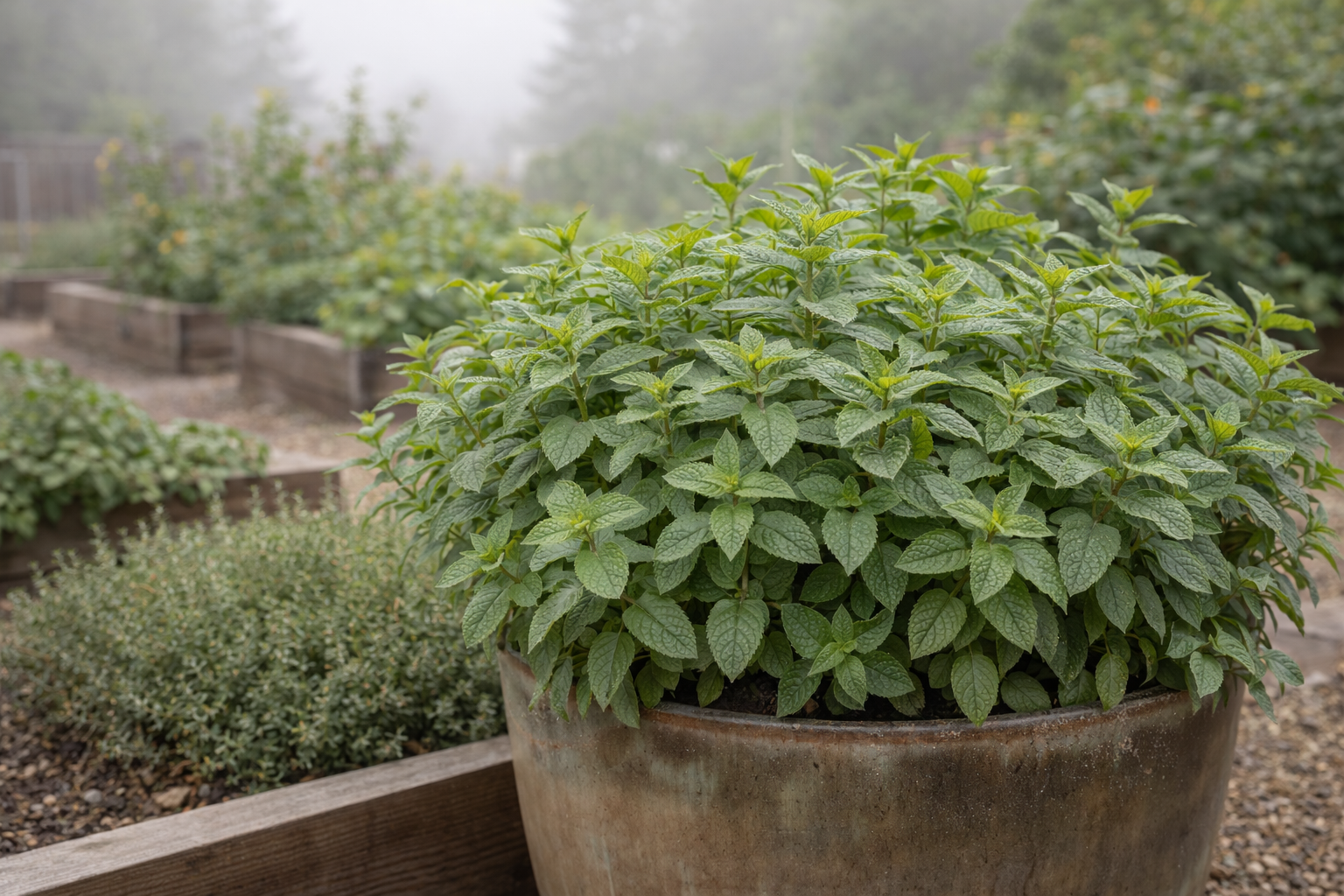
Growing mint in containers is the foolproof containment solution. No runners can escape from a pot sitting on your patio. This is the approach I recommend for most Santa Cruz County gardeners.
Container requirements:
Choose a pot at least 12 inches in diameter and 12 inches deep. Mint's runners spread horizontally, so width matters more than depth, but shallow pots dry out too quickly. Larger containers (16-20 inches) require less frequent watering and produce more abundant harvests.
Ensure excellent drainage holes. Mint tolerates more moisture than Mediterranean herbs like rosemary and thyme, but standing water still causes root rot.
Any material works (plastic, ceramic, terra cotta), but remember that terra cotta dries faster and may need more frequent watering in summer.
Placement:
Position containers where you'll use them. Near the kitchen door makes harvesting convenient. On a patio or deck keeps mint accessible and visible, so you'll remember to water and harvest.
Mint tolerates partial shade better than most herbs. In fact, in Santa Cruz County's hotter inland areas (Watsonville, sunny parts of Boulder Creek), afternoon shade prevents leaf scorch during heat waves. Coastal gardeners can grow mint in full sun without problems.
Maintenance:
Water container mint regularly. Unlike drought-tolerant Mediterranean herbs, mint prefers consistently moist (not waterlogged) soil. In summer, this may mean daily watering for smaller containers. Check soil moisture by inserting your finger an inch deep; water when dry.
Feed container mint monthly during the growing season with diluted liquid fertilizer. Container plants deplete nutrients faster than in-ground plants.
Repot or divide container mint every 2-3 years when plants become root-bound. Signs include roots growing out of drainage holes, water running straight through without being absorbed, and declining vigor despite adequate care.
One warning about containers: If you set containers on the ground, runners may escape through drainage holes and root in the soil below. Place containers on paved surfaces, gravel, or pot feet to prevent escape.
Strategy 2: Buried Barriers (Very Effective)
If you want mint in the ground (for example, as a groundcover in a specific area), buried barriers can contain spread effectively.
The method:
Remove the bottom from a large plastic nursery pot (15-gallon or larger), a plastic bucket, or a similar container. Bury this bottomless container in the ground, leaving 2 inches of the rim above soil level. Plant mint inside the buried barrier.
The barrier blocks horizontal runner spread. The above-ground rim prevents runners from traveling over the top. The open bottom allows drainage and deep root development.
Critical details:
The barrier must extend at least 12 inches deep, preferably 18 inches. Shallow barriers fail because runners simply grow under them.
The rim must stay above soil level. If soil or mulch builds up over the rim, runners will escape over the top.
Check the barrier annually for cracks or deterioration. Replace damaged barriers before mint escapes.
Even with barriers, inspect the contained area regularly. Pull any runners attempting to escape.
Alternative barrier materials:
Metal edging (at least 12 inches deep) works but is harder to install.
Concrete blocks or pavers sunk into the ground create effective barriers, though they're labor-intensive to install.
Root barrier fabric alone is not sufficient; mint runners are aggressive enough to find gaps and weak points.
Strategy 3: Isolated Beds (Moderately Effective)
A dedicated mint bed surrounded by hardscape (concrete, pavers, gravel) or lawn contains spread reasonably well.
The concept:
Mint runners can't easily cross paved surfaces or thick gravel. A bed surrounded by hardscape on all sides keeps mint contained as long as you maintain boundaries.
Lawn also provides modest containment. Regular mowing kills mint runners that venture into turf. However, mint-versus-lawn battles require ongoing vigilance, and mint often wins in the long run.
Limitations:
Hardscape must completely surround the bed. One gap is all mint needs to escape.
Runners may grow under shallow hardscape installations. Deep edges (6+ inches) work better.
Seeds or stem fragments can still spread mint beyond the isolated bed, though this is less common than runner spread.
Strategy 4: Regular Vigilance (Labor-Intensive)
You can grow mint in a regular garden bed if you're willing to patrol for escaping runners constantly.
The approach:
Plant mint and monitor the bed perimeter weekly during the growing season. Pull any runners extending beyond the desired area. Trace runners back to their source and remove the entire runner, not just the emerging tip.
In practice, this approach requires significant dedication. Miss a few weeks, and runners establish beyond your boundaries. Once mint roots in a new area, it's much harder to remove than catch-before-rooting prevention.
Realistic assessment:
This strategy works for highly attentive gardeners who genuinely enjoy the maintenance ritual. Most gardeners find containers or barriers far less frustrating. Life gets busy, you skip a few patrols, and suddenly mint is in your tomato bed.
I don't recommend this approach unless you enjoy weeding as a meditative practice.
Strategy 5: Full Takeover (Sometimes Intentional)
Some gardeners intentionally allow mint to colonize an area, using it as a fragrant groundcover in spaces where other plants aren't desired.
When this works:
Areas where nothing else will grow (heavy shade, poor soil, compacted areas).
Spaces you're fine with being exclusively mint (alongside a shed, in a narrow side yard, filling a contained planting strip).
As an alternative to lawn in small areas (mint is mowable and smells great when cut).
Considerations:
Once mint colonizes an area, eliminating it is extremely difficult. Be certain you want permanent mint before allowing full spread.
Mint may still attempt to spread beyond the designated area. Some boundary maintenance is always required.
A solid mint patch can be productive: you'll have more mint than you can possibly use, which makes generous sharing with neighbors easy.
How Should You Plant and Grow Mint in Santa Cruz County?
With containment strategy chosen, here's how to plant and care for mint successfully.
When to Plant
Spring (March through May) is ideal for planting mint. Warming soil and increasing day length promote vigorous growth. Spring-planted mint establishes quickly and produces abundant harvests by summer.
Fall (September through November) also works well. Mint establishes roots during cool weather and takes off in spring. This timing avoids summer heat stress on new transplants.
Year-round planting is possible in Santa Cruz County's mild climate, but summer planting requires more attention to watering as new plants establish.
Starting Mint
From nursery transplants: This is the easiest approach. Buy established plants from local nurseries, plant at the same depth they were growing in the pot, and water well. You'll be harvesting within weeks.
From cuttings: Mint roots extremely easily from stem cuttings. Cut 4-6 inch stems just below a leaf node, strip the lower leaves, and place in water or moist potting mix. Roots develop in 1-2 weeks. This is a great way to share mint with friends or start new containers from an existing plant.
From runners: If you know someone with mint (and you almost certainly do), ask for a section of runner with roots attached. Plant this runner segment 1-2 inches deep and water well. New growth appears within weeks.
From seed: Growing mint from seed is possible but rarely worthwhile. Seeds germinate slowly and erratically, seedlings take months to reach usable size, and many mint varieties are hybrids that don't come true from seed. Buy transplants or start from cuttings instead.
Sun and Shade
Mint tolerates a wider range of light conditions than most culinary herbs. Full sun produces the most vigorous growth and strongest flavor, but mint also grows well in partial shade (4-6 hours of sun).
In Santa Cruz County, afternoon shade benefits mint during hot spells, especially in inland areas like Watsonville and the sunny parts of Boulder Creek. Coastal gardeners can grow mint in full sun without problems since fog moderates temperatures.
For shady gardens under the redwoods in Felton or Ben Lomond, mint is one of the few culinary herbs that performs reasonably well. It won't be as vigorous as in full sun, but you'll still get useful harvests.
Soil and Water
Mint prefers moist, reasonably fertile soil. This sets it apart from Mediterranean herbs (rosemary, thyme, oregano) that want lean, dry conditions.
Soil preparation: Work compost into the planting area to improve moisture retention and fertility. Mint isn't particular about pH and tolerates our range of Santa Cruz County soils, from acidic redwood forest soil to alkaline coastal sand.
Watering: Keep mint consistently moist, especially in containers. Unlike drought-tolerant herbs, mint wilts noticeably when dry and recovers more slowly. In summer, container mint may need daily watering; in-ground mint benefits from deep watering twice weekly during dry periods.
Coastal gardens often need less supplemental irrigation since fog provides moisture. Inland and mountain gardens, particularly on sunny exposures, need more attention to watering.
Fertilizing: Mint benefits from regular feeding, especially in containers. Apply liquid fertilizer monthly during the growing season, or work slow-release organic fertilizer into the soil in spring. Don't overdo it: excessive fertilizer produces lots of leaves with diminished flavor.
Year-Round Care
Spring: Begin harvesting as new growth emerges. Cut back any winter-damaged stems. Divide and repot container mint if root-bound. Begin regular watering as weather warms.
Summer: Harvest frequently to encourage bushy growth. Water regularly, especially containers. Watch for pests (mostly minor issues). Pinch off flower buds to prolong leaf production, or allow some flowers for pollinators.
Fall: Continue harvesting. Reduce watering as weather cools and rains return. This is a good time to take cuttings for sharing or starting new plants.
Winter: Mint slows down but doesn't go fully dormant in Santa Cruz County. You can continue light harvests year-round. Stop fertilizing until spring.
Pest and Disease Issues
Mint is remarkably trouble-free. Its aromatic oils repel many pests, and healthy plants resist disease well.
Spider mites occasionally attack during hot, dry weather. Look for stippled, yellowing leaves and fine webbing. Spray plants with water to knock mites off. Improve air circulation and increase humidity (mist foliage) to discourage recurrence.
Aphids sometimes cluster on new growth. A strong water spray controls minor infestations. For persistent problems, insecticidal soap is effective.
Rust (orange-brown spots on leaves) occasionally affects mint, especially in humid conditions with poor air circulation. Remove affected leaves, improve airflow, and avoid overhead watering. Severely affected plants may need removal.
Powdery mildew (white powdery coating on leaves) appears in humid conditions. Improve air circulation and avoid overhead watering. Remove affected foliage.
Mint flea beetles (tiny holes in leaves) are occasionally problematic. Damage is mostly cosmetic. Floating row cover prevents beetle access if damage is severe.
When and How Should You Harvest Mint?
Mint is ready to harvest as soon as plants are established and producing vigorous growth, usually 3-4 weeks after planting transplants.
Timing
Harvest in the morning after dew dries but before midday heat. Essential oils are most concentrated in the morning.
Harvest before flowering for best flavor. Once mint flowers, leaf production slows and flavor becomes somewhat sharper. Pinch flower buds to extend the harvest season, or allow some flowers for pollinators (bees love mint flowers) and harvest around them.
Year-round harvest is possible in Santa Cruz County. Growth slows in winter but doesn't stop. You can pick fresh mint even in January, though harvests are smaller than in summer.
Technique
Cut sprigs rather than picking individual leaves. Use scissors or pinch stems just above a leaf node (where leaves emerge from the stem). The plant branches from this point, producing two new stems for every one you cut.
Harvest frequently. Regular cutting encourages bushy, productive plants. If you're not using much mint, cut it anyway and compost the excess. Unharvested mint becomes leggy and less productive.
Take up to one-third of the plant at each harvest. Mint is vigorous enough to handle heavy cutting, but leaving adequate foliage ensures continued photosynthesis and regrowth.
Cut back entire plants once or twice per season to rejuvenate growth. When mint becomes leggy and sparse at the base, cut all stems back to a few inches tall. New growth emerges quickly and is bushier than before.
Using Fresh Mint
Fresh mint is best used immediately or within a few days. For short-term storage, place stems in a glass of water like flowers (they'll stay fresh for a week or more) or wrap loosely in damp paper towels and refrigerate in a plastic bag.
Mint leaves bruise easily, releasing their essential oils. For best presentation in drinks and salads, handle leaves gently and add them at the last moment.
How Can You Preserve Mint for Later Use?
Mint's volatile oils dissipate somewhat during preservation, but several methods retain good flavor for off-season use.
Drying
Dried mint makes excellent tea but loses much of its bright, fresh character. It's worth drying some mint for winter teas, but fresh or frozen mint is better for culinary use.
To air dry: Bundle 4-6 stems and hang upside down in a warm, dry spot out of direct sunlight. Mint dries in 1-2 weeks depending on humidity. Our dry Santa Cruz summers make air drying easy; coastal fog may slow the process.
Dehydrator drying produces faster, more consistent results. Set temperature to 95-105°F and dry until leaves crumble easily, typically 4-8 hours.
Store dried mint in airtight containers away from light and heat. Use within 6-12 months for best flavor.
Freezing
Freezing preserves mint's fresh flavor better than drying. Two methods work well.
Ice cube method: Pack fresh mint leaves into ice cube trays and cover with water. Freeze, then transfer cubes to freezer bags. Drop cubes directly into drinks, smoothies, or cooking. This is the best method for preserving bright mint flavor.
Flash freezing: Spread clean, dry leaves on a baking sheet and freeze until solid. Transfer to freezer bags. Use frozen leaves directly in cooking (they'll be limp when thawed, but flavor is intact).
Mint Syrup
Simple syrup infused with mint preserves the flavor for cocktails, lemonade, and desserts.
Combine equal parts sugar and water in a saucepan. Heat until sugar dissolves. Add a generous handful of fresh mint (stems included), remove from heat, and let steep for 30 minutes to an hour. Strain, cool, and refrigerate. Mint syrup keeps for several weeks refrigerated.
Mint Extract
For a shelf-stable mint flavoring, make extract by packing fresh mint leaves into a jar and covering with vodka. Let steep for 4-6 weeks, shaking occasionally. Strain and store indefinitely. Use in baking, beverages, and wherever mint flavor is wanted.
How Do You Grow Mint in Different Santa Cruz Microclimates?
Mint adapts well throughout Santa Cruz County, with minor adjustments for local conditions.
Coastal gardens (Aptos, Capitola, Santa Cruz, Live Oak): Summer fog keeps temperatures moderate and provides some moisture, reducing watering needs. Mint grows vigorously here with minimal stress. Full sun is fine at the coast since fog prevents scorching. Watch for fungal issues (rust, powdery mildew) during foggy periods; ensure good air circulation.
San Lorenzo Valley (Boulder Creek, Ben Lomond): Sunny exposures can get quite hot in summer. Afternoon shade prevents leaf scorch during heat waves. Morning sun with afternoon shade is ideal for mint here. Your drier conditions mean more attention to watering. Mint in sunny, dry spots may need daily watering in summer.
Under the redwoods (Felton, Ben Lomond canyons): Mint is one of the few culinary herbs that tolerates redwood shade. The moist, cool conditions suit mint reasonably well. Expect less vigorous growth than in sunnier areas, but you'll still get useful harvests. Corsican mint (the tiny groundcover species) especially thrives in shade.
Inland valleys (Scotts Valley, Soquel hills): Good mint-growing conditions with moderate adjustments. Afternoon shade helps during hot spells. Water more attentively than coastal gardeners since you lack the moderating fog influence.
Pajaro Valley (Watsonville): Your warm, sunny conditions produce vigorous mint growth, but heat stress is possible during summer. Provide afternoon shade or grow mint on the north or east side of buildings where it receives morning sun and afternoon protection. Water generously.
Where to Buy Mint Locally
Mint is one of the most commonly available herbs at local nurseries. You'll find it year-round, with the best selection in spring.
San Lorenzo Garden Center (235 River Street, Santa Cruz) carries mint varieties including spearmint and peppermint. Ask about specialty varieties; availability varies seasonally.
Dig Gardens (420 Water Street, Santa Cruz, and 7765 Soquel Drive, Aptos) stocks herbs including mint. Their plants are well-grown and establish easily.
Mountain Feed & Farm Supply (9550 Highway 9, Ben Lomond) carries herb starts including mint in spring and summer.
Scarborough Gardens (33 El Pueblo Road, Scotts Valley) offers mint and other herbs with knowledgeable staff.
Sierra Azul Nursery (2660 E. Lake Avenue, Watsonville) occasionally carries mint among their herb selection.
Farmers markets throughout Santa Cruz County often have vendors selling herb starts, including mint. The Downtown Santa Cruz Farmers Market (Wednesday) and Westside Santa Cruz Farmers Market (Saturday) are good places to look.
Or just ask a friend. Anyone who grows mint has more than they can use and will happily share divisions or cuttings.
Frequently Asked Questions About Growing Mint in Santa Cruz
How do I stop mint from spreading?
The most reliable method is growing mint in containers rather than in the ground. If you prefer in-ground growing, use buried barriers (a bottomless pot or bucket sunk at least 12 inches deep with 2 inches of rim above soil). Regular patrol and removal of escaping runners also works but requires consistent effort. Once mint establishes beyond its intended area, removal becomes very difficult.
Can I grow different mint varieties together?
You can grow multiple varieties, but keep them in separate containers or separate barrier-contained areas. Different mints planted together will intertwine their root systems, making it impossible to distinguish varieties. They may also cross-pollinate if they flower, producing seedlings unlike either parent. For culinary clarity, maintain variety separation.
Why is my mint leggy and sparse?
The most common cause is insufficient harvesting. Mint becomes leggy when left unharvested because it puts energy into elongating stems rather than producing side branches. Cut your mint back frequently, even if you're not using it. Other causes include insufficient light (move to a sunnier spot) and nutrient deficiency in containers (begin regular fertilizing).
Does mint come back every year?
Yes, mint is perennial in Santa Cruz County and comes back reliably year after year. In fact, the problem is usually that it comes back too enthusiastically, spreading well beyond where you planted it. Container-grown mint can last indefinitely with occasional repotting. In-ground mint persists essentially forever once established.
Can I grow mint indoors?
Mint grows better indoors than most herbs because it tolerates lower light levels. Provide a bright window (south or west-facing is best) and keep soil consistently moist. Indoor mint won't grow as vigorously as outdoor plants but produces enough for occasional harvests. Rotate containers outdoors periodically if possible to boost vigor.
When should I cut mint back?
Cut mint back when it becomes leggy, when it starts flowering (unless you want flowers for pollinators), or any time it outgrows its space. You can cut mint back to just a few inches tall, and it regenerates quickly with bushier growth. Most gardeners cut mint back hard once or twice during the growing season plus light harvesting in between.
Is mint invasive in California?
Common garden mints (spearmint, peppermint) are not listed as invasive species in California, though they can certainly become invasive in your garden if not contained. They don't generally spread into wild areas or outcompete native plants on a landscape scale. However, their aggressive spreading habit within gardens makes containment important for keeping your garden under control.
Can mint grow in shade?
Mint tolerates partial shade (4-6 hours of sun) better than most culinary herbs. This makes it a good choice for gardens with limited sun, including the redwood shade common in parts of Santa Cruz County. In dense shade (less than 4 hours of sun), mint will grow but may be sparse and less flavorful. Corsican mint specifically prefers shadier, moister conditions.
Free Gardening Resources
Getting Started
Beginner Garden Setup Checklist , Complete setup guide to start your garden right.
Know Your Microclimate Worksheet , Understand your local conditions before planting.
Planning & Timing
Seasonal Planting Calendar , Avoid timing mistakes with month-by-month guidance.
Vegetables by Season Chart , Quick reference for what to plant and when in Santa Cruz County.
Seasonal Garden Tasks Checklist , Stay on track with monthly garden maintenance tasks.
Growing Guides
Companion Planting Guide , Learn which plants grow better together and which to keep apart.
Tomato Variety Selector , Find the best tomato varieties for your Santa Cruz microclimate.
Problem Solving
Garden Troubleshooting Guide , Diagnose common problems before they become disasters.
Gopher Control Guide , Humane and effective strategies for managing gophers in your garden.
Santa Cruz-Specific Guides
Water-Wise Gardening Guide , Conserve water while keeping your garden thriving through dry seasons.
Grow Mint Without Regrets
Mint deserves a place in your Santa Cruz County garden. The fresh flavor beats dried mint so dramatically that once you've made mojitos with homegrown spearmint, you'll never go back. And with proper containment, you can enjoy abundant mint harvests without the plant staging a garden takeover.
Start with a container on your patio. It's the simplest, most foolproof approach. Choose a pot at least 12 inches wide, fill with regular potting mix, plant a nursery start of spearmint or peppermint, and keep it watered. Within weeks, you'll be picking fresh mint for tea, cocktails, and summer cooking.
Your mint will try to escape. All mint does. But contained in a pot, it can try all it wants. You'll have the last laugh (and the fresh mint juleps).
Related Articles
Herb Growing Guides
Growing Herbs in Santa Cruz County - Complete guide to growing culinary herbs
Growing Basil in Santa Cruz - Tips for our most popular summer herb
Growing Rosemary in Santa Cruz - The easiest Mediterranean herb
Growing Lavender in Santa Cruz - Fragrant, drought-tolerant beauty
Growing Mint in Santa Cruz - Vigorous grower for mojitos and more
Growing Thyme in Santa Cruz - Versatile culinary and cocktail herb
Growing Oregano in Santa Cruz - Mediterranean kitchen essential
Growing Sage in Santa Cruz - Savory herb for cooking and cocktails
Growing Parsley in Santa Cruz - The underrated two-year herb
Growing Cilantro in Santa Cruz - Cool-season favorite
Growing Dill in Santa Cruz - Quick-growing annual herb
Growing Chives in Santa Cruz - Easy perennial onion flavor
Herb Care & Preservation
Preventing Basil from Bolting - Keep basil productive all season
Preserving Fresh Herbs - Drying, freezing, and infusing methods
Special Topics
Growing Herbs for Cocktails - From garden to glass
Fire-Wise Herb Gardens - Low-growing, high-moisture plants for defensible space
