

Fall Vegetable Planting Guide for Santa Cruz County
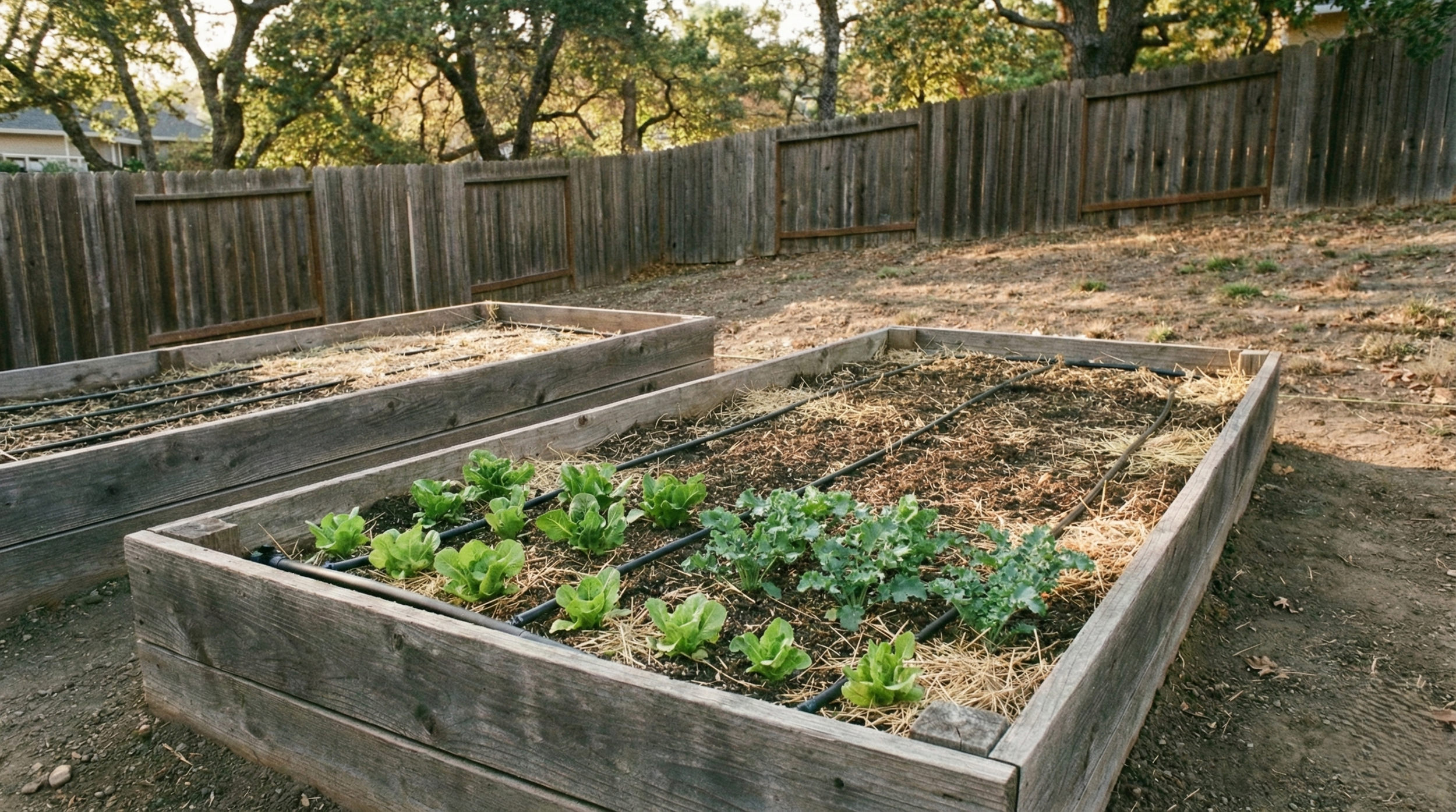
Start your fall vegetables in Santa Cruz County between mid-July and mid-September. The UC Master Gardener Program of Alameda County puts it plainly: "July and August are the months to choose what to grow during our cooler months and to begin planting." Cool-season crops produce their best quality when average temperatures sit between 55 and 75 degrees, according to the UC Master Gardener Program, which describes our coastal fall and winter almost exactly. The limiting factor here is usually shrinking daylight, not frost.
Why Is Fall the Best Vegetable Season on the Central Coast?
Most vegetable gardening advice is written for places where fall means a hard stop. A first freeze arrives, the tomatoes blacken overnight, and the beds go to sleep until spring. That is not our year.
On the Santa Cruz coast, fall is a long, mild, gradually cooling stretch that lines up almost perfectly with what cool-season vegetables want. The UC Master Gardener Program defines cool-season crops as those that "grow best and produce the best quality when the average temperatures are 55°F to 75°F" and notes they are "usually tolerant of slight frosts." Root crops, leafy crops, immature-flower crops like broccoli and cauliflower, and alliums all live in that group. Warm-season crops, by the same UC source, want 65 to 95 degrees, which large parts of this county never reliably deliver. The marine layer that rolls over Live Oak, Capitola, and the Westside in June is the reason so many local tomato plants sulk.
There is a second advantage that gets less attention. Fall planting means your seedlings go in while the soil is still warm and the weather is settled, then grow into cooling, moistening conditions. Spring planting is the reverse: you put tender starts into cold, wet ground and hope. If you have ever wondered why your spring broccoli bolted and your fall broccoli did not, that sequence is most of the answer. We compare the two seasons in Fall Planting vs Spring Planting.
The county's commercial growers already know this. Brussels sprouts, broccoli, cauliflower, and lettuce are Pajaro Valley staples and appear year after year in the Santa Cruz County Agricultural Commissioner's crop reports. Nobody farms Brussels sprouts on this coast because it is hard here. They farm them because our cool, foggy, frost-light climate is close to ideal for them.
That said, fall gardening here is not effortless. It is slower, wetter, and buggier than summer, and the timing window is narrower than the mild weather makes it look.
How Do You Do the Timing Math When Frost Is Not the Real Limit?
Every fall planting guide tells you to count back from your first frost date. On the Santa Cruz coast, that instruction quietly breaks, for two reasons.
There is no single Santa Cruz County frost date
Santa Cruz County is not one climate. It is a coastal shelf, a river valley, a redwood canyon system, and a set of warm inland pockets, all inside about 40 miles. A garden two blocks from Cowell Beach and a garden on a valley floor in Ben Lomond can have completely different winter minimums in the same week.
Do not trust any article (including this one) that prints one countywide frost date. Look up your own location on the USDA Plant Hardiness Zone Map, which takes a ZIP code and returns the average annual extreme minimum winter temperature for your area. Read it carefully, though: a hardiness zone describes how cold your coldest night typically gets, not the calendar date of your first frost. It is a temperature answer, not a timing answer.
The practical version, after 20 years of growing here: on the immediate coast, frost is an occasional nuisance rather than a season-ending event, and most cool-season vegetables shrug at the slight frosts UC describes them as tolerating. Inland and up the San Lorenzo Valley, frost is a real planning input, and our guide to frost protection for plants on the California coast covers what actually works.
Daylight is the limit that actually bites
Using sunrise and sunset data from the U.S. Naval Observatory for Santa Cruz (roughly 37 degrees north), day length runs about:
14 hours 26 minutes on July 15
12 hours 25 minutes on September 15
11 hours 15 minutes on October 15
10 hours 11 minutes on November 15
9 hours 37 minutes at the winter solstice
Plants do not grow on the calendar. They grow on light. From late fall through midwinter, a coastal Santa Cruz garden does not receive enough daily light to push much new growth, no matter how mild the air is. Plants that are already sized up will hold in the ground and can be harvested through the dark months. Plants that are still small in November sit there and wait for February.
Crops also mature more slowly in the short, cool days of fall and winter than in the long, warm days of spring and summer, which is why a seed packet's "60 days to maturity" is a summer figure, not an autumn one.
The count-back formula that works here
Instead of counting back from frost, count back from useful daylight:
Set the target. Your crop should be at or near full size by around mid-November, when day length drops through 10 hours.
Take the days to maturity from your seed packet or plant tag.
Add two to four extra weeks of padding, because growth slows as light and temperature decline.
If you are starting from seed rather than buying a transplant, add the seed-to-transplant time. UC's Alameda County program gives the example: "broccoli takes about 6 weeks from seed to transplanting, so broccoli seeds should be started around August 1 to have seedlings ready to transplant in mid-September."
Count backward from mid-November. That is your sow date.
Run that on a 70-day broccoli and you land in early August for the seed. Run it on a 30-day arugula and you can sow into October and still eat well. The math tells you which crops are still in play in any given week.
What Should You Plant for Fall in Santa Cruz, and When?
A coastal fall garden comes down to six crop families.
Brassicas (broccoli, cauliflower, cabbage, kale, Brussels sprouts, collards, bok choy)
These are the backbone of a Central Coast fall garden. The UC Master Gardener Program lists July through September as a broccoli planting window for the North and North Coast region, which covers everything from Monterey County northward.
Start brassica seeds indoors or in a protected spot from mid-July through mid-August, and set transplants out from mid-August through late September. Kale and collards are the forgiving end of the family and tolerate a later start. Cauliflower is the fussy end: it wants steady conditions and produces small, loose heads if it is stressed or planted late.
Brussels sprouts need a long, cool season, which is why they are a commercial crop in the Pajaro Valley and a frustrating one in a hot inland yard. Start seed in July and transplant by August, or you will be harvesting marbles. See Brussels Sprouts in the Pajaro Valley and our Brassica Planting Calendar for Santa Cruz.
Leafy greens (lettuce, spinach, chard, arugula, mustards, Asian greens)
Greens keep a coastal fall garden productive the longest, because they are harvested young and never have to finish anything.
Their timing depends on soil temperature more than most gardeners expect. Lettuce germinates best between 60 and 75 degrees and fails above 85, and spinach is pickier still, with an optimum range of 65 to 75 and a maximum of 75, according to the seed germination data compiled by J.F. Harrington of UC Davis and published by the UC Master Gardener Program. Spinach sown into hot late-summer soil in a Scotts Valley or Corralitos garden often does not come up at all. That is a germination failure, not a bad seed lot. So sow lettuce and spinach in the coolest part of your garden, or start them in flats in the shade and transplant.
From September onward, coastal soil temperatures usually cooperate and direct sowing gets easy. Arugula, mustard greens, and Asian greens germinate fast and can be sown in succession into October and beyond. See Best Lettuce Varieties for Santa Cruz, Growing Arugula and Mustard Greens in Santa Cruz, and Succession Planting Greens.
Root crops (carrots, beets, radishes, turnips, parsnips)
Root crops are direct-sow only. They resent transplanting, and a carrot that was moved will fork.
Sow carrots and beets from August through late September, radishes and turnips from August through October (radishes are fast enough to keep sowing later still). Carrots and beets germinate across a broad range, 65 to 85 degrees optimum per the UC germination data, so late-summer soil is not the obstacle it is for spinach.
The real challenge here is keeping the seedbed evenly moist through germination while the weather is still dry. A board or a piece of burlap laid over the row until sprouts appear does more for carrot success than anything else. Our carrot troubleshooting guide covers the rest.
Alliums (garlic, bulb onions, leeks, green onions)
Garlic is the easiest win on this list. UC Master Gardener guidance puts garlic planting in October and November, with harvest the following June or July. Plant the largest cloves from the head, pointy end up. Softneck types generally suit our mild winters better than hardnecks, which want more cold.
Bulb onions are trickier. Bulbing is driven by day length, and the UC Master Gardener Program of Alameda County identifies day length as the most important factor, recommending intermediate-day varieties (which need 12 to 14 hours of daylight) for the Bay Area. That guidance applies to us. A long-day onion bred for Oregon will never bulb properly here, no matter how well you feed it. From seed, expect roughly six months to harvest.
Leeks and green onions have no such constraint and go in from late summer through fall. See Garlic and Onion Troubleshooting.
Peas and fava beans
Peas are a fall-sown crop here, not a spring one, which surprises gardeners who moved from colder states. Sow snap, snow, and shelling peas from late August through October for harvest through the mild part of winter and into early spring. They germinate best at 65 to 75 degrees soil temperature, per the UC germination data, so letting late-summer soil cool a little improves your stand. Our comparison of sugar snap vs snow peas helps with variety choice.
Fava beans do double duty: eat them, or grow them as a nitrogen-fixing cover crop and cut them down before they set pods. Sow favas in October and November.
Cover crops
If you are not going to plant a bed, plant a cover crop in it. Bare winter soil on our slopes loses topsoil to the rains and gains weeds.
The window is October through early November, timed to the start of the rainy season, and legumes (vetch, bell beans, field peas, clovers) do the most for nitrogen. The UC SAREP Cover Crops Database has entries for more than 40 species, and the UC Marin Master Gardeners cover crop page is a good plain-language starting point. Buy legume inoculant when you buy the seed. Local specifics are in Winter Cover Crops in California and the complete Santa Cruz cover crop guide.
Should You Start Seeds Indoors, Direct Sow, or Buy Transplants?
The right answer changes by crop.
Start indoors (or in flats in the shade)
Brassicas and lettuce do better started in a controlled spot in July and August. Late-summer soil on the sunnier side of the county is often too warm and too dry for good germination, and a seedling tray you can move into afternoon shade solves that. Six weeks from seed to transplant is the working number for broccoli, per UC's Alameda County program, and most brassicas run four to six weeks.
Direct sow
Root crops (carrots, beets, radishes, turnips, parsnips) have to be direct sown. So do peas, favas, and cover crops, both because they transplant poorly and because you are planting an area rather than individual plants. Fast greens like arugula and mustards are not worth the tray.
Buy transplants
Six-packs win in two situations: when you have run out of runway (if it is mid-September and you want broccoli, a transplant buys back the six weeks you no longer have), and when you only want a few plants. Nobody needs a full flat of cauliflower. The trade-off is variety, since nurseries carry a handful of reliable sellers and the good ones sell out. See transplants vs seeds and where to buy in Santa Cruz County.
What Does the Mid-July to September Action Window Look Like?
If you are reading this in July, here is the sequence.
Mid-July to end of July
Start Brussels sprouts, cauliflower, and cabbage seed now, plus your first round of broccoli. Sow into flats or 4-inch pots kept somewhere with morning sun and afternoon shade. Meanwhile, take a hard look at your summer beds and decide which are done. A tired zucchini pulled in July is a fall bed gained.
August
The busiest month. Transplant your July-sown brassicas as they size up. Start a second round of broccoli and kale seed. Direct sow carrots and beets. Begin lettuce in flats. Keep seedbeds damp. If you only do one thing this month, get the brassicas in the ground.
September
The last practical month for most heading brassicas from transplant, the easiest month for direct-sowing greens (the soil has finally cooled), and the start of pea season. Radishes, turnips, and spinach go in now. If you missed August entirely, buy transplants and move fast.
October and November
Garlic goes in. Favas go in. Cover crops go in with the first real rains. Keep sowing quick greens and radishes. Everything else should already be growing. Our monthly guides break it down further: what to plant in August, September, and October.
How Does Your Microclimate Change the Dates?
The UC Master Gardener Program is explicit that its regional planting dates "are only approximate, as the climate may vary even in small sections of the state." In Santa Cruz County, that variation is the whole story. Four broad patterns:
The coastal fog belt (Santa Cruz, Live Oak, Capitola, Aptos, Davenport)
Cool, damp, mild, slow. The friendliest fall zone in the county and the one where the season stretches longest. Soil stays cool, so late-summer germination of lettuce and spinach is easier here than anywhere else, and you can push your dates to the later end of every window. The cost is slug and snail pressure, which is severe.
The Pajaro Valley and Watsonville
Cool nights, good sun, deep soils, and enough moderation from the bay to make this the county's cool-season powerhouse. Follow the standard windows in this guide. Frost is possible on open valley floor on cold clear nights, more so than on the immediate coast.
The San Lorenzo Valley and redwood canyons (Felton, Ben Lomond, Boulder Creek)
The hard case. Cold air drains into these valleys at night, so frost arrives earlier and hits harder, and the redwood canopy cuts light in an already light-limited season. Plant on the early end of every window: both your frost risk and your light budget run out sooner. Under redwood shade, heading brassicas may never get enough light to finish, and greens and root crops in the sunniest opening you have are the better bet.
Warm inland pockets and banana belts (Scotts Valley, parts of Soquel, ridge tops above the fog)
More summer heat, more sun, warmer soil into September. Germination is the challenge: hot soil stops lettuce and spinach cold, so start those in flats in the shade or wait for September. Fall brassicas grow fast here in the shoulder season, and ridge tops above the fog also sit above the coldest air on winter nights.
Our guide to microclimate gardening and finding your warm and cool spots helps you work out which of these you actually live in, which is not always obvious from a map.
How Do You Prep a Bed After Summer Crops?
The temptation is to rip out the summer crop and plant the same afternoon. Slow down by a week and you will grow a better one.
Clear, but keep the roots in mind. Pull spent squash and cucumbers. Legume roots hold nitrogen-fixing nodules, so cut beans and peas off at the soil line and leave the roots. Take diseased material (powdery mildew, blight) out of the garden rather than composting it. Piled dry summer debris is also fire fuel, which our guide to fall garden cleanup for fire safety covers.
Feed the soil, not just the plant. Summer crops leave a bed depleted. Work in two to three inches of finished compost. Brassicas are hungry and want real organic matter and steady nitrogen. If you have been composting kitchen scraps all summer, this is what it was for. See Composting 101.
Do not rotate brassicas into a brassica bed. Clubroot and brassica pests build in soil. If you grew kale there last winter, put carrots or greens there this time.
Water differently. Fall planting means irrigating dry beds in August and September, then abruptly not needing to once the rains start. Get your drip working before you plant, and be ready to shut it off. Overwatering a coastal fall bed in November is a common way to lose a crop.
What Pests Should You Expect in a Coastal Fall Garden?
Fall trades summer's pests for a different set.
Slugs and snails are the main event.UC IPM notes that snails and slugs are most active at night and during cloudy or foggy conditions, and that in mild California coastal areas they remain active year-round rather than hibernating. That is a precise description of a Santa Cruz fall, and a brassica transplant set out into damp October soil can be gone by morning. UC IPM recommends habitat removal (boards, debris, dense ground covers), drip irrigation, early-morning watering, copper barriers, thorough handpicking at night, and iron phosphate baits, which it describes as "safer for use around children, domestic animals, birds, fish, and other wildlife" than metaldehyde. Bait alone will not do it. Our guide to slug and snail control in foggy Santa Cruz gardens is the local version.
Cabbage aphids build up on brassicas.UC IPM reports that cabbage aphids reproduce through much of the year in California with many generations, feeding on young leaves and flowering parts in dense waxy colonies that curl the leaves around them and make spray coverage difficult, and that populations often jump after transplanting. Check growing tips weekly, knock small colonies off with water, and protect the natural enemies (lady beetles, syrphid fly larvae, and the parasitic wasp *Diaeretiella rapae*) that do most of the work. See how to get rid of aphids organically.
Imported cabbageworm and cabbage looper chew holes.UC IPM recommends handpicking, floating row covers to prevent egg-laying in the first place, and *Bacillus thuringiensis* or spinosad, noting that Bt is most effective on young larvae. Row cover over new brassica transplants solves the cabbageworm problem and the bird problem at once.
Gophers do not take the winter off. See gopher control that actually works in Santa Cruz and, for a fuller brassica rundown, Brassica Pests and Diseases in Santa Cruz.
What Is Not Worth Planting for Fall Here?
Some things will not work, and knowing that saves a bed.
Warm-season crops, full stop. Tomatoes, peppers, eggplant, corn, squash, melons, and beans want 65 to 95 degrees, per the UC Master Gardener Program. A second planting of bush beans in August is a common coastal mistake. They grow slowly, flower late, and give you almost nothing.
Anything with a long maturity started late. A 90-day cauliflower transplanted in October ties up a bed for months in exchange for nothing. If the count-back math does not land before mid-November, pick a different crop or a shorter variety.
Spinach direct-sown into hot soil. UC's germination data puts spinach's maximum soil temperature at 75 degrees. An inland Santa Cruz County garden in August is above that. Wait, or start it somewhere cool.
Bulb onions from the wrong day-length category. Long-day onions bred for northern latitudes will not bulb here. Buy intermediate-day varieties.
Bare winter beds. On our rain-fed slopes, leaving soil uncovered is usually the wrong call.
What to Do This Week
If it is mid-July:
Buy or order brassica seed, and start Brussels sprouts, cauliflower, and your first broccoli this week.
Pick one underperforming summer bed and mark it for clearing in the next two weeks.
Run the count-back math on the two or three crops you actually want to eat this winter, and write the sow dates on a calendar.
The work is front-loaded into the next eight weeks. Almost everything good about a coastal winter garden traces back to a decision made in July or August.
Our free planting calendar tool covers 45 crops across four California zones, and the Garden Toolkit has free seed-starting guides for Santa Cruz County. For questions specific to your block, the UC Master Gardeners of Monterey, San Benito & Santa Cruz Counties run a free help desk.
Frequently Asked Questions
When should I start fall vegetable seeds in Santa Cruz County?
Start most fall vegetable seeds between mid-July and mid-September. The UC Master Gardener Program of Alameda County states that "July and August are the months to choose what to grow during our cooler months and to begin planting," and gives broccoli as an example: sow around August 1 for transplants ready in mid-September. Garlic, favas, and cover crops go in later, during October and November.
Is Santa Cruz too warm for a fall vegetable garden?
No. Cool-season vegetables produce their best quality at average temperatures between 55 and 75 degrees, according to the UC Master Gardener Program, which describes coastal Santa Cruz fall and winter closely. The bigger constraint is heat at the start of the season: soil above 85 degrees prevents lettuce germination and soil above 75 degrees prevents spinach germination, per UC seed germination data, so inland gardeners often start those crops in flats in the shade.
What is the first frost date in Santa Cruz County?
There is no reliable countywide answer, because frost behavior varies sharply between the immediate coast, the Pajaro Valley, the San Lorenzo Valley, and inland ridges. Look up your own location on the USDA Plant Hardiness Zone Map, keeping in mind that a hardiness zone reports your average coldest winter temperature, not a frost date. On the coast, declining daylight limits fall growth more than frost does.
Can I still plant vegetables in Santa Cruz in October?
Yes, but the list narrows. October is right for garlic, fava beans, cover crops, peas, radishes, turnips, and fast greens like arugula and mustards. It is too late to start heading brassicas from seed, and generally too late to transplant cauliflower or Brussels sprouts and expect a real harvest. Day length falls to about 11 hours by mid-October and about 10 hours by mid-November, per U.S. Naval Observatory data, which sharply slows growth.
Do I need to protect fall vegetables from frost in Santa Cruz?
Usually not on the immediate coast. The UC Master Gardener Program describes cool-season crops as "usually tolerant of slight frosts," and most brassicas, greens, and root crops handle light coastal frost without help. In the San Lorenzo Valley and other cold-air drainage areas, keep row cover on hand for the coldest clear nights, particularly for young transplants.
