

Heat Wave Garden Survival Guide for California
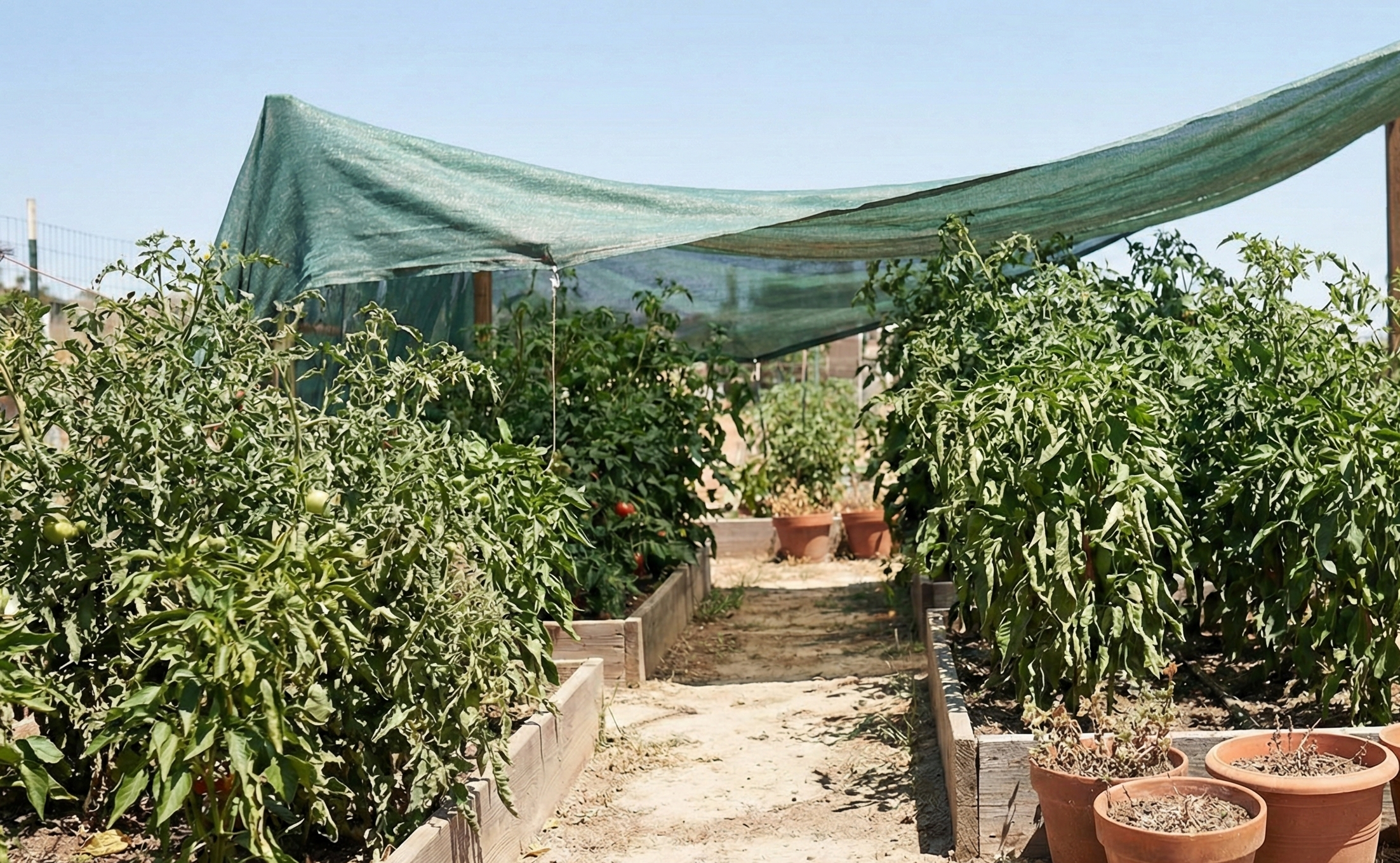
When a heat wave is forecast, the work happens before the heat arrives: water deeply the day before, top up mulch, get shade cloth over tomatoes and peppers, and move containers into afternoon shade. During the heat itself, water early in the morning, harvest ripening fruit, and stop fertilizing, pruning, and transplanting until it passes. The UC Master Gardener Program advises against fertilizing during hot summer months because new growth increases a plant's water demand exactly when soil is drying fastest.
That is the short version. The rest of this guide is the coastal California part, which is where most heat-wave advice falls apart.
Why Does a 95 Degree Day Hurt a Santa Cruz Garden More Than a Sacramento Garden?
The California Department of Public Health defines extreme heat as temperatures much hotter than average for a given geographic area, with an extreme heat event lasting two or more days and nights of unusually high heat. The key words are "for a given geographic area." Heat is relative. A garden acclimated to the conditions it usually gets will handle a hot day. A garden that almost never sees one will not.
A tomato plant in Sacramento has spent weeks in warm, dry, bright conditions. Its leaves are smaller and tougher, its roots have chased water downward, its canopy has thickened. When a 100 degree day arrives, that plant is already partly adapted. A tomato plant three blocks from the Santa Cruz Wharf has spent June under marine layer, pushing soft, thin, shade-adapted leaves in air that rarely climbs out of the 60s. When an offshore flow shuts off the fog and the temperature jumps 30 degrees in a day, that plant has no acclimation at all. Same thermometer reading, very different outcome.
Two things stack on top of that. Fruit that has been shaded all June is suddenly fully exposed, and UC IPM names the sudden exposure of previously shaded tissue as a sunburn risk factor. And heat waves here arrive with dry offshore wind. Heat plus low humidity plus wind is much harder on a plant than heat alone.
How the Three Santa Cruz County Zones Experience the Same Heat Wave
Coastal fog belt (Santa Cruz, Live Oak, Capitola, Aptos, Davenport). Lowest absolute temperatures, highest relative shock. Your plants have the least acclimation in the county. Expect leaf scorch and fruit sunburn on plants that looked perfectly healthy the week before. The fog usually returns within a day or two of the peak, but the damage is done in those first two afternoons.
Inland valleys (Watsonville and the Pajaro Valley, Scotts Valley, parts of Soquel). Several degrees hotter than the coast on the same afternoon. These gardens see more warm days in a normal year, so they carry a little more acclimation, but they also reach genuinely damaging temperatures more often. Scotts Valley runs hot by day and cold at night. Watsonville gets the heat but often keeps enough moisture in the air to soften the edge.
San Lorenzo Valley redwoods (Felton, Ben Lomond, Boulder Creek, Brookdale). The redwood canopy buffers air temperature, so the peak reading is often lower than Scotts Valley on the same day. What it does not buffer is drought. Redwood duff is dry and root-competitive, and heat waves here arrive alongside the driest, most fire-prone conditions in the county. The risk is less "sunburned tomato" and more "the whole bed went from moist to bone dry in 36 hours." See 9 vegetables that thrive in redwood shade for crops already suited to it.
Not sure which you are in? Our guide to figuring out your microclimate walks through it, and the Santa Cruz banana belt is its own case.
What Should You Do Before a Heat Wave Arrives?
Most of the value in this guide is here. You typically get a few days of warning from the National Weather Service Bay Area office, which covers Santa Cruz County. Use them. Once the heat is on you, your options narrow to damage control.
Water Deeply the Day Before, Not the Morning Of
Send your beds into the heat wave with a full profile of moisture in the root zone. Deep, infrequent watering is the standing recommendation from UC Master Gardeners, who note that clay soils absorb slowly but hold water while sandy soils absorb quickly and need watering more often. Most of Santa Cruz County sits between heavy clay and sandy loam, so water slowly and long enough that moisture actually reaches the root zone rather than wetting the top inch.
Do this the day before the peak, not during it. Soil that is already deeply moist buffers the plant through the worst afternoon. Soil you are frantically watering at 2pm is not doing much for the roots yet. See deep watering vs frequent light watering and our summer watering guide for Santa Cruz County.
Top Up Your Mulch
Mulch is the cheapest heat insurance you can buy. UC Master Gardeners recommend roughly four inches of medium shred bark mulch to prevent excessive soil heating, reduce evaporation, and protect fine roots. In vegetable beds, UC Master Gardeners of Sacramento County recommend two to three inches of straw, leaves, or grass clippings to keep soil moisture even.
Check what you actually have out there. Mulch settles, breaks down, and gets raked aside during weeding, so a bed that had three inches in April may have one left in July. Pull it back an inch or two from stems, but cover the soil. For material choice, see straw mulch vs wood chip mulch and mulch and soil health.
Get Shade Cloth Up Over the Vulnerable Crops
Shade cloth is rated by the percentage of light it blocks. UC Master Gardeners of Contra Costa County note that it is sold blocking anywhere from 20 to 90 percent of sunlight, and recommend 20 to 40 percent for sun-loving plants like tomatoes and peppers, and 50 to 60 percent for delicate seedlings and cool-season plants like lettuce and spinach. UC Master Gardeners in Stanislaus County recommend 40 percent density for home gardens and say anything higher is not necessary.
The install matters as much as the percentage:
Cover the afternoon, not the morning. The shade needs to be there during the hottest part of the day. Morning sun is not the problem.
Keep it above the canopy. UC's Stanislaus guidance notes that for tall tomatoes the top of the structure may need to be at eight feet. Cloth resting on leaves traps heat against them.
It does not need to reach the ground. As long as the plants are mostly shaded, open sides are fine and help airflow.
Anchor it. Heat waves here come with offshore wind. Cloth with taped edges and grommets survives multiple seasons instead of shredding in one.
Row cover is not a substitute. It reduces light but also traps heat, which is the opposite of what you want. Floating row cover vs shade cloth covers the difference. An old bedsheet or a patio umbrella pulled over a bed for two afternoons also works, and the statewide UC Master Gardener guidance explicitly lists a shade cloth, patio umbrella, or other temporary structure. Use what you have.
Move Your Containers
Containers dry out and heat up faster than anything else in the garden, because the root ball is surrounded by air on all sides instead of insulated by the earth. A dark plastic or metal pot in full afternoon sun can cook roots directly.
Relocate. Pull containers into afternoon shade: the east side of the house, under an eave, beneath a tree. UC's statewide guidance specifically recommends temporarily relocating containers to shadier areas.
Group them. Clustering containers shades the pot walls and creates a small humid microclimate, which UC Master Gardeners note can help.
If a pot cannot be moved, lean a board against the sunny side or wrap it in light-colored cloth. Container tomatoes are usually the first thing to fail in a heat wave here, and growing tomatoes in containers in Santa Cruz covers pot sizing so it is less of a crisis every year.
Harvest Anything That Is Close
Ripe and nearly ripe fruit sitting on the plant through a heat wave is fruit at risk. Tomatoes that have started to color will finish on the counter. Zucchini and cucumbers left on the plant get bitter or woody. Lettuce and greens that are close should come out now, because heat will push them to bolt.
What Should You Do During the Heat Wave Itself?
Water Early in the Morning
UC's extreme heat guidance says watering in early morning hours minimizes water loss to evaporation, and it fills the plant's reservoir before afternoon demand peaks. Evening watering is a distant second choice, because leaves and soil stay wet overnight and that encourages fungal problems.
Midday watering is not ideal because more of it evaporates, but the frequently repeated claim that water droplets act as lenses and burn leaves is not why, as we covered in the myth that midday watering burns leaves. If a plant is genuinely in trouble at 2pm, water it. Do not let a plant die to protect a rule.
What you should not do is switch to shallow daily sprinkling out of anxiety. That trains roots to stay near the surface, which is exactly the wrong root system to have in a heat wave. See the myth that you have to water every day in California summers.
Do Not Fertilize
UC Master Gardeners are direct: do not fertilize plants or trees during hot summer months. Fertilizer, especially anything high in nitrogen, triggers new green growth, and new growth means higher water and nutrient demand at the exact moment the soil is drying fastest. Hold off until the weather breaks.
Do Not Prune
This one costs people their tomato crop every year. UC's guidance is not to prune during a heat wave, because pruning directs the plant's energy toward the wound and encourages new growth. For fruiting crops there is a second, more immediate reason: leaves are what shade the fruit.
UC IPM's page on sunscald on tomatoes says sunscald causes fruit to become brown and leathery on the side exposed to the sun, and its core management recommendation is to maintain plant vigor with the water and fertilizer needed to produce adequate leaf cover. UC Master Gardeners of Sacramento County put it plainly: maintain adequate leaf cover and avoid excessive pruning.
So the urge to open a plant up for airflow during a heat wave is backwards. Suckering and thinning a tomato in the middle of a 95 degree stretch strips off its umbrella. Leave it alone.
Do Not Transplant or Plant Anything New
New plants have small root systems and need more water more often. UC Master Gardeners say new plants introduced during hot summer months have a significantly higher rate of failure, and recommend waiting until fall. Your fall brassica starts can wait a week, and they will establish better for it. The brassica planting calendar for Santa Cruz has the timing.
Skip the Sprays
Do not apply horticultural oils, insecticidal soaps, or most foliar products in high heat. Labels almost universally warn against application above a stated temperature, because the risk of phytotoxicity (chemical burn on the leaf) rises sharply. Read the label. The aphids can wait.
How Do You Tell Normal Wilting From Real Water Stress?
This is the question that causes the most unnecessary overwatering in July.
Plants transpire, meaning they move water out through their leaves. On a hot afternoon, transpiration can outrun what the roots can pull in even when the soil is perfectly moist. The plant closes its stomata, loses turgor pressure, and droops. That is a defense mechanism, not a distress signal, and squash, cucumbers, and melons do it on almost every hot afternoon.
The diagnostic is recovery plus a soil check:
Probably normal afternoon wilt:
Wilts in the afternoon, perks back up by evening or the next morning
Soil two to three inches down still feels moist to your finger
Big-leaved plants (squash, cucumber, melon) are affected while smaller-leaved neighbors are not
No browning or crisping at the leaf margins
Real water stress:
Still wilted the next morning after a cool night
Soil is dry two to three inches down
Leaf margins and tips are browning or crisp
The whole plant looks dull or gray-green rather than just droopy
New growth and flower buds are dropping
The most reliable tool you own is your finger. Push it into the soil past the mulch and past the top inch. If it is moist down there, the plant is managing and does not need more water. Watering a plant that is already sitting in wet soil, because it looks sad, is how you get root problems on top of heat problems. UC IPM's sunburn page does list insufficient soil moisture as a sunburn risk factor, so moisture matters, but the fix is a properly moist root zone, not a soggy one.
What Heat Damage Should You Expect to See, and Which Kinds Matter?
Sunscald and Sunburn on Tomatoes and Peppers
Sunscald is a pale, whitish or tan, papery or leathery patch on the side of the fruit that faced the sun. UC IPM describes tomato fruit becoming brown and leathery on the exposed side. Mature-green and breaker stage fruit are the most susceptible. Peppers get it badly, and commercial pepper growers use shade cloth specifically to prevent it.
It is easy to confuse with blossom end rot, which appears at the bottom of the fruit rather than the sun-facing side and comes from uneven water and calcium availability. We compared the two at blossom end rot vs sunscald, and UC IPM's blossom end rot page covers the cause.
Sunscalded fruit is damaged, not dangerous. Cut the bad patch off and eat the rest if the fruit is still firm, but do not leave affected fruit hanging, because the damaged tissue is an entry point for secondary rots.
Prevention is leaf cover first, shade cloth second. UC IPM notes that defoliation from disease and insect damage makes fruit susceptible, so a plant already stripped by tomato hornworms is at much higher risk.
Blossom Drop and Failed Fruit Set
Heat interrupts pollination. According to UC Master Gardeners of Placer County, optimal tomato fertilization occurs at 80 to 85 degrees during the day with night temperatures above 62 and below 72 degrees. Night temperatures above 75 degrees interfere with the growth of pollen tubes and prevent normal fertilization, and day temperatures above 90 degrees combined with very low humidity also hamper fruit set. UC Master Gardeners of Sacramento County note that tomato fruit set fails when daytime temperatures consistently exceed 90 degrees.
The practical consequence is a gap in your harvest weeks later, when the flowers that failed to set would have become fruit. Nothing is wrong with your plant. It will resume setting once temperatures return to range, which on the coast is usually fast. No product fixes this, and UC Master Gardeners specifically note that fruit-setting hormones are ineffective in hot weather. This is a different problem from tomatoes that set fine but will not ripen, which we cover in why tomatoes are not turning red on the coast.
Bolting in Greens and Herbs
UC IPM describes bolting as flowers developing too quickly, with the plant growing tall and sending up flower stalks, and identifies high temperatures as the trigger for flower stalk initiation in lettuce. Once a lettuce, spinach, arugula, or cilantro plant bolts, the leaves turn bitter and it is not coming back.
The two useful responses are to harvest ahead of the heat and shade what you cannot harvest. UC Master Gardeners of Sacramento County recommend shade cloth or planting on the shady side of taller vegetables, plus slow-bolting varieties. Jericho, Red Cross, Nevada, Merlot, and Year Round Bronze Oak Leaf performed best in their trials, and loose-leaf types held up better than head-forming types. Cilantro is the local heartbreaker, which we wrote about in why is my cilantro bolting already.
Leaf Scorch
Browning and crisping along leaf margins and tips, worst on the south and west sides of the plant, which is exactly where UC IPM says sunburn damage tends to appear. On an established plant this is cosmetic and rarely fatal. Do not strip the damaged leaves off. They are still shading the interior of the plant and the fruit.
Protect the Soil, Not Just the Plants
Bare soil is what you are actually losing in a heat wave. It gives up moisture straight to evaporation, it heats enough to damage the fine feeder roots in the top few inches, and it sets back the soil biology that makes the whole system work. UC Master Gardeners recommend mulch specifically to prevent excessive soil heating, reduce evaporation, protect fine root systems, and support soil ecology. If a bed is between crops, mulch it anyway.
What About Your Own Safety, and Your Animals?
You
According to the California Department of Public Health, heat kills more people directly than any other weather-related hazard. Garden work is physical work, and gardeners underestimate it because it does not feel like exercise.
California's heat illness prevention rules for outdoor workers, enforced by Cal/OSHA, are a useful yardstick even though they do not apply to your backyard. Employers must provide access to shade when temperatures exceed 80 degrees and must implement additional high-heat procedures at or above 95 degrees, with fresh, suitably cool drinking water close to the work area. If the state treats 80 degrees as the point where shade becomes mandatory, that is a reasonable signal for your own afternoon in the beds.
Garden in the early morning or evening. UC's extreme heat advice is to garden only during the cooler times of day.
Drink water before you are thirsty. Take breaks in real shade, not in the sun with a hat on.
Know the warning signs. CDPH lists heavy sweating, muscle cramps, weakness, headache, nausea or vomiting, paleness, tiredness, and dizziness. Stop, get into shade or air conditioning, and cool down.
The National Weather Service heat safety page is the plain-language reference, and NOAA's HeatRisk tool gives a forecast risk level for your area rather than a raw temperature.
For cooling centers, Santa Cruz County's Office of Response, Recovery and Resilience is the county point of contact during heat events.
The tomatoes are not worth a hospital visit. They will still be there at 6pm.
Chickens, Ducks, and Pets
Birds do not sweat. According to eXtension's small and backyard poultry resource, a hen under moderate heat stress pants more heavily and holds her wings away from her body to dissipate heat through the unfeathered areas underneath. A hen in danger of heat exhaustion pants heavily with pale wattles and comb, and may be lethargic, limp, or unconscious. The three basics are shade, water, and ventilation. Shade at the middle or west end of the run keeps birds covered through the hottest hours, and small enclosed coops get dangerously stuffy, so open them up and move air. We have two detailed guides already: keeping your flock cool in Santa Cruz County summer heat and how to keep your flock cool during inland California heat.
Dogs and cats follow the same logic as containers: shade, water, and no lying on hot hardscape. A dog will cheerfully follow you around a sunbaked garden until it is in real trouble. Bring them in.
What Should You Do After the Heat Wave Passes?
The main instruction is to do less than you want to.
Wait Before You Judge the Damage
Give plants several days of normal weather before you decide what is dead. Heat-stressed plants usually look worse than they are, and dull, miserable, wilted plants frequently come back once night temperatures drop and the fog returns. Cutting things back on day one removes the leaf area the plant needs to rebuild.
Do Not Overcorrect on Water
The instinct after a heat wave is to drown everything. Resist it. Go back to your normal deep, infrequent schedule as soon as the temperature drops. When the marine layer returns, evapotranspiration falls fast, and a coastal garden still on a heat-wave watering schedule in fog is a garden with root rot coming. Check the soil with your finger.
Then Resume Normal Care
Once the weather has been normal for several days and the plants have visibly recovered:
Prune off genuinely dead tissue. Not scorched leaves that are still partly green. Dead tissue.
Fertilize again, lightly. The plant has been through it. Do not push it hard.
Resume planting. Fall brassicas, second-round bush beans, and anything else on the July and August list.
Reassess the shade. If the same bed cooked twice this summer, it needs permanent afternoon shade, not another emergency bedsheet.
Write down what happened. Which bed cooked, which pot dried out first, which variety sailed through. Next July you will want that and you will not remember it.
Our Santa Cruz garden checklist for July has the rest of this month's tasks, and the summer garden survival guide for coastal California covers the season rather than the emergency. If you have wildland at your fence line, summer garden irrigation for fire safety is worth reading alongside this one, since heat waves and fire weather arrive together.
Frequently Asked Questions
Why are my tomatoes dropping their flowers during a heat wave?
Heat interferes with pollination. According to UC Master Gardeners of Placer County, night temperatures above 75 degrees interfere with the growth of pollen tubes and prevent normal fertilization, and day temperatures above 90 degrees with very low humidity also hamper fruit set. Optimal fertilization occurs around 80 to 85 degrees by day with nights above 62 and below 72. The plant will resume setting fruit once temperatures return to that range.
What percentage shade cloth should I use over my vegetable garden?
UC Master Gardeners of Contra Costa County recommend 20 to 40 percent shade cloth for sun-loving crops like tomatoes and peppers, and 50 to 60 percent for lettuce, spinach, and delicate seedlings. UC Master Gardeners in Stanislaus County recommend 40 percent density as the general home garden choice and note that anything higher is not necessary for home use. Position it to shade the afternoon and keep it clear of the foliage.
Is my squash dying or is it just wilting from the heat?
Check two things. First, does it recover by evening or the next morning? Temporary afternoon wilt in big-leaved crops is a normal water-conservation response, not a distress signal. Second, push a finger two to three inches into the soil. If it is moist down there, the plant is managing and does not need more water. Wilt that persists overnight, plus dry soil and browning leaf margins, indicates real water stress.
Should I prune my tomatoes to help them handle the heat?
No. UC Master Gardener guidance is to avoid pruning during a heat wave, and UC IPM's core recommendation for preventing sunscald is to maintain adequate leaf cover, because leaves shade the fruit. Mature-green and breaker stage fruit are the most susceptible to sunscald, and pruning during heat exposes exactly that fruit. Pruning also directs the plant's energy toward the wound and encourages new growth it cannot support.
Why does a heat wave hurt my coastal garden more than gardens inland?
Heat damage is relative to what a plant is acclimated to. The California Department of Public Health defines extreme heat as temperatures much hotter than average for a given geographic area. A fog belt garden that has spent June under marine layer has soft, thin, shade-adapted foliage and no heat acclimation, so a 95 degree day is a far bigger shock there than the same reading in a garden that sees hot days routinely.
Want the rest of the summer plan? Our free Garden Toolkit has the seasonal planting and watering references for Santa Cruz County, and the Garden Conditions page shows current local conditions before you head out. Sign up and we will send you the seasonal reminders before the weather does.
