

Succession Planting Greens for Continuous Salads
Some links in this guide are affiliate links. If you buy through them, we may earn a small commission at no extra cost to you. Read our full disclosure.
There's a frustrating pattern many gardeners fall into with salad greens. You plant a bed of lettuce in early spring, enjoy abundant salads for a few weeks, then suddenly everything bolts at once. You're left with no salad greens just when you want them most. Or the opposite happens: you plant multiple varieties on the same day, and they all mature at once, overwhelming you with more lettuce than any family could eat.
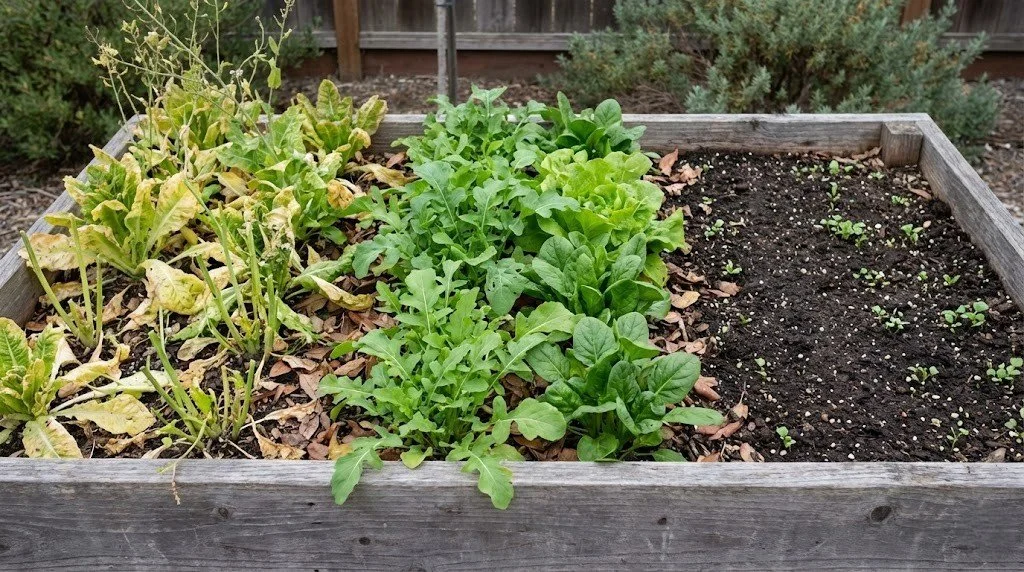
Succession planting solves both problems. By sowing small amounts of greens at regular intervals rather than one big planting, you create a continuous harvest that matches your actual consumption. There's always something ready to pick, never too much or too little. Combined with the cut-and-come-again technique, succession planting can provide fresh salad greens from your garden for ten months of the year or more in Santa Cruz County.
This guide provides a practical succession planting schedule tailored to Santa Cruz's microclimates, with specific timing for lettuce, spinach, arugula, and other popular salad greens.
What Is the Logic of Succession Planting?
The concept is simple: instead of planting everything at once, you make small plantings at regular intervals. As older plantings finish, newer ones are coming into production. You're always harvesting greens at their peak, and the steady supply matches your steady demand.
For most salad greens, a two- to three-week interval between plantings works well. This timing allows each planting to reach harvest stage before the next one is ready, creating overlapping production windows.
According to UC Cooperative Extension, the key to successful succession planting is matching your planting intervals to both the crop's days to maturity and your consumption rate. Fast-maturing crops like arugula (21 to 30 days) can be planted more frequently than slower crops like romaine (70 to 80 days).
How Do You Calculate Your Planting Schedule?
Before we get to specific schedules, consider these factors.
How Much Do You Eat?
A common guideline is four to six lettuce plants per person for regular salad consumption. If you eat salad daily, lean toward more plants; if you eat salad a few times a week, fewer plants suffice.
For a family of four eating salad regularly, a succession planting might include 16 to 24 lettuce plants every two to three weeks.
Days to Maturity
This number on the seed packet tells you when to expect harvestable greens.
Fast greens (21 to 40 days): arugula, baby lettuce, mizuna, spinach Medium greens (40 to 60 days): full-size loose-leaf lettuce, chard, Asian greens Slower greens (60 to 85 days): romaine, head lettuce, kale to full size
For continuous harvest, plant fast greens more frequently (every 2 weeks) and slower greens less frequently (every 3 to 4 weeks).
Seasonal Adjustments
Greens grow faster in warm weather (spring and fall) and slower in cold weather (winter) or when days are very short. You may need more frequent plantings in peak growing season and less frequent plantings in winter.
| Green Type | Days to Harvest | Suggested Interval | Plants per Sowing (family of 4) |
|---|---|---|---|
| Arugula | 21-40 | Every 2 weeks | 1 sq ft or 6-8 plants |
| Baby Lettuce | 30-40 | Every 2 weeks | 2 sq ft or 12-16 plants |
| Loose-leaf Lettuce | 45-55 | Every 2-3 weeks | 16-24 plants |
| Spinach | 40-50 | Every 2-3 weeks | 1-2 sq ft |
| Mizuna/Asian Greens | 35-50 | Every 2-3 weeks | 1 sq ft or 6-8 plants |
| Romaine | 70-85 | Every 3-4 weeks | 8-12 plants |
What Is the Month-by-Month Succession Planting Schedule?
This schedule is designed for Santa Cruz County's climate. Adjust timing based on your specific microclimate: coastal areas can plant slightly later in spring and slightly earlier in fall than inland areas.
September
Plant: Everything. This is the prime month for starting greens succession.
September 1: Loose-leaf lettuce, spinach, arugula, mizuna, chard, kale September 15: Loose-leaf lettuce, spinach, arugula, Asian greens September 30: Loose-leaf lettuce, spinach, arugula
Notes: Soil is still warm from summer, so germination is quick. Days are shortening, reducing bolting pressure. This is your foundation planting for fall and winter harvests.
October
Plant: Continue all greens except spinach varieties that require shorter days.
October 1: Loose-leaf lettuce, arugula, mizuna, romaine (coastal areas) October 15: Loose-leaf lettuce, arugula, Asian greens October 31: Loose-leaf lettuce, arugula (last planting for pre-winter harvest)
Notes: Cooling temperatures slow growth slightly. September plantings are ready to harvest. Keep planting through October for continuous supply into winter.
November
Plant: Cold-hardy varieties only. Growth will be slow but steady.
November 1: Winter-hardy lettuce ('Winter Density', 'Winter Marvel'), kale November 15: Cold-tolerant lettuce, arugula (coastal and protected areas)
Notes: New plantings will grow slowly. Focus shifts to maintaining established plants from September and October. This is a good time to plant garlic and other overwintering crops between greens rows.
December
Plant: Minimal new planting. Focus on maintaining existing beds.
December 1: Optional: Winter lettuce in protected spots or cold frames
Notes: Shortest days mean slowest growth. Existing plants produce but slowly. Keep harvesting established greens using cut-and-come-again method. Protect tender plants from frost if needed.
January
Plant: Begin thinking ahead to spring, but wait for slightly longer days.
January 15: Start lettuce indoors for February transplanting (optional) January 31: Earliest outdoor sowing in coastal areas, cold-hardy varieties
Notes: Days are lengthening, triggering gradual acceleration of growth. Watch for slug damage on winter greens. Late January is the earliest reasonable time for new outdoor sowings.
February
Plant: Resume succession planting as days lengthen.
February 1: Spinach, lettuce, arugula (bolt-resistant varieties) February 15: Spinach, lettuce, arugula, Asian greens February 28: Lettuce, arugula, mizuna
Notes: Growth accelerates noticeably. Choose bolt-resistant varieties for all plantings; lengthening days increase bolting risk. This is your chance to establish spring greens before summer heat arrives.
March
Plant: Focus on bolt-resistant varieties and fast-maturing types.
March 1: Bolt-resistant lettuce ('Jericho', 'Muir'), spinach ('Space') March 15: Bolt-resistant lettuce, arugula (last reliable arugula sowing) March 31: Fast lettuce varieties only (expect bolting by May)
Notes: Racing against bolting now. Prioritize fast-maturing and bolt-resistant varieties. Late March plantings may only yield one or two harvests before bolting.
April
Plant: Very limited. Transition away from cool-season greens.
April 1-15: Only very bolt-resistant lettuce in afternoon shade April 15-30: Stop planting lettuce and spinach; switch to heat-tolerant alternatives
Notes: Bolting pressure is high. Fall-planted greens will be finishing up. This is the transition month; accept that greens production will decline.
May through July
Plant: Heat-tolerant alternatives only.
May: Malabar spinach, New Zealand spinach June: Malabar spinach transplants July: Begin thinking about fall; prepare beds
Notes: Traditional greens won't work. Malabar spinach provides summer greens for cooking. Chard planted in fall may still produce. Accept reduced salad production in the hottest weeks.
August
Plant: Resume greens succession as temperatures begin moderating.
August 15: Lettuce (start indoors or in shade), chard, kale August 31: Lettuce, spinach, arugula, Asian greens
Notes: Late August marks the return of greens season. Start transplants indoors or in shade if weather is still hot. This is the beginning of the fall planting cycle.
| Month | Activity Level | What to Plant | Key Notes |
|---|---|---|---|
| September | Peak planting | All greens | Best month to establish succession |
| October | Active | All greens | Continue regular succession |
| November | Slowing | Cold-hardy types | Focus on maintenance |
| December | Minimal | Optional | Harvest existing; shortest days |
| January | Beginning | Cold-hardy, late month | Days lengthening; plan ahead |
| February | Active | Bolt-resistant types | Resume succession; watch bolting |
| March | Active but cautious | Bolt-resistant, fast types | Last good spring window |
| April | Ending | Very limited | Transition to heat-tolerant crops |
| May-July | Alternative crops | Malabar, NZ spinach | Summer break for cool-season greens |
| August | Resuming | All greens (late month) | Begin fall cycle |
How Should You Adjust for Your Microclimate?
Coastal Areas (Westside Santa Cruz, Live Oak, Aptos, Capitola)
You have the longest growing season. Summer fog may allow some greens production even in June and July with afternoon shade. You can plant slightly later in fall (through November) and slightly earlier in spring (late January) than inland gardeners.
Key advantage: Summer greens are possible in the foggiest locations. Key challenge: Slugs thrive in your moist climate. Be vigilant.
Inland Areas (Scotts Valley, Boulder Creek, Soquel Hills)
Your season is slightly shorter at both ends. Spring plantings bolt earlier due to warmer temperatures, and fall plantings need to go in earlier to establish before cold weather.
Key advantage: Warmer fall temperatures mean faster establishment in September. Key challenge: Spring bolting; stop planting lettuce by mid-March.
Under the Redwoods (Felton, Ben Lomond Canyons)
Cool shade extends the spring season and allows later plantings. However, low winter light slows growth significantly from December through February.
Key advantage: You may grow greens later into spring than other areas. Key challenge: Very slow winter growth; don't expect much production December through January.
Pajaro Valley and Watsonville
Warmer temperatures mean the shortest traditional greens season. Focus heavily on fall and winter; spring is very short.
Key advantage: Warm fall soil allows fast germination and establishment. Key challenge: Spring bolting starts early; last lettuce sowing by early March.
How Do Succession Planting and Cut-and-Come-Again Work Together?
These two techniques work beautifully together. Cut-and-come-again extends the harvest from each planting, while succession planting ensures you always have plants at peak production.
Example scenario: You make a lettuce planting on September 1. By October 15, those plants are mature enough for cut-and-come-again harvesting. You harvest outer leaves every 7 to 10 days.
Meanwhile, on September 15, you made another planting. These plants are ready for cut-and-come-again by early November. When the September 1 plants start to decline in December, the September 15 plants are still going strong.
You continue this pattern, always having plants at different stages. Younger plants come into production as older ones finish.
What Are the Best Tips for Succession Planting Success?
Mark Your Calendar
Successful succession planting requires regular action. Set reminders every two weeks during the growing season. Make it a routine: every other Saturday is planting day, for example.
Keep Records
Note what you plant, when, and how it performs. Over a season or two, you'll learn exactly what works in your specific garden. This is more valuable than any generic schedule.
Start Small
If you're new to succession planting, start with one or two crops (lettuce and arugula are good choices) rather than trying to succession plant everything. Add crops as you get comfortable with the rhythm.
Use Transplants When Needed
Succession planting doesn't mean you have to direct sow everything. Starting transplants indoors allows you to have plants ready to go into the ground exactly when you want, regardless of soil conditions or weather.
Plan for Gaps
Accept that there will be gaps, particularly in the transition between spring and fall seasons. Use this time to refresh beds, add compost, and prepare for the next planting cycle.
Where to get seeds: For varieties that do well in our climate, we like Seeds Now, a California company selling non-GMO, open-pollinated, and heirloom seed. (Affiliate link, see our disclosure.)
Frequently Asked Questions
How do I remember to plant every two weeks?
Set calendar reminders, tie it to a regular activity (every other Saturday morning, for example), or use a simple spreadsheet or garden planner. Consistency matters more than precision; even roughly regular plantings will improve your harvest continuity.
What if I miss a planting date?
Just plant when you can. The system is forgiving. One missed planting might create a brief gap in production, but you'll catch up. Don't let perfectionism prevent you from getting started.
How much space do I need for succession planting?
Less than you might think. A single 4-by-4-foot bed can support succession planting of salad greens for a small family if you use cut-and-come-again harvesting and replant sections as they finish. Larger beds give you more flexibility.
Can I succession plant in containers?
Absolutely. Use multiple smaller containers with staggered plantings, or replant sections of larger containers as greens finish. Container growing actually makes rotation easier because you can move pots around.
What's the minimum number of plantings for continuous harvest?
For lettuce, four to five succession plantings in fall (September through November) combined with cut-and-come-again harvesting can provide greens from October through March. More plantings give you greater continuity and insurance against losses.
How do I fit succession planting into crop rotation?
Treat each planting bed as cycling through greens, resting (or growing something else), and back to greens. After a bed has grown greens for a full season, follow with a different crop family before returning to greens.
Should I plant the same variety each time or mix it up?
Both approaches work. Planting the same variety simplifies planning and ensures predictable results. Mixing varieties adds diversity to your salad bowl and spreads risk if one variety has problems. Many gardeners do a bit of both: a reliable core variety with occasional experiments.
Free Resources
Download these guides from our Garden Toolkit:
Seasonal Planting Calendar provides detailed timing for all greens in each Santa Cruz microclimate.
Succession Planting Template offers a printable planning sheet for tracking your plantings.
Garden Troubleshooting Guide helps solve problems that can derail your succession planting plans.
Related Articles
Best Lettuce Varieties for Santa Cruz Microclimates helps you choose the right varieties for each planting window.
Cut-and-Come-Again Greens: Maximizing Your Harvest explains the technique that extends each planting's production.
Growing Spinach in Santa Cruz (and Why It Bolts) covers timing for this bolt-prone crop in detail.
Greens Troubleshooting: Bolting, Bitterness, and Pests helps you solve problems that can disrupt continuous production.
