

Mulch and Soil Health: The Hidden Irrigation System in Your Santa Cruz County Garden
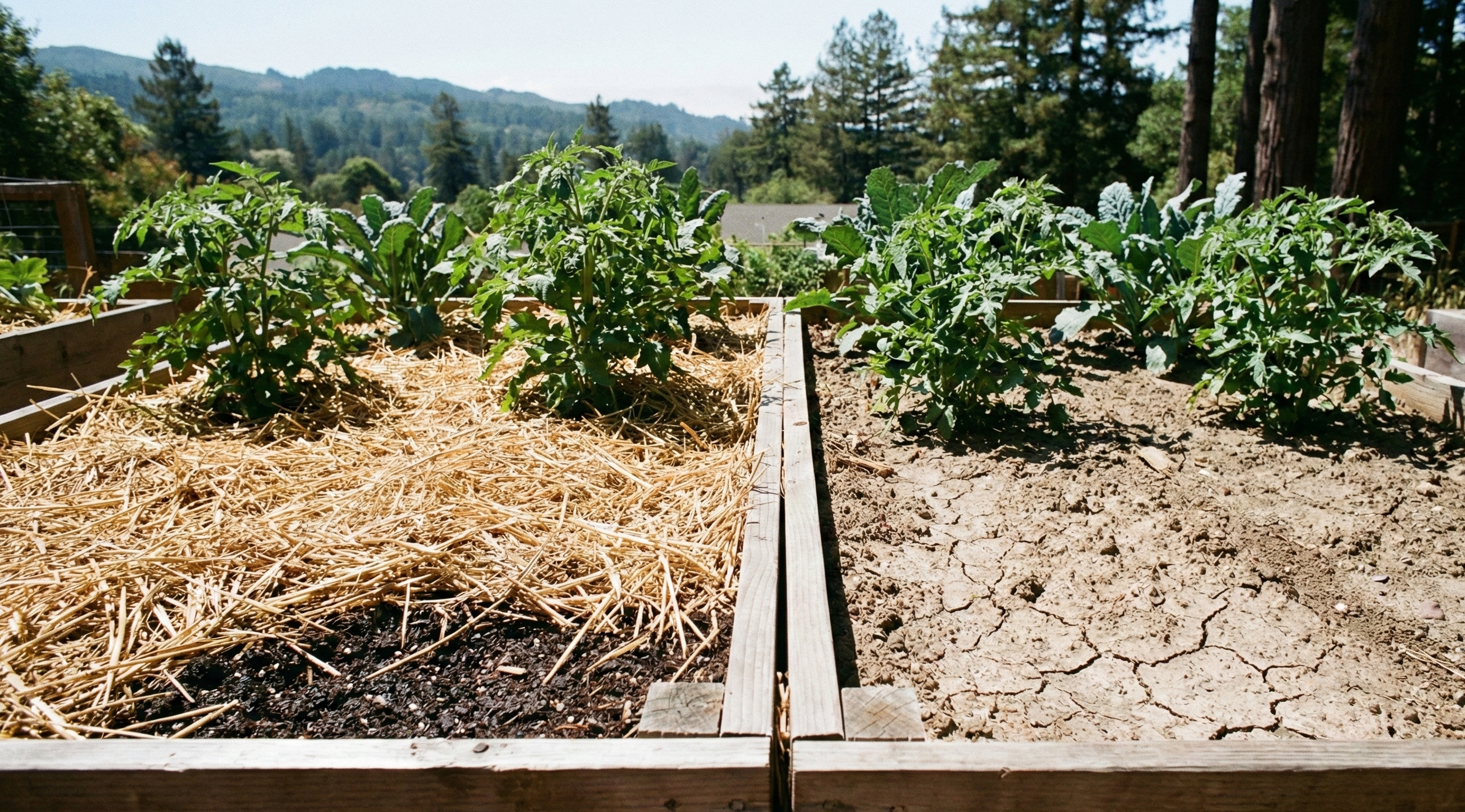
Mulch and healthy soil don't add gallons to your garden, but they slow water losses so dramatically that your plants can go longer between waterings without stress. For a place with long dry summers and shoulder seasons where every drop counts, that hidden water is often the difference between watering twice a week and watering once a week for the same plants.
Think of it this way: your irrigation system delivers water, but your soil and mulch determine how long that water sticks around. A garden with bare, compacted soil is like a leaky bucket. A garden with deep mulch and rich organic matter is like a well-sealed tank. Same water in, very different results.
This guide explains the science behind why mulch and soil health matter so much, gives you specific recommendations for Santa Cruz County's different soil types, and quantifies how much water you can actually save by getting these fundamentals right.
How Does Mulch Act Like Extra Water?
The research is clear: surface cover is one of the most powerful tools gardeners have for keeping soil moist.
Studies on urban gardens (including a Central Coast site similar to Santa Cruz County conditions) show that the two biggest drivers of how long soil stays moist after watering are surface cover and water-holding capacity. In a multi-garden study, beds with straw or other surface cover lost water more slowly and maintained more stable soil moisture than bare beds, even under identical weather and irrigation.
Experimental work on containers found that bare soil lost about 3 liters of water over three days, while mulched soil lost about 2 liters. That's roughly a 33% reduction in evaporation just from adding a mulch layer. Nothing else changed: same soil, same water input, same weather. The only difference was whether the surface was covered.
Extension and water-efficiency resources translate this into practical guidance: a 2 to 3 inch mulch layer can reduce outdoor water use by 25 to 60% by cutting evaporation, shading the soil surface, and suppressing water-stealing weeds.
From a gardener's standpoint, that's like having a small, invisible irrigation system working between your scheduled waterings. You're not adding water; you're keeping more of what you already applied.
How Mulch Saves Water: The Mechanics
Understanding why mulch works helps you use it more effectively.
Reduced evaporation. Bare soil exposed to sun and wind loses moisture rapidly from the surface. Mulch creates a physical barrier that blocks direct sunlight and slows air movement across the soil surface. The soil underneath stays cooler and moister.
Temperature moderation. Mulched soil stays significantly cooler than bare soil on hot summer days. Cooler soil means less evaporative demand and less heat stress on roots. This is especially valuable in Santa Cruz County's inland areas where summer temperatures climb into the 80s and 90s.
Weed suppression. Weeds compete directly with your plants for water. A thick mulch layer suppresses weed germination and growth, meaning more of your irrigation water goes to the plants you actually want.
Improved soil structure over time. As organic mulches break down, they feed soil organisms and add organic matter to the top layers of soil. This gradually improves water-holding capacity, creating a compounding benefit over years.
How Much Mulch Actually Works
| Bed condition | Surface cover | Approx. evaporation vs. bare soil | Typical summer watering (100 sq ft veggie bed) | Soil-moisture stability |
|---|---|---|---|---|
| Bare, low-organic-matter soil | None or <0.5" mulch | 100% (baseline) | 2 to 3 times per week | Low to dries quickly after each watering |
| Mulched, average soil | 2 to 3" organic mulch | ~70 to 75% of baseline (≈25 to 30% less evaporation) | 1 to 2 times per week (same plants, same weather) | Medium to moisture drops more slowly, fewer swings |
| Mulched + high-organic-matter “sponge” soil | 2 to 3" mulch + improved soil structure and OM | Even lower effective loss (less evaporation + more water held in root zone) | Often 1 to 2 times per week with slightly shorter or less frequent runs, especially for deep-rooted crops | High to moisture changes gradually; plants tolerate longer gaps |
A thin dusting of mulch does very little. The water-saving effect really kicks in once you get into the 2 to 3 inch range.
Depth Recommendations
UC guidance and local Santa Cruz County resources offer consistent recommendations:
Trees and shrubs: 2 to 4 inches of organic mulch, extending at least to the drip line (the outer edge of the canopy). Keep mulch pulled back several inches from the trunk to prevent rot.
Perennial beds: 2 to 3 inches of mulch around established plants. Refresh annually as material breaks down.
Vegetable gardens: At least 2 inches between rows and around plants. Straw and shredded leaves work well here since you'll be reworking the soil more frequently.
Annual flower beds: 2 inches minimum. Pull mulch back slightly from stems of young transplants until they're established.
The Santa Cruz County mulch guide emphasizes leaving a small gap (2 to 4 inches) around stems and trunks. Mulch piled against plant stems creates moisture conditions that encourage rot and pest problems. The goal is to cover soil, not bury plants.
Water Lost vs. Saved
How mulch and healthy soil keep more water in your garden
The takeaway: Adding a 2 to 3 inch layer of mulch can cut evaporation roughly 25 to 33% compared to bare soil, and improving soil organic matter increases how much water is stored in the root zone. Together, they act like hidden irrigation between your scheduled waterings.
Best Mulch Materials for Santa Cruz County
Different mulches suit different situations. Local programs and UC resources recommend:
Wood chips and shredded bark: Excellent for trees, shrubs, and perennial beds. Long-lasting, attractive, and widely available. Arborist chips (the mixed material tree services produce) work well and are often available free or cheap.
Straw: Ideal for vegetable gardens and annual beds. Breaks down relatively quickly, adding organic matter to soil. Easy to move aside for planting and harvest. Avoid hay, which contains weed seeds.
Shredded leaves: Free if you have deciduous trees. Excellent for vegetable paths and perennial beds. Breaks down within a season, feeding soil biology.
Compost as mulch: Finished compost makes a good thin mulch layer (1 to 2 inches) that feeds soil while suppressing weeds. Best used in combination with other mulches on top.
Local forest chips and leaf litter: Appropriate around native and drought-tolerant plantings, especially in mountain and San Lorenzo Valley gardens where this material mimics natural forest floor conditions.
Materials to avoid or use carefully: Fresh grass clippings (mat and smell), black plastic (blocks water and air), landscape fabric under mulch (often counterproductive and creates problems over time), dyed mulches (potential chemical concerns and no benefit over natural materials).
How Does Soil Health Hold Water?
Mulch protects the surface, but soil health determines how much water the root zone can actually hold. Think of mulch as the lid on a container; soil organic matter determines the size of the container itself.
The urban garden soil moisture study concluded that water-holding capacity was the single factor that most consistently affected both how quickly plots absorbed water and how slowly they lost it. Gardens with higher organic matter and better soil structure held onto irrigation longer, regardless of other variables.
USDA soil health guidance explains the mechanism: increasing organic matter and improving soil structure (aggregates, pore space) leads to higher infiltration rates, better water storage, and reduced runoff. Your soil literally behaves like a larger tank when it's healthy.
You can frame this simply: Mulch slows water leaving the soil. Organic matter slows water moving through the soil. Both work together to keep moisture in the root zone where plants can use it.
How Do Soil Needs Vary by Santa Cruz County Microclimate?
Different parts of the county have different soil challenges. Local guidance and regional knowledge point to specific strategies for each zone.
Coastal Clay and Loam Soils
The challenge: Heavy soils that can become compacted, leading to poor infiltration. Water may pond on the surface or run off rather than soaking in. When dry, these soils can crack and become hydrophobic (water-repelling).
The strategy: Add compost regularly to build stable soil aggregates. Reduce tillage to preserve soil structure. Use cover crops in the off-season to keep roots in the ground and feed soil biology. Avoid working soil when it's wet, which destroys structure.
The benefit: Well-structured clay soil actually holds more plant-available water than any other soil type. The goal is getting water into the soil, then it stays available longer.
San Lorenzo Valley and Mountain Soils
The challenge: Often sandy, gravelly, or decomposed granite with low organic matter. Water drains straight through the root zone quickly. Even with adequate irrigation, moisture doesn't stick around.
The strategy: Build organic matter aggressively through compost additions, cover crops, and leaving roots in place. Mulch heavily to slow surface evaporation. Consider adding biochar or other stable organic amendments to increase long-term water retention.
The benefit: Sandy soils are easy to work and warm up quickly in spring. Once you build organic matter content, they become productive while remaining well-drained.
Watsonville Valley Soils
The challenge: Often productive loams that can lose structure under frequent cultivation. Commercial agriculture in the area demonstrates both the potential and the demands of these soils.
The strategy: Maintain organic matter through regular compost additions and cover cropping. Rotate beds to give soil recovery time. Use permanent pathways to concentrate foot traffic away from growing areas.
The benefit: These naturally fertile soils respond quickly to good management. Building on their existing productivity while maintaining structure keeps them performing well season after season.
How Much Water Can Mulch and Good Soil Actually Save?
Let's quantify the hidden irrigation effect using the same 100-square-foot summer vegetable bed from the seasonal watering guides.
Without Mulch, With Poor Soil
Based on ET calculations, the bed needs around 4 to 4.5 inches of water per month in summer (approximately 250 to 300 gallons). With bare soil and low organic matter:
Water evaporates quickly from the exposed surface
Soil dries out rapidly between waterings
Plants may show midday wilt even with frequent irrigation
You likely need to water 2 to 3 times per week to prevent stress
With 2 to 3 Inches of Mulch and Improved Soil
Research indicates evaporation can be reduced by roughly one-third or more. Higher water-holding capacity from organic matter means moisture stays in the root zone longer.
Practically, this often means:
The same bed can stay healthy with 1 to 2 irrigations per week
You use roughly the same total inches of water but stretch each watering further
Or you can reduce total water slightly without visible plant stress
Plants maintain turgor through hot afternoons rather than wilting
A Simple Rule of Thumb
If you currently water a bed three times per week in summer on bare soil, properly mulching and improving soil organic matter may let you cut one of those watering days while keeping plants equally happy.
That's effectively saving about one-third of your weekly irrigation for that bed. For a 100-square-foot vegetable garden using 60 to 70 gallons per week, you might save 20 to 25 gallons weekly, or roughly 250 to 300 gallons over a summer. Scale that across your whole garden and the savings become significant.
Building Soil Health Over Time
Soil improvement isn't instant, but it compounds over years. Here's how to build toward better water retention.
Add Compost Regularly
Compost is the simplest, most reliable way to increase soil organic matter. Apply 1 to 2 inches annually to vegetable beds, working it into the top few inches of soil. For perennial beds and around trees, top-dress with compost and let soil organisms incorporate it naturally.
Quality matters. Well-finished compost (dark, crumbly, earthy-smelling) adds stable organic matter. Partially decomposed material can tie up nitrogen temporarily and may contain weed seeds.
Use Cover Crops
Cover crops (also called green manures) are plants grown specifically to benefit the soil. In Santa Cruz County's mild climate, you can grow cover crops through winter on beds that would otherwise sit bare.
Good options include:
Crimson clover and fava beans: Fix nitrogen and add organic matter
Winter rye and oats: Add bulk organic matter and suppress weeds
Mustard family covers: Break up compaction and may suppress some soil diseases
Cut or incorporate cover crops a few weeks before planting your main crops to allow decomposition.
Reduce Tillage
Every time you turn soil deeply, you break up the aggregates that give soil its structure and expose organic matter to rapid decomposition. Soil health research consistently shows that reduced tillage preserves structure and builds organic matter faster.
Consider:
Using permanent raised beds with defined pathways
Minimal disturbance planting (make holes for transplants rather than turning whole beds)
Broad forking or shallow cultivation rather than deep rototilling
Leaving roots in place when possible (cut plants at soil level rather than pulling)
Keep Soil Covered Year-Round
The urban garden study showed that covered soils maintained more stable moisture than bare soils across all conditions. Aim to keep your soil covered with either:
Living plants (crops, cover crops, groundcovers)
Dead plant material (mulch, crop residues)
Or both (mulch between actively growing plants)
Bare soil is vulnerable soil. It loses moisture rapidly, erodes in winter rains, and doesn't support the soil biology that builds long-term health.
Mulch and Soil Health for Different Garden Types
Vegetable Gardens
Mulch approach: 2 inches of straw, shredded leaves, or compost between rows and around established plants. Pull back mulch when direct-seeding, then push it back once seedlings are a few inches tall.
Soil building: Annual compost additions, winter cover crops on resting beds, crop rotation to maintain fertility and structure.
Water savings: Expect to reduce watering frequency by 25 to 35% compared to bare soil, or maintain the same frequency while reducing plant stress during heat waves.
Fruit Trees and Orchards
Mulch approach: 3 to 4 inches of wood chips or shredded bark in a ring extending to the drip line. Keep mulch several inches away from the trunk. Refresh annually as material breaks down.
Soil building: Let fallen leaves remain as mulch. Plant beneficial understory plants or groundcovers. Avoid soil compaction in the root zone.
Water savings: Established trees with good mulch coverage may need 30 to 40% less irrigation than those with bare soil underneath, especially during establishment years.
Native and Drought-Tolerant Plantings
Mulch approach: 2 to 3 inches of materials that mimic natural conditions: leaf litter, small wood chips, or gravel/rock for plants from Mediterranean or chaparral environments. Local drought-tolerant gardens demonstrate effective mulching approaches.
Soil building: Many California natives prefer lean soils and don't need compost additions. Focus on appropriate mulch and avoiding soil compaction rather than fertility building.
Water savings: Once established (usually after 2 to 3 years with supplemental irrigation), many drought-tolerant plants can survive on rainfall alone or with only occasional deep summer watering when properly mulched.
Ornamental Beds
Mulch approach: 2 to 3 inches of decorative bark, wood chips, or other materials that complement your aesthetic. Uniform appearance matters more here than in food gardens.
Soil building: Annual compost top-dressing, avoiding soil disturbance around established plantings.
Water savings: Well-mulched ornamental beds typically need 25 to 40% less water than bare soil, with the bonus of reduced weeding and more attractive appearance.
What Are the Most Common Mulching Mistakes to Avoid?
Volcano mulching around trees. Piling mulch against tree trunks creates conditions for rot, disease, and pest problems. Always leave a gap of several inches between mulch and trunk.
Applying mulch too thin. A half-inch dusting of mulch provides minimal benefit. You need 2 to 3 inches minimum to see real water savings.
Using the wrong material. Fresh grass clippings mat and smell. Black plastic blocks water and air. Landscape fabric under mulch often creates more problems than it solves over time.
Mulching over dry soil. Always water thoroughly before applying mulch to a new bed. Mulch locks in whatever moisture is present; if the soil is dry when you mulch, you've locked in dryness.
Ignoring the soil underneath. Mulch is most effective when combined with healthy, organic-matter-rich soil. Mulching over compacted, dead soil helps but doesn't solve the underlying problem.
For more on reducing your garden water use, see our water-wise gardening guide and our soil amendments guide.
Two related myths worth clearing up: whether mulch attracts termites to your home, and whether deep watering means soaking for hours.
Frequently Asked Questions About Mulch and Soil Health
How much mulch do I need for my garden?
Calculate your bed area in square feet, then figure roughly 1 cubic yard of mulch covers about 100 square feet at 3 inches deep. For a 200-square-foot garden, you'd need approximately 2 cubic yards. Most landscape supply companies sell by the cubic yard; bagged mulch from nurseries works for smaller areas but gets expensive at scale.
When is the best time to apply mulch in Santa Cruz County?
Apply mulch in late spring after soil has warmed and before summer heat arrives. This locks in moisture at the optimal time. You can also apply in fall after rains begin to protect soil through winter. Avoid mulching in late winter when you want soil to warm up for spring planting.
Will mulch attract pests or termites?
Wood mulch kept several inches away from structures and foundations poses minimal termite risk. The benefits of mulch far outweigh concerns about pests for most garden applications. If you're concerned, use non-wood mulches like straw near your home's foundation.
How often should I replace mulch?
Most organic mulches break down over 1 to 2 years. Plan to add 1 to 2 inches annually to maintain effective depth. You don't need to remove old mulch; just add on top. The decomposing layer underneath is adding organic matter to your soil.
Does mulch steal nitrogen from plants?
Fresh wood mulch can temporarily tie up nitrogen at the soil surface where it contacts soil. This is rarely a problem when mulch sits on top of soil rather than being mixed in. If you notice yellowing in heavily mulched beds, a light application of nitrogen fertilizer solves the issue.
How long does it take to see results from building soil health?
You'll see moisture retention improvements from mulch immediately. Soil organic matter builds more slowly, with noticeable improvements in water-holding capacity typically visible after 2 to 3 years of consistent compost additions and cover cropping. The benefits compound over time.
Can I mulch around vegetables without problems?
Yes, with some care. Keep mulch a few inches away from stems of young plants to prevent rot. Use materials that break down relatively quickly (straw, shredded leaves) since you'll be reworking the soil more often. Mulch is especially valuable for long-season crops like tomatoes, peppers, and squash.
What's the difference between mulch and compost?
Compost is fully decomposed organic matter ready to mix into soil or use as a thin top-dressing. Mulch is less decomposed material meant to sit on top of soil as a protective layer. Compost feeds the soil; mulch protects it. Both are valuable, and the line between them blurs as mulch breaks down over time.
Your Hidden Irrigation Checklist
Here's your action plan for getting the full water-saving benefit of mulch and healthy soil.
Add real mulch depth. Top-dress beds to 2 to 3 inches of organic mulch, keeping a small ring clear around stems and trunks. A thin dusting doesn't cut it.
Aim for year-round cover. Use cover crops, groundcovers, or mulch so soil is rarely bare. Research shows covered soils maintain more stable moisture under all conditions.
Feed the soil sponge. Incorporate compost annually, leave roots in the ground when possible, and avoid frequent deep tillage so aggregates and organic matter can build over time.
Test it in your own yard. After a deep watering, track how many days it takes for plants in a mulched, compost-rich bed versus a bare, compacted bed to show mild stress. Use that observation to adjust your watering schedule.
Match materials to purpose. Wood chips for trees and shrubs, straw for vegetables, leaf litter for native plantings. Use what makes sense for each area of your garden.
What Is the Invisible System Working for You?
Every time you water your garden, you're starting a countdown. How long until that moisture is gone? In bare, compacted soil, the answer is "not long." In mulched beds with healthy, organic-matter-rich soil, the answer is "much longer."
That difference is your hidden irrigation system. It doesn't add gallons, but it makes every gallon you apply work harder and last longer. Over a Santa Cruz County summer, that can mean the difference between struggling plants and thriving ones, between watering three times a week and watering twice, between stressed and satisfied.
The best part? Unlike actual irrigation systems, mulch and soil health get better over time. Each year's compost builds on the last. Each season's mulch adds more organic matter as it breaks down. You're not just saving water this summer; you're building a garden that needs less water every summer going forward.
Start with one bed. Mulch it properly, add compost, and pay attention to how it performs compared to the rest of your garden. Once you see the difference, you'll want to extend that hidden irrigation system everywhere you grow.
Related Guides
This article connects to our complete water-wise gardening series:
Year-Round Watering Guide , The complete framework for understanding Santa Cruz County's irrigation rhythm
Summer Watering Guide , Peak irrigation season when mulch and soil health matter most
Free Water-Wise Gardening Resources
Water-Wise Gardening Guide , Comprehensive irrigation strategies including mulch and soil health recommendations.
Know Your Microclimate Worksheet , Identify your specific soil type and conditions to tailor your approach.
Seasonal Garden Tasks Checklist , Month-by-month guide including mulch application timing and soil building tasks.
Garden Troubleshooting Guide , Diagnose water stress and soil problems affecting plant health.
