

Yes, You Can Grow Blackberries in Pots (Here's How)
A few of the product links in this guide are affiliate links. If you buy through one, Ambitious Harvest may earn a small commission at no extra cost to you, which helps keep these guides free. We only point to gear we would use in our own Santa Cruz garden. As an Amazon Associate, we earn from qualifying purchases. Read our full disclosure.
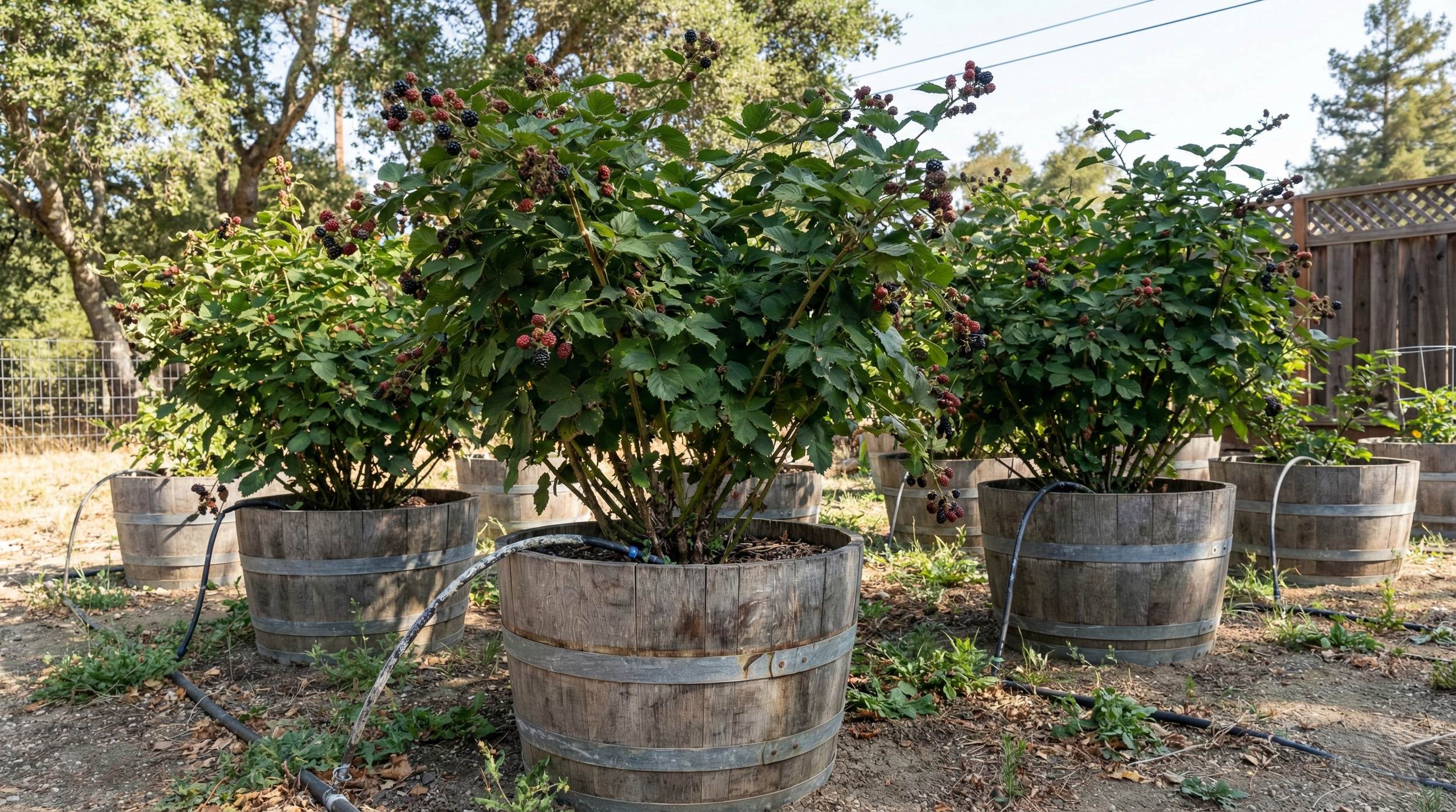
The best blackberry varieties for containers are the primocane-fruiting erect types, and Prime-Ark Freedom and Baby Cakes are the two easiest to find. Oregon State Extension puts the floor at a pot at least 2 feet deep, with 20 to 30 gallons working well for a full-sized cultivar. According to the University of Arkansas breeding program, Prime-Ark Freedom is the first thornless, primocane-fruiting blackberry, meaning it flowers and fruits on first-year canes, so you can get a crop in the planting year without waiting for a cane to overwinter.
Here in Santa Cruz County, our mild climate makes container blackberries particularly rewarding. We rarely see the temperature extremes that stress potted plants in other regions, and our long growing season gives blackberries plenty of time to produce.
The UC Master Gardener guide to growing berries in containers confirms that blackberries with erect growth habits adapt best to container culture, with deeper pots producing better results.
Why Grow Blackberries in Containers?
According to Gardener's Path, growing blackberries in containers offers several advantages:
Containment: Blackberries spread via underground rhizomes and can take over garden spaces. In containers, they stay exactly where you put them.
Control: You can optimize soil pH, drainage, and fertility without amending existing garden soil.
Flexibility: Move containers to catch more sun, protect from heat, or bring closer to harvest.
Space efficiency: Perfect for apartments, rentals, or small yards where in-ground planting isn't possible.
Protection: Easier to protect from pests like gophers (a major benefit in Santa Cruz County).
The main trade-off is more intensive care. Container plants need more frequent watering and fertilizing than in-ground plants, and they require winter protection in colder climates.
What Are the Best Blackberry Varieties for Containers?
Not all blackberries are suited for container growing. Savvy Gardening notes that the rambling roots and long vines of standard blackberries make them poor candidates for pots. Choose varieties bred for compact growth or those with growth habits that adapt well to containers.
Baby Cakes (Best for Containers)
According to Plant Addicts, Baby Cakes is a dwarf, thornless blackberry specifically developed for container gardening:
Height: 3 to 4 feet tall and wide
Thorns: None
Trellis needed: No
Fruiting: Summer crop on floricanes, fall crop on primocanes in most climates
Container size: the breeder suggests a pot 12 to 16 inches across for a mature plant, and a wider pot holds moisture better
GrowOrganic confirms that Baby Cakes produces two harvests per year in mild climates like Santa Cruz County, with a main summer crop and a smaller fall crop.
Why it's ideal: Compact size, no trellising required, thornless for easy harvesting, and self-pollinating.
Prime-Ark Freedom
According to Stark Bro's, Prime-Ark Freedom is the first thornless primocane-fruiting blackberry:
Height: 4 to 5 feet tall
Thorns: None
Trellis needed: Light support helpful
Fruiting: First-year canes ripen in July, second-year canes in June, both continue until frost
Container size: 15 to 20 gallon minimum
Raintree Nursery notes that Prime-Ark Freedom can be managed without a trellis and cut to the ground each fall for simplified care. This makes container management much easier.
Why it works: Thornless, fruits the first year, erect growth habit, and can be managed with simple annual pruning.
Compact Erect Varieties
Standard erect blackberries can work in large containers with some management. Oregon State Extension notes that primocane-fruiting erect cultivars are the best choice for container production.
Good options include:
Ouachita: Thornless, erect, self-supporting with tipping
Arapaho: Compact growth, thornless, early ripening
Apache: Thornless, very erect growth
These need larger containers (20+ gallons) and more careful pruning than compact varieties.
Varieties to Avoid in Containers
According to Oregon State Extension, semi-erect blackberry cultivars are generally too vigorous to grow easily in containers. Trailing varieties like Marionberry present challenges too, requiring substantial trellising that's difficult to manage in pots.
Skip these for containers:
Triple Crown: Too vigorous, needs extensive trellising
Chester: Semi-erect, very vigorous
Marionberry: Trailing, 15 to 20 foot canes
Boysenberry: Trailing, difficult to manage in pots
What Size Container Do Blackberries Need?
Container size is critical for blackberry success. Too small, and plants become root-bound, stressed, and unproductive. Always err on the side of larger.
Minimum Container Sizes
According to Oregon State Extension, blackberries are relatively deep-rooted and require a deep pot or raised bed, with a minimum of 2 feet deep. A 20 to 30 gallon container works well, but careful pruning is needed to prevent plants from outgrowing the container.
By variety:
Baby Cakes: 10 gallon minimum for this dwarf cultivar, 15 gallon better
Prime-Ark Freedom: 20 gallon minimum, 25 to 30 gallon better
Standard erect varieties: 20 to 30 gallon minimum, at least 2 feet deep
Use the variety-specific container sizes above when choosing a permanent pot. A five-gallon grow bag is smaller than the recommended minimum for these varieties and is not the container recommended in this guide.
Container Materials
Plastic pots: Lightweight when empty, inexpensive, and they retain moisture well. Choose thick-walled containers that won't crack.
Fabric grow bags: Excellent drainage and air pruning of roots. Dry out faster than plastic, so require more frequent watering.
Ceramic or terra cotta: Attractive but heavy and may crack in freezes. Terra cotta dries out quickly.
Half whiskey barrels: Bushel and Berry recommends these (22 inches diameter) for their berry plants. Good size but ensure drainage.
Metal containers: Can overheat in sun. If using, choose light colors or provide shade for the container.
Drainage Requirements
Whatever container you choose, drainage is non-negotiable. Blackberries will not tolerate waterlogged roots.
Ensure multiple drainage holes in the bottom
Elevate containers slightly on pot feet or bricks
Never let containers sit in saucers of standing water
Skip the gravel layer at the bottom. A coarse layer raises the water table inside the pot rather than lowering it. Cover the holes with mesh instead, so mix does not wash out
What Soil Mix Do Container Blackberries Need?
Garden soil is too heavy and poorly draining for containers. You need a quality potting mix.
Basic Potting Mix
Gardener's Path recommends a mixture of one-third topsoil, one-third perlite or vermiculite for drainage, and one-third well-rotted manure or compost.
Oregon State's Recommended Mix
Oregon State Extension recommends: one part perlite or pumice, one part finely ground bark, and two parts garden or potting soil. If desired, mix slow-release fertilizer into the potting mix at 8 cups per cubic yard.
Key Soil Requirements
pH: 5.5 to 6.5 (slightly acidic)
Drainage: Excellent; roots rot in soggy soil
Organic matter: Rich in compost for moisture retention and nutrients
Structure: Light and airy, not compacted
Pre-Mixed Options
Quality commercial potting mixes work well. Look for mixes designed for fruits and vegetables, or amend standard potting mix with extra perlite and compost.
How Do You Plant Blackberries in a Container?
When to Plant
In Santa Cruz County, plant container blackberries from late winter through early spring (January through March). This gives plants time to establish before summer heat and before fruiting begins.
Fall planting (October through November) also works in our mild climate.
Planting Steps
Prepare the container: Ensure drainage holes are clear and cover them with mesh or landscape fabric so mix does not wash out.
Add potting mix: Fill container about two-thirds full with your soil mix.
Prepare the plant: If bare-root, soak roots in water for 1 to 2 hours before planting. For potted plants, gently loosen the root ball.
Position the plant: Set the plant so the crown (where roots meet stem) sits at or slightly above the soil surface. Bushel and Berry emphasizes keeping the crown above soil level to prevent rot.
Fill and firm: Add soil around the roots, gently firming to eliminate air pockets.
Water thoroughly: Soak until water runs from drainage holes.
Mulch (optional): A thin layer of bark mulch helps retain moisture. Oregon State Extension cautions not to bury the crown with organic mulch as this can promote rot.
How Much Sun Do Container Blackberries Need?
Clemson Cooperative Extension is blunt about sun: blackberries should be planted in full sun, and plants in part shade harbor more disease and never produce good yields. In Santa Cruz County, south-facing patios and decks typically provide enough light. Coastal gardens may benefit from reflected heat off walls or fences to compensate for fog-reduced sun hours.
Sun Requirements
Blackberries need full sun for best production. According to Ty Ty Plant Nursery, full sun is the requirement, and shade costs you both yield and plant health.
Oregon State Extension notes that hot summer temperatures can cause fruit sunburn, which shows up as white drupelets on the berry. In Santa Cruz County's warmer inland areas, afternoon shade during heat waves can prevent sunscald on berries.
Placement Tips
South or west-facing locations provide maximum sun
Avoid wind tunnels that can dry plants and damage canes
Near a water source makes frequent watering easier
Accessible for harvest since you'll be picking every few days
On wheels or a plant dolly for easy repositioning (helpful for large containers)
How Often Should I Water Container Blackberries?
Watering is the biggest challenge with container blackberries. Potted plants dry out much faster than those in the ground.
General Guidelines
According to Bushel and Berry, container plants often need daily watering, especially on warm summer days. Water until you see runoff coming out of the drainage holes.
White Flower Farm recommends at least 1 inch of water per week, but notes that plants in containers need more frequent watering than in-ground plants.
Seasonal Watering Schedule
Spring (March through May):
Water every 2 to 3 days as plants leaf out
Increase frequency as temperatures rise
Summer (June through September):
Water daily during hot weather
Twice daily during heat waves
Morning watering is ideal; evening watering acceptable
Fall (October through November):
Reduce to every 2 to 3 days
Continue until plants go dormant
Winter (December through February):
Water sparingly, just enough to prevent soil from drying completely
Dormant plants need little water but shouldn't be bone dry
Signs of Water Problems
Underwatering:
Wilting leaves, especially in afternoon
Dry, crumbly soil
Leaf edges turning brown and crispy
Fruit shriveling before ripening
Overwatering:
Yellowing leaves
Soggy soil that doesn't dry
Root rot (black, mushy roots)
Fungal growth on soil surface
How Do You Fertilize Blackberries in Containers?
Container plants need regular fertilizing since nutrients leach out with frequent watering.
First Year
Gardener's Path notes that if you use a potting mix containing fertilizer, you may not need additional feeding in the first year. Otherwise, begin light feeding in late spring.
Established Plants
According to White Flower Farm, blackberries and raspberries need at least 1 inch of water per week, and fertilizing helps plants thrive.
Bushel and Berry recommends a balanced liquid fertilizer in early and late spring. Choose a fertilizer containing nitrogen, phosphorus, and potassium with similar numbers (like 10-10-10) and follow product label instructions.
Fertilizing Schedule
Early spring (March): Apply balanced fertilizer as growth begins Late spring (May): Second application as flowering starts Midsummer (July): Light feeding during fruit production After harvest: Final feeding to support next year's canes
Signs of Nutrient Deficiency
Yellowing leaves (general): Nitrogen deficiency
Purple-tinged leaves: Phosphorus deficiency
Brown leaf edges: Potassium deficiency
Pale new growth: Iron deficiency (often from high pH)
Do Container Blackberries Need a Trellis?
Some varieties need support even in containers.
When Support Is Needed
According to Ty Ty Plant Nursery, blackberry canes grow tall and benefit from support. Use a trellis, tomato cage, or bamboo stakes.
Varieties that need support:
Prime-Ark Freedom (light support)
Standard erect varieties (moderate support)
Any variety producing heavy fruit loads
Varieties that don't need support:
Baby Cakes (compact, self-supporting)
Other dwarf Bushel and Berry varieties
Simple Support Options
Tomato cage: Insert a sturdy tomato cage at planting time. Tie canes loosely to the cage as they grow.
Bamboo stakes: Place 3 to 4 stakes around the perimeter of the container, connected with twine at several heights.
Obelisk trellis: Attractive option for decorative containers. Insert at planting.
Wall-mounted trellis: If container sits against a wall or fence, train canes to an attached trellis.
How Do You Prune Blackberries in Containers?
Pruning keeps container blackberries manageable and productive.
Pruning Baby Cakes
According to Horticulture Magazine, pruning Baby Cakes is straightforward:
After summer harvest: Remove second-year floricanes that have fruited, cutting them at the base
Leave new canes: Primocanes that emerged this year will fruit next summer (and possibly this fall)
No tipping required: Compact growth doesn't need summer tipping
Pruning Prime-Ark Freedom
Raintree Nursery describes a simple approach for primocane management:
Single-crop method (easiest):
Let canes grow and produce fall fruit
Cut all canes to ground level in late fall or winter
New canes emerge in spring and fruit in late summer/fall
Repeat annually
Double-crop method:
Let primocanes fruit in fall
Leave canes through winter
These floricanes produce early summer crop
Remove floricanes after they fruit
Meanwhile, new primocanes grow for fall crop
Pruning Standard Erect Varieties in Containers
Follow normal pruning guidelines but be more aggressive about containing size:
Summer tipping: Tip primocanes at 3 feet instead of 4 feet to keep plants compact
Remove floricanes: Cut out fruited canes after harvest
Thin canes: Keep only 3 to 5 strong canes per container
Shorten laterals: Cut back to 8 to 12 inches in late winter
Do Container Blackberries Need Winter Protection in Santa Cruz?
Chill requirements vary a lot by cultivar rather than by type. NC State lists Natchez at around 300 hours, Ouachita at 400 to 500, and Apache at 800, while Prime-Ark Freedom needs only about 100. The UCSC Farm and Garden reports that Santa Cruz averages 500 to 800 chill hours a year, which covers the low and mid-chill cultivars comfortably but can fall short of a high-chill variety like Apache in a warm winter.
Container plants are more vulnerable to cold than in-ground plants because roots are exposed above the soil level.
Santa Cruz County Winters
Coastal winters here rarely drop below the mid twenties, which makes overwintering container blackberries relatively easy near the water. Most varieties hardy to Zone 5 or 6 will survive without special protection in most of our area.
Basic Winter Care
According to Bushel and Berry, plants in containers are more at risk than in-ground plants during cold months. Their recommendations:
Mulch heavily around the base of container plants
Give extra water before cold spells (moist soil holds heat better than dry)
Move to protected locations during unusual cold snaps
Protection Strategies
Move containers:
Against a south-facing wall for heat reflection
Under eaves for protection from heavy rain
Into an unheated garage during hard freezes
Insulate containers:
Wrap pots in bubblewrap or burlap
Group containers together
Mulch heavily on top of soil
Most of Santa Cruz County sits in USDA Zones 9b to 10a, so container blackberries can stay outside year-round on the coast and in the lower valleys. Gardens up in the mountains run colder and may want the pot moved into shelter during a hard freeze.
Winter Watering
Don't forget winter water. Bushel and Berry emphasizes watering sparingly during dormancy, just enough to prevent the soil from drying out completely.
Troubleshooting Container Blackberries
Poor Fruit Production
Possible causes:
Not enough sun (need 6+ hours)
Overwatering or underwatering
Nutrient deficiency
Plant too young (most produce by second or third year)
Removed wrong canes during pruning
Yellowing Leaves
Possible causes:
Overwatering (most common in containers)
Nutrient deficiency
Root bound (needs larger container)
Soil pH too high
Wilting Despite Wet Soil
This indicates root rot from overwatering. Reduce watering, ensure excellent drainage, and consider repotting in fresh soil if roots appear black and mushy.
Fruit Not Ripening
Possible causes:
Not enough sun
Too much nitrogen fertilizer (promotes leaves over fruit)
Temperature issues (very hot weather can delay ripening)
Frequently Asked Questions
How long do container blackberries produce?
A container blackberry will not match an in-ground planting for longevity, and vigor usually starts to fade well before that. Plan to repot into fresh soil every 3 to 4 years to maintain vigor.
Can I grow blackberries on a balcony?
Yes, if the balcony receives at least 6 hours of direct sun. Choose compact varieties like Baby Cakes that don't require trellising. Check that the balcony can carry the weight before you commit. Twenty gallons of wet potting mix alone runs roughly 90 to 150 pounds depending on how saturated it is, and the pot and plant add more on top of that. If you are unsure of the load rating, ask the building manager.
Do I need more than one plant for pollination?
No. Baby Cakes, Prime-Ark Freedom, and most blackberry varieties are self-pollinating. However, Stark Bro's notes that adding a second plant can increase crop size.
When will I get fruit?
Plant Addicts notes that Baby Cakes will produce fruit by the second or third growing season. Prime-Ark Freedom can fruit the first year on primocanes.
Can I bring my container blackberry indoors for winter?
Only into an unheated space like a garage or shed. Blackberries need winter dormancy (chilling hours) and won't do well in heated indoor spaces.
How often should I repot?
Every 3 to 4 years, or when you notice reduced vigor, water draining too quickly (root-bound), or roots circling the surface.
Downloadable Guides
For more help with your container garden, download these PDF guides:
Seasonal Garden Tasks Checklist: When to prune, fertilize, and plant
Garden Troubleshooting Guide: Solutions for common problems
Container blackberries let you enjoy homegrown berries wherever you have sunny space. Start with a compact variety like Baby Cakes for the easiest experience, or try Prime-Ark Freedom if you want larger plants with first-year fruit.
The keys to success are straightforward: use a large enough container with excellent drainage, provide consistent water (daily in summer), feed regularly during the growing season, and don't forget winter care. With these basics covered, you'll be harvesting fresh blackberries from your patio, balcony, or deck for years to come.
Related Articles:
Growing Blackberries in Containers
