

Blackberry Growth Stages: What Each Year Looks Like
A few of the product links in this guide are affiliate links. If you buy through one, Ambitious Harvest may earn a small commission at no extra cost to you, which helps keep these guides free. We only point to gear we would use in our own Santa Cruz garden. As an Amazon Associate, we earn from qualifying purchases. Read our full disclosure.
Blackberry plants develop through five main growth stages: dormancy (winter), primocane emergence (spring), vegetative growth (summer of year one), flowering and fruiting on floricanes (year two), and senescence of spent canes. According to Oregon State University Extension, most blackberry varieties take two full growing seasons to produce their first fruit, and full production arriving in the third year.
Unlike annual vegetables that produce in a single season, blackberries operate on a biennial cane cycle with perennial roots. This means the crown lives for many years, but individual canes live for only two seasons. Once you understand this pattern, blackberry care becomes intuitive.
How Does the Blackberry Biennial Cane Cycle Work?
According to NC State Extension, the crown of blackberry plants is perennial (lives for many years), while the canes are biennial (two-year lifecycle).
Here's how it works:
Year 1 - Primocane Stage: A new cane emerges from the crown or roots. This first-year cane is called a primocane. It grows vigorously, developing leaves and height, but on traditional varieties, it doesn't produce fruit. The primocane's job is to establish itself and prepare for next year.
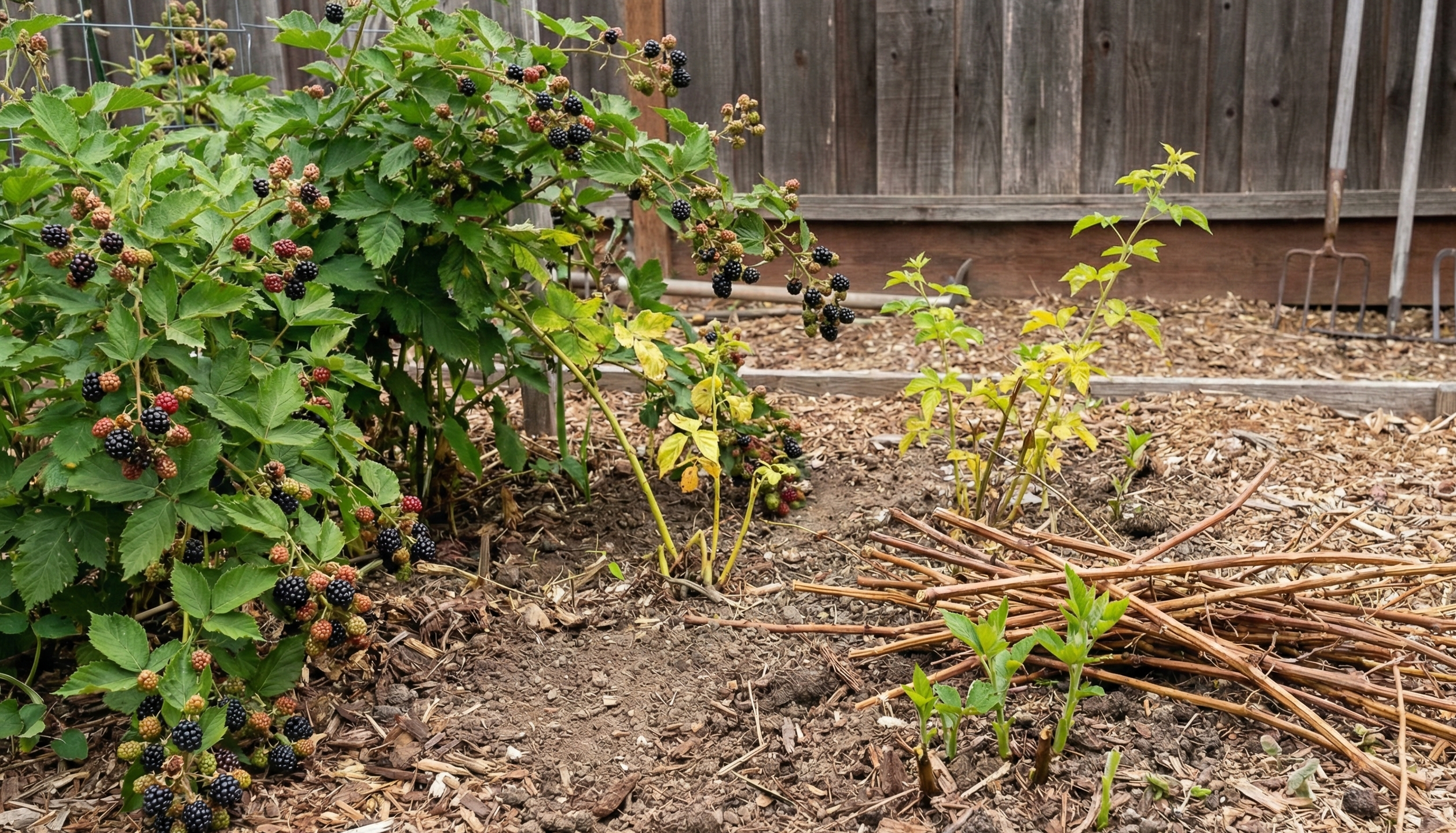
Year 2 - Floricane Stage: That same cane overwinters and returns for a second year. Now it's called a floricane. In spring, it develops lateral branches, flowers, and produces fruit. After harvest, the floricane dies and should be removed.
Meanwhile, new primocanes are growing from the crown. These will be next year's floricanes.
Biology Insights sums it up as perennial roots and biennial canes, which is the single idea that makes the rest of blackberry care fall into place.
The Exception: Primocane-Fruiting Varieties
Some modern varieties (like Prime-Ark Freedom) produce fruit on first-year primocanes, typically in late summer or fall. According to University of Maryland Extension, these primocane-fruiting cultivars can also produce a second crop on floricanes the following summer, extending the harvest season.
This changes the timeline significantly. You can get fruit the first year with primocane varieties.
Where we buy our trees · Affiliate partner
Fast Growing Trees
We have ordered from Fast Growing Trees many times and genuinely recommend them. All of our tropical pond plants come from them, and they ship established, ready-to-plant trees and shrubs straight to your door.
Reader code AMBITIOUS-TREES is built into this link. As an affiliate, we may earn a commission at no extra cost to you.
What Happens During a Blackberry Plant's First Year?
The first year after planting is all about roots and structure. Don't expect fruit from traditional varieties, and even primocane types will produce minimally.
What Happens
According to Oklahoma State Extension, during the first growing season after planting, erect blackberry plants often produce prostrate to semi-erect canes. Erect canes will be produced in subsequent years.
Spring (March through May):
Planted canes break dormancy
New growth emerges from buds
Root system begins establishing
Primocanes start growing from the crown
Summer (June through August):
Primocanes grow rapidly, reaching 3 to 6 feet depending on variety
Focus is on vegetative growth
Trailing varieties may "flop" once canes reach about 3 feet
Plants may attempt to flower (remove these flowers)
Fall (September through November):
Growth slows as temperatures cool
Canes harden off for winter
Energy moves to root system storage
What to Expect
The Crunchy Baker provides this realistic progression:
"Year 1: Three blackberry canes, very small, no trellising needed yet. We pulled any blooms from each plant all season."
According to Stark Bro's, if blackberries try to bloom and set fruit the first year, you should pinch these flowers off. This allows new plants to devote energy to becoming established so they can support bigger, better crops for years to come.
Year 1 Care
Don't prune first-year erect canes. According to Arbor Day Foundation, first year erect canes should be left unpruned.
Do summer tip primocanes on erect/semi-erect types once they reach 3 to 4 feet (in subsequent years, but some growers start year one).
Water consistently. Maine Organic Farmers and Gardeners emphasizes keeping shallow-rooted plants well watered throughout their first season, at least 1 inch per week.
Fertilize lightly. Oklahoma State Extension notes that very little commercial fertilizer is needed during the first year of establishment.
When Do Blackberry Plants Start Producing Fruit?
Year two is when things get exciting. Those primocanes from year one are now floricanes, and they'll produce your first berries.
What Happens
Late Winter/Early Spring:
Dormant pruning: shorten laterals, thin canes
Train floricanes to trellis
New primocanes begin emerging
Spring:
Floricanes leaf out and develop fruiting laterals
Flower buds form on lateral branches
Flowering occurs (typically late spring in Santa Cruz County)
Summer:
Fruit develops and ripens
Harvest period begins (varies by variety)
New primocanes grow vigorously
Remove spent floricanes after harvest
According to NC State Extension, the number of days for fruit to develop from full bloom to ripe fruit varies by cultivar and region, ranging from 35 to 60 days.
What to Expect
Maine Organic Farmers and Gardeners sets realistic expectations:
"A partial crop of berries can be expected in the second year and a full crop in the third."
The Crunchy Baker describes year two:
"The blackberry plants are lifted about four feet by my trellises, and producing about a cup of berries per day. And there are a lot more than three canes now."
Year 2 Yields
Expect a modest harvest. The plant is still establishing, and you'll have relatively few floricanes. This is normal. Think of year two as a preview of what's to come.
For erect blackberries in Maine, Maine Organic Farmers and Gardeners notes mature plants yield 3 to 6 pounds per plant. Year two will be significantly less, perhaps 1 to 2 pounds.
Year 2 Care
Prune properly: Remove spent floricanes after harvest; Felco F2 bypass pruning shears are one option for canes within the tool's rated cutting capacity
Free planting guide
Know what to plant, and when, in Santa Cruz County
Join the free Ambitious Harvest email list for seasonal planting reminders and practical Central Coast gardening notes. As a welcome, I will send you the one-page California Seed Starting Cheat Sheet, so you always know what to start indoors, what to sow direct, and the right timing for your zone.
Send me the planting guide
One email field, no name needed. Unsubscribe anytime.
Summer tip new primocanes: When they reach 3 to 4 feet
Fertilize at bloom and after harvest: Oklahoma State Extension recommends applying fertilizer at bloom time and again after fruit harvest
Water during fruit development: Critical for berry size and quality
How Long Until Blackberries Reach Full Production?
By year three, your blackberry patch starts to feel like a real berry garden. You'll have more floricanes, stronger canes, and significantly more fruit.
What Happens
The cycle continues: last year's primocanes are now floricanes, and the plant produces more primocanes than ever. The root system is well established, supporting vigorous growth.
What to Expect
The Crunchy Baker describes year three:
"Huge, woody canes that are now trellised on metal wire and stakes, with canes stretching 6 feet or more."
Maine Organic Farmers and Gardeners confirms:
"A full crop in the third year."
Year 3 Yields
Expect yields approaching mature plant levels:
Erect varieties: 3 to 6 pounds per plant
Trailing varieties: Up to 20 pounds per plant (according to Maine Organic Farmers and Gardeners)
You'll also notice the patch starting to spread. Suckers may appear outside the original planting area. Decide whether to remove these or allow limited expansion.
Year 3 Care
Thin canes to maintain 3 to 4 canes per foot of row
Stay on top of summer tipping
Consider pest and disease monitoring as the planting matures
Maintain good air circulation through proper pruning
What Are the Peak Production Years for Blackberry Plants?
Once established, blackberry plants reach their productive prime. With proper care, expect consistent harvests for many years.
What to Expect
According to Oklahoma State Extension:
"Properly maintained, irrigated plantings of good varieties may produce crops for 10 years or more."
And at full production:
"Well-established plants can produce up to 20,000 pounds per acre."
That figure is a commercial per-acre number. For a home garden, the per-plant yields below are the useful measure.
Mature Plant Yields
Maine Organic Farmers and Gardeners provides these yield expectations for mature plants:
Erect blackberries: 3 to 6 pounds per plant
Trailing varieties: Up to 20 pounds per plant
The Old Farmer's Almanac gives planting and harvest guidance for home growers.
Signs of Healthy Mature Plants
Vigorous primocane production each year
Strong, upright canes (erect types) or long, healthy canes (trailing types)
Consistent fruit production
Minimal disease pressure
Controlled spread (not taking over the garden)
Maintaining Production
Annual pruning keeps plants productive and manageable
Regular fertilization at bloom and after harvest
Consistent watering especially during fruit development
Disease monitoring and removal of affected canes
Periodic soil testing to maintain proper pH and fertility
What Are the Seasonal Growth Stages of Blackberry Plants?
Beyond the year-by-year timeline, Biology Insights a blackberry moves through seven recognizable stages each growing season:
1. Dormancy (Winter)
Plants are visually inactive. Leaves may drop (depending on variety). Energy is stored in roots and crown. Cold acclimation occurs. According to NC State Extension, dormant plants can survive the coldest parts of winter if adapted to the area and properly acclimated.
2. Bud Break (Late Winter/Early Spring)
As temperatures rise and days lengthen, buds begin swelling. NC State Extension describes three stages of bud development: delayed dormant, popcorn, and full bloom.
3. Vegetative Growth (Spring)
New primocanes emerge from the crown. Floricanes leaf out and develop lateral branches. According to Greg App, primocanes can put on several feet in a single season, with UC ANR noting that erect types arch over once they reach about 5 to 6 feet.
4. Flowering (Late Spring)
White to pink flowers appear on floricanes. Greg App and bloom runs for several weeks rather than opening all at once. Bees and other pollinators transfer pollen, though blackberries are largely self-pollinating.
5. Fruit Development (Early Summer)
After pollination, each flower sets a cluster of small drupelets, one from each carpel, around a central white receptacle. Berries gradually increase in size over several weeks.
6. Ripening (Summer)
Berries transition through color stages:
Green (immature)
Red (still unripe)
Black (ripe)
Dull black and slightly soft (peak ripeness)
According to SF Gate Home Guides, blackberries turn from a full shiny black to a dull black when they are truly ripe, and shiny black fruit is higher in acid with less flavor and sweetness than dull black fruit.
7. Post-Harvest/Senescence (Late Summer/Fall)
Floricanes that bore fruit begin dying back. Primocanes mature and harden. The plant shifts energy to roots before dormancy.
How Do Primocane-Fruiting Blackberry Varieties Differ?
If you're growing Prime-Ark Freedom or other primocane-fruiting types, your timeline is different.
Year 1
Spring/Summer: Primocanes grow vigorously Late Summer/Fall: Primocanes flower and fruit at their tips Result: You get berries the first year (though yields are modest)
Year 2
Summer: Floricanes (last year's primocanes) produce early summer crop Late Summer/Fall: New primocanes produce fall crop Result: Two harvests per year
According to University of Maryland Extension:
"By their second year of establishment, the floricanes will set fruit in the summer and new primocane stems will set fruit in the fall. This will extend your fresh fruit season."
Simplified Management Option
You can also manage primocane varieties by cutting all canes to the ground each winter. This eliminates the floricane crop but simplifies care and produces a single fall harvest on primocanes.
Why Aren't My Blackberry Plants Growing as Expected?
Sometimes plants don't develop as expected. Here's what might be happening:
Slow Growth in Year 1
Possible causes:
Planting too late in season
Insufficient water
Poor soil drainage
Planting too deep
Root damage during planting
Solution: Ensure consistent moisture, proper planting depth, and good drainage. Be patient; some plants establish slowly.
No Fruit in Year 2
Possible causes:
Removed the wrong canes (cut out floricanes instead of primocanes)
Winter damage to flower buds
Insufficient chilling hours
Birds or animals eating fruit
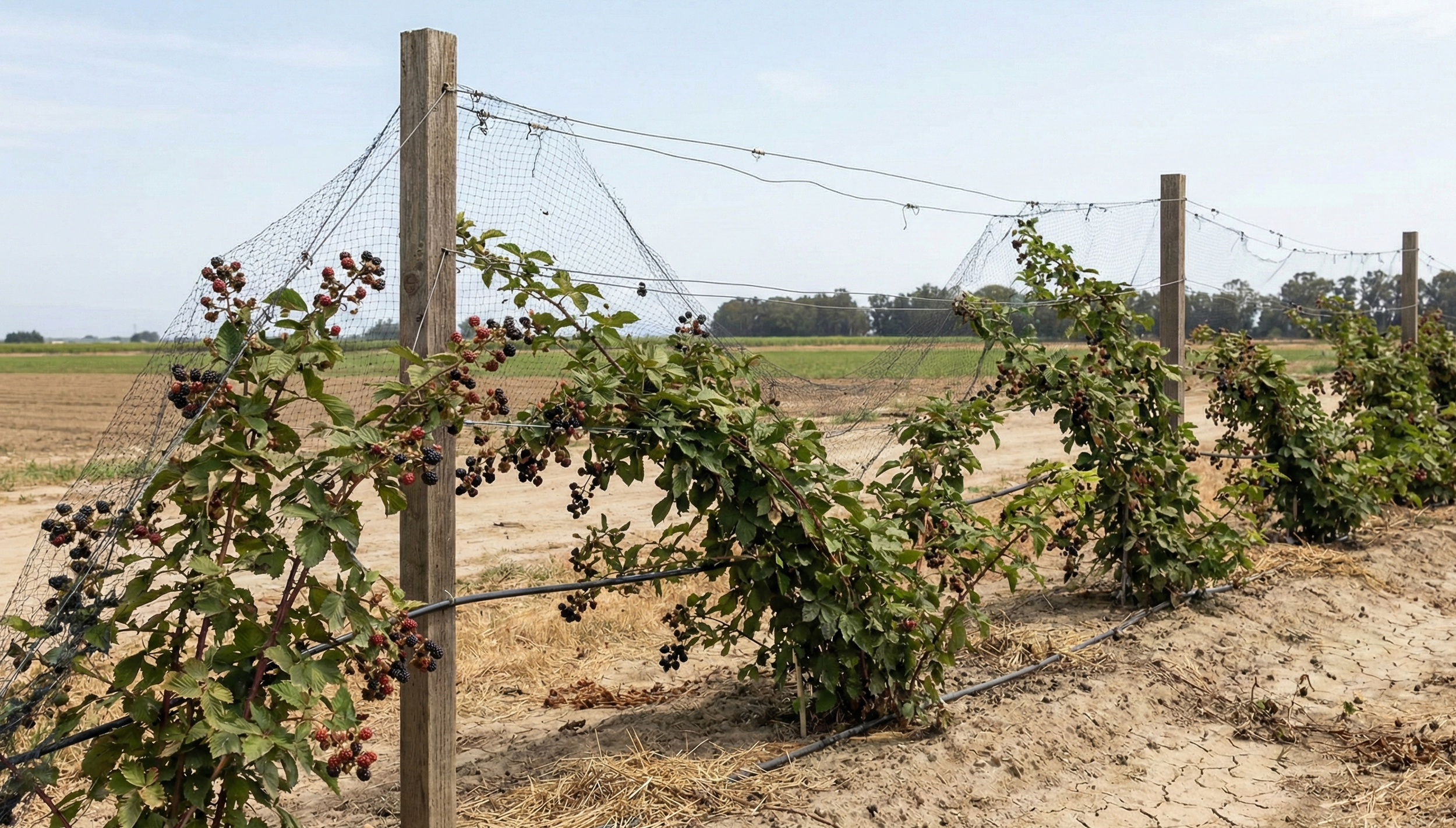
Solution: Learn to identify primocanes vs floricanes. Protect plants from extreme cold. Pull taut and stake down any bird netting during ripening.
Declining Production in Later Years
Possible causes:
Disease buildup
Soil depletion
Poor pruning (not removing old floricanes)
Plants becoming root-bound (containers)
Solution: Maintain good sanitation, fertilize regularly, prune properly, and consider replacing very old plants.
Every crop in the garden moves through its own version of this cycle. If you are tracking other plantings, see our raspberry growth stages and strawberry growth stages guides, or browse growth stage guides for every crop, from tomatoes to blueberries.
The Blackberry Life Cycle, Year by Year
A blackberry plant follows the same life cycle every year. It goes dormant in winter, pushes out new canes and leaves in spring, blooms in late spring, and produces its berries through the summer. First-year canes, called primocanes, grow and store energy, and in most varieties those same canes fruit the next year as floricanes. Once you can see the blackberry life cycle laid out, you know exactly when to prune, when to expect flowers, and when to expect fruit.
Go deeper · Recommended guide
The California Berry Growing Guide
Strawberries to mulberries, matched to your zone and pruned without fear.
$12.99View the guide
Free download
The California Berry Growing Cheat Sheet
A free one-page quick reference for growing strawberries, blueberries, blackberries, raspberries, and mulberries in coastal California. Enter your email and I will send the PDF straight to your inbox.
Send me the cheat sheet
You will also get practical Santa Cruz gardening tips. Unsubscribe anytime.
Frequently Asked Questions
When will my blackberries first produce fruit?
For traditional floricane varieties, expect a partial crop in year two and full production by year three. Primocane-fruiting varieties can produce a small fall crop in year one.
Should I let blackberries fruit the first year?
For most varieties, no. Stark Bro's recommends pinching off flowers in year one so plants can establish strong roots for better future production.
How long do blackberry plants live?
The crown and root system are perennial. Oregon State puts blackberry plantings at 15 to more than 40 years of production, depending on type, soil, and pest pressure. Individual canes are biennial, living only two years.
How many pounds of berries can I expect?
At maturity, erect blackberries yield 3 to 6 pounds per plant. Trailing varieties can produce up to 20 pounds per plant. Year two yields will be significantly lower.
Why do my canes look different from each other?
You're seeing primocanes and floricanes. Primocanes (first-year) are green and flexible. Floricanes (second-year) are woody and gray/brown. According to Clemson Extension, primocanes have five leaflets while floricanes have three.
Can I speed up production?
Choose primocane-fruiting varieties for first-year fruit. Otherwise, focus on good establishment practices: proper watering, fertility, and weed control to maximize growth each year.
When do blackberries bloom?
In our coastal gardens, blackberries generally bloom from mid-April into June, with most flowers opening in May. Flowers open on the second-year floricanes, and each berry ripens roughly 40 to 60 days after its flower is pollinated. Primocane-fruiting varieties add a second bloom on first-year canes from midsummer into early fall.
When do blackberry plants come out of dormancy?
In Santa Cruz County's mild winters, bud swell usually starts around February and new leaves tend to show by early March, with fresh primocanes pushing up from the crown around the same time. Watch your own plants rather than the calendar, since the date moves a couple of weeks either way with the season. Cooler inland and mountain gardens run two to three weeks behind the coast.
Can blackberries fruit twice in one season?
Most blackberries fruit only on second-year canes, called floricanes, so you get one main crop in summer. Primocane-fruiting varieties are the exception. Types like the Prime-Ark series, bred at the University of Arkansas, set fruit on first-year canes in late summer and fall, which can give you a second, later harvest on top of the summer crop. In our mild coastal climate that fall crop often keeps producing well into autumn.
Downloadable Guides
For help at each growth stage, download these PDF guides:
Seasonal Garden Tasks Checklist: When to prune, tip, and harvest
Garden Troubleshooting Guide: Solutions for common problems
Understanding blackberry growth stages transforms you from a hopeful planter to a confident grower. The biennial cane cycle means you're always managing two generations of canes: this year's primocanes (next year's fruit) and last year's floricanes (this year's fruit).
Year one is about patience and establishment. Year two brings your first taste of success. By year three, you're harvesting real quantities. And from years four through ten and beyond, you'll enjoy abundant production if you maintain good pruning, watering, and fertility practices.
The key insight: every primocane you nurture this year becomes a floricane that rewards you next year. That long-term perspective makes blackberry growing incredibly satisfying.
Related Articles:
Blackberry Growth Stages
Blackberry Growth Timeline: Year by Year (Floricane Varieties)
Expect fruit in Year 1 (fall, from primocanes) and two crops per year starting Year 2 (summer floricane + fall primocane).
The Blackberry Growth Cycle: 7 Stages Each Season
How to Identify Primocanes vs Floricanes
- Green, flexible canes
- 5 leaflets per leaf
- Smooth, soft texture
- No flowers/fruit (usually)
- Keep these! They fruit next year
- Gray/brown, woody canes
- 3 leaflets per leaf
- Rough, bark-like texture
- Flowers and fruit appear
- Remove after fruiting
