

How to Prune and Trellis Blackberries: A Step-by-Step Guide
A few of the product links in this guide are affiliate links. If you buy through one, Ambitious Harvest may earn a small commission at no extra cost to you, which helps keep these guides free. We only point to gear we would use in our own Santa Cruz garden. As an Amazon Associate, we earn from qualifying purchases. Read our full disclosure.
Pruning and trellising are where many blackberry growers struggle. Without annual attention, blackberry canes become a tangled mess that harbors disease, produces fewer berries, and makes harvesting miserable. With proper pruning and support, the same plants become organized, productive, and a pleasure to work with.
The good news is that once you understand how blackberries grow, the pruning approach becomes logical and straightforward. This guide breaks down the process by growth type so you can confidently manage whatever varieties you're growing.
What Is the Primocane-Floricane Cycle?
Before touching your pruners, you need to understand how blackberry canes work. This knowledge makes all pruning decisions clear.
According to Illinois Extension, blackberries bear fruit on canes that live for two years:
Year 1 (Primocanes): New canes emerge from the crown in spring. These first-year canes are called primocanes. They're green, flexible, and vigorous. On traditional varieties, primocanes grow all season but don't produce fruit.
Year 2 (Floricanes): Those same canes overwinter and return as floricanes. They develop lateral branches, flower, produce fruit, and then die after harvest. Meanwhile, new primocanes are growing from the crown.
This means your blackberry patch always has two generations of canes growing simultaneously: this year's primocanes (future producers) and last year's floricanes (current producers).
The key insight from Ohio State Extension: after floricanes fruit, they're done forever. Removing them makes room for the primocanes that will be next year's fruit producers.
Primocane-Fruiting Varieties: The Exception
Some modern varieties (like Prime-Ark Freedom) fruit on first-year primocanes, typically in late summer or fall. According to NC State Extension, these can be managed by simply cutting all canes to the ground each winter. New primocanes emerge in spring and fruit in fall.
Tools You'll Need
Hand pruners: For tipping primocanes and removing small growth
Loppers: For cutting out spent floricanes at the base
Leather gloves: Essential for thorny varieties
Long sleeves: Protect your arms
Garden twine or soft ties: For securing canes to trellis
Keep tools clean and sharp. According to NC State Extension, dull cuts create larger wounds that are more susceptible to disease.
How Should You Prune Erect Blackberries?
Erect varieties (Ouachita, Apache, Navaho, Arapaho) produce stiff, upright canes that can often grow without a trellis. However, they still need pruning for best production.
Summer Tipping (Critical Step)
The most important pruning for erect blackberries happens in summer when you "tip" the primocanes.
According to Missouri Extension, tip erect blackberries when primocanes reach 36 to 40 inches tall. Ohio State recommends tipping at 48 inches in late June and July.
How to tip:
When primocanes reach 3 to 4 feet tall, cut off the top 2 to 4 inches
Use hand pruners or simply pinch with fingers if growth is soft
Check weekly and tip new primocanes as they reach the target height
Continue tipping throughout summer as new primocanes emerge
Why tip? Gardening Know How explains that removing the growing tip releases hormones that stimulate lateral branch development. These lateral branches are where fruit will form next year, so more laterals means more berries.
Illinois Extension notes this characteristic is specific to erect blackberries (and black raspberries). Trailing types don't benefit from summer tipping the same way.
Dormant Pruning (Late Winter)
In late winter before growth begins, do your dormant pruning:
1. Remove spent floricanes Cut last year's fruiting canes to the ground. These are the gray, woody canes that produced fruit last summer. They're done and won't produce again.
2. Thin primocanes if needed According to Illinois Extension, leave 3 to 4 vigorous canes per linear foot of row. Remove weak, damaged, or crowded canes.
3. Shorten lateral branches Those laterals that developed after summer tipping need to be shortened. Stark Bro's recommends cutting laterals back to 16 to 18 inches. Missouri Extension suggests 12 to 18 inches.
This dormant shortening encourages larger fruit and makes the plant more manageable.
Post-Harvest Cleanup
After the fruiting season ends (typically August), remove the spent floricanes. While some growers wait until dormant pruning, Gardening Know How notes that removing them sooner clears the way for new primocanes and reduces disease pressure.
How Should You Prune Semi-Erect Blackberries?
Semi-erect varieties (Triple Crown, Chester, Hull) produce arching canes that need trellising for support. Their pruning is similar to erect types with some adjustments.
Summer Tipping
According to Crop Circle Farms, let semi-erect primocanes grow to about 3 to 4 feet, then tip the growing point to encourage lateral branches.
NC State Extension adds that you should tie primocanes loosely to the trellis as they develop, training them up through the plant to the top wire.
Dormant Pruning
Same approach as erect types:
Remove spent floricanes at the base
Thin to strong canes (leave 5 to 6 per linear foot)
Shorten laterals to 12 to 18 inches
Stark Bro's notes that first-year canes of semi-erect varieties may trail along the ground. Let them grow; they'll become more upright and can be trained to the trellis.
Training to Trellis
As floricanes leaf out in spring, tie them to your trellis wires. Space canes evenly along the wires for maximum light exposure and air circulation. New primocanes can grow up through the center of the plant while floricanes fruit on the outside.
How Should You Prune Trailing Blackberries?
Trailing varieties (Marionberry, Boysenberry, Thornless Evergreen, Olallieberry) produce long, flexible canes that absolutely require trellising. Their management differs significantly from erect types.
First-Year Management
According to Oregon State Extension, trailing blackberry primocanes flop over and run along the ground once they reach about 3 feet, so keep them bundled below the floricanes through the first season.
NC State Extension suggests tying primocanes loosely together as they develop during the first growing season to allow for weed control under the canes.
Summer Tipping (Optional)
Wikifarmer notes that trailing blackberries generally aren't tipped like erect types, but canes can be topped when they reach 8 to 10 feet to keep different plant canopies distinct and manageable.
Dormant Pruning
In late winter:
1. Remove spent floricanes Cut the canes that fruited last summer to the ground.
2. Train primocanes to trellis Take last year's primocanes (now floricanes) and train them onto your trellis wires. Common methods include:
Weaving canes along the wires
Fanning canes out from the crown
Training 2 canes in each direction along the wires
3. Shorten main canes Stark Bro's recommends pruning each main cane back to 3 to 4 feet, then cutting side branches to about 12 inches, leaving 5 to 6 buds on each.
The Training Pattern
Oregon State Extension describes this system:
In year one, train primocanes as they grow, keeping them bundled below the trellis
In subsequent years, you'll have floricanes trained on the trellis (flowering and fruiting) while new primocanes grow below
After harvest, remove the spent floricanes and the primocanes move up to take their place
This keeps fruiting canes and new growth separated, making management much easier.
How Should You Prune Primocane-Fruiting Blackberries?
Primocane varieties (Prime-Ark Freedom, Prime-Ark 45, Prime-Ark Traveler) offer the simplest pruning of all.
Single-Crop System (Easiest)
For primocane-fruiting varieties like Prime-Ark 45, NC State Extension says you can remove all canes at the base in late winter or early spring before growth begins, then let the new primocanes fruit in late summer or fall.
This eliminates the complexity of managing two generations of canes.
Double-Crop System
If you want two harvests, manage primocane varieties more like traditional floricane types:
Let primocanes fruit in fall (they'll produce at the tips)
Don't remove these canes in winter
The following summer, the lower portions will fruit as floricanes
After this second crop, remove the spent canes
Resprout cautions that with everbearing varieties, the primocanes look partially dead at the end of the season (dead at the tips where they fruited, green at the bottom). Don't remove them if you want the floricane crop.
Summer Tipping
NC State Extension recommends soft-tipping primocane-fruiting varieties, removing about 2 inches, once the canes reach 3 feet tall.
Trellis Systems for Blackberries
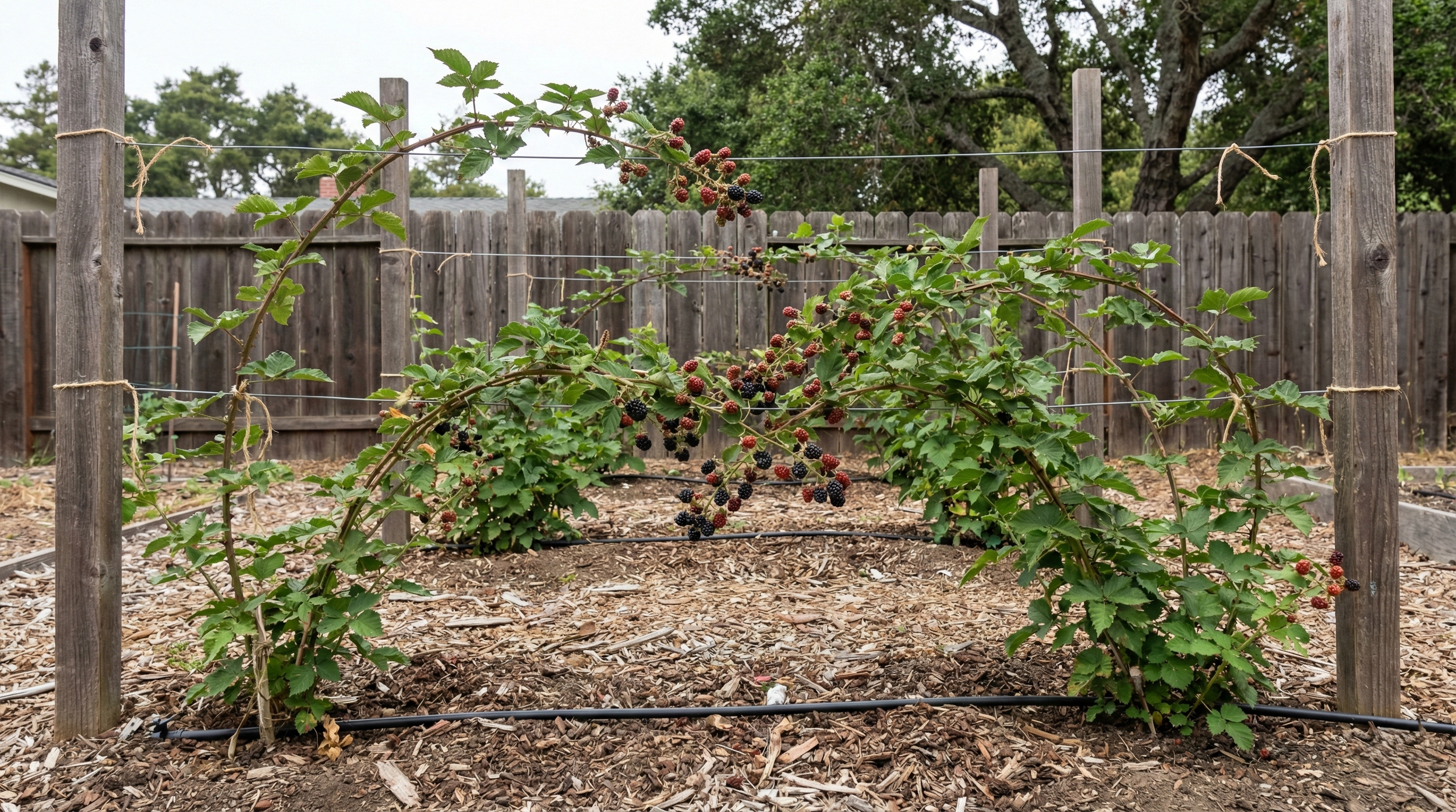
According to Stark Bro's, erect blackberries usually don't require a trellis, semi-erect types need support to keep fruit off the ground, and trailing varieties must be trellised.
That said, even erect varieties benefit from some support. A trellis improves air circulation, makes harvesting easier, and keeps canes organized.
Simple Two-Wire Trellis (Best for Home Gardens)
This basic system works for erect and semi-erect varieties and is easy to build.
Materials:
Sturdy posts (4x4 wood or metal T-posts)
12 to 14 gauge galvanized wire
Eye screws or wire clips
Construction:
According to University of Florida Extension:
Set posts 2 feet into the ground, leaving 5 feet above ground
Space posts 15 to 25 feet apart along the row
String lower wire at 2 to 3 feet above ground
String upper wire at 4 to 5 feet above ground
Lovely Greens recommends spacing posts about 7 to 10 feet apart for home gardens and using 14 gauge wire minimum to prevent sagging.
Training:
Tie floricanes to the wires, spacing evenly
Let primocanes grow up through the center
Use soft ties (string, plant tape) in a figure-8 pattern to prevent wire from rubbing canes
T-Trellis
For larger plantings or very vigorous semi-erect varieties, a T-trellis provides more support.
Construction:
Set posts as above
Attach 2-foot crossarms at the top of each post
Run wires along the ends of the crossarms
A T-trellis adds a crossarm at the top of each post with a wire at each end, which spreads the canes for better light and air; NC State Extension sets trellis posts 20 to 30 feet apart in the row.
V-Trellis (Best for Trailing Types)
For trailing blackberries that need more spreading room, a V-trellis works well.
According to University of Florida Extension, the V-shape allows floricanes to be tied to outside wires while primocanes grow up the middle. This keeps the two generations of canes separated.
The Seasonal Homestead describes the V-trellis setup:
Two posts placed 18 inches apart at ground level, angling outward
Top of the V is about 42 inches wide
Lower wire at 24 inches, upper wire at 48 inches
Advantages:
Excellent separation of primocanes and floricanes
Easy to see canes for pruning
Good air circulation reduces disease
Using Existing Structures
Stark Bro's notes that you don't need a purpose-built trellis. Many common structures work well:
Existing fences
Deck railings
Arbors
Building walls (with wire attached)
Just ensure whatever you use can handle the weight of mature canes loaded with fruit.
Seasonal Pruning Calendar
Here's a month-by-month guide for Santa Cruz County:
Winter (December to February)
Dormant pruning: Remove spent floricanes, thin canes, shorten laterals
Trellis maintenance: Repair wires, tighten supports
Training: Tie floricanes to trellis for the coming season
Spring (March to May)
Watch for new growth: Primocanes will begin emerging
Train as needed: Guide primocanes toward trellis or bundle below
Remove damaged canes: Cut out any winter-damaged growth
Summer (June to August)
Tip primocanes: When erect/semi-erect canes reach 3 to 4 feet, tip them
Continue tipping: Check weekly for new canes reaching target height
Harvest: Pick ripe berries every 2 to 3 days
Post-harvest cleanup: Remove spent floricanes after fruiting ends
Fall (September to November)
Primocane varieties: Harvest fall crop if growing primocane types
Late cleanup: Remove any remaining spent floricanes
Prepare for winter: Ensure canes are secured to trellis
What Are the Most Common Pruning Mistakes?
Mistake 1: Not Tipping Erect Types
Skipping summer tipping on erect and semi-erect blackberries dramatically reduces yield. Without tipping, canes produce fewer lateral branches and therefore fewer fruiting sites.
Mistake 2: Cutting the Wrong Canes
According to Resprout, a common mistake is confusing primocanes and floricanes. Learn to identify them:
Primocanes: Green, flexible, emerged this season
Floricanes: Woody, gray/brown, grew last year
If you accidentally remove all primocanes, you'll have no fruit next year.
Mistake 3: Leaving Floricanes After Fruiting
Spent floricanes compete with primocanes for space and can harbor diseases. Remove them after they finish fruiting.
Mistake 4: Not Shortening Laterals
Those lateral branches that develop after tipping need to be shortened in late winter. Without this step, laterals become unwieldy and produce smaller fruit.
Mistake 5: Ignoring the Trellis
Even self-supporting erect varieties benefit from trellising. Unsupported canes fall over under fruit weight, leading to ground contact, disease, and difficult harvesting.
For additional pruning guidance specific to California conditions, the UC IPM pruning guide for caneberries covers timing, technique, and pest prevention through proper cane management.
Frequently Asked Questions
When is the best time to prune blackberries?
Major dormant pruning happens in late winter (January to February in Santa Cruz County) before growth begins. Summer tipping of primocanes occurs in June and July when canes reach 3 to 4 feet. Post-harvest removal of spent floricanes can happen anytime after fruiting ends.
Do I need to tip trailing blackberries?
Generally no. Illinois Extension notes that tipping has no advantage for trailing blackberries. You can top excessively long canes (8 to 10+ feet) to keep them manageable, but it won't stimulate lateral branching the way it does on erect types.
How short should I cut lateral branches?
During dormant pruning, shorten lateral branches to 12 to 18 inches. This encourages larger berries and keeps the plant manageable. Longer laterals produce more but smaller fruit.
Can I prune blackberries in fall?
You can remove spent floricanes in fall after harvest. However, save major pruning (shortening laterals, thinning canes) for late winter. Fall pruning can stimulate new growth that may be damaged by winter cold.
What if I didn't prune last year?
Start fresh this winter. Remove all the tangled floricanes, identify the healthiest primocanes, and thin to 4 to 6 per foot of row. Tip any primocanes that are excessively tall. It may take a season to get back on track, but blackberries are forgiving.
Do thornless and thorny varieties prune the same way?
Yes, the pruning approach is the same. Ohio State notes that thornless varieties are simply easier to handle. Wear protective clothing when working with thorny types.
How tall should my trellis be?
Most blackberries grow 4 to 6 feet tall, so a trellis with the top wire at 5 feet works well for erect and semi-erect types. Trailing varieties may need slightly taller supports (6 feet) to accommodate their more vigorous canes.
Can primocane blackberries be trellised?
Yes, though it's optional. A trellis helps keep the canes upright and makes harvesting easier. If you're using the single-crop system (mowing all canes annually), a simple temporary support may be sufficient.
Downloadable Guides
For quick reference, download these PDF guides:
Seasonal Garden Tasks Checklist: Includes berry pruning timing
Garden Troubleshooting Guide: Help with common problems
Companion Planting Guide: What to plant near berries
Pruning and trellising blackberries comes down to understanding one simple concept: you're always managing two generations of canes. Current-year primocanes are next year's producers, while last year's floricanes fruit and die this season.
For erect and semi-erect types, summer tipping is the key to high yields. For trailing types, keeping primocanes and floricanes separated makes management much easier. And for primocane varieties, you can skip the complexity entirely by mowing everything to the ground each winter.
Start with a simple two-wire trellis, stay on top of summer tipping, remove spent canes after harvest, and do your dormant pruning in late winter. Your blackberries will reward you with organized, productive plants for many years.
Related Articles:
How to Prune and Trellis Blackberries
