

Cut-and-Come-Again Greens: Maximizing Your Harvest
A few of the product links in this guide are affiliate links. If you buy through one, Ambitious Harvest may earn a small commission at no extra cost to you, which helps keep these guides free. We only point to gear we would use in our own Santa Cruz garden. As an Amazon Associate, we earn from qualifying purchases. Read our full disclosure.
What Are Cut-and-Come-Again Greens and Why Do They Maximize Your Harvest?
Cut-and-come-again greens are leafy vegetables that regrow after harvesting, allowing you to pick from the same plants repeatedly over weeks or even months. Cut-and-come-again harvesting can roughly double the total leaf yield from a plant compared to cutting it once, since the crown keeps pushing new leaves over several weeks, making this technique one of the most efficient ways to use garden space in Santa Cruz County. If you have limited beds but want a steady supply of fresh salad greens, this method transforms a small planting into a season-long harvest.
For variety-specific growing recommendations, the UC Master Gardener guide to growing salad greens covers cut-and-come-again techniques and variety selection for California gardens.
The principle is simple: instead of waiting for a full head of lettuce or a mature bunch of kale and then pulling the whole plant, you harvest individual outer leaves or cut the plant back to a few inches above the soil line. The growing point remains intact, and the plant puts out new leaves within days. This approach works with a surprising number of leafy crops and pairs beautifully with succession planting to create an almost unbroken supply of fresh greens from your Santa Cruz County garden.
Which Greens Regrow Best After Cutting?
Not all leafy greens are equally suited to cut-and-come-again harvesting. Some regrow vigorously and produce tender new leaves for months, while others quickly bolt or produce tough, bitter regrowth. Here are the top performers for Santa Cruz County gardens.
Loose-leaf lettuce. This is the single best crop for cut-and-come-again harvesting. Loose-leaf varieties like 'Salad Bowl,' 'Red Sails,' 'Oakleaf,' and 'Deer Tongue' regrow rapidly after cutting and can provide 3 to 5 harvests before quality declines. Avoid heading types like iceberg and romaine for this technique, as they are bred to form a single dense head and do not regrow reliably after cutting. Lettuce mixes labeled "cutting mix" or "mesclun" are specifically selected for repeated harvest.
Swiss chard. Perhaps the most durable cut-and-come-again green, chard produces new leaves from the center of the rosette for 8 to 12 months in Santa Cruz County's mild climate. The 'Bright Lights' variety adds vivid color to the garden with its multicolored stems. Harvest outer leaves individually, leaving the center growth point intact, and chard will keep producing through multiple seasons. A fall planting of chard can produce harvestable leaves straight through winter and into the following summer.
Kale. Both curly and Tuscan (lacinato) kale respond well to ongoing leaf harvest. Pick the lower, outer leaves while leaving the growing tip and at least 6 to 8 inner leaves. Kale plants managed this way can produce for a full year in our climate before flowering. 'Lacinato' and 'Red Russian' are the best varieties for repeated cutting because they produce new leaves quickly and maintain good flavor even as plants mature.
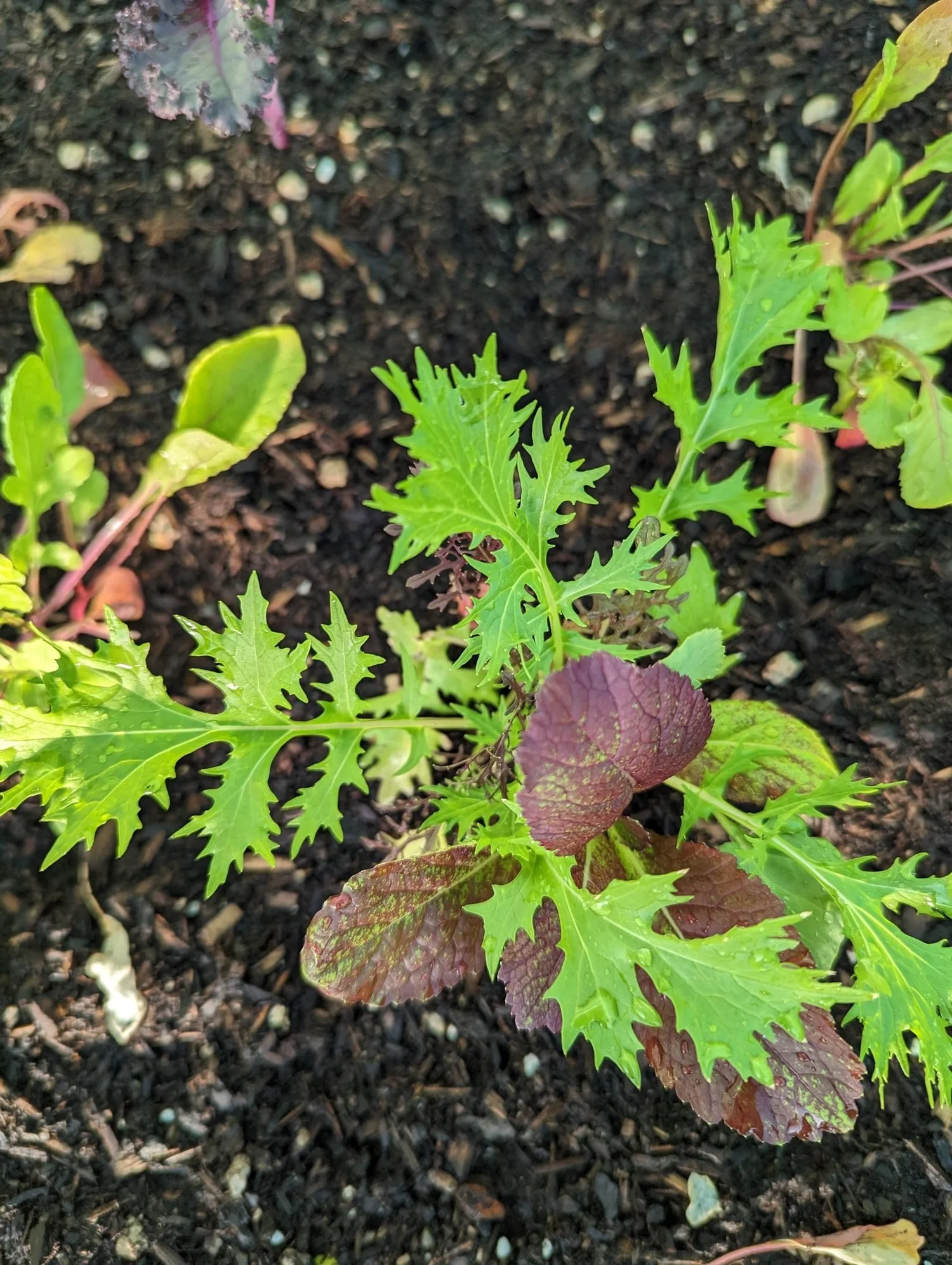
Mizuna and other Asian greens. Mizuna is exceptionally fast-growing and can be ready for its first cutting just 20 to 25 days after sowing. It regrows 3 to 4 times before bolting and handles our cool coastal temperatures beautifully. Tatsoi, komatsuna, and pac choi also work as cut-and-come-again greens, though pac choi tends to bolt faster after cutting than the others.
Spinach. Spinach can be harvested as a cut-and-come-again crop for 2 to 3 cuttings during the cool season. It is more bolt-prone than the other greens listed here, especially as days lengthen in spring. For the longest harvest window, plant bolt-resistant varieties like 'Bloomsdale Long Standing' or 'Space' and grow them through our cool, foggy months when bolting pressure is lowest.
Arugula. Both wild and cultivated arugula regrow well after cutting. Wild arugula (Diplotaxis tenuifolia) is particularly long-lived, producing for 6 months or more with regular cutting. Cultivated arugula (Eruca sativa) is faster-growing but bolts sooner. Both types add peppery flavor to salads and can handle partial shade, which makes them useful for tucking into less sunny garden spots.
How Do You Harvest Cut-and-Come-Again Greens Properly?
The way you harvest determines whether your greens regrow vigorously or struggle. There are two main harvesting techniques, and the right one depends on the crop and the size of your plants.
The individual leaf method. This works best for chard, kale, and mature lettuce plants. Pick individual outer leaves by snapping or cutting them at the base of the leaf stem, right where it meets the main stalk. Always leave the center rosette and at least 4 to 6 inner leaves intact. This method is slower at harvest time but puts the least stress on the plant and supports the longest harvest period. For chard and kale, this method can keep a single plant producing for many months.
The cut-across method. This works best for young, densely planted lettuce, mizuna, arugula, and spinach. Using sharp scissors or a knife, cut all the leaves about 1 to 2 inches above the soil line in a single pass. Leave the growing crown and the smallest emerging leaves untouched. New growth appears within 3 to 7 days, and the planting is ready for another full cut in 2 to 3 weeks. This method is fast and efficient but puts more stress on the plants, so expect fewer total harvests (typically 3 to 4) before replanting is needed.
Timing your harvest. Harvest in the early morning when leaves are fully hydrated and at their crispest. Greens cut in afternoon heat wilt faster and have a shorter shelf life. For the best flavor, harvest before plants reach full maturity. Young, tender leaves from regrowth are often more mild and delicate than the first harvest.
How much to take. Never harvest more than one-third of a plant's foliage at one time when using the individual leaf method. Taking too much weakens the plant and slows regrowth dramatically. With the cut-across method, the general rule is to leave at least 1 inch of stem above the soil. Cutting too low can damage the growing point and kill the plant.
What Is the Best Succession Planting Schedule for Year-Round Greens?
Cut-and-come-again harvesting extends each planting's productive life, but even the most vigorous greens eventually bolt, become tough, or lose flavor. Succession planting fills the gaps and ensures you always have tender, productive plants coming online as older ones decline.
Cool-season succession (October through April). Santa Cruz County's mild winters are ideal for continuous greens production. Sow a new batch of lettuce, spinach, and arugula every 3 to 4 weeks from early October through February. These plantings will carry you through winter and into spring. Add chard and kale transplants in October and November. These slower-growing, longer-lived plants provide the backbone of your cool-season supply while the faster crops rotate through.
The spring transition (March through May). This is the trickiest period for greens in our climate. Lengthening days trigger bolting in cool-season crops, and summer heat has not yet arrived to support warm-season alternatives. Extend your spring greens harvest by choosing bolt-resistant varieties, providing afternoon shade with cloth or taller crops, and focusing on the most bolt-resistant species: chard, kale, and wild arugula. These three can often bridge the gap when lettuce and spinach give up for the season.
Warm-season strategy (May through September). Traditional salad greens struggle during our warmest months, but you have options. New Zealand spinach (Tetragonia tetragonioides) thrives in summer heat and can be harvested as a cut-and-come-again green. Malabar spinach, a tropical vine, produces glossy leaves through the warm months. Sweet potato greens are another underused summer option with mild-flavored leaves. For lettuce lovers, plant heat-tolerant varieties like 'Jericho' or 'Muir' in afternoon shade and harvest frequently to prevent bolting.
Fall restart (September through October). As temperatures cool in September, begin your fall succession plantings of lettuce, spinach, arugula, and mizuna. This is one of the most productive planting windows in Santa Cruz County. Greens planted in September and October grow quickly in the still-warm soil and then slow to a comfortable pace through winter, producing tender leaves for months with minimal bolting pressure.
How Does Shade Tolerance Affect Where You Plant Cut-and-Come-Again Greens?
One of the great advantages of leafy greens is their tolerance for partial shade, which opens up planting options in gardens with limited sun exposure. In Santa Cruz County, where large redwoods, oaks, and neighboring structures can create significant shade, knowing which greens thrive in lower light is valuable information.
Full shade performers (2 to 3 hours of direct sun). Very few food crops produce well in deep shade, but lettuce and mizuna come closest. In spots that receive just 2 to 3 hours of direct sun, these greens still produce harvestable leaves, though growth is slower and plants will be more open and leggy than those in sunnier spots. During summer, these deeply shaded areas can actually be your best lettuce locations because the cool conditions resist bolting.
Partial shade performers (3 to 5 hours of direct sun). Arugula, spinach, chard, and kale all produce well with 3 to 5 hours of direct sun. In fact, during our warmest months, partial shade improves the quality of all these greens by keeping leaves tender and reducing bitterness. A bed on the north side of a fence or building that catches morning sun but is shaded in the afternoon is an ideal summer greens location.
Full sun considerations (6 or more hours). While greens can grow in full sun during the cool season, full summer sun in inland Santa Cruz County locations can be too intense. Leaves become tough, bitter, and quick to bolt. If your only garden space gets full sun, use shade cloth (30 to 50 percent shade rating) over your greens beds during summer, or interplant greens beneath taller crops like tomatoes, corn, or pole beans that provide natural filtered shade.
The microclimate advantage. Santa Cruz County's varied topography creates microclimates that savvy greens growers can exploit. Coastal gardeners in Santa Cruz, Capitola, and Aptos enjoy natural fog shade that extends the greens season well into summer. Inland gardeners in the San Lorenzo Valley and Scotts Valley can use their naturally cooler, shadier canyon conditions to their advantage. Small garden spaces with partial shade that seem limiting for sun-loving vegetables are often perfect for year-round greens production.
What Soil and Fertilization Do Cut-and-Come-Again Greens Need?
Greens that you plan to harvest repeatedly need more nutritional support than single-harvest crops. Each time you cut leaves, you are removing nutrients that the plant must replace to regrow. Keeping the soil well-supplied with the right nutrients is essential for sustained production.
Soil preparation. Before planting, work 2 to 3 inches of finished compost into the top 6 inches of soil. Greens prefer soil with a pH between 6.0 and 7.0, which is within the range of most Santa Cruz County garden soils. If your soil is particularly acidic, as can happen in areas with heavy redwood leaf litter, a light application of lime helps bring the pH into the optimal range.
Nitrogen is key. Leafy greens are nitrogen-hungry crops, and plants that are being repeatedly harvested need even more than usual. Side-dress with a nitrogen-rich organic fertilizer (blood meal, feather meal, or fish emulsion) every 3 to 4 weeks during active growth. UC soil scientists recommend keeping nitrogen available throughout the growing season for cut-and-come-again crops, as nitrogen deficiency is the most common cause of slow regrowth and yellowing leaves.
Watering. Consistent moisture is essential for tender, mild-flavored greens. Irregular watering causes leaf bitterness and toughness, even in varieties that are normally mild. Water deeply 2 to 3 times per week during the warm season and once or twice per week during the cool season. Mulch around plants with straw or compost to maintain even soil moisture. Drip irrigation or soaker hoses are preferable to overhead watering, which can promote fungal diseases on dense leaf plantings.
Mulching. A 1 to 2 inch layer of fine mulch (straw, compost, or finely shredded leaves) around greens plantings serves multiple purposes: it keeps soil evenly moist, suppresses weeds, keeps soil-borne pathogens from splashing onto leaves, and moderates soil temperature. In our coastal climate, mulch helps keep soil from drying out during summer's dry months, reducing the need for frequent watering.
How Do You Prevent Common Problems With Repeated Harvesting?
Cut-and-come-again greens face some specific challenges that are less relevant to single-harvest crops. Understanding these issues helps you maintain productive plants over their extended harvest period.
Disease buildup. Repeatedly cutting plants creates wound sites where fungal and bacterial pathogens can enter. Minimize this risk by harvesting with clean, sharp tools, cutting in dry conditions when possible, and providing good air circulation through proper spacing. If you notice any diseased leaves, remove them immediately and do not add them to your compost pile.
Declining leaf quality. After 3 to 5 cuttings, most greens begin producing smaller, tougher, or more bitter leaves. This is a natural signal that the plant is approaching the end of its productive life for leaf harvest. Rather than trying to squeeze out one more cutting, pull these plants and replace them with fresh seedlings from your succession planting schedule.
Nutrient depletion. Each harvest removes nutrients from the soil. If you notice that regrowth is slow, leaves are pale or yellowing, or plants seem stunted, the soil likely needs feeding. Apply a liquid organic fertilizer like fish emulsion for a quick nutrient boost, and side-dress with a granular organic fertilizer for longer-term feeding. Pay particular attention to nitrogen, which is the nutrient most rapidly depleted by leafy crop production.
Pest accumulation. Long-lived greens plants can become magnets for aphids, whiteflies, and leaf miners that build populations over time. Monitor plants regularly and address pest issues early, before populations explode. A strong spray of water dislodges most aphids. Row cover prevents leaf miners and whiteflies from reaching plants. Sometimes the most practical solution is to remove a heavily infested plant and start fresh with clean seedlings, especially if the plant was already declining in productivity.
How Do You Set Up a Dedicated Cut-and-Come-Again Greens Bed?
If you want to take full advantage of the cut-and-come-again approach, a dedicated greens bed makes management easier and more efficient. Here is how to set one up for Santa Cruz County conditions.
Bed size. A 4-by-8-foot raised bed provides enough space for a continuous supply of greens for a family of two to four. If you eat salads daily, consider two beds of this size so one can always be in active production while the other is being replanted or resting.
Layout. Divide your bed into 4 sections, each 2 by 4 feet. Plant a new section every 3 to 4 weeks for continuous succession. While one section is being harvested at its peak, another is growing in, a third is just sprouting, and the fourth is being cleared and replanted. This rotation keeps fresh greens coming without interruption.
Variety mix. In each section, plant a mix of greens with different growth rates and flavors. A good combination for Santa Cruz County: one row of loose-leaf lettuce, one row of mizuna or arugula, one row of spinach (cool season) or chard (warm season), and one row of a wild card like endive, radicchio, or mustard greens. This diversity gives you interesting salad mixes and provides insurance if one crop does not perform as expected.
Infrastructure. Install drip irrigation on a timer to ensure consistent watering. Add a simple hoop frame made from PVC pipe or wire that can support shade cloth in summer and row cover in winter. This dual-purpose frame extends your productive season in both directions and protects against pest pressure.
Frequently Asked Questions
How many times can you harvest cut-and-come-again lettuce?
Loose-leaf lettuce typically provides 3 to 5 quality harvests using the cut-across method before plants become bitter or begin to bolt. Using the individual leaf method, you can extend the harvest to 6 to 8 pickings. The exact number depends on the variety, season, and how carefully you manage watering and fertilization. In Santa Cruz County's cool season, lettuce lasts longer between cuttings than during the warm months when bolting pressure increases.
Can you do cut-and-come-again with romaine lettuce?
Romaine lettuce can regrow after cutting, but it is less reliable than loose-leaf types. Cut romaine about 2 inches above the base and it may produce a smaller, looser head on the second growth. However, the quality of regrown romaine is generally inferior to the first harvest. For cut-and-come-again purposes, you will get better results with loose-leaf varieties that are specifically bred for repeated harvesting.
How long does chard last as a cut-and-come-again crop in Santa Cruz County?
Swiss chard is the longest-lived cut-and-come-again green in our climate. A single chard plant can produce harvestable leaves for 8 to 12 months when managed with the individual leaf harvest method. Plants set out in fall often produce through winter, spring, and into the following summer before finally bolting. This makes chard the most space-efficient green you can grow in a small Santa Cruz County garden.
Do cut-and-come-again greens need more fertilizer than regular greens?
Yes. Each time you harvest leaves, you remove nutrients that the plant needs to regrow. Side-dress with a nitrogen-rich organic fertilizer every 3 to 4 weeks during active harvesting. Fish emulsion applied as a foliar spray or soil drench provides a quick nitrogen boost between granular applications. Without supplemental feeding, regrowth becomes progressively slower and leaves become smaller and paler with each successive cutting.
What is the best way to store cut-and-come-again greens after harvest?
Wash harvested greens gently in cool water, spin dry in a salad spinner, and store in a sealed container or zip-top bag lined with a paper towel. Properly stored greens last 5 to 7 days in the refrigerator. For the longest shelf life, harvest in the early morning when leaves are fully hydrated and cool them quickly after picking. Greens harvested in afternoon heat wilt faster and have a noticeably shorter storage life.
Can you grow cut-and-come-again greens in containers?
Containers are excellent for cut-and-come-again greens. Use a wide, shallow container (at least 6 inches deep and 12 inches across) filled with quality potting mix. Lettuce, arugula, and mizuna are the best choices for containers because their shallow roots do not need deep soil. Water containers more frequently than in-ground beds, as they dry out faster. A half-barrel planter can produce a meaningful quantity of salad greens for months using this approach.
How do you prevent lettuce from bolting in Santa Cruz County?
Bolting is triggered by long days and warm temperatures, especially when combined. In Santa Cruz County, lettuce bolting peaks from May through August. To delay bolting, plant bolt-resistant varieties, provide afternoon shade, keep soil consistently moist, and harvest frequently. Coastal gardens have a natural advantage because fog moderates temperatures. For more on managing bolting, see our guide to greens troubleshooting.
What is the fastest-growing cut-and-come-again green?
Mizuna is the speed champion, ready for its first harvest just 20 to 25 days after direct sowing. Arugula is close behind at 25 to 30 days. Both can be cut and regrow 3 to 4 times before needing replacement. For the fastest possible greens harvest, direct sow a mix of mizuna and arugula in prepared soil and begin cutting at the baby leaf stage. You can have fresh greens from bare soil to plate in under a month.
Start Your Greens Bed This Week
Cut-and-come-again greens are one of the smartest techniques a Santa Cruz County gardener can master. Whether you have a full raised bed or a single container on a patio, the combination of repeated harvesting and succession planting gives you months of fresh salad from a minimal footprint. Start with loose-leaf lettuce and chard for the most forgiving introduction, then branch out into arugula, mizuna, and spinach as you get comfortable with the rhythm of cutting and regrowing.
Ready to make the most of your growing space? Visit Your Garden Toolkit for planting calendars, variety guides, and more resources tailored to Santa Cruz County conditions.
