

Blackberry Problems? Here's What's Wrong (and the Fix)
A few of the product links in this guide are affiliate links. If you buy through one, Ambitious Harvest may earn a small commission at no extra cost to you, which helps keep these guides free. We only point to gear we would use in our own Santa Cruz garden. As an Amazon Associate, we earn from Read our full disclosure.
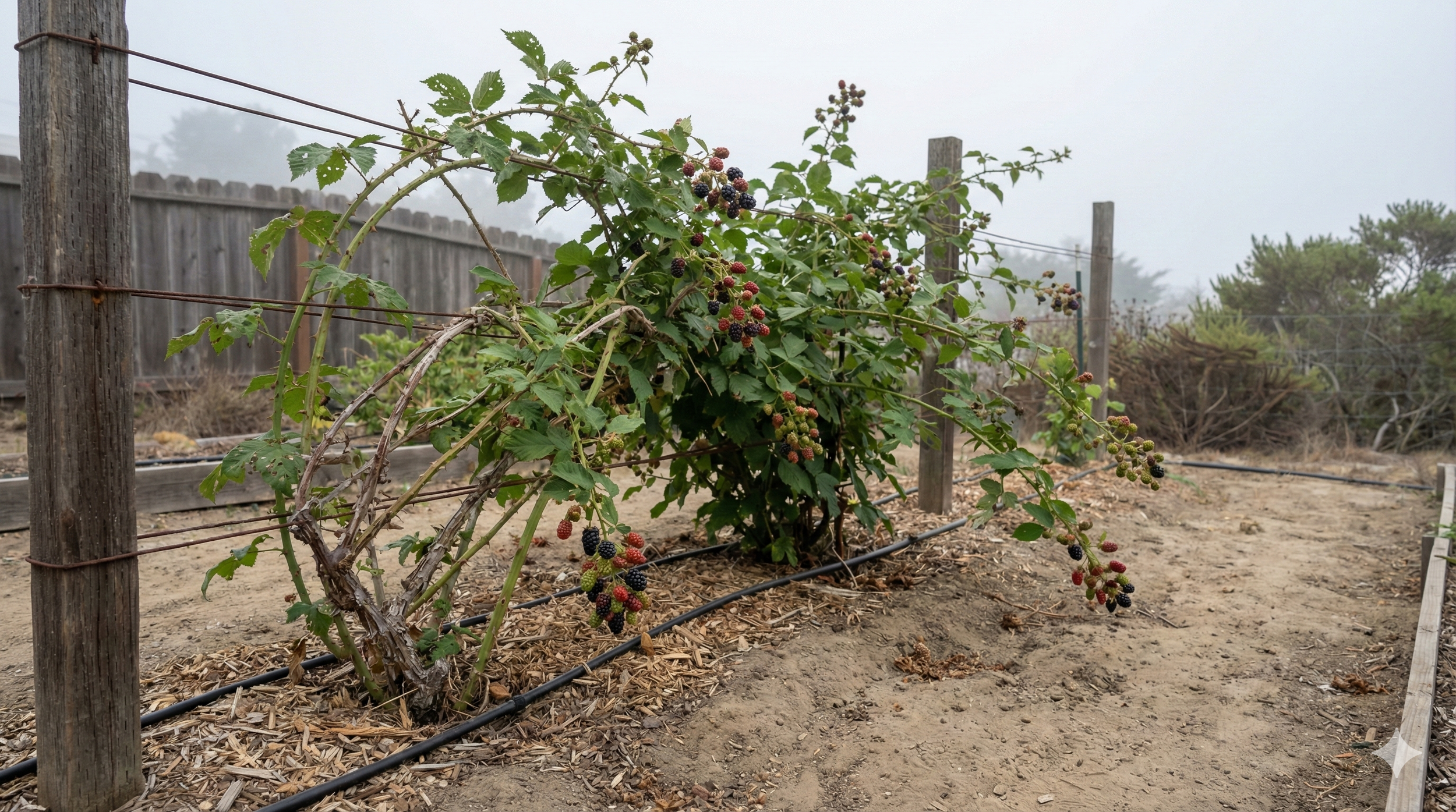
What Does a Healthy Blackberry Look Like?
Before diagnosing problems, know what healthy looks like.
UC ANR describes healthy blackberry plantings as long-lived plants: the crown and roots persist for many years while each cane grows one season, fruits the next, and dies. A planting that is doing well pushes strong new primocanes every spring and carries full clusters of well-formed berries.
Oregon State notes that when planted in well-drained soil and pruned correctly, blackberries produce consistently for many years. Chronic yellowing, sparse fruiting, or cane dieback are signs something is off.
Signs of a healthy plant:
Dark green leaves without spots, yellowing, or mottling
Vigorous new primocanes each spring and summer
Floricanes that produced well before dying back
Full clusters of plump, well-formed berries
No unusual lesions, cankers, or dieback on canes
Red flags that indicate problems:
Persistent yellow or pale leaves
Stunted growth or weak, spindly canes
Canes dying back before or during fruiting
Sparse fruit clusters or crumbly, malformed berries
Visible spots, lesions, or fuzzy growth on canes or fruit
What Causes Yellow Leaves and Weak Growth?
Yellow, pale, or stunted plants are among the most common complaints. The causes range from simple soil issues to serious root diseases.
Nutrient Deficiencies and pH Problems
Yellowing foliage and stunted growth often result from nutrient deficiencies or improper soil pH, not diseases.
Oregon State recommends a soil pH of 5.6 to 6.5 for blackberries, and notes that soil above that range can be acidified with elemental sulfur. Blackberries prefer slightly acidic soil, in the range of pH 5.6 to 6.5.
Symptoms:
Overall pale or yellow-green color
Yellowing between leaf veins (interveinal chlorosis) suggests iron deficiency, often caused by high pH
Weak, slow growth despite adequate water
Older leaves affected first (nitrogen deficiency) or newer leaves affected first (iron, manganese)
Diagnosis and fixes:
Test your soil pH and nutrients. This is the essential first step. Many garden centers and extension offices offer affordable soil testing.
Adjust pH if needed. If pH is above 7.0, apply elemental sulfur according to soil test recommendations. This takes time to work, so be patient.
Address nutrient deficiencies. Based on soil test results, apply appropriate fertilizers. Balanced fertilizer in early spring addresses most macronutrient needs; iron sulfate or chelated iron can help with iron chlorosis in high-pH soils.
Improve organic matter. Regular compost applications improve nutrient availability and soil structure over time.
Root Rot (Phytophthora)
If soil and nutrients check out but plants remain yellow and weak, suspect root problems.
UC IPM reports that Phytophthora root rot in caneberries causes yellowing, wilting, and dieback, especially in poorly drained soils. The roots rot, preventing water and nutrient uptake even when both are present in the soil.
Symptoms:
Yellowing and wilting, especially in warm weather
Plants that don't respond to watering or fertilizing
Canes that collapse or die back
Dark, mushy roots when dug up (healthy roots are white or tan and firm)
Often worst in low spots or heavy clay
Diagnosis and fixes:
Check drainage. Does water pool around plants after rain? Does soil stay soggy for days? Poor drainage is the primary enabler of root rot.
Improve drainage. Options include raised beds, French drains, or relocating the planting to better-drained ground.
Switch to drip irrigation. Avoid keeping the root zone constantly saturated. Water deeply but allow soil to dry somewhat between irrigations.
Remove severely affected plants. Phytophthora persists in soil. Heavily infected plants won't recover and can spread the pathogen.
Replant in better conditions. Choose a new site with excellent drainage, or build raised beds with fresh soil.
Variety Mismatch
Sometimes yellow, weak plants simply aren't suited to their location.
Production guides note that variety choice and site can interact to cause stressed, underperforming plants. A variety that thrives in Oregon may struggle in a hot inland California valley, and vice versa.
When to suspect variety mismatch:
Plants remain weak and unproductive by year 3 despite correct care
Soil tests are normal, drainage is good, but plants don't thrive
Neighboring gardens with different varieties do better
Solution: Consult local extension recommendations or experienced local nurseries. In Santa Cruz County, trailing varieties often excel in foggy coastal areas, while heat-tolerant erect varieties may do better inland. Sometimes the best fix is replacing an unsuitable variety.
What Causes Cane Dieback, Lesions, and Blights?
The blackberry problems that come up most often here are spotted wing drosophila, cane diseases such as cane blight and anthracnose, cane and leaf rust on trailing types, bird damage, and poor fruit set after a cold or wet bloom. Spotted wing drosophila is the one that surprises people most, because it lays eggs in ripe, undamaged fruit rather than waiting for damaged berries. Most blackberry problems are preventable with proper variety selection, pruning, and sanitation.
Cane Diseases: Spur Blight, Cane Blight, and Anthracnose
UMass and other pathology resources describe spur blight, cane blight, and anthracnose as major cane diseases of brambles, causing dark lesions on canes, premature leaf drop, and dieback of laterals.
UMN's cane disease guide notes that infected canes often show brown or purple lesions at nodes; affected buds may produce weak, short laterals or none at all.
Spur blight symptoms:
Brown or purple lesions around nodes (where leaves attach)
Lesions often appear first on lower canes
Affected buds fail to grow or produce weak shoots
Can spread up the cane over time
Cane blight symptoms:
Lesions that girdle the cane, causing everything above to wilt and die
Often enters through wounds (pruning cuts, mechanical damage, insect injury)
Affected canes may snap at the lesion site
Anthracnose symptoms:
Small, sunken gray spots with purple borders on canes
Spots can merge into larger lesions
Severe infections cause cane cracking and dieback
Also affects leaves and fruit
Management for all cane diseases:
Prune out and destroy diseased canes. Cut at ground level and remove from the garden. Do not compost diseased material.
Thin canes to improve airflow. Dense, crowded plantings stay wet longer, promoting fungal growth. UC ANR suggests keeping three or four of the strongest canes per plant on erect types, and six to twelve on trailing types.
Avoid overhead irrigation. Wet foliage spreads spores. Use drip irrigation instead.
Sanitize pruning tools. Clean with rubbing alcohol or 10% bleach solution between cuts, especially when removing diseased canes.
Prune in dry weather. Pruning wounds heal faster and are less likely to become infected when conditions are dry.
Winter Injury and Mechanical Damage
Not all cane problems are diseases.
Oregon State notes that canes can be damaged by cold or drying winds, leading to dieback on overwintering canes that may be mistaken for disease. Similar injury results from string trimmers, mowers, or other mechanical damage at the base.
Symptoms:
Dieback starting from cane tips or from damaged areas at the base
No obvious lesions or spots, just brown, dead tissue
Often affects only canes on the exposed side of the planting
Base damage shows as scraped or cut areas near soil level
Prevention and fixes:
Protect from mechanical injury. Keep mowers and string trimmers away from cane bases. Use mulch rings rather than trimming close.
Provide winter protection where needed. In cold-winter areas, laying canes down and covering with mulch can prevent winter kill. (Less relevant in coastal Santa Cruz but important for mountain gardens.)
Site plants in protected locations. Avoid exposed, windy spots that cause desiccation damage.
Why Is Your Blackberry Producing Poor Fruit or No Fruit?
Few things are more frustrating than healthy-looking canes that produce little or no fruit. Several factors can cause this.
Incorrect Pruning or Cane Management
This is the most common cause of poor fruiting in home gardens.
UC ANR emphasizes that blackberries require removal of two-year-old floricanes after fruiting and proper training of new canes. Failing to remove old canes or cutting all canes at the wrong time can drastically reduce yields.
In trailing and semi-erect types, new primocanes must be trained to the trellis; if they are cut or damaged, next year's fruiting potential is reduced.
Common pruning mistakes:
Cutting primocanes instead of floricanes: Primocanes (first-year canes) are next year's fruit producers. Removing them eliminates your crop.
Not removing spent floricanes: Old canes that have fruited take up space, harbor disease, and don't fruit again. Remove them at ground level after harvest.
Pruning at the wrong time: Winter pruning should thin and shape, not remove all growth. Post-harvest pruning removes only the canes that just fruited.
Damaging canes during training: Broken or kinked canes may fail to fruit properly.
Fixes:
Review the two-year cane cycle. Make sure you understand which canes to keep and which to remove. See our guide to pruning and trellising blackberries for step-by-step instructions.
Label cane types if needed. Use different colored ties or markers to distinguish primocanes from floricanes until you can identify them easily.
Be patient after pruning errors. If you accidentally removed next year's fruiting canes, you'll need to wait for new primocanes to grow and mature.
Pollination and Weather Problems
Poor fruit set or crumbly, malformed berries sometimes result from poor pollination.
Production guides list cold, wet, or very hot, dry conditions at bloom as causes of poor seed set and incomplete drupelet development. When individual drupelets (the small round segments) aren't pollinated, they don't develop, leaving gaps in the berry.
Symptoms:
Berries with missing or underdeveloped drupelets (lumpy, uneven fruit)
Overall small crop despite healthy canes
Problems that vary year to year (weather-related)
Fixes:
Encourage pollinators. Plant diverse flowering plants nearby to support bee populations. Avoid broad-spectrum insecticides, especially during bloom.
Accept weather variability. Some years will simply produce less due to poor bloom-time conditions. This is normal.
Provide wind protection. In very windy sites, pollinators may be less active. Windbreaks can help.
Water and Nutrient Stress
Fruit quality and size depend on adequate resources during berry development.
Inadequate water leads to small, seedy berries, especially during hot spells. Excessive nitrogen can stimulate lush cane growth at the expense of fruit.
Symptoms of water stress:
Small, hard, seedy berries
Berries that dry or shrivel on the plant
Problems worse during hot, dry periods
Symptoms of excess nitrogen:
Lots of vigorous leafy growth, few flowers or fruit
Soft, disease-prone canes
Lush appearance but poor production
Fixes:
Water consistently during flowering and fruiting. This is the critical period; don't let plants stress.
Use moderate nitrogen. Apply balanced fertilizer in early spring; avoid heavy late-season nitrogen applications that fuel vegetative growth.
Mulch to retain moisture. A 2-4 inch layer of organic mulch helps maintain even soil moisture.
What Are Leaf Spots, Rusts, and Foliar Diseases?
Spotted, discolored, or prematurely dropping leaves indicate fungal problems.
Rust Diseases
Cane and leaf rust causes small yellow pustules on the undersides of blackberry leaves and lemon yellow pustules that split the bark of fruiting canes, with premature defoliation and yield loss.
Symptoms:
Small yellow pustules on leaf undersides, and yellow pustules splitting the bark of fruiting canes
Corresponding yellow spots on leaf tops
Premature leaf drop
Weakened plants with reduced yields
Orange rust is a separate and far more serious rust disease of blackberries, and UC IPM lists it among California caneberry diseases. Infected plants produce weak, spindly shoots with pale, stunted leaves covered in bright orange spores in spring. Orange rust is systemic and incurable; infected plants must be removed.
Management:
Remove infected leaves and canes. For minor rust infections, removing affected material can slow spread.
Maintain open canopies. Good airflow helps leaves dry quickly, reducing infection.
Avoid overhead irrigation. Wet leaves promote rust development.
Remove plants with orange rust completely. This systemic disease cannot be cured; dig out entire plants including roots to prevent spread to healthy plants.
Consider resistant varieties. Where rust is persistent, some cultivars show better resistance.
Other Leaf Spots
Anthracnose and other leaf spot fungi cause small dark or gray spots on leaves and canes. If severe, they weaken plants and lower yield.
Symptoms:
Small spots that may have dark borders
Spots may merge into larger dead areas
Premature leaf drop in severe cases
Management:
Prune out heavily infected canes.
Rake and remove leaf litter. Fallen leaves harbor fungal spores that reinfect plants.
Improve airflow. Avoid crowding and excessive shade.
Water at soil level. Avoid wetting foliage.
What Causes Fruit Rots and "Fuzzy Berries"?
Berries that turn soft, mushy, or develop fuzzy gray mold are suffering from fruit rot, usually Botrytis (gray mold).
Gray Mold (Botrytis cinerea)
UC IPM notes that Botrytis fruit rot on caneberries causes soft, water-soaked berries that soon become covered with gray mold, especially under cool, wet, or very humid conditions.
Symptoms:
Berries become soft and water-soaked
Gray, fuzzy mold develops on affected fruit
Can spread quickly through clusters
Worst in cool, humid weather or dense, shaded plantings
Management:
Harvest frequently. Don't leave ripe fruit on plants; Botrytis targets mature berries.
Remove damaged or rotting fruit. Take infected berries off plants and pick up fallen fruit. Don't leave rotting berries in the row.
Improve airflow. Open up canes with pruning to improve air circulation and sun penetration.
Avoid overhead watering. Wet fruit and foliage promote Botrytis.
Pick in dry conditions. If possible, harvest when plants are dry rather than wet from rain or dew.
What Causes "Wormy" Berries?
Finding small white maggots in your berries is one of the most distressing blackberry problems. The culprit is almost always spotted wing drosophila (SWD), an invasive fruit fly.
Understanding the Pest
UC IPM reports that spotted wing drosophila is a major pest of berries in California: females lay eggs in ripening fruit, and larvae feed inside, leading to soft, collapsing berries with small white maggots.
Unlike common fruit flies that only attack overripe or damaged fruit, SWD females can puncture the skin of ripe, undamaged fruit to lay eggs. This makes them much harder to avoid.
Symptoms:
Soft, mushy spots on otherwise ripe berries
Small white larvae visible inside damaged fruit
Berries that collapse or leak juice
Tiny flies hovering around ripening fruit (though you may not see them)
Life cycle: UC IPM describes a short life cycle of one to several weeks depending on temperature, with as many as ten generations a year, so populations build quickly through berry season.
Home Garden Management
IPM guidelines for home gardens focus on sanitation, exclusion, and monitoring.
1. Harvest frequently and completely. The most important step. Pick fruit as soon as it ripens; don't leave ripe berries on the plant. SWD prefers fully ripe fruit, so harvesting promptly reduces available egg-laying sites.
2. Remove infested and fallen fruit. Dispose of damaged berries and any fruit on the ground. Don't compost infested fruit; seal in bags and dispose in trash, or solarize in sealed clear bags in the sun.
3. Refrigerate harvested berries immediately. Cold temperatures kill eggs and larvae. Refrigerating berries within hours of picking prevents any eggs present from developing.
4. Use exclusion netting. Fine mesh netting (smaller than 1mm openings) can exclude SWD from ripening fruit. This is labor-intensive but effective for high-value plantings.
5. Monitor with traps. Apple cider vinegar traps help monitor SWD presence and population levels. Mix apple cider vinegar with a drop of dish soap in a container with small entry holes. Check weekly during berry season.
6. Clean up after harvest. Remove all remaining fruit and fallen berries at the end of the season. This reduces the population heading into the next year.
What About Sprays?
For home gardens, sanitation and exclusion are the primary tools. Organic sprays such as spinosad appear in UC IPM's guidance but need frequent reapplication, and spinosad is toxic to bees until it dries, so it must never go on during bloom or while pollinators are active. Most home gardeners find that diligent harvesting and cleanup provide adequate management without spraying.
How Do You Identify Blackberry Viruses?
Some blackberry problems can't be fixed, only managed by removal.
Recognizing Viral Infections
MSU's production guide warns that viruses are easily spread by vegetative propagation and insects, leading to stunting, yellow patterns on leaves, and poor fruit.
UMass emphasizes that there is no cure for virus-infected plants; infected blackberries should be removed and replaced with certified disease-free stock.
Symptoms suggesting viral infection:
Mosaic patterns (irregular yellow and green mottling) on leaves
Leaf curling or distortion
Stunted growth that doesn't respond to fertilizer or water
Crumbly fruit (drupelets that separate or fall off)
Chronic poor performance despite good growing conditions
Symptoms that spread through a planting over time
Common blackberry viruses:
Blackberry calico virus (mosaic patterns)
Blackberry yellow vein virus (yellowing along veins)
Raspberry bushy dwarf virus (can affect blackberries; causes crumbly fruit)
What to Do About Viruses
1. Confirm the problem. Rule out nutrient deficiencies, pH issues, and environmental stress first. Viral symptoms are often similar to other problems.
2. Remove infected plants. There is no cure. Dig out affected plants including as much root material as possible. Destroy (don't compost) the removed material.
3. Control aphids. Aphids spread many berry viruses. Manage aphid populations with water sprays, insecticidal soap, or by encouraging natural predators.
4. Don't propagate from infected or questionable stock. Viruses spread through cuttings, suckers, and tip layers. Only propagate from healthy, preferably certified virus-free plants.
5. Replant with certified disease-free stock. When replacing removed plants, start fresh with plants from reputable nurseries that sell virus-indexed (tested) stock.
When Should You Start Over with New Plants?
Sometimes the best solution is removing an old, struggling planting and starting fresh.
Oregon State gives three signs that it is time to prepare a new planting: the planting becomes less vigorous, fruit runs smaller than is typical for the cultivar, or pest problems stop responding to management.
Signs It's Time for a Fresh Start
Large portions of the row show poor vigor despite following best practices
Heavy disease pressure that doesn't respond to sanitation and pruning
Chronic low yields for multiple years
Viral symptoms spreading through the planting
The patch is in a poorly drained, shaded, or otherwise unsuitable location that can't be easily corrected
Plants are well past their productive years and declining despite good care
How to Start Over
1. Remove old plants completely. Dig out crowns and as much root material as practical. This is hard work but important for preventing carryover of diseases and pests.
2. Replanting in the same spot is usually fine. Oregon State notes there are very few soilborne pest problems in blackberry, so rotating the planting is usually unnecessary. Move the row only if you had root rot or another soilborne problem you could not correct.
3. Improve the site. Address drainage problems, adjust pH, and build up soil organic matter before replanting.
4. Choose disease-resistant, climate-appropriate varieties. Learn from what didn't work. Select varieties proven to perform in your specific conditions.
5. Start with certified disease-free plants. Don't transplant divisions from old, questionable plantings. Invest in healthy nursery stock.
Quick Reference: Symptom to Cause
Use this table to quickly identify likely causes of common symptoms:
SymptomLikely CausesFirst StepsYellow, weak plantsNutrient deficiency, high pH, root rot, poor drainageTest soil; check drainage; examine rootsCane lesions and diebackCane blight, spur blight, anthracnose, winter injuryPrune out affected canes; improve airflowLots of leaves, few berriesPruning error, excess nitrogen, weather at bloomReview pruning practice; reduce nitrogenSmall, seedy berriesWater stress, poor pollinationWater consistently; encourage pollinatorsGray fuzzy berriesBotrytis (gray mold)Harvest frequently; improve airflow; remove infected fruit"Wormy" berriesSpotted wing drosophilaHarvest daily; remove fallen fruit; refrigerate immediatelyOrange pustules on leavesRust diseases (orange rust is worst)Remove infected material; improve airflowMosaic patterns, crumbly fruitViral infectionRemove infected plants; replant with certified stock
Frequently Asked Questions
Why are my blackberry leaves turning yellow?
Start with soil testing. Yellow leaves most commonly indicate nutrient deficiency or pH problems. If soil tests normal and drainage is good, suspect root rot, especially if plants wilt in warm weather despite adequate water.
What's eating holes in my blackberry leaves?
Many insects chew on blackberry leaves, including Japanese beetles, raspberry sawfly larvae, and various caterpillars. Minor damage is cosmetic and doesn't affect fruit production. For severe infestations, identify the specific pest and treat accordingly; hand-picking works for many leaf-chewing insects.
Why are my berries small and seedy?
Usually water stress during fruit development. Blackberries need consistent moisture while berries are forming and ripening. Increase watering frequency during this period, and mulch to retain soil moisture.
How do I know if my blackberry has a virus?
Suspect virus when plants show mosaic patterns (irregular yellow/green mottling), leaf distortion, stunted growth, and crumbly fruit that doesn't respond to improved care. Symptoms typically worsen over time and may spread to neighboring plants.
Should I spray my blackberries for pests and diseases?
For most home gardens, cultural practices (proper pruning, good airflow, sanitation, prompt harvest) provide adequate pest and disease management without spraying. Sprays are a last resort for severe problems that don't respond to cultural controls.
My blackberries produced great for years but now they're declining. What happened?
Oregon State puts blackberry planting life at 15 to more than 40 years, depending on type, soil, and pest pressure. Accumulated disease, soil depletion, and aging root systems all shorten that. Consider renovating or replanting with fresh, disease-free stock.
Can I save a plant with orange rust?
No. Orange rust is a systemic disease that infects the entire plant. Infected plants must be removed completely (including roots) to prevent spread. Replant with resistant varieties if available.
How do I prevent spotted wing drosophila?
Harvest frequently (every 1-2 days at peak), remove all fallen fruit, refrigerate berries immediately after picking, and clean up thoroughly at season's end. These sanitation practices are the most effective home garden controls.
How Do You Prevent Blackberry Problems?
Most blackberry problems are easier to prevent than to fix. Build these practices into your routine:
Start with healthy plants. Buy certified disease-free stock from reputable nurseries.
Choose appropriate varieties. Match varieties to your climate and microclimate.
Ensure good drainage. Root rot kills more blackberries than any other disease.
Prune correctly. Remove spent floricanes promptly; maintain open canopy for airflow.
Water wisely. Consistent moisture at soil level; avoid wetting foliage.
Harvest promptly. Don't leave ripe fruit for pests and diseases.
Practice good sanitation. Remove fallen fruit, diseased canes, and leaf litter.
Monitor regularly. Catch problems early when they're easier to manage.
With these fundamentals in place, your blackberries should thrive for many productive years.
Free Gardening Resources
Know Your Microclimate Worksheet: Understand your specific Santa Cruz County growing conditions
Garden Troubleshooting Guide: General problem-solving for vegetable and fruit gardens
Seasonal Planting Calendar: Month-by-month guidance for Santa Cruz County
Related Articles:
Blackberry Problems, Pests, and Diseases
- Dark green leaves without spots or yellowing
- Vigorous new primocanes each year
- Strong, upright canes (trailing types on trellis)
- Full clusters of plump, well-formed berries
- No visible lesions or cankers on canes
- Consistent production year after year
- Clean foliage with no mottling or distortion
- Yellow, pale, or mottled leaves
- Weak, spindly, or stunted canes
- Brown lesions or dieback on canes
- Sparse, small, or crumbly berries
- Gray mold or soft rot on fruit
- Orange or rust-colored pustules on leaves
- Declining production despite good care
