

Growing Strawberries: In the Ground vs. Raised Beds vs. Containers
A few of the product links in this guide are affiliate links. If you buy through one, Ambitious Harvest may earn a small commission at no extra cost to you, which helps keep these guides free. We only point to gear we would use in our own Santa Cruz garden. As an Amazon Associate, we earn from qualifying purchases. Read our full disclosure.
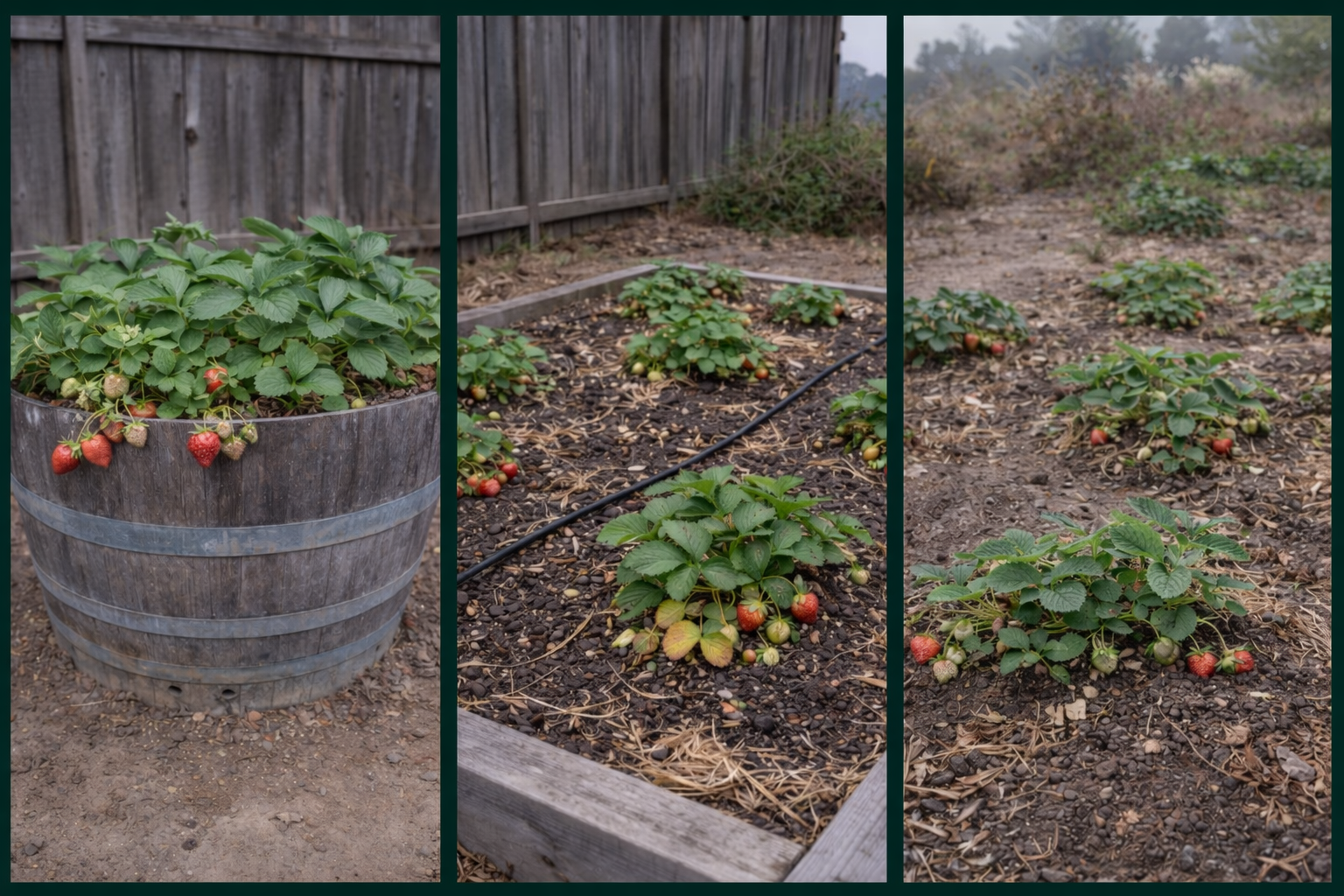
According to UC Agriculture and Natural Resources, strawberries are adaptable plants that can grow almost anywhere you put them: in the ground, in raised beds, or in containers. But each approach has tradeoffs. The best choice depends on your soil, space, goals, and how much effort you want to invest.
This guide breaks down the pros, cons, and best practices for each method to help you decide what's right for your Santa Cruz County garden.
| Factor | In-Ground | Raised Beds | Containers |
|---|---|---|---|
| Startup Cost | Low Best | Medium-High | Low-Medium |
| Drainage | Depends on soil | Excellent Best | Excellent |
| Watering Frequency | Lower Best | Moderate | High (daily) |
| Soil Control | Limited | Full Best | Full |
| Space Required | Large | Moderate | Minimal Best |
| Production Potential | High Best | High | Moderate |
| Maintenance Effort | Moderate | Lower Best | Higher |
| Gopher Protection | Difficult | Easy Best | N/A |
| Back-Friendly | No | Somewhat | Yes Best |
| Portability | None | None | Full Best |
| Best for Santa Cruz | Good soil only | Most gardeners Top Pick | Renters, patios |
What Are the Pros and Cons of Growing Strawberries In-Ground?
Planting directly in existing garden soil is the oldest and simplest method. It works well if you have good soil and adequate space.
Best For
Large patches (25+ plants)
Gardeners with naturally good soil (sandy loam, well-draining)
Low-maintenance approaches
Traditional matted-row production systems
Those who don't want to build or buy structures
Advantages
Lower startup cost. No beds or containers to build or buy. Just prepare your existing soil and plant.
More root space. Roots can spread as far as they need, accessing deep moisture and nutrients.
Easier runner management. If you want runners to root naturally and expand your patch, in-ground planting makes this simple.
Less watering. In-ground soil retains moisture longer than raised beds or containers.
Disadvantages
Soil quality matters more. If your soil is heavy clay, poorly draining, or compacted, in-ground planting invites problems.
Drainage issues. In Santa Cruz County's wet winters, poorly draining ground can lead to root rot.
More weed pressure. Weeds find in-ground patches easily and can be harder to control.
Harder on your back. All work happens at ground level.
Pest access. Gophers, voles, and other underground pests have easy access to roots.
Making In-Ground Work in Santa Cruz County
Soil preparation is essential. Add compost generously. In clay soils, add amendments to improve drainage.
Mound rows help drainage. Even without raised beds, creating raised mounds (6 to 8 inches high) improves drainage and soil warming.
Choose the right spot. Avoid low areas where water collects. South-facing slopes drain well.
Consider gopher protection. Line planting areas with hardware cloth if gophers are a problem in your area. See our Gopher Control Guide.
Why Are Raised Beds the Best Option for Most Strawberry Growers?
Raised beds are my top recommendation for most Santa Cruz County strawberry gardeners. They solve most common problems while remaining relatively simple.
Best For
Gardens with heavy clay or poor drainage
Gardeners who want control over soil quality
Easier maintenance (less bending)
Defined, organized patches
Areas with gopher pressure
Advantages
Perfect drainage. Raised beds drain freely, eliminating the root rot that kills strawberries in wet soil. This is the biggest advantage in our rainy-winter climate.
Customized soil. Fill beds with ideal strawberry soil regardless of what's underneath.
Warmer soil. Raised beds warm earlier in spring, extending the growing season slightly.
Easier maintenance. Working at bed height is easier on backs and knees.
Better pest management. Line bed bottoms with hardware cloth to exclude gophers. Defined boundaries make slug management easier.
Organized patches. Clear boundaries prevent strawberry sprawl and make runner management straightforward.
Disadvantages
Upfront cost and effort. You need to build or buy beds and fill them with soil/compost.
More watering needed. Raised beds drain so well that they dry out faster, especially in summer.
Limited space. Unless you build extensive beds, you're limited to smaller plantings.
Soil replacement eventually. Bed soil can become depleted or diseased over time and may need refreshing.
Raised Bed Specifications for Strawberries
Height: 8 to 12 inches minimum. Deeper is fine and provides more root space.
Width: 3 to 4 feet allows easy reach from both sides. Wider beds require reaching over plants to harvest.
Length: Whatever fits your space. 8 feet is a common manageable size.
Materials: Untreated wood, galvanized metal, concrete blocks, or food-safe composite materials all work.
Soil mix: High-quality raised bed mix or a blend of compost, topsoil, and perlite/pumice for drainage.
Plant Spacing in Raised Beds
In a 4×4 foot bed, plant in offset rows:
12-inch spacing between plants
3 rows of 4 plants = 12 plants per 4×4 bed
This provides adequate air circulation while maximizing production in a defined space.
How Do You Grow Strawberries Successfully in Containers?
Container gardening lets you grow strawberries on patios, balconies, or anywhere you can place a pot. It's also the best approach if you rent or want to move your plants.
Best For
Balconies, patios, and decks
Renters who may move
Testing strawberry growing before committing to beds
Controlling soil and conditions precisely
Growing in otherwise unsuitable areas
Advantages
Grows anywhere. No yard required. A sunny balcony or patio works fine.
Complete control. You determine exact soil, drainage, and location.
Portable. Move containers to follow the sun or bring them to shelter during frost or heat.
No gophers. Elevated containers are immune to underground pests.
Easy pest monitoring. Smaller scale makes inspection simple.
Disadvantages
Frequent watering. Containers dry out much faster than ground or raised beds, especially in summer. Daily watering may be needed.
Limited production. Each container holds a few plants; total harvest is smaller than beds or ground plantings.
Root space limits. Containers restrict root growth, which can limit plant vigor.
More feeding needed. Nutrients leach out of containers with frequent watering.
Winter vulnerability. Container soil freezes more readily than ground, though this is rarely a problem in Santa Cruz County.
Best Containers for Strawberries
| Container Type | Size Needed | Pros/Cons | Best For |
|---|---|---|---|
| Standard Pots Terracotta, plastic, or ceramic |
12"+ diameter 8-10" deep 1 plant per pot |
|
Beginners testing strawberries. Single plants on a patio or deck. Easy to bring inside for frost protection. |
| Hanging Baskets Wire or plastic with liner |
12"+ diameter 6-8" deep 1-3 plants per basket |
|
Balconies and small patios. Keeping berries away from slugs. Decorative growing. |
| Strawberry Jars Tiered pots with side pockets |
Various sizes Multiple pockets 4-10 plants per jar |
|
Decorative gardens. Experienced container gardeners willing to fuss with watering. |
| Fabric Grow Bags Breathable fabric containers |
5-10 gallon 3-5 plants per bag (depending on size) |
|
Budget-conscious gardeners. Temporary or seasonal setups. Those prioritizing plant health over aesthetics. |
| Window Boxes Long rectangular planters |
24"+ long 8"+ deep and wide 3-4 plants per box |
|
Balcony railings. Apartment gardeners. Easy daily harvesting. |
| Large Planters Half barrels, troughs, large pots |
18-24"+ diameter 12"+ deep 4-6 plants per container |
|
Permanent patio plantings. Those wanting closest experience to in-ground growing. Serious container production. |
Minimum size: 12-inch diameter or larger per plant. Roots need depth.
Drainage: Must have drainage holes. No "self-watering" containers that keep roots sitting in water.
Material options:
Terracotta: Classic look, breathes well, dries out fast
Plastic: Lightweight, retains moisture longer, less expensive
Fabric pots: Excellent drainage and aeration, dry out quickly
Strawberry jars (tiered pots): Fun but dry out very fast and can be challenging to water evenly
Specialty options:
Hanging baskets: Great for trailing varieties and tight spaces
Vertical planters: Maximize plants in small footprints
Rain gutters mounted on walls: A clever DIY option for vertical growing
Container Soil Mix
Don't use garden soil in containers; it compacts and drains poorly.
Use:
Quality potting mix (not garden soil or topsoil)
Add perlite for extra drainage (20% by volume)
Mix in slow-release fertilizer at planting
Watering Containers
This is the biggest challenge. Containers dry out fast, especially in summer.
Tips:
Check moisture daily (stick finger in soil)
Water when top inch is dry
Water thoroughly until it drains from bottom
Consider drip irrigation or self-watering systems for consistency
Mulch the surface to slow evaporation
Group containers together to create a humid microclimate
What Is the Best Strawberry Growing Method for Santa Cruz County?
For most gardeners: Raised beds.
According to UC Cooperative Extension, our wet winters and heavy clay soils (common in many areas) make drainage the biggest strawberry challenge. Raised beds solve this elegantly. The upfront investment pays off in healthier plants and better harvests.
A single 4×4 raised bed with 10 to 12 plants produces enough strawberries for fresh eating plus some extra for sharing. Two beds give you enough for light preserving.
Exceptions:
If you have naturally excellent soil (sandy loam, good drainage), in-ground planting works well
If you're renting, testing, or have minimal space, containers are practical
If you're growing commercially or want 50+ plants, in-ground may be more feasible
Can You Combine Multiple Growing Methods?
You don't have to choose just one method:
Main patch in raised beds for reliable production
A few containers on the patio for convenient snacking
In-ground runners in a sunny border for casual expansion
Strawberries are forgiving. Experiment with what works for your space and conditions.
Frequently Asked Questions
Which method produces the most strawberries?
In-ground and raised beds have the highest production potential due to more root space. Containers are limited by size but can still produce well with good care.
Do strawberries grow better in raised beds?
In Santa Cruz County, raised beds often produce better results because they solve our drainage problems. If your native soil is already well-draining, in-ground can be equally productive.
How big of a container do strawberries need?
At least 12 inches in diameter and 8 to 10 inches deep per plant. Larger is better. Small containers stress plants and require constant watering.
Can I grow strawberries in a hanging basket?
Yes! Hanging baskets work well, especially for trailing varieties. Choose baskets at least 12 inches in diameter and be prepared to water frequently (possibly daily in summer).
What's the best raised bed height for strawberries?
At least 8 inches, ideally 12 inches or more. Deeper beds provide more root space and better drainage.
Do I need to replace container soil every year?
Not entirely, but refresh it annually. Top off with fresh compost and replace exhausted plants. Every 2 to 3 years, consider replacing a larger portion of the soil.
How do I protect in-ground strawberries from gophers?
Line the planting area with hardware cloth (¼ inch mesh) before planting. Create a "basket" under and around the root zone. See our Gopher Control Guide.
Can I move a raised bed of strawberries?
Standard raised beds are not portable. If you need mobility, consider large containers or build beds on casters. Typically, you'd move the plants, not the beds.
Choose What Works for You
There's no single "right" way to grow strawberries. Gardeners have succeeded with all three methods for generations. The best choice depends on your specific situation: your soil, your space, your physical abilities, and how much time you want to spend on maintenance. That said, for most Santa Cruz County gardeners dealing with our clay soils and wet winters, raised beds offer the best balance of production, reliability, and manageable effort. They're worth the upfront investment. If you're just getting started, a single 4×4 raised bed is an excellent place to begin. You can always expand later or experiment with containers on the side. For help selecting the right varieties for your setup, see our Best Strawberry Varieties for Santa Cruz County, and our Drip Irrigation Setup 101 guide can help you simplify watering regardless of which method you choose.
Free Gardening Resources
Find all our free guides in Your Garden Toolkit.
More Strawberry Growing Guides
Part of our Complete Strawberry Series for Santa Cruz County:
Growing Strawberries in Santa Cruz County: A Local Guide to Sweet Success - Everything you need to know about growing strawberries in our coastal climate
Best Strawberry Varieties for Santa Cruz County - Which varieties thrive here and where to find them locally
Planting Bare-Root Strawberries: A Santa Cruz Guide - Step-by-step instructions for bare-root planting success
Understanding Strawberry Growth Stages in Your Santa Cruz Garden - What to expect from dormancy through harvest
How to Multiply Strawberries from Runners (Free Plants Forever) - Propagate new plants from runners for an ever-expanding patch
Top Strawberry Mistakes New Gardeners Make (And How to Avoid Them) - Common pitfalls and how to sidestep them
Strawberry Troubleshooting Guide - Identify and solve pests, diseases, and growing problems
Reviving Your Strawberry Patch After Harsh Weather - Recovery strategies for storm or heat-damaged plants
