

Grafting Fruit Trees in Santa Cruz County: Add Varieties, Save Trees, and Grow Your Own
A few of the product links in this guide are affiliate links. If you buy through one, Ambitious Harvest may earn a small commission at no extra cost to you, which helps keep these guides free. We only point to gear we would use in our own Santa Cruz garden. As an Amazon Associate, we earn from qualifying purchases. Read our full disclosure.
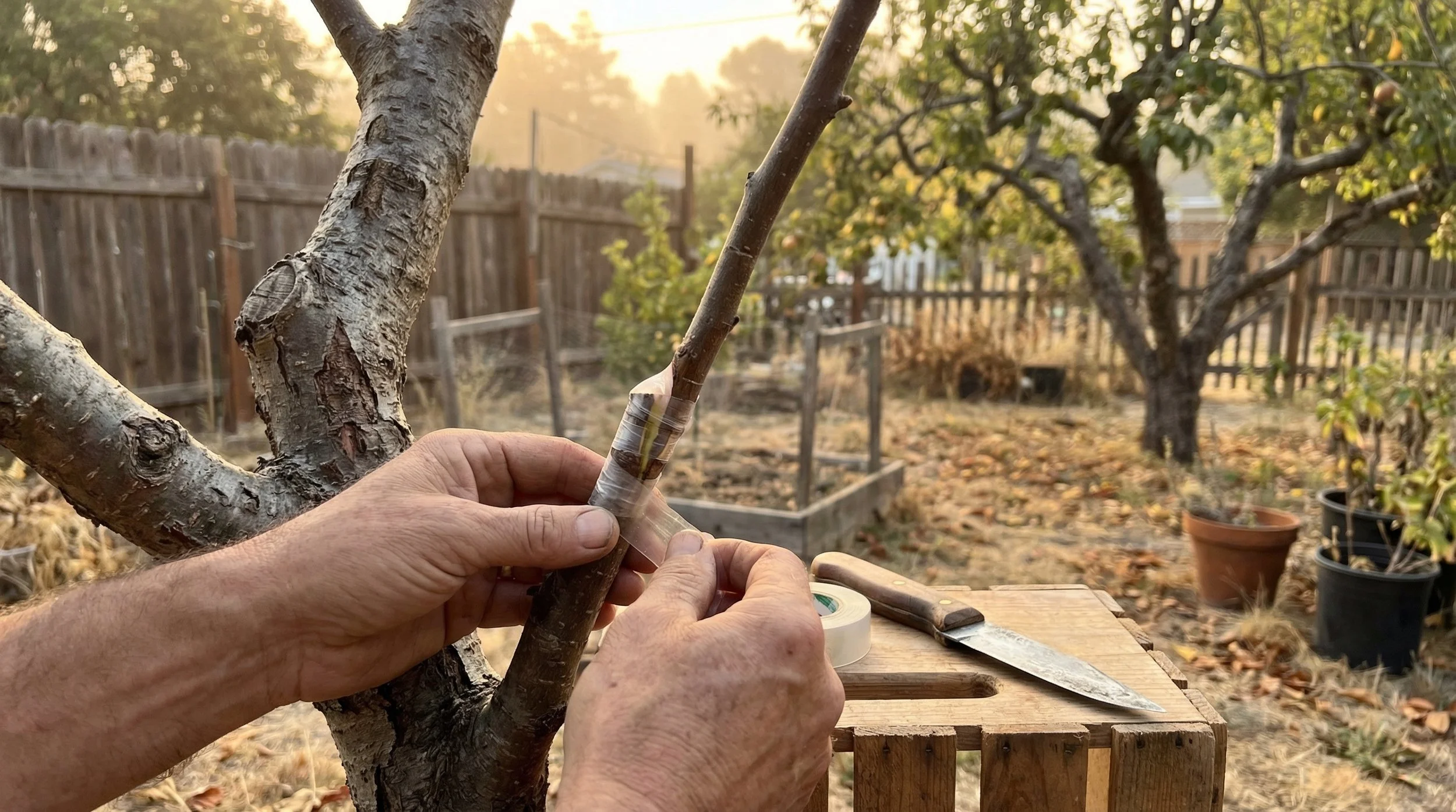
Grafting is one of the most useful skills a home orchardist can learn. With a sharp knife and a little practice, you can add new varieties to existing trees, propagate heritage varieties that aren't available in nurseries, extend your harvest season by months, and even save a tree that's producing disappointing fruit by changing it to a better variety.
The technique isn't difficult. At its core, grafting simply joins two pieces of wood so they grow together as one. If you can whittle a stick to a point and wrap it with tape, you can graft. This guide covers everything Santa Cruz County gardeners need to know to get started, from basic concepts and timing to step-by-step methods for the most useful grafting techniques.
What Is Grafting and Why Does It Matter?
Grafting is the process of joining tissue from one plant (the scion) to another plant that provides the root system (the rootstock). The two grow together, and the scion develops into the fruiting portion of the tree while the rootstock provides the roots.
University of New Hampshire Extension explains that grafting has been used for several thousand years because most fruit trees don't come true from seed (seeds from a Fuji apple won't grow into Fuji apple trees), and cuttings don't root easily. Grafting is how virtually every named fruit variety gets propagated.
As UNH notes, all fruit trees sold for home orchards are grafted combinations of a rootstock (which controls size, disease resistance, and soil adaptation) and a scion (which determines variety and fruit). When you graft at home, you're essentially doing what nurseries do on a smaller scale.
Why Grafting Matters for Home Orchardists
The same UNH fact sheet notes that grafting lets home gardeners "create trees with several varieties or introduce new varieties into your home orchard" and "change varieties of trees in your existing orchard."
Add multiple varieties to one tree. Instead of a single variety producing more fruit than you can use in a two-week window, graft three or four varieties with staggered ripening onto one tree. Over several years, some home grafters have added nine to twelve varieties to a single tree.
Extend your harvest season. An apple tree grafted with early, mid-season, and late varieties can produce fruit from July through November rather than just a few weeks in September.
Save space. Four varieties on one tree take up less room than four separate trees, and you avoid the problem of having too much of one fruit at once.
Add pollinizers. Some fruit trees need cross-pollination from a different variety. Rather than planting a separate pollinizer tree, graft a few branches of a compatible variety onto your main tree.
Change an unproductive variety. If you have a healthy tree producing fruit you don't like, you can "top-work" it by grafting better varieties onto the existing scaffold branches rather than removing the tree and starting over.
Propagate heritage and rare varieties. Many excellent fruit varieties aren't available commercially. Grafting lets you obtain scionwood from friends, neighbors, or scion exchanges and grow your own.
Adapt trees to local conditions. By grafting onto locally adapted rootstock, you can grow varieties that might otherwise struggle in your soil or microclimate.
What Are the Basics of Grafting?
Rootstock and Scion
Rootstock is the lower portion of a grafted tree, providing the root system. Rootstock determines:
Tree size (dwarf, semi-dwarf, or standard)
Soil adaptation (tolerance to wet soil, clay, drought)
Disease resistance
Precocity (how quickly the tree begins bearing)
Anchoring and stability
Scion (also called scionwood) is the upper portion that becomes the fruiting part of the tree. The scion determines:
Fruit variety
Fruit characteristics (flavor, size, color, timing)
Growth habit of the canopy
When you buy a fruit tree from a nursery, it's almost always a grafted tree: a named variety (the scion) joined to a rootstock chosen for size control and local adaptation.
The Cambium Layer: Where the Magic Happens
For a graft to succeed, the cambium layers of the scion and rootstock must align and grow together. The cambium is the thin green layer just beneath the bark where active cell division occurs. Orchard People explains that when a tree is wounded (cut for grafting), it sends signals to repair the damage. Plant hormones direct the tree to seal the wound, and if the cambium layers of two pieces are in contact, callus tissue forms and they fuse together.
This is why sharp, clean cuts matter: ragged cuts don't align well, and dirty cuts can introduce disease. It's also why matching the diameter of scion and rootstock (or at least aligning one edge if diameters differ) is critical for cambium contact.
Compatibility: What Can Be Grafted Together?
The basic rule is simple: you can graft within a species, and usually within a genus, but not between unrelated plants. UNH states that "you are almost always limited to grafting within a species" and that "most apple varieties are compatible with each other as are most pears," explicitly adding: "You cannot graft an apple scion on a pear rootstock or vice versa."
There are some exceptions, especially with quince-pear combinations and some cherries, so it's worth checking specific compatibility before attempting unusual combinations.
Graft Compatibility Basics
| Rootstock Genus / Type | Generally Compatible Scions | Important Notes | Supporting Resources |
|---|---|---|---|
| Apple (Malus) | Any apple variety | Most named apples are mutually compatible. Apples cannot be grafted onto pear or other genera. | UNH Extension - Grafting Fruit Trees in the Home Orchard |
| Pear (Pyrus) | European and Asian pears | Apple–pear grafts fail. Some pears can be grafted onto quince, but others require an interstem. | UNH Extension grafting fact sheet; Orchard People on pear–quince compatibility |
| Quince (Cydonia) | Some pears, quince, loquat | Compatibility is variety-specific. Interstems are needed for incompatible pears such as Bartlett and Bosc. | Orchard People - Pear on Quince Compatibility |
| Stone fruits (Prunus) | Peach, nectarine, plum, apricot; some cherry combinations | Many Prunus species are intergraftable. Cherries are more particular; always check recommended rootstocks for each species. | NPR - Tree of 40 Fruit |
| Citrus (Citrus) | Most citrus varieties | Many citrus cultivars are mutually compatible. Be aware of patent restrictions on newer varieties. | Citrus grafting practice consistent with UNH’s “grafting within genus” guidance |
Creating "fruit salad" trees: Because stone fruits are generally compatible with each other, you can graft peaches, nectarines, plums, and apricots all onto the same tree. The famous "Tree of 40 Fruit" by artist Sam Van Aken demonstrates this dramatically, using conventional grafting techniques to combine 40 different kinds of stone fruit onto a single tree.
When Should You Graft in Santa Cruz County?
Timing depends on the grafting method. Our mild climate gives us some flexibility, but matching the technique to the season is essential for success.
Grafting Calendar for Santa Cruz County
| Technique | Best Timing (Local) | Tree State | Notes | Supporting Resources |
|---|---|---|---|---|
| Whip and tongue | Late January through early April | Scion dormant; rootstock dormant or just breaking | Classic dormant graft on pencil-thick wood; excellent for bench grafting and small branches with closely matched diameters. | UNH Extension - Grafting Fruit Trees in the Home Orchard |
| Cleft graft | February through April | Rootstock just beginning to grow | Ideal for top-working 1–4 inch branches; one or two scions are inserted into a split stock. | Mississippi State Extension - Basic Grafting Techniques |
| Bark (inlay) graft | March through April | Bark “slipping” on actively growing stock | Used on larger stumps or limbs when bark lifts cleanly from wood; not suitable once bark tightens. | UNH Extension and general bark-grafting references |
| T-budding | July through August | Active growth; bark slipping | Summer technique; bud heals over the season and pushes growth the following spring. | Cummins Nursery - How to Summer Bud a Tree |
| Chip budding | July through September | Stock may have “tight” bark | Works when bark is not slipping; extends the budding window into late summer and early fall. | University of Wisconsin Fruit Program - Preparing for Late Summer Budding |
"Bark slipping" means the bark separates easily from the underlying wood, indicating active growth. This is essential for T-budding and bark grafting.
Santa Cruz adjustments: Our mild winters mean trees may begin growth earlier than in colder climates. Watch your trees' growth stage rather than following a rigid calendar. Dormant grafts work best late February through March, while our cool coastal summers often extend the budding window since bark may slip longer than in hot inland areas.
Collecting and Storing Scionwood
For dormant grafting (whip and tongue, cleft, bark), collect scionwood while the source tree is fully dormant, typically January through early March in Santa Cruz County.
Good scionwood characteristics:
Pencil-diameter thickness (about 1/4 to 3/8 inch)
One-year-old wood (last season's growth)
Straight and smooth
Healthy vegetative buds (plump, not shriveled)
Water sprouts from the center of the tree are often ideal
How to store:
UNH's fact sheet instructs growers to:
Cut 12 to 18 inch lengths
Wrap in damp (not wet) paper towels or sphagnum moss
Place in a sealed plastic bag
Refrigerate at 32 to 40°F
Use within a few weeks for best results
Properly stored scionwood remains viable for several weeks, allowing you to collect wood in February and graft in April.
For summer budding: Collect budwood the day you plan to graft. Cut current-season shoots with mature buds, remove leaves (leave the leaf stems as handles), and keep in a cooler with damp paper towels until you're ready to use them.
What Grafting Methods Work for Home Orchardists?
Several grafting techniques exist, each suited to different situations. Here are the most useful for home gardeners.
Whip and Tongue Grafting
This is the most common method for bench grafting (grafting bare rootstocks indoors before planting) and for adding varieties to branches of similar diameter.
Best for:
Grafting scionwood to rootstock of matching diameter (both pencil-thick)
Adding varieties to existing trees on small-diameter branches
Creating new trees from purchased rootstock
When: Late winter through early spring while scion is dormant
Success rate: High when done correctly; the interlocking tongues provide good cambium contact and mechanical strength
Step-by-step:
UNH describes whip and tongue grafting as a way to join scion and rootstock "about pencil thickness," with a long sloping cut on each and an interlocking tongue that increases cambium contact and mechanical strength.
Prepare the rootstock. Make a smooth, sloping cut about 1-1/4 to 1-1/2 inches long at the point where you want to graft. The cut should come to a sharp point. Use a single knife stroke for a clean surface.
Cut the tongue. Starting about one-third of the way down from the tip of the sloping cut, make a shallow cut downward into the wood, about 1/2 inch deep. This creates the "tongue."
Prepare the scion. Cut a 4 to 6 inch piece of scionwood with 2 to 4 healthy buds. Make matching cuts on the bottom: a sloping cut the same length as the rootstock cut, and a tongue cut in the same position.
Join the pieces. Slide the tongue of the scion into the tongue of the rootstock. The two pieces should interlock snugly. If diameters don't match perfectly, align the cambium on at least one side.
Wrap the union. Use parafilm grafting tape, rubber budding strips, or stretchy plastic tape to wrap the entire graft union tightly. This holds the pieces together and prevents drying.
Seal exposed surfaces. Apply grafting wax or compound to any exposed cut surfaces, especially the top of the scion.
People's Trust for Endangered Species notes that the interlocking tongues "lock" pieces together and enlarge the cambial contact area, making this one of the most reliable grafting methods.
Cleft Grafting
This technique joins a small scion to a larger-diameter rootstock or branch. It's particularly useful for top-working established trees to change varieties.
Best for:
Top-working existing trees (changing variety)
Grafting onto branches 1 to 4 inches in diameter
Situations where you need to graft a small scion onto a larger stock
When: Late winter to early spring, just as buds begin to swell. Mississippi State's "Basic Grafting Techniques" notes that "late February and March, just before new growth begins, is the time to cleft graft."
Step-by-step:
Cut the rootstock. Using a saw, cut the branch or trunk straight across at the point where you want to graft.
Split the stock. Using a grafting chisel, heavy knife, or cleft grafting tool, split the stock down the center, 2 to 3 inches deep.
Prepare the scions. Cut the bottom of each scion into a wedge shape, about 1-1/2 to 2 inches long. One side of the wedge should be slightly thicker than the other.
Insert the scions. Open the cleft with your grafting tool or a screwdriver. Insert one or two scions at the edges of the cleft (not the center), with the thicker side of the wedge facing outward. Position so the cambium of the scion aligns with the cambium of the stock (just inside the bark).
Seal thoroughly. Remove the tool holding the cleft open; the natural tension holds the scions in place. Cover all exposed surfaces with grafting wax or compound.
You can insert two scions (one on each side of the cleft) for insurance. If both take, remove the weaker one later.
Bark Grafting (Inlay Grafting)
Similar to cleft grafting but used when the rootstock is larger (4+ inches diameter) and the bark is actively slipping.
Best for:
Top-working large branches or trunks
Spring grafting when bark separates easily
When: Spring, when bark is actively slipping
Step-by-step:
Cut the stock straight across with a saw.
Prepare the scion. Make a sloping cut on one side, about 1-1/2 inches long. Some grafters also make a small shoulder cut at the top.
Insert under the bark. Make a vertical slit through the bark on the side of the stock, then lift the bark slightly and slide the scion underneath so the cut surface lies flat against the wood of the stock.
Secure and seal. Nail or staple the scion in place if needed, then seal all exposed surfaces with grafting compound.
Multiple scions can be placed around a large stump, spaced 2 to 3 inches apart. As they grow, select the strongest and remove the others.
T-Budding
Budding techniques graft a single bud rather than a multi-bud scion. T-budding is the classic summer technique.
Best for:
Summer propagation when spring grafts failed or weren't done
Efficient use of limited scionwood (one bud = one potential tree)
Adding varieties to actively growing trees
When: Mid-summer (July through August) when bark is slipping
Step-by-step:
UC ANR and Cummins Nursery describe T-budding as a mid-summer technique when bark is slipping, with a T-shaped cut and shield-bud insertion:
Collect budwood. Cut current-season shoots from the variety you want to propagate. Remove leaves, leaving short leaf stems (petioles) as handles. Keep budwood moist and cool.
Cut the bud. Starting about 1/2 inch below a healthy bud, make a shallow cut under and up past the bud, ending about 1/2 inch above it. You should have a small "shield" of bark with the bud attached.
Prepare the rootstock. On a smooth section of bark, make a T-shaped cut: a horizontal cut about 1/2 inch across, then a vertical cut about 1 inch downward.
Insert the bud. Lift the bark flaps with the tip of your knife or a budding knife's bark lifter. Slide the bud shield down under the bark until it seats firmly.
Wrap. Use budding rubber or grafting tape to wrap the union firmly, leaving the bud itself exposed.
Check and force. After 2 to 4 weeks, check if the bud took (it will be plump and healthy) or failed (shriveled and brown). The following spring, cut off the rootstock just above the successful bud to force it to grow.
Chip Budding
A variation of budding that doesn't require the bark to be slipping, giving you a longer grafting window.
Best for:
Late summer budding when bark has stopped slipping
Situations where T-budding timing was missed
When: July through September; UW Fruit Program notes that chip budding works when bark is not slipping and has a longer window into late summer.
The technique is similar to T-budding, but instead of a T-cut, you cut a chip-shaped piece out of the rootstock and replace it with a matching chip containing the bud. The cuts must match closely for good cambium contact.
How Do You Help Grafts Succeed After the Cut?
First Few Weeks
UNH explains that newly grafted unions must be wrapped to prevent drying and protected from rootstock suckers:
Keep unions wrapped until healed (typically 4 to 8 weeks for dormant grafts)
Monitor for drying. If wrapping loosens or grafting compound cracks, reapply
Watch for growth from the scion. Once buds push 1 to 2 inches, the graft has likely taken
Remove wrapping gradually once healed. Parafilm degrades naturally; other materials need removal to prevent girdling
First Growing Season
Remove rootstock growth. Any shoots emerging below the graft union are from the rootstock and will not produce the desired variety. Remove them promptly.
Support new growth. Young grafted shoots can be tender and easily broken. Stake or tie loosely if needed.
Protect from sunburn. In sunny locations, wrap the graft union with white paper or tree wrap to prevent bark damage.
Water appropriately. Newly grafted trees need consistent moisture but not waterlogged soil.
Long-Term Care
Keep the graft union above soil. If the scion roots, you lose the benefits of the rootstock.
Remove rootstock suckers throughout the tree's life.
Maintain balance on multi-grafted trees. If one variety grows much more vigorously than others, prune it harder to keep all varieties productive.
Where Can You Get Scionwood?
Scion Exchanges
The California Rare Fruit Growers (CRFG) holds scion exchanges every January and February at local chapters throughout California. These events are goldmines for home grafters:
Hundreds of varieties of apple, pear, plum, peach, apricot, cherry, and more
Rootable cuttings of fig, pomegranate, grape, and other species
Grafting demonstrations and expert advice
Rootstocks often available for purchase
Local chapters:
Monterey Bay Chapter holds their exchange in Santa Cruz County, typically at Soquel High School in early February
Golden Gate Chapter serves the greater Bay Area
Central Coast Chapter covers the region south to San Luis Obispo
Membership in CRFG (about $45/year) is worthwhile for serious fruit growers, but most exchanges welcome non-members.
Other Sources
Friends and neighbors. If you admire someone's fruit tree, ask for a few cuttings in winter. Most gardeners are happy to share.
Local orchardists. Some may let you collect scionwood during their winter pruning. Ask at farmers markets.
Mail order nurseries:
Fedco Trees offers scionwood for apples and some other fruits
Various specialty nurseries sell small quantities of scionwood
Note on patented varieties: Many newer fruit varieties are patented. UNH's grafting fact sheet notes that propagating patented varieties requires permission from the patent holder along with a royalty fee for each new tree created. This applies to both deciduous fruit trees and many citrus cultivars. Heirloom and older varieties are generally unrestricted.
Rootstock Sources
Raintree Nursery sells rootstocks in small quantities
CRFG scion exchanges often have rootstocks available
Local nurseries may special-order rootstock
How Do You Create a Multi-Grafted Fruit Salad Tree?
One of the most rewarding grafting projects is adding multiple varieties to a single tree. This works best with:
Apples: Graft early, mid-season, and late varieties for months of harvest
Stone fruits: Combine peaches, nectarines, plums, and apricots on one tree
Pears: Mix European and Asian pear varieties
Citrus: Add different oranges, mandarins, and lemons to one tree
Tips for Success with Multi-Grafted Trees
Orchard People discusses balancing vigor among varieties and keeping labels accurate on multi-grafted trees:
Match vigor. If one variety grows much more vigorously than others, it will eventually dominate. Choose varieties with similar growth habits, or be prepared to prune aggressive varieties harder.
Maintain balance. Each variety needs adequate leaf area to support its fruit. Prune to keep all sections roughly equal.
Label everything. It's easy to forget which branch is which variety after a few years. Permanent metal or plastic tags prevent confusion.
Start with compatible rootstock. For stone fruit combinations, choose a rootstock compatible with all the varieties you plan to graft (Citation is a good multi-purpose choice).
How Do You Top-Work an Existing Tree?
If you have a healthy tree producing disappointing fruit, you can change its variety through top-working rather than removing the tree and starting over.
When to Top-Work
Tree is healthy with a good root system
You dislike the fruit but not the tree's location or size
You want to convert to multiple varieties
An old variety needs updating to something more productive
Top-Working Process
In late winter, cut back scaffold branches to 2 to 4 feet from the trunk, leaving stubs for grafting.
Graft using cleft or bark grafting techniques. Place 2 to 4 grafts on each stub.
As grafts grow, select the strongest on each stub and remove weaker ones.
Train the new growth as you would a young tree.
The existing root system supports rapid growth, so a top-worked tree can return to production within 2 to 3 years.
What Should Santa Cruz County Grafters Keep in Mind?
Timing Adjustments
Our mild winters mean trees may begin growth earlier than in colder climates. Watch your trees rather than the calendar:
Dormant grafting window: Later in our area than cold-winter regions; trees may push growth by early March in warm microclimates
Summer budding: Our cool coastal summers extend the budding window; bark may slip longer than in hot inland areas
Disease Prevention
Fire blight (affects apples and pears) can spread through grafting cuts and tools. When grafting potentially affected trees:
Sterilize tools between cuts with rubbing alcohol or 10% bleach solution
Avoid grafting during wet weather
Don't collect scionwood from trees with fire blight symptoms
Local Varieties to Consider
Some varieties perform especially well in Santa Cruz County's microclimates:
Apples: Gravenstein (our local heritage apple), Fuji, Pink Lady, Golden Russet, Cox's Orange Pippin
Pears: Bartlett, Warren, Comice, Asian varieties like Hosui and Shinko
Stone fruits: Varieties with low chill requirements suited to coastal areas; consult Dave Wilson Nursery's chill requirement lists
What Tools and Supplies Do You Need?
| Tool | Use | Notes |
|---|---|---|
| Grafting knife | Making precise grafting cuts | Specialty grafting knives have a single-bevel blade; keep razor-sharp for clean cambium contact. |
| Budding knife | T-budding and chip budding | Includes a bark-lifting tip; a dedicated budding blade improves success rates. |
| Pruning shears | Collecting scionwood and cutting rootstock | Use high-quality bypass pruners; sanitize between trees and varieties. |
| Grafting tape | Wrapping and securing graft unions | Parafilm is self-sealing, stretches as the graft grows, and degrades naturally over time. |
| Grafting wax or compound | Sealing exposed cuts | Prevents drying and disease entry, especially important in windy or dry spring conditions. |
| Labels | Identifying grafted varieties | Use metal or durable plastic labels for permanence; write with UV-resistant marker or engraving. |
Optional but Helpful
Grafting tool/pruner: Makes matching omega cuts automatically; good for beginners
Cleft grafting tool: For opening clefts in larger branches
Sharpening stone: Maintaining knife edge
Frequently Asked Questions About Grafting
What's the easiest grafting method for beginners?
Whip grafting (without the tongue) is the simplest cut to make. If you're nervous about knife work, grafting pruners that make matching omega cuts are very beginner-friendly and produce good results. T-budding is also relatively simple once you learn it.
Can I graft an apple onto a pear tree?
No. UNH Extension states explicitly that "you cannot graft an apple scion on a pear rootstock or vice versa," even though both are pome fruits. You must graft apple to apple and pear to pear. Some pears can be grafted onto quince rootstock, but this requires checking variety compatibility and may need an interstem.
When is the best time to graft fruit trees in Santa Cruz County?
For most dormant grafting (whip and tongue, cleft), late February through March is ideal. Summer budding (T-bud, chip bud) is done in July through September. Watch your trees' growth stage rather than following a rigid calendar.
How do I know if my graft was successful?
Within 4 to 8 weeks for dormant grafts, the buds on the scion should swell and begin to push new growth. If the scion remains dormant and starts to shrivel or dry, the graft failed. For summer buds, the bud should remain plump and healthy-looking; shriveled brown buds indicate failure.
Can I graft different stone fruits together?
Yes. Peaches, nectarines, plums, and apricots can generally be grafted onto each other, though some combinations work better than others. The "Tree of 40 Fruit" project demonstrates this dramatically. Cherries are more limited in compatibility. Check specific rootstock recommendations for your planned combinations.
Where can I get scionwood?
The CRFG scion exchanges held every January and February are the best local source, offering hundreds of varieties plus expert advice. You can also ask friends and neighbors, contact local orchardists, or order from specialty mail-order nurseries.
Do I need to buy special rootstock, or can I use any tree?
You can graft onto any compatible tree. Many people graft onto existing trees in their yard to add varieties. If starting from scratch, purchasing appropriate rootstock gives you control over final tree size and other characteristics. Rootstocks are available at CRFG exchanges and some specialty nurseries.
How long until a grafted branch produces fruit?
Grafted branches on an established tree can produce fruit in 1 to 3 years. A newly grafted tree (scion on rootstock) typically takes 2 to 5 years depending on rootstock vigor and tree type. This is still faster than growing from seed, which can take 6 to 10 years or more.
For choosing the right fruit trees to graft onto, see our guide to California fruit trees.
Starting with bare-root trees? Our bare-root fruit tree guide covers selection and planting.
Free Grafting Resources
Guide to Growing Fruit Trees in Santa Cruz County - Variety recommendations and rootstock guidance for our climate.
Bare Root Fruit Trees Planting Guide - How to select and plant bare-root trees, which are often the starting point for home grafting.
Pruning and Training Fruit Trees - Maintaining grafted trees for best production.
Seasonal Planting Calendar - Month-by-month guide including grafting timing.
Local Resources
Classes and demonstrations:
CRFG Monterey Bay Chapter - Grafting demonstrations at scion exchange
UC Master Gardeners of Monterey and Santa Cruz Counties - Occasional grafting workshops
Where to buy rootstock and supplies:
CRFG scion exchanges (January/February)
Raintree Nursery (mail order)
Peaceful Valley Farm Supply (tools and supplies)
More information:
University of New Hampshire: Grafting Fruit Trees in the Home Orchard - Excellent beginner resource
Orchard People: The Simple Art of Grafting Fruit Trees - Video tutorials
Raintree Nursery Grafting Guide - Comprehensive technique descriptions
Why Not Start Grafting This Winter?
Grafting opens up possibilities that buying trees simply can't match. Where else can you get a heritage apple variety from your grandmother's yard, a plum you tasted at a friend's house, or an apricot bred specifically for coastal California? Grafting lets you create exactly the orchard you want, one branch at a time.
Start simple. Attend a CRFG scion exchange this winter, collect some scionwood, and try a few whip grafts on a small branch. Even if only one takes, you'll have learned the technique and added a new variety to your garden. Next year, you'll do more, with increasing confidence.
The worst that happens is a graft fails, and you try again next season. The best that happens is years of fruit from varieties you chose yourself, on trees you created with your own hands.
