

Succession Planting Cut Flowers for Continuous Blooms
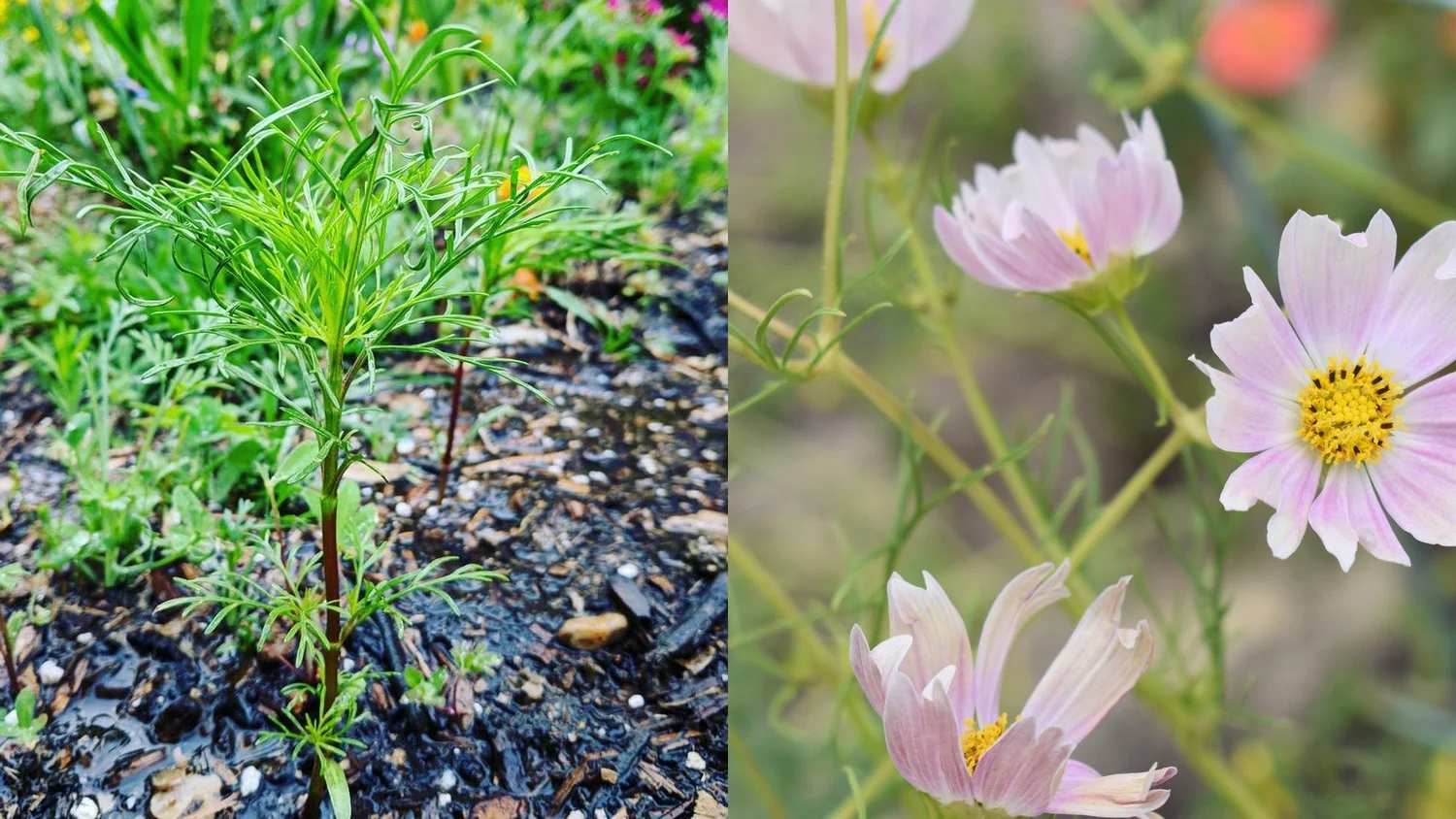
Side-by-side photos from Adrienne's garden show a young cosmos plant and mature pink-and-white cosmos blooms. The diptych illustrates why staggered sowing keeps a cut-flower bed producing. Photos: Adrienne Gaughan / Ambitious Harvest Co
The difference between a cutting garden that produces one glorious flush of flowers and one that yields bouquets from spring through fall comes down to one technique: succession planting. By staggering your plantings over weeks or months, you ensure fresh flowers are always coming into production as earlier plantings fade.
This approach transforms a small cutting garden into a surprisingly productive flower source. Instead of harvesting frantically during one peak week and then having nothing, you'll have a steady, manageable supply of blooms throughout the growing season.
This guide covers succession planting strategies for Santa Cruz County's unique climate, where our mild temperatures and long growing season make continuous flower production not just possible but relatively easy to achieve.
Succession Planting at a Glance
Stagger plantings so you have steady bouquets instead of one short peak.
What it is
Plant the same crop multiple times at set intervals (often every 2–4 weeks) rather than all at once.
Why it matters
As earlier plantings slow down, newer ones enter their prime, keeping harvests manageable and consistent.
Typical result
Better stem quality, fewer “too many flowers” weeks, and a longer overall season in Santa Cruz County.
What Is Succession Planting?
Succession planting simply means planting the same crop multiple times at intervals rather than all at once. For cut flowers, this typically means:
Sowing seeds every 2-4 weeks during the planting season
Transplanting seedlings in waves rather than all on one day
Planning for overlapping bloom periods from different plantings
The math is simple: If zinnias bloom about 60 days after sowing and remain productive for 6-8 weeks, a single planting gives you flowers for roughly two months. But if you plant every three weeks from April through July, you'll have fresh zinnia plants coming into production continuously from June through October.
Why Succession Planting Matters for Cut Flowers
Steady supply vs. feast or famine. Without succession planting, you'll have more flowers than you can use during peak bloom, then nothing. With succession planting, you have a manageable, consistent harvest.
Fresher, healthier plants. Older plants become woody, pest-prone, and less productive. Succession plantings ensure you always have young, vigorous plants entering their prime.
Extended harvest window. In Santa Cruz County, succession planting can extend your cut flower season from a few months to 8-10 months for some flowers.
Insurance against problems. If one planting fails due to pests, disease, or weather, you have others coming along. You're never dependent on a single batch.
Better quality blooms. First blooms from fresh plants are typically larger and longer-stemmed than later blooms from exhausted plants.
Flowers That Benefit Most from Succession Planting
Not all flowers need succession planting. Some bloom continuously for months from a single planting; others have such short bloom periods that multiple plantings are essential.
Succession Priority (by production window)
| High priority | Bloom per planting | Succession interval |
|---|---|---|
| Sunflowers (single-stem) | 1–2 weeks | Every 2 weeks |
| Sweet peas | 6–8 weeks (heat ends them) | Plant fall + late winter |
| Ranunculus | 6–8 weeks | One fall planting usually sufficient |
| Stock | 4–6 weeks | Every 3–4 weeks in cool season |
| Bachelor’s buttons | 4–6 weeks | Every 3 weeks |
| Moderate priority | Bloom per planting | Succession interval |
|---|---|---|
| Zinnias | 6–8 weeks | Every 3 weeks |
| Cosmos | 8–10 weeks | Every 4 weeks |
| Snapdragons | 6–8 weeks per flush | Every 4–6 weeks |
| Celosia | 8–12 weeks | Every 4 weeks |
| Low priority | Notes | |||||||||||||||||||||||||||||||||||||||||||||||||||||||||
|---|---|---|---|---|---|---|---|---|---|---|---|---|---|---|---|---|---|---|---|---|---|---|---|---|---|---|---|---|---|---|---|---|---|---|---|---|---|---|---|---|---|---|---|---|---|---|---|---|---|---|---|---|---|---|---|---|---|---|
| Dahlias | Bloom continuously once started until frost. | |||||||||||||||||||||||||||||||||||||||||||||||||||||||||
| Strawflowers | Very long bloom period from a single planting. | |||||||||||||||||||||||||||||||||||||||||||||||||||||||||
| Marigolds | Continuous if deadheaded. | |||||||||||||||||||||||||||||||||||||||||||||||||||||||||
| Calendula | Self-sows; continuous
Creating Your Succession Planting ScheduleStep 1: Identify your target harvest window. When do you want cut flowers? For most Santa Cruz County gardeners, the goal is flowers from late spring through fall (May-October), with possible cool-season flowers in winter and early spring. Step 2: Work backward from desired bloom dates. Each flower has a "days to bloom" number (found on seed packets or in variety descriptions). Use this to calculate when to plant: Planting date = Desired bloom date - Days to bloom Example: You want zinnias blooming July 1. Zinnias take about 60-75 days from seed. Plant around April 15-May 1. Step 3: Map out succession intervals. For each flower you want to succession plant, create a simple schedule: Zinnia example (60-75 days to bloom, 6-8 week production):
Step 4: Adjust for Santa Cruz County microclimates. Coastal gardens: Add 1-2 weeks to "days to bloom" estimates (cooler temps slow growth) Inland gardens: Estimates are usually accurate Pajaro Valley: May be slightly faster than estimates Work backward from bloom
Planting date = Desired bloom date − Days to bloom
Example: Want zinnias by July 1 (60–75 days) → plant roughly Apr 15–May 1.
Zinnia succession exampleAssume: 60–75 days to bloom, ~6–8 weeks productive.
Practical Succession Planting MethodsMethod 1: Repeat sowing at intervals The simplest approach. Set calendar reminders to plant seeds every 2-4 weeks during the appropriate season. Best for: Direct-sown flowers (zinnias, cosmos, sunflowers) Tip: Write planting dates on plant markers so you can track which succession is which. Method 2: Staggered transplanting Start all seeds at once but transplant in waves, holding some seedlings in larger pots. Best for: Transplanted flowers when you want to batch seed-starting Tip: Pot up seedlings you're holding to prevent them from becoming rootbound. Method 3: Mixed timing with variety selection Combine succession planting with variety selection. Plant early, mid, and late-maturing varieties of the same flower at the same time. Best for: Sunflowers, where variety days-to-bloom ranges from 50 to 90+ days Example: Plant 'ProCut Orange' (55 days), 'Sunrich Gold' (65 days), and 'Autumn Beauty' (80 days) on the same day for staggered bloom. Method 4: Cool-season/warm-season rotation Plan for different flowers in different seasons, with successions within each season. Santa Cruz County example:
Sample Succession Planting Calendar for Santa Cruz CountyThis calendar provides a starting framework. Adjust based on your specific microclimate and the flowers you want to grow.
Microclimate timing (Santa Cruz County)
Coastal fog belt add ~1–2 weeks to “days to bloom.” Sample Succession Planting Calendar (Santa Cruz County)
Space Management for Succession PlantingSuccession planting requires space for new plantings while older ones are still producing. Here are strategies to manage limited space. Space management options
Common Succession Planting Mistakes
Common succession planting mistakes
Tracking Your SuccessionsKeep records to improve your succession planting over time: Track your successions (simple template)Keeping a few notes helps you dial in timing for your specific yard and microclimate.
After a season or two, you'll have personalized data for your specific garden and microclimate, allowing you to fine-tune your schedule. Garden markers: Label each succession with its planting date. This helps you track which plantings are which and identify the most productive succession timing. Where to get flower seeds: For cut-flower and pollinator varieties that do well here, we like Seeds Now, a California company selling non-GMO, open-pollinated, and heirloom seed. (Affiliate link, see our disclosure.) Frequently Asked QuestionsHow many succession plantings do I need?For most flowers, 3-4 successions provide good continuous coverage. High-use flowers like zinnias and sunflowers may warrant 5-6 successions. What if I miss a planting date?Plant as soon as you remember. A slightly off-schedule succession is better than none. Your harvest timing will simply shift accordingly. Can I succession plant in containers?Yes. Start successions in containers and transplant to beds as space opens, or grow entire successions in large containers. How do I know when to stop planting for the season?Count backward from your expected first frost date (or desired end of harvest). Stop planting when there isn't enough time for flowers to mature. In coastal Santa Cruz, frost may never come, extending your window significantly. Do I need to succession plant dahlias?Not typically. Dahlias bloom continuously once they start and don't need succession planting. However, planting early and late-blooming varieties gives you a longer overall dahlia season. What's the minimum number of seeds/plants per succession?For home use, 10-20 plants per succession of productive flowers like zinnias is usually plenty. For prolific flowers like cosmos, even fewer may suffice. Should I succession plant all my cut flowers?No. Focus succession planting on short-production flowers. Long-blooming flowers like dahlias and strawflowers don't need it. Free ResourcesDownload these guides to support your succession planting:
Visit our Garden Toolkit for more downloadable resources. Sources
Related Articles |
