

12 Crops That Grow Well in Windy Coastal Gardens | Ambitious Harvest Co
A few of the product links in this guide are affiliate links. If you buy through one, Ambitious Harvest may earn a small commission at no extra cost to you, which helps keep these guides free. We only point to gear we would use in our own Santa Cruz garden. As an Amazon Associate, we earn from Read our full disclosure.
12 Crops That Grow Well in Windy Coastal Gardens
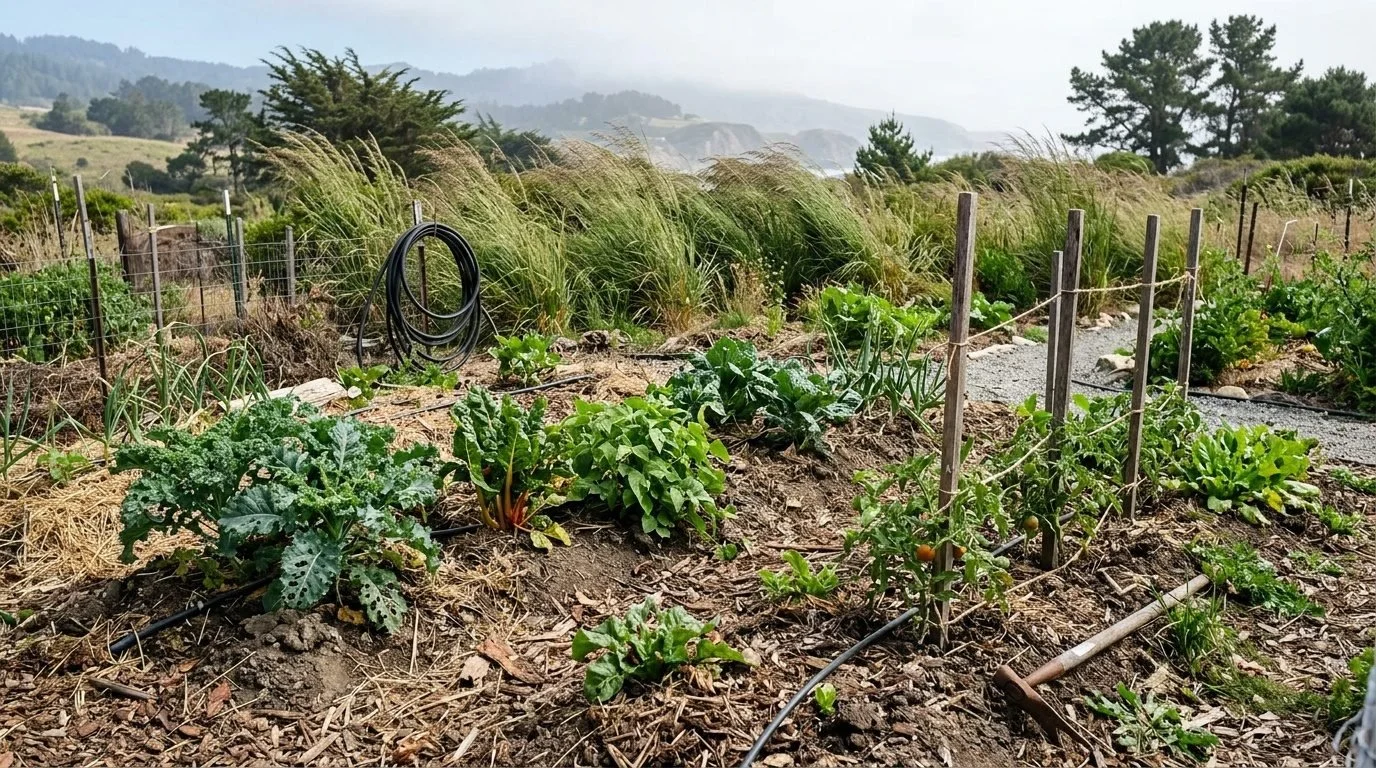
Sustained afternoon winds dry out leaves, break stems, and interfere with pollination, all of which lower yields on exposed coastal sites. Along California's coast, afternoon winds regularly exceed this threshold, with exposed Santa Cruz and San Mateo County gardens recording gusts of 25-35 mph during summer's prevailing northwesterlies. These 12 crops withstand coastal wind while still producing reliable harvests in exposed garden sites.
Wind is the challenge that coastal gardeners talk about less than fog, but it often matters more. A garden that gets decent sun between fog banks can still underperform if every afternoon brings 20 mph gusts that dry out leaves, snap stems, and knock over trellises. The solution combines wind-tolerant crop selection with simple windbreak strategies that reduce damage without blocking the light your garden needs.
How Does Wind Damage Garden Crops?
Wind hurts gardens in three distinct ways, and understanding each helps you choose the right crops and protections.
Desiccation. Wind strips moisture from leaf surfaces faster than roots can replace it, causing wilting even in well-watered soil. Wind pulls moisture from leaves and soil faster than still air, so windy gardens lose water more quickly and need more frequent irrigation. Broad-leafed crops with thin leaves are most vulnerable.
Physical damage. Sustained wind bends and breaks stems, shreds large leaves, and knocks over tall plants. Repeated bending weakens stems over time even when individual gusts are not severe. Fruiting crops like tomatoes and peppers suffer when branches loaded with fruit catch the wind.
Pollination disruption. While moderate wind aids pollination of some crops, strong sustained wind keeps pollinators grounded and can strip pollen from flowers before fertilization occurs. This primarily affects insect-pollinated crops like squash, cucumbers, and beans.
1. Kale
Kale's thick, sturdy leaves and low, compact growth habit make it one of the most wind-resistant leafy crops. The curly and lacinato types have different strategies: curly kale's ruffled texture creates less wind resistance than flat leaves, while lacinato kale's narrow, strap-like leaves simply flex with the wind without tearing. Both perform well in exposed coastal sites.
In windy Santa Cruz gardens, kale plants often develop thicker stems and more compact growth than sheltered plants, a natural response to wind stress that actually makes them more productive over time. UC Master Gardeners of Sonoma County note that kale is sweetened by frost and turns bitter under high temperatures and strong sun, so it is the cool coastal conditions rather than the wind that improve the flavor.
Best varieties for windy gardens: Lacinato (flexible strap leaves handle wind well), Dwarf Blue Curled Scotch (stays low and compact), Red Russian (pliable leaves resist tearing), and Redbor (sturdy stems, beautiful color).
Planting tips: Space plants 18-24 inches apart to allow air movement. In very windy sites, plant in a grid rather than rows to create mutual shelter. Stake or cage larger kale plants if they tend to lean. Mulch heavily to reduce the drying effect of wind on soil. growing kale in California
2. Chard
Swiss chard combines wind tolerance with remarkable adaptability to coastal conditions. The thick, fleshy stems and waxy leaf surfaces resist desiccation better than most leafy greens. Even when outer leaves show wind damage, the central growing point stays protected and continues producing new leaves. UC Cooperative Extension lists chard among the most reliable crops for challenging coastal growing sites (UC ANR Vegetable Research and Information Center).
Chard also recovers from wind damage faster than most crops. Torn or battered leaves can be harvested and eaten, while the plant quickly replaces them with fresh growth from the center.
Best varieties for windy gardens: Fordhook Giant (heavy, thick stems resist wind), Rhubarb Chard (sturdy red stems), and Bright Lights (surprisingly tough despite its delicate appearance).
Planting tips: Plant slightly closer together in windy sites (10-12 inches) so plants shelter each other. Harvest outer leaves regularly to reduce wind catch. Water more frequently in windy locations, as wind increases evaporation significantly. In the most exposed spots, a low temporary windbreak (even a board or row of containers) helps establish young transplants before they toughen up. growing chard in California
3. Root Vegetables (Carrots, Beets, Turnips)
Root vegetables are inherently wind-tolerant because the harvestable portion grows underground, protected from all wind damage. The above-ground foliage may look battered, but as long as enough leaf surface remains for photosynthesis, root development continues normally. UC research on root crop production confirms that moderate wind has minimal impact on root yield (UC ANR Vegetable Research and Information Center).
Carrots, beets, and turnips all perform well in windy coastal gardens. Their relatively low growth habit keeps them below the worst gusts, and the compact foliage creates less wind resistance than tall, leafy crops.
Best varieties for windy gardens: Carrots: Nantes types (Bolero, Napoli) with moderate tops. Beets: Chioggia (compact foliage), Detroit Dark Red (reliable). Turnips: Hakurei (fast, compact), Purple Top White Globe (sturdy).
Planting tips: Direct sow in well-worked soil. In windy gardens, keep seed beds moist until germination, as wind dries the surface layer quickly. Use row cover or burlap temporarily to protect tiny seedlings during their first 2-3 weeks. Once established, root crops need minimal wind protection. Succession plant every 3-4 weeks for continuous harvest. growing root vegetable in California
4. Garlic
Garlic is one of the toughest crops for exposed coastal gardens. The narrow, upright leaves offer minimal wind resistance, and the bulbs develop underground where wind cannot affect them. Garlic also tolerates the cool, windy conditions of coastal winter and spring, growing steadily through conditions that keep many gardeners indoors. UC Cooperative Extension recommends garlic as a reliable crop for California's diverse growing conditions, including windy coastal sites (UC Vegetable Research and Information Center).
Planted in fall, garlic grows through the windiest months of winter and is harvested in early summer before the strongest afternoon winds of July and August.
Best varieties for windy coastal gardens: California Early (softneck, well-adapted), Inchelium Red (softneck, excellent flavor, sturdy), Lorz Italian (artichoke type, reliable), and Spanish Roja (hardneck, good in mild coastal winters). Softneck varieties are generally better for coastal California.
Planting tips: Plant cloves in October-November, pointed end up, 2 inches deep, 6 inches apart. Garlic needs vernalization (cold period) to develop bulbs, which coastal winters provide naturally. Mulch with straw to conserve moisture. Stop watering 2-3 weeks before harvest when lower leaves begin to brown. Harvest when about half the leaves have dried. Cure in a dry, shaded location with good air circulation for 2-3 weeks before storage. growing garlic in California
5. Strawberries
Low-growing strawberry plants naturally avoid the worst wind exposure. Their compact habit and flexible stems handle gusts that would damage taller crops. Commercial strawberry production along the windy Watsonville and Oxnard coasts demonstrates the crop's tolerance for sustained wind. UC Davis strawberry research shows that coastal wind does not significantly reduce yields when plants are properly mulched and irrigated to compensate for increased evaporation (UC Davis Strawberry Breeding Program).
In windy gardens, strawberry plants may show some leaf edge drying, but fruit production typically remains strong. The fruit itself, nestled close to the ground under leaf cover, is well-protected from wind damage.
Best varieties for windy gardens: Seascape (bred for coastal conditions), Albion (compact habit, wind-resistant), and Chandler (sturdy plants, excellent flavor).
Planting tips: Plant on slight mounds or raised beds for drainage. Use straw mulch to protect fruit and reduce wind-driven soil drying. In very exposed sites, consider planting strawberries at the base of a windbreak where they benefit from shelter without competing for light. Drip irrigation is essential in windy gardens where overhead watering is inefficient. growing strawberries in California
6. Rosemary
Rosemary is native to windy Mediterranean coastlines and handles California coastal wind without any special care. The narrow, waxy leaves minimize water loss, and the woody stems become increasingly wind-resistant as plants mature. Established rosemary shrubs can serve as low windbreaks for more sensitive crops. UC Master Gardeners note that rosemary is one of the most drought and wind-tolerant herbs for California gardens (UC Master Gardener Program).
In exposed coastal gardens, rosemary develops a sculptural, wind-shaped form that is genuinely beautiful. Plants may lean away from the prevailing wind, but this does not affect their productivity or health.
Best varieties for windy gardens: Tuscan Blue (upright, makes a good low windbreak), Arp (hardiest variety, handles cold wind), Prostratus (trailing, stays below the wind), and Huntington Carpet (low-growing, ground-cover type).
Planting tips: Plant in well-drained soil in full sun. Rosemary needs very little supplemental water once established, even in windy conditions. Avoid rich, moist soil, which promotes soft growth vulnerable to wind damage. Prune regularly to maintain a dense, compact form that resists wind better than open, leggy growth. Rosemary planted as a low hedge can shelter adjacent vegetable beds from ground-level gusts. growing herb in California
7. Potatoes
Potatoes are surprisingly wind-tolerant. The short, bushy plants stay low to the ground, and the thick stems resist breakage. Even when foliage shows wind damage, tuber development continues underground. UC research confirms that moderate wind has minimal impact on potato yields when soil moisture is maintained (UC Vegetable Research and Information Center).
In windy coastal gardens, potatoes often benefit from the wind's cooling effect, which keeps soil temperatures in the ideal 60-70F range for tuber development. The wind also helps dry morning dew from foliage, reducing the late blight risk that plagues coastal gardens.
Best varieties for windy gardens: Yukon Gold (compact plants, sturdy), Red Pontiac (strong stems), Kennebec (vigorous, handles stress), and Purple Majesty (sturdy, adapted to variable conditions).
Planting tips: Plant seed potatoes in March-April. Hill soil around stems as plants grow. In windy gardens, hilling also provides some wind shelter for lower stems. Mulch heavily with straw to conserve moisture, as wind dries soil quickly. If foliage is repeatedly flattened by wind, plants recover but may need additional watering to compensate for the stress. growing potato in California
8. Thyme
Thyme, like rosemary, is a Mediterranean native evolved on windy coastal hillsides. The tiny, tightly-packed leaves and low, creeping growth habit make thyme nearly immune to wind damage. It grows happily in exposed locations where many other plants struggle. Thyme is one of the most wind and drought-tolerant culinary herbs for California gardens.
Creeping thyme varieties can serve double duty as wind-resistant ground cover around taller crops, suppressing weeds and reducing soil erosion from wind.
Best varieties for windy gardens: English Thyme (classic culinary, tough), Lemon Thyme (slightly less hardy but excellent flavor), Creeping Thyme (ground cover, extremely wind-resistant), and Silver Thyme (ornamental, drought-tolerant).
Planting tips: Plant in well-drained soil in full sun. Thyme thrives in lean soil and needs minimal fertilizer. Space 8-12 inches apart. In windy gardens, thyme often grows more compact and intensely flavored. Trim after flowering to maintain a tight, dense form. Thyme is excellent in rock gardens, raised bed edges, and anywhere you need a low, tough, edible ground cover that laughs at wind. growing herb in California
9. Favas
Fava beans have thick, sturdy stems that handle moderate wind, and their compact bushy growth (when properly managed) resists gusts better than most legumes. They have been grown on exposed European and Mediterranean coastal farms for centuries, developing natural wind tolerance. UC Master Gardeners of Sonoma County describe favas as a cool-season crop for home food gardens as well as agricultural fields.
The main wind concern with favas is lodging (falling over) when plants are tall and loaded with heavy pods. Simple staking or support strings prevent this in most wind conditions.
Best varieties for windy gardens: Broad Windsor (shorter, sturdier plants), Aquadulce (strong stems), and Sweet Lorane (compact growth habit). Avoid extra-tall varieties in very exposed sites.
Planting tips: Plant in October-November for spring harvest, or February-March for early summer harvest. Space 6-8 inches apart in blocks rather than single rows so plants support each other. Run a string or twine perimeter around blocks at 12-inch and 24-inch heights to keep plants upright in wind. Pinch growing tips when pods begin forming to reduce height and wind catch. growing fava bean in California
10. Onions
Onions have narrow, tube-shaped leaves that offer almost no wind resistance. Wind passes through onion rows with minimal drag, making them one of the most wind-proof crops available. The bulb develops underground, completely protected from wind effects. Onions grow reliably across California's climate zones and tolerate a wide range of conditions.
Green onions (scallions) and bulbing onions both perform well in windy gardens. The only wind-related concern is that the hollow leaves may dry out faster in constant wind, requiring slightly more frequent irrigation.
Best varieties for windy coastal gardens: Red Torpedo (Italian heirloom, intermediate day length for coastal CA), Walla Walla (sweet, mild), Yellow Granex (short-day, good for Southern California coast), and Evergreen White Bunching (scallion type, extremely tough).
Planting tips: Start from sets or transplants for easiest success. Plant in fall (October-November) for spring bulbing onions, or any time for scallions. Space 4-6 inches apart for bulbing types, 2 inches for scallions. Consistent moisture is important, especially in windy gardens where soil dries faster. Keep beds weeded, as onions compete poorly. Light mulch helps conserve moisture without keeping the soil too damp around developing bulbs. growing onion and allium in California
11. Artichokes
Artichokes may seem like an unlikely choice for windy gardens, given their large leaves, but their Mediterranean heritage includes adaptation to coastal wind. The thick, silvery leaves have a waxy coating that reduces moisture loss, and the sturdy central stalk supports heavy buds in moderate wind. Castroville's artichoke fields sit in one of the windiest stretches of California's coast, demonstrating the crop's inherent wind tolerance.
In very exposed sites, artichoke plants may lean away from prevailing wind, but this rarely affects production. The waxy leaf surface actually helps artichokes conserve water even as wind increases evaporation from surrounding soil.
Best varieties for windy gardens: Green Globe (the Castroville standard, proven in coastal wind), Imperial Star (shorter, more compact), and Big Heart (thornless, sturdy).
Planting tips: Plant divisions or transplants in spring, spacing 4-6 feet apart. In windy sites, orient rows perpendicular to the prevailing wind so plants shelter each other. Established artichokes need only moderate watering but benefit from extra irrigation in wind-exposed positions. The large, architectural plants can serve as partial windbreaks for adjacent lower-growing crops. growing artichoke in California
12. Peas (Bush Types)
Bush peas stay compact and low, avoiding the wind problems that tall climbing peas face in exposed gardens. While vining peas on a tall trellis can become a wind-catching wall that damages both crop and structure, bush peas grow 18-24 inches tall and ride out coastal gusts without support. Bush pea varieties are a practical choice for challenging, windy sites where trellising is impractical.
In windy coastal gardens, bush peas planted in blocks rather than rows provide mutual shelter and produce well despite regular afternoon wind.
Best varieties for windy gardens: Tom Thumb (extremely compact, 8 inches tall, nearly windproof), Little Marvel (bush shelling pea, 18 inches), Oregon Sugar Pod II (compact snow pea, 28-30 inches, sturdy), and Patio Pride (bred for containers, very compact).
Planting tips: Direct sow in March-April and again in August-September. Plant in wide blocks (at least 3 rows wide) rather than single rows. The interior plants benefit from wind shelter provided by the outer rows. Even bush peas benefit from a short fence or mesh support in windy gardens. Harvest frequently to keep plants producing and reduce the weight that makes them susceptible to lodging. growing pea in California
What Are the Best Windbreak Strategies for Coastal Gardens?
Choosing wind-tolerant crops is half the solution. The other half is reducing wind speed in your garden through strategic windbreaks. USDA National Agroforestry Center research on windbreaks shows that a permeable barrier reduces wind speed downwind for a distance of up to 10 to 15 times its height, with the greatest reduction closest to the barrier (within about 5 times the height). A 6-foot windbreak provides meaningful protection for crops 48-90 feet downwind.
Living windbreaks. Hedges of native plants like coffeeberry, coyote brush, or California wax myrtle create effective, permanent windbreaks that filter wind rather than blocking it completely. A solid wall can create turbulence on the lee side, while a permeable hedge reduces wind speed smoothly. Rosemary, lavender, and artichokes can also serve as lower-level living windbreaks within the garden.
Temporary structures. Shade cloth (50-60%) attached to sturdy posts makes an effective seasonal windbreak that also provides shade for sensitive crops. Snow fencing, reed mats, or burlap screens work for specific beds. Position temporary windbreaks on the windward side (usually northwest along the California coast) at a height of 3-4 feet for vegetable gardens.
Garden design. Raised beds with solid sides provide some wind protection at ground level. Sunken gardens and bermed beds reduce wind exposure naturally. Planting tall, wind-tolerant crops (like corn, sunflowers, or Jerusalem artichokes) on the windward edge of the garden creates a natural shield for shorter crops behind them. planning your California garden
Frequently Asked Questions
How much wind is too much for a vegetable garden?
Sustained winds above 15 mph begin reducing yields for most vegetable crops through increased water loss and physical stress. Above 25 mph, most unprotected garden plants suffer significant damage. A permeable windbreak that noticeably slows the wind can restore much of the yield lost to exposure in moderately windy locations. Coastal California gardens commonly experience 15-25 mph afternoon winds, making windbreaks or wind-tolerant crop selection important for reliable production.
Do I need to water more in a windy garden?
Yes, significantly. Wind noticeably increases evapotranspiration, so a windy garden needs more water than a sheltered one growing the same crops. A windy garden may need nearly double the water of a sheltered garden growing the same crops. Drip irrigation is strongly preferred in windy locations because it delivers water directly to roots without wind-driven spray waste. Mulching with 3-4 inches of straw or wood chips also reduces wind-driven soil evaporation. Monitor soil moisture more frequently in windy gardens and adjust your irrigation schedule accordingly (UC ANR Irrigation Management).
Will a solid fence work as a windbreak?
A solid fence is less effective than a permeable barrier. USDA National Agroforestry Center research shows that solid walls create turbulent eddies on the downwind side that can actually increase wind damage close to the wall. A permeable windbreak (roughly 40 to 60% density) reduces wind speed more gradually over a larger area than a solid wall (USDA National Agroforestry Center). Lattice panels, hedge plantings, or shade cloth attached to a fence frame all create better wind protection than a solid board fence. The ideal windbreak allows some air to pass through while reducing overall wind speed (USDA National Agroforestry Center).
Can I use row cover to protect crops from wind?
Lightweight row cover (also called floating row cover or garden fabric) provides moderate wind protection while allowing light and water to pass through. UC Master Gardeners recommend it as a temporary solution for establishing young transplants in windy gardens. Secure edges thoroughly with soil, rocks, or landscape pins. Wind can tear unsecured row cover and damage plants. Heavier weight row cover (1.5 oz) provides more wind protection than lightweight (0.5 oz) but reduces light transmission. Remove or vent row cover during calm periods to prevent overheating (UC Master Gardener Program).
What native plants make good windbreaks for California coastal gardens?
Several California natives are excellent coastal windbreaks. Coyote brush (Baccharis pilularis) is extremely wind-tolerant and grows 3-8 feet tall. California wax myrtle (Morella californica) reaches 10-15 feet and thrives in coastal conditions. Coffeeberry (Frangula californica) grows 6-12 feet with dense branching. For lower hedges, try coast buckwheat (Eriogonum latifolium) or seaside daisy (Erigeron glaucus). California Native Plant Society Calscape lists these species for exposed coastal sites in the Santa Cruz region.
Windy gardens do not have to mean frustrating gardens. With the right crops and a few strategic windbreaks, exposed coastal sites can be just as productive as sheltered ones. Start with the low-growing, tough crops on this list, add a simple windbreak on your prevailing wind side, and build from there as you learn your garden's specific wind patterns.
Looking for more coastal gardening strategies? Join the Ambitious Harvest newsletter for Santa Cruz-tested tips on making the most of your coastal garden, wind and all. [EMAIL SIGNUP]
