

Growing Fava Beans: Winter Cover Crop and Food
A few of the product links in this guide are affiliate links. If you buy through one, Ambitious Harvest may earn a small commission at no extra cost to you, which helps keep these guides free. We only point to gear we would use in our own Santa Cruz garden. As an Amazon Associate, we earn from qualifying purchases. Read our full disclosure.
Why Are Fava Beans the Best Winter Crop for Santa Cruz Gardens?
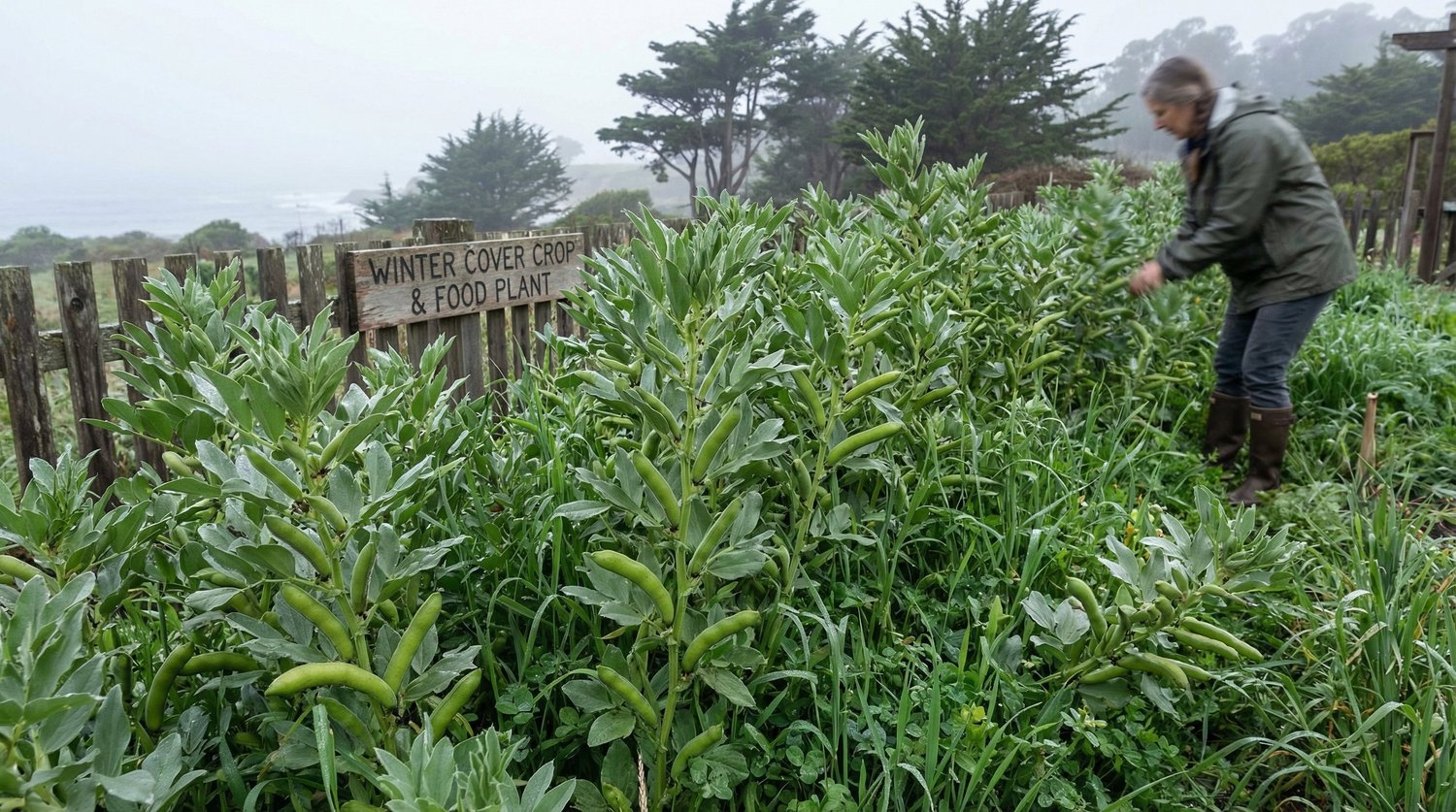
Fava beans are one of the few crops that produce food and improve your soil simultaneously, fixing up to 200 pounds of nitrogen per acre through symbiotic rhizobium bacteria in their root nodules. According to UC Agriculture and Natural Resources, fava beans (Vicia faba) are among the most effective nitrogen-fixing cover crops for California's mild-winter regions. In Santa Cruz County, where winters rarely drop below 25 degrees, favas grow vigorously from October through May, filling a gap in the garden calendar when most other crops sit idle.
Walk through community gardens at the Natural Bridges or Pogonip sites during January, and you will see fava beans standing three to four feet tall, lush and green, while neighboring beds lie bare. These plants are quietly banking nitrogen that will feed tomatoes, peppers, and squash in the months ahead, all while producing one of the most underrated culinary beans available to home gardeners.
What Makes Fava Beans Different from Other Garden Beans?
Fava beans belong to an entirely different genus than common green beans and runner beans. While snap beans, kidney beans, and limas are all Phaseolus species that need warm soil and frost-free conditions, favas are Vicia faba, a cool-season legume closely related to vetches. This distinction matters for Santa Cruz gardeners because it means favas fill a completely different niche in your planting calendar.
Favas tolerate temperatures down to about 15 degrees Fahrenheit once established, though young seedlings are more frost-sensitive. They actually prefer daytime temperatures between 60 and 65 degrees, which describes a typical Santa Cruz winter day almost perfectly. Heat is their enemy: when temperatures consistently exceed 80 degrees, plants stop flowering and begin to decline.
The plants grow upright, typically three to five feet tall depending on variety, with thick, square stems that rarely need staking in sheltered gardens. In exposed coastal locations where wind is a factor, a simple string line between stakes at 18 inches and 36 inches keeps plants upright. The fragrant white and black flowers attract early-season pollinators, making favas a valuable resource for bees during months when few other crops are blooming.
Which Fava Bean Varieties Grow Best in Santa Cruz County?
Several fava bean varieties thrive in our coastal climate, each with slightly different characteristics suited to different garden goals.
Windsor (Broad Windsor): The classic large-seeded fava, producing pods 7 to 9 inches long with 4 to 6 large beans each. Windsor is the best choice if culinary use is your primary goal. The large seeds are easy to shell and have the rich, nutty flavor that fava lovers prize. Plants reach 3 to 4 feet and mature in about 80 to 90 days from transplant.
Aguadulce: A Spanish heirloom variety with extra-long pods (up to 12 inches) and excellent cold tolerance. Aguadulce is the top choice for fall planting in Santa Cruz because it handles our coolest winter nights without damage. It also produces heavily, making it a good dual-purpose variety for both eating and cover cropping.
Sweet Lorane: A small-seeded fava bred by Steve Solomon in Oregon's Willamette Valley in the 1980s and selected for sweet flavor, which makes it a dual-purpose cover crop and food crop. The seeds are too small for easy culinary use, but the plants produce exceptional biomass and fix more nitrogen per plant than large-seeded types. If building soil fertility is your main objective, Sweet Lorane is the variety to choose.
Crimson-flowered fava: A beautiful heirloom with deep red flowers instead of the typical white and black. The beans are medium-sized and perfectly edible, and the plants serve double duty as ornamentals. This variety is worth growing near garden paths where you can appreciate the flowers during winter months when color is scarce.
For most Santa Cruz gardeners wanting both food and soil improvement, Windsor or Aguadulce is the right choice. Local nurseries like Scarborough Gardens and the Cabrillo College plant sale typically carry fava bean seeds in fall.
When and How Should You Plant Fava Beans?
The planting window for fava beans in Santa Cruz County runs from October through early January, with mid-October through November being the sweet spot. Planting in this window gives plants time to establish strong root systems before the shortest days of winter, and positions them for vigorous spring growth when days lengthen.
Direct sowing method: Push seeds 1.5 to 2 inches deep into prepared soil, spacing them 4 to 6 inches apart in rows 18 to 24 inches apart. Fava seeds are large and easy to handle, making them a satisfying crop for children to plant. Water thoroughly after planting and keep soil consistently moist until germination, which typically takes 7 to 14 days in fall soil temperatures.
Soil preparation: Favas are not fussy about soil quality, which is part of their value as a cover crop. They grow in clay, sandy loam, and everything in between. However, they do need reasonable drainage because waterlogged roots are susceptible to fungal diseases. If your garden has heavy clay, mounding rows slightly or planting in raised beds helps water drain away from the root zone during our winter rains.
Inoculation: For maximum nitrogen fixation, inoculate seeds with the appropriate rhizobium bacteria before planting. Fava beans require a different inoculant strain than common beans (they need Rhizobium leguminosarum, the same strain used for peas and vetches). If you have grown favas or peas in the same bed within the past three to four years, the bacteria are likely still present in your soil. For new beds, inoculant is inexpensive and available at well-stocked garden centers.
You can also start favas in 4-inch pots in late September for transplanting in October, giving them a head start. Transplant when seedlings are 4 to 6 inches tall, handling the root ball gently to minimize disturbance.
How Do Fava Beans Work as a Cover Crop?
The cover crop function of fava beans is what elevates them from a nice winter vegetable to an essential part of sustainable Santa Cruz gardening. Understanding how nitrogen fixation works helps you maximize the benefit.
Rhizobium bacteria colonize fava bean roots, forming visible nodules (small, round bumps on the roots). Inside these nodules, the bacteria convert atmospheric nitrogen gas into ammonia, a form of nitrogen that plants can use. The plant provides the bacteria with carbohydrates from photosynthesis in exchange. When you cut the fava plants and incorporate them into the soil, this stored nitrogen becomes available to subsequent crops as the plant material decomposes.
According to the UC SAREP cover crop database, a fava or bell bean cover crop may fix somewhere between 50 and 200 pounds of nitrogen per acre, with about 100 pounds achievable in six weeks of growth. For a home garden bed, this translates to meaningful fertility that reduces or eliminates the need for supplemental nitrogen for the following summer crop.
To maximize the cover crop benefit:
- Cut plants at ground level when they are in full bloom or just beginning to set pods (typically March or April in Santa Cruz). This is when nitrogen content in the plant tissue is highest.
- Chop the stems and leaves into small pieces and work them into the top 4 to 6 inches of soil.
- Wait 2 to 3 weeks before planting your summer crops. The decomposing fava material temporarily ties up nitrogen as soil microbes break it down, but then releases a surge of available nitrogen.
- Leave the roots in the ground. The nodules on fava roots contain the most concentrated nitrogen, and they decompose in place, releasing nutrients directly into the root zone.
If you want both food and cover crop benefits, harvest the pods you want to eat, then cut the remaining plant material and incorporate it. You will get less total nitrogen than turning in the entire plant at peak bloom, but you still get substantial soil improvement plus a food harvest. For more on building soil through organic matter, see our guide to composting techniques.
How Do You Manage Aphids on Fava Beans?
If you grow fava beans in Santa Cruz, you will deal with aphids. Black bean aphids (Aphis fabae) are attracted to favas with remarkable consistency, typically appearing in late winter or early spring as new growth emerges. This is the most common pest issue for local fava growers, and managing it well is the difference between a good harvest and a frustrating one.
According to UC Integrated Pest Management, bean aphids feed in dense groups on leaves and stems, sucking plant sap and excreting honeydew that turns black with sooty mold. Heavy infestations weaken plants and reduce pod production.
Prevention and management strategies, in order of priority:
- Pinch growing tips: Once plants have set several tiers of pods (usually in March), pinch off the top 4 to 6 inches of each stem. These tender tips are where aphids concentrate, and removing them eliminates the most attractive feeding site while redirecting the plant's energy into pod development. The pinched tips are edible and delicious sauteed with garlic and olive oil.
- Encourage beneficial insects: Ladybugs, lacewing larvae, syrphid fly larvae, and parasitic wasps all prey on black bean aphids. Planting flowering herbs and native plants near your fava beans provides habitat for these predators. Avoid any broad-spectrum insecticide that would harm them.
- Water spray: A strong jet of water from the hose knocks aphids off plants. Do this in the morning so foliage dries before evening, reducing fungal disease risk. Repeat every few days during heavy infestations.
- Insecticidal soap: For severe infestations that beneficials are not controlling, insecticidal soap sprayed directly on aphid clusters is effective and breaks down quickly without harming beneficial insects that arrive later. Spray coverage must be thorough because insecticidal soap only works on contact.
Avoid the temptation to spray at the first sign of aphids. A small aphid population actually attracts beneficial insects to your garden. The goal is management, not elimination. In most Santa Cruz gardens, the predator-prey balance establishes itself by April, and aphid populations crash naturally.
When Should You Harvest Fava Beans, and How Do You Prepare Them?
Harvesting fava beans at the right stage depends on how you plan to use them. There are actually three distinct harvest stages, each with different culinary applications.
Young pods (snap stage): When pods are 3 to 4 inches long and the beans inside are barely visible, you can eat the entire pod like a snap bean. Slice them thinly and saute, or add to stir-fries. This stage is brief, so check plants every few days. Many gardeners do not realize favas can be eaten this way.
Fresh shell stage: This is the most prized stage for culinary use. Harvest when pods are plump and full-sized (6 to 12 inches depending on variety), with beans clearly visible through the pod wall. The pod exterior should still be green and somewhat flexible. Shell the beans by opening the pod along the seam and popping out the beans. Most cooks then blanch the shelled beans for 60 seconds, shock in ice water, and slip off the pale outer skin to reveal the bright green bean inside. This double-shelling process is traditional for a reason: the inner bean is tender and sweet, while the outer skin can be tough and slightly bitter.
Dry stage: For seed saving or dried bean storage, leave pods on the plant until they turn black and papery. The beans inside will be hard and dry. See our seed saving guide for detailed drying and storage instructions.
Simple fava bean preparation: Shell and double-peel about 2 pounds of pods (this yields roughly 1 cup of peeled beans). Toss the bright green beans with good olive oil, lemon juice, salt, shaved pecorino, and torn mint leaves. This simple preparation showcases the sweet, earthy flavor that makes favas a spring delicacy in Mediterranean cuisines.
Important note: Some people of Mediterranean, African, and Middle Eastern descent carry a genetic condition called G6PD deficiency (favism) that causes a dangerous reaction to fava beans. If you have this condition in your family history, consult your doctor before eating favas.
How Do Fava Beans Fit into a Year-Round Santa Cruz Garden Plan?
The genius of fava beans in our climate is how seamlessly they fit into a year-round rotation. Here is a practical timeline that many experienced Santa Cruz gardeners follow:
- October: After removing spent summer crops (tomatoes, peppers, squash), sow fava beans directly into cleared beds. Add a light layer of compost but no nitrogen fertilizer.
- November through February: Favas grow steadily through winter with minimal care. Water during dry spells between rains, but our winter rainfall usually provides adequate moisture.
- March through April: Harvest pods for eating. Pinch growing tips to manage aphids and redirect energy to pods.
- Late April through early May: Once pod production slows, cut plants at ground level. Chop and incorporate plant material into the soil.
- Mid-May: After 2 to 3 weeks of decomposition, plant summer crops into the nitrogen-enriched bed. Tomatoes, peppers, corn, and squash all benefit enormously from following favas.
This rotation creates a self-sustaining fertility cycle that reduces dependence on purchased fertilizers. According to UC Agriculture and Natural Resources, well-planned legume rotations can supply 50 to 100 percent of the nitrogen needs for a following heavy-feeding crop. If you are planning your spring planting timeline, our March garden checklist helps coordinate fava bed transitions with summer crop starts.
Frequently Asked Questions
Do fava beans survive frost in Santa Cruz?
Established fava bean plants tolerate temperatures down to about 15 degrees Fahrenheit, which is well below anything Santa Cruz County typically experiences. Even in the coldest inland valleys like Ben Lomond or Bonny Doon, winter lows rarely drop below the mid-20s. Young seedlings are slightly more frost-sensitive, so planting in October gives plants time to establish before the coldest nights in December and January. The UC Small Farms Network reports that fava beans resist frost damage to at least 21 degrees F, which makes them a dependable winter legume on the coast, though they struggle in interior summer heat.
How much nitrogen do fava beans actually add to soil?
A well-grown fava bean crop fixes approximately 100 to 200 pounds of nitrogen per acre, though home garden results vary based on inoculation, soil conditions, and how long plants grow before incorporation. For a typical 4-by-8-foot raised bed, this translates to roughly the equivalent of several cups of blood meal. According to UC Agriculture and Natural Resources, maximum nitrogen fixation occurs when plants are cut and incorporated at peak bloom, before pods fully develop, because the plant stores the most nitrogen in its tissues at that stage.
Can you eat fava bean leaves?
Yes, fava bean leaves and tender growing tips are edible and increasingly popular in California farm-to-table restaurants. The young leaves have a mild, slightly sweet flavor reminiscent of spinach with a hint of the bean's nuttiness. Harvest the top 4 to 6 inches of growing tips, which also helps manage aphids by removing their preferred feeding site. The UC Small Farms Network describes the fava bean as native to the Mediterranean region, especially Italy and Iran, and as one of the oldest cultivated plants known.
Why are my fava bean pods turning black?
Black pods on fava beans can indicate two different things. If the pods are mature and drying down naturally, blackening is the normal end-of-life process, and the dried beans inside are ready for seed saving. If pods are still immature and turning black, the likely cause is chocolate spot (Botrytis fabae), a fungal disease favored by cool, wet conditions. According to UC Integrated Pest Management, spacing plants for adequate air circulation and avoiding overhead sprinklers helps prevent bean rust, whose spores spread by wind and splashing water. Powdery mildew behaves differently, so match the practice to the disease.
Should you stake fava beans?
In sheltered Santa Cruz gardens, fava beans usually stand upright without staking, especially compact varieties planted at close spacing where plants support each other. In exposed coastal locations or windy hillside gardens, staking prevents plants from toppling when heavy with pods. The simplest method is placing stakes at each end of the row and running string along both sides at 18-inch and 36-inch heights. UC Master Gardeners of Santa Clara County note that favas grow on sturdy stalks and do not need supports, though you may want to corral tall stalks so they do not lean into pathways.
Can you plant fava beans in spring instead of fall?
Spring planting is possible but produces inferior results in Santa Cruz County. Favas planted in February or March have a compressed growing season and hit warm temperatures before they reach full production. Fall-planted favas grow through our ideal cool-season window and produce much heavier harvests. UC Cooperative Extension notes that cover crops are typically grown in the fall, and that fava and bell beans are the upright cool-season legumes to reach for when the goal is adding nitrogen.
Do fava beans cross-pollinate with other beans?
No. Fava beans (Vicia faba) cannot cross with common beans (Phaseolus vulgaris), runner beans (Phaseolus coccineus), or lima beans (Phaseolus lunatus) because they are in entirely different genera. However, different fava bean varieties will cross-pollinate with each other, carried by bees visiting the flowers. If you are saving seed from a specific variety, you need 500 feet of isolation or physical barriers. See our seed saving guide for details on maintaining variety purity.
How do fava beans compare to other cover crops for Santa Cruz?
Fava beans are the top cover crop choice for Santa Cruz home gardeners because they combine food production with soil building in a single plant. Other excellent options include crimson clover (more nitrogen per square foot but no food harvest), cereal rye (excellent biomass but no nitrogen fixation), and field peas (similar nitrogen fixation but less cold-hardy). According to UC Agriculture and Natural Resources, a mix of fava beans and cereal rye provides both nitrogen fixation and erosion control, which is particularly valuable on sloped garden sites common in the Santa Cruz hills.
Grow Fava Beans This Fall
Fava beans are the rare crop that asks very little of the gardener while giving back generously, both to your kitchen and to your soil. Planting them in October is one of the smartest moves a Santa Cruz gardener can make, turning an idle winter bed into a nitrogen-fixing, food-producing asset. Even if you never cook a single bean, the soil improvement alone justifies the effort.
For more growing guides, seasonal planning tools, and crop-specific advice for Santa Cruz County, visit Your Garden Toolkit.
Keep Reading:
