

Garden Planning 101: Mapping Your Space
A few of the product links in this guide are affiliate links. If you buy through one, Ambitious Harvest may earn a small commission at no extra cost to you, which helps keep these guides free. We only point to gear we would use in our own Santa Cruz garden. As an Amazon Associate, we earn from qualifying purchases. Read our full disclosure.
The difference between a frustrating garden and a thriving one often comes down to planning. A well-designed garden makes efficient use of space, maximizes sun exposure, simplifies maintenance, and sets you up for years of abundant harvests.
You don't need fancy software or design skills to plan a productive vegetable garden. A simple hand-drawn map, some basic measurements, and thoughtful consideration of your space will get you 90% of the way there.
This guide walks you through the process of mapping your garden space and creating a layout that works for Santa Cruz County's year-round growing season.
Why Does Garden Planning Matter?
Walking outside with a flat of tomato seedlings and digging holes wherever feels right might work once or twice. But as your garden grows and you want to plant multiple successions, rotate crops, and make the most of our long season, a plan becomes essential.
A garden plan helps you:
Maximize space. You'll fit more plants into your available area without overcrowding.
Track crop rotation.Knowing where you planted tomatoes last year helps you avoid planting them in the same spot this year, reducing disease and pest pressure.
Time plantings correctly. Planning shows you where space will open up as early crops finish, letting you succession plant for continuous harvests.
Avoid impulse purchases. Walking into Sierra Azul Nursery in spring without a plan means coming home with more plants than you have room for. A plan keeps you focused.
Work with microclimates. You can map sun patterns and place heat-loving crops in the warmest spots while reserving shadier areas for leafy greens.
How Do You Measure Your Garden Space?
Start with accurate measurements. You need to know exactly how much space you're working with.
Grab a measuring tape (a 25-foot tape works for most yards) and measure:
Overall garden area dimensions
Existing structures (shed, fence, house)
Trees and large shrubs
Pathways and access points
Water sources (hose bibs, irrigation lines)
Don't guess. A space that looks 10 feet wide might actually be 8 feet, and those 2 feet matter when deciding if a bed will fit.
Sketch it out. Use graph paper if you have it, one square equals one foot. Or grab a large sheet of blank paper and rough it out. This doesn't need to be precise, just reasonably to scale.
Mark existing features: house, fences, trees, sheds, gates, water access. Include anything permanent that you'll need to work around.
How Do You Track Sun Exposure?
Sun exposure is the single most important factor in garden placement. Vegetables are sun-hungry plants. Most need 6 to 8 hours of direct sun daily.
Do a sun audit. Spend a full day observing your space. Check at 9 am, noon, 3 pm, 6 pm.
Note which areas receive full sun, partial sun, or shade at each time. Mark this on your sketch.
In Santa Cruz, sun patterns vary dramatically by microclimate:
Coastal areas (Aptos, Capitola, Live Oak) often have morning fog that doesn't burn off until 10am or 11am. Your "full sun" area might only get 5 to 6 hours of direct light. Choose fog-tolerant varieties and focus on crops that handle partial sun.
Inland valleys (Scotts Valley, Soquel hills) and San Lorenzo Valley sunny exposures get more consistent sun. These areas can grow the full range of sun-loving crops.
Under or near redwoods (Felton, Ben Lomond canyons), shade is a major factor. Identify any spots that get 4+ hours of sun for leafy greens and herbs. Full-sun crops may not thrive.
Sun changes with seasons. The sun is lower in winter, casting longer shadows. A bed that's full sun in July might be partly shaded in December. If possible, observe your space across seasons before committing to permanent structures.
How Do You Identify Microclimates in Your Yard?
Even within a small yard, you'll have microclimates: spots that are warmer, cooler, windier, or more protected than others.
Look for:
South-facing walls or fences. These radiate heat and create a warmer microclimate ideal for tomatoes, peppers, and basil.
Low-lying areas. Cold air sinks. These spots may experience frost when the rest of your yard doesn't. Avoid planting tender crops here.
Windy exposures. Coastal winds can shred leaves and stress plants. Windbreaks (fences, hedges) create calmer zones.
Existing shade. Under eaves, near large shrubs, or on the north side of structures. Reserve these spots for shade-tolerant crops like lettuce, spinach, and herbs.
Dry spots. Areas far from water sources or under roof overhangs. These need extra attention or drought-tolerant plantings.
Map these microclimates on your sketch. A simple note ("warmest spot," "afternoon shade," "windy") helps you place crops strategically later.
How Should You Lay Out Your Beds?
Now that you know your sun and space, decide how to arrange your planting beds.
Raised Beds vs In-Ground
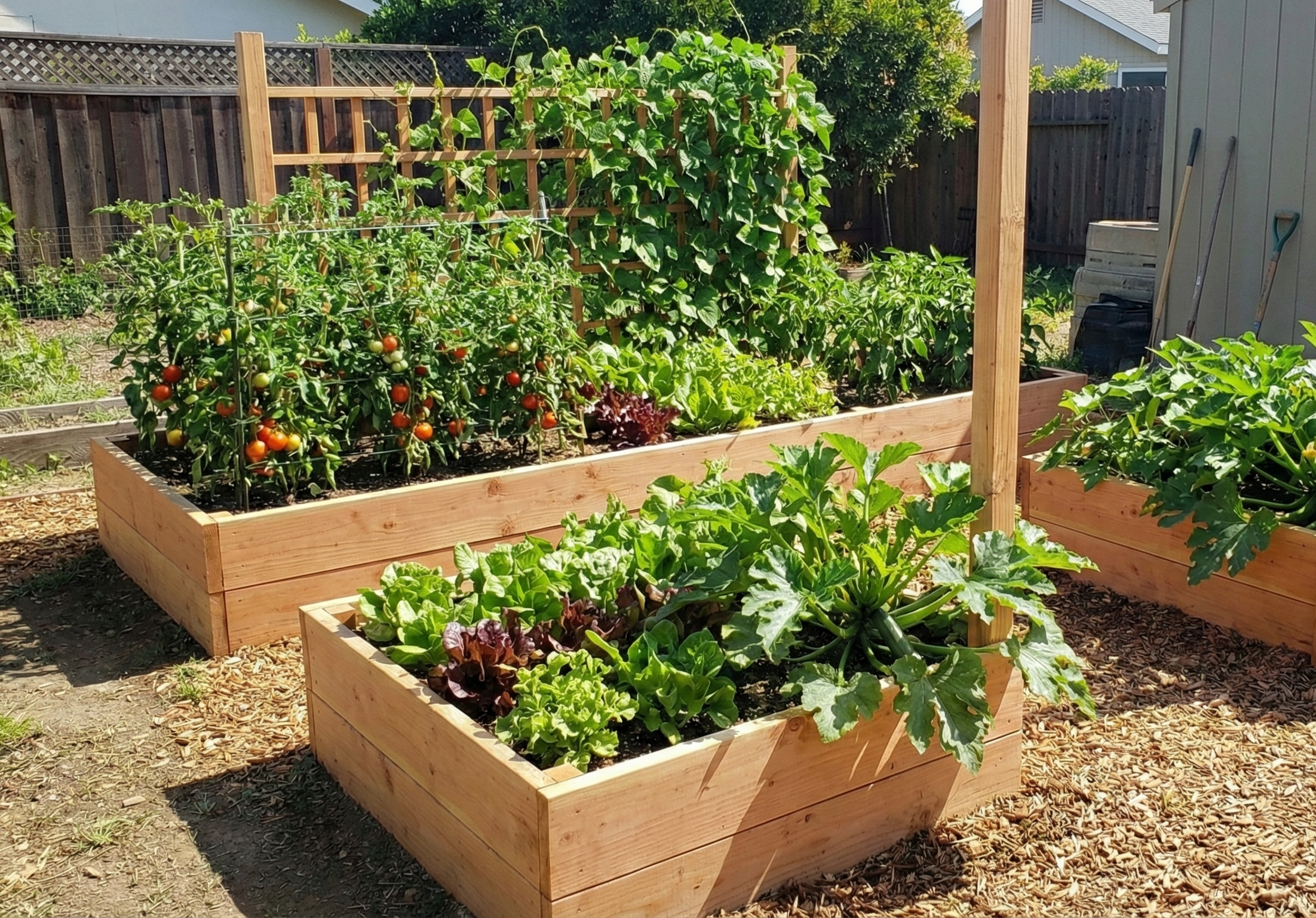
Raised beds are standard in Santa Cruz for good reason: gopher protection, better drainage, improved soil. Most gardeners use 4x8-foot beds, though 4x4 or 3x6 also work depending on space.
In-ground rows work if you have good native soil, no gopher issues, and a larger space. Rows are traditional but require more area for pathways.
Container gardens are perfect for patios, balconies, or small yards. Use pots at least 12 inches deep for most vegetables.
How Many Beds?
This depends on your space and ambition. For a beginner:
One 4x8 bed (32 square feet) can produce a surprising amount of food: 4 tomato plants, 2 pepper plants, a zucchini, a row of lettuce, a row of carrots, and a few herb plants. This is plenty for a first season.
Two to three 4x8 beds (64 to 96 square feet) lets you diversify and practice crop rotation. One bed for tomatoes and warm-season crops, one for cool-season greens and root vegetables, one for squash and beans.
Four or more beds supports serious food production and allows proper rotation of plant families.
Leave at least 2 to 3 feet between beds for access. You'll be walking these paths daily with watering cans, harvest baskets, and wheelbarrows. Comfortable access matters.
Orientation
North-south orientation is ideal. Beds running north to south expose both sides to morning and afternoon sun, minimizing shading between plants.
East-west works too, especially if you're limited by space. Just be mindful of taller plants shading shorter ones. Place taller crops (tomatoes, pole beans, trellised cucumbers) on the north side of the bed so they don't shade shorter crops.
How Wide Should Your Pathways Be?
Pathways are as important as planting areas. Skimping on path width is a common mistake that makes gardens frustrating to work in.
Minimum path width: 2 feet for basic access
Comfortable path width: 3 feet allows two people to pass, makes harvesting easier, and accommodates a wheelbarrow
Main pathways: 4 feet if you plan to use a cart or wheelbarrow regularly
Pathway materials:
Mulch (wood chips, straw): Affordable, easy, suppresses weeds. Free wood chips available through ChipDrop (getchipdrop.com).
Gravel: Permanent, drains well, clean look. Available at Aptos Landscape Supply or Central Home Supply in Scotts Valley.
Pavers or flagstone: Attractive and durable but expensive. Create a finished garden look.
Compacted decomposed granite: Popular in drier microclimates. Stays put, looks neat.
Paths also provide room for beneficial insects and a mental break between planting areas. Don't cram beds so tightly that you eliminate pathways.
How Can You Incorporate Vertical Growing?
Vertical space is underused in most gardens. Growing up instead of out maximizes production, especially in small spaces.
What grows vertically:
Pole beans on teepees or trellises
Indeterminate tomatoes on tall stakes or cages
Cucumbers on trellises or fencing
Peas on netting or branches
Winter squash trained up sturdy supports
Benefits:
More food in less space
Better air circulation (reduces disease)
Easier harvesting (no bending)
Cleaner fruit (off the ground, away from soil splash)
Plan for trellises when mapping your beds. Place them on the north side so they don't shade other crops. A 6-foot trellis can double the production of a 4x8 bed.
Local trellis materials:
Bamboo stakes from San Lorenzo Garden Center or Scarborough Gardens
Cattle panels (wire fencing) from Mountain Feed & Farm Supply in Ben Lomond, make excellent sturdy trellises
Lumber for building structures from local hardware stores
How Do You Plan Water Access?
Every plant needs water, and in Santa Cruz's dry summers, you'll be providing all of it from May through October.
Hose access: Can you reach every bed with a hose? If not, consider installing additional hose bibs or running drip irrigation.
Drip irrigation: The most efficient watering method for vegetables. Map out where your mainline will run and how you'll connect to each bed.
Rainwater catchment: If you have gutters and downspouts, consider adding rain barrels. One inch of rain on a 1,000-square-foot roof yields 600 gallons of water. That's gold during summer.
Components available locally:
Drip irrigation supplies at San Lorenzo Garden Center, Dig Gardens, and Scarborough Gardens
Rain barrels occasionally at Mountain Feed & Farm Supply or through county rebate programs (check Water Conservation at cityofsantacruz.com)
Mark your water sources on your plan. It influences where you site beds and how you design irrigation.
What Is Succession Planting and How Does It Work?
Santa Cruz's year-round season allows succession planting: harvesting one crop and immediately replanting that space with another.
Example succession plan for a 4x8 bed:
Spring (March to May): Lettuce, spinach, peas, radishes Summer (June to August): Tomatoes, peppers, basil, summer squash Fall (September to November): Broccoli, kale, carrots, chard Winter (December to February): Garlic, fava beans, Asian greens
This pattern maximizes production by keeping beds planted year-round. Plan your layout with this in mind. Leave room for quick crops between main plantings.
Relay cropping means planting a new crop before the current one finishes. Example: Plant lettuce seedlings between tomato plants in late July. By the time you pull tomatoes in October, lettuce is established and growing.
How Do You Map Crop Families for Rotation?
Crop rotation prevents disease buildup and balances nutrient use. Plants in the same family are susceptible to the same pests and diseases, so you don't want to plant them in the same spot year after year.
Four main vegetable families:
1. Nightshades: Tomatoes, peppers, eggplants, potatoes 2. Brassicas: Broccoli, kale, cabbage, cauliflower, radishes, turnips 3. Cucurbits: Squash, cucumbers, melons, pumpkins 4. Legumes: Beans, peas
Also consider: Alliums (onions, garlic, leeks), Umbellifers (carrots, parsley, cilantro), and Leafy greens (lettuce, spinach, chard).
On your plan, assign each bed a crop family. Next season, rotate families to different beds. A simple four-bed rotation:
Bed 1: Nightshades (Year 1), Brassicas (Year 2), Cucurbits (Year 3), Legumes (Year 4), repeat
Bed 2: Brassicas (Year 1), Cucurbits (Year 2), Legumes (Year 3), Nightshades (Year 4), repeat
Bed 3: Cucurbits (Year 1), Legumes (Year 2), Nightshades (Year 3), Brassicas (Year 4), repeat
Bed 4: Legumes (Year 1), Nightshades (Year 2), Brassicas (Year 3), Cucurbits (Year 4), repeat
This might feel complicated at first, but keeping simple records makes it easy. Just note what you planted where each season.
Why Should You Leave Room for Perennials?
Not everything in a vegetable garden is annual. Some crops produce year after year:
Artichokes (grow fantastically in Santa Cruz)
Asparagus (takes 2 to 3 years to establish but produces for 20+ years)
Rhubarb
Perennial herbs (rosemary, thyme, sage, oregano)
Strawberries (productive for 3 to 4 years)
Place perennials outside your rotating beds so they don't interfere with your annual crop plan. Edges of the garden, along fences, or in dedicated perennial beds work well.
Bare-root artichokes and asparagus crowns are available in early spring at San Lorenzo Garden Center, Sierra Azul Nursery, and through mail-order from Peaceful Valley Farm Supply.
What Do Sample Garden Plans Look Like?
Here are two example layouts for common Santa Cruz garden sizes:
Small Garden: Two 4x8 Beds
Bed 1 (Full sun):
Tomatoes (4 plants, staked)
Basil (interplanted with tomatoes)
Peppers (2 plants)
Bed 2 (Full to partial sun):
Lettuce (spring and fall)
Summer squash (summer)
Kale and chard (fall and winter)
Carrots (fall and winter)
Perennials along fence: Rosemary, thyme, strawberries
Medium Garden: Four 4x8 Beds
Bed 1 (Nightshades):
Tomatoes, peppers, eggplant
Bed 2 (Brassicas):
Broccoli, kale, cabbage (fall/winter)
Lettuce (succession planted spring and fall)
Bed 3 (Cucurbits):
Summer squash, cucumbers (trellised)
Winter squash (if space allows)
Bed 4 (Legumes and others):
Pole beans (trellised)
Bush beans
Carrots, beets, radishes
Perennial area: Artichokes, asparagus, perennial herbs
What Tools Help with Garden Planning?
Graph paper and pencil: Old-school but effective. One square equals one foot.
Free online tools:
GrowVeg.com offers a free trial of their garden planner with Santa Cruz as a location option
Sketching apps on tablets (Procreate, Concepts) work great for digital planning
Garden journals: Keep notes on what you planted, when, and how it performed. These become invaluable over the years. A simple notebook works, or try apps like Gardenate or From Seed to Spoon.
What Are the Most Common Planning Mistakes?
Planting too much at once. It's tempting to fill every bed in April. But succession planting (staggering plantings every 2 to 3 weeks) extends your harvest and prevents overwhelming gluts.
Ignoring access. If you can't comfortably reach the center of a bed or walk between them with a harvest basket, your design needs adjustment.
Forgetting about height. Tall crops shade short crops. Always place tall plants on the north side of beds.
No plan for trellises. Decide where vertical supports go before planting, not after your cucumber vines are sprawling everywhere.
Overpacking plants. Crowding reduces airflow and increases disease. Follow spacing guidelines on seed packets.
Why Is Your Plan Just a Starting Point?
Your garden plan will evolve. You'll learn what grows best in your specific microclimate. You'll discover that your "full sun" area is actually only 5 hours of direct light. You'll decide you hate broccoli but love kale.
That's fine. Gardening is experimental. The plan simply gives you a framework to work from and helps you avoid common mistakes.
Measure your space. Track your sun. Design for access and succession. Start small and expand as you learn. A little planning up front saves frustration and wasted effort later.
The UC Master Gardener Program recommends sketching your garden dimensions, listing the vegetables you want to grow, and arranging crops according to planting dates and available space.
Ready to start planting? Check out our guide to the first 5 vegetables to grow in Santa Cruz, or browse our seasonal planting guides to see what you can plant right now based on your microclimate.
For help identifying the microclimates in your specific neighborhood, see our guide to Santa Cruz microclimates.
Once your beds are planned, our companion planting guide helps you choose plant combinations that support each other.
Frequently Asked Questions About Garden Planning
How much sun do vegetables need in Santa Cruz?
Most vegetables need 6-8 hours of direct sun daily. In coastal areas (Aptos, Capitola, Live Oak), morning fog may not burn off until 10-11am, reducing effective sun hours. Inland valleys and San Lorenzo Valley sunny exposures get more consistent sun. Track sun in your specific yard at 9am, noon, 3pm, and 6pm to map actual exposure. Leafy greens tolerate partial shade (4+ hours); tomatoes, peppers, and squash need full sun.
What size raised beds should I use?
Standard raised beds are 4x8 feet (32 square feet), though 4x4 or 3x6 also work depending on space. Don't make beds wider than 4 feet since you need to reach the center without stepping on soil. One 4x8 bed can produce surprising amounts: 4 tomato plants, 2 peppers, a zucchini, lettuce, carrots, and herbs. Start with 1-2 beds your first season and expand as you learn.
Should raised beds run north-south or east-west?
North-south orientation is ideal because both sides of the bed receive morning and afternoon sun, minimizing shading between plants. East-west works too, especially if limited by space. With east-west beds, place taller crops (tomatoes, pole beans, trellised cucumbers) on the north side so they don't shade shorter crops. Consider existing structures and fences when deciding orientation.
How do I track microclimates in my yard?
Look for south-facing walls or fences (radiate heat, ideal for tomatoes), low-lying areas (cold air sinks, frost pockets), windy exposures (coastal winds stress plants), and existing shade (north side of structures, under trees). Mark these on your garden sketch with simple notes like "warmest spot" or "afternoon shade." Even small yards have multiple microclimates that affect what thrives where.
What is crop rotation and why does it matter?
Crop rotation means not planting the same crop family in the same spot year after year. Plants in the same family (nightshades: tomatoes, peppers; brassicas: broccoli, kale; cucurbits: squash, cucumbers; legumes: beans, peas) share pests and diseases. Rotating prevents disease buildup and balances nutrient use. A four-bed garden rotates families through each bed over four years. Keep simple records of what you planted where.
How wide should garden pathways be?
Minimum path width is 2 feet for basic access. Comfortable width is 3 feet, allowing two people to pass and accommodating harvest baskets. Main pathways should be 4 feet if you use a wheelbarrow regularly. Skimping on path width is a common mistake that makes gardens frustrating. Free wood chips from ChipDrop (getchipdrop.com) make affordable, weed-suppressing path material.
What is succession planting?
Succession planting means harvesting one crop and immediately replanting that space with another. Santa Cruz's year-round season makes this possible. Example: spring lettuce, then summer tomatoes, then fall broccoli, then winter garlic, all in the same bed. You can also stagger plantings of the same crop (lettuce every 2-3 weeks) for continuous harvest rather than one overwhelming glut.
How do I plan vertical growing in my garden?
Plan trellises before planting, not after vines are sprawling. Place vertical structures on the north side of beds so they don't shade other crops. Pole beans, indeterminate tomatoes, cucumbers, peas, and winter squash all grow vertically. A 6-foot trellis can double the production of a 4x8 bed. Cattle panels from Mountain Feed & Farm Supply make excellent sturdy trellises. Bamboo stakes are available at San Lorenzo Garden Center.
Once the map is drawn, a day spent looking at real gardens usually helps more than another sketch. Our guide to a garden day close to home in Santa Cruz County lays out a route you can do in an afternoon.
