

12 Companion Plants That Boost Pepper Plants in California
12 Companion Plants That Boost Pepper Plants
A few of the product links in this guide are affiliate links. If you buy through one, Ambitious Harvest may earn a small commission at no extra cost to you, which helps keep these guides free. We only point to gear we would use in our own Santa Cruz garden. As an Amazon Associate, we earn from Read our full disclosure.
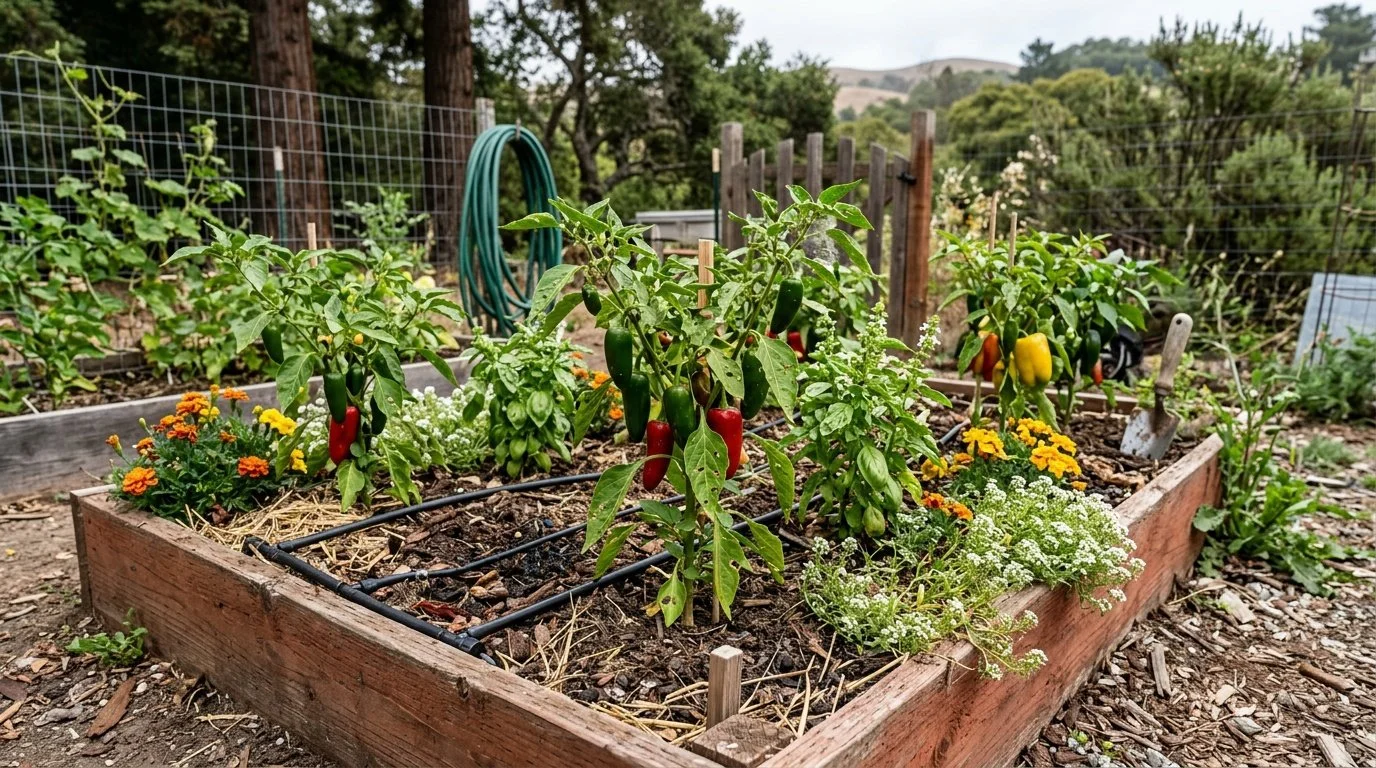
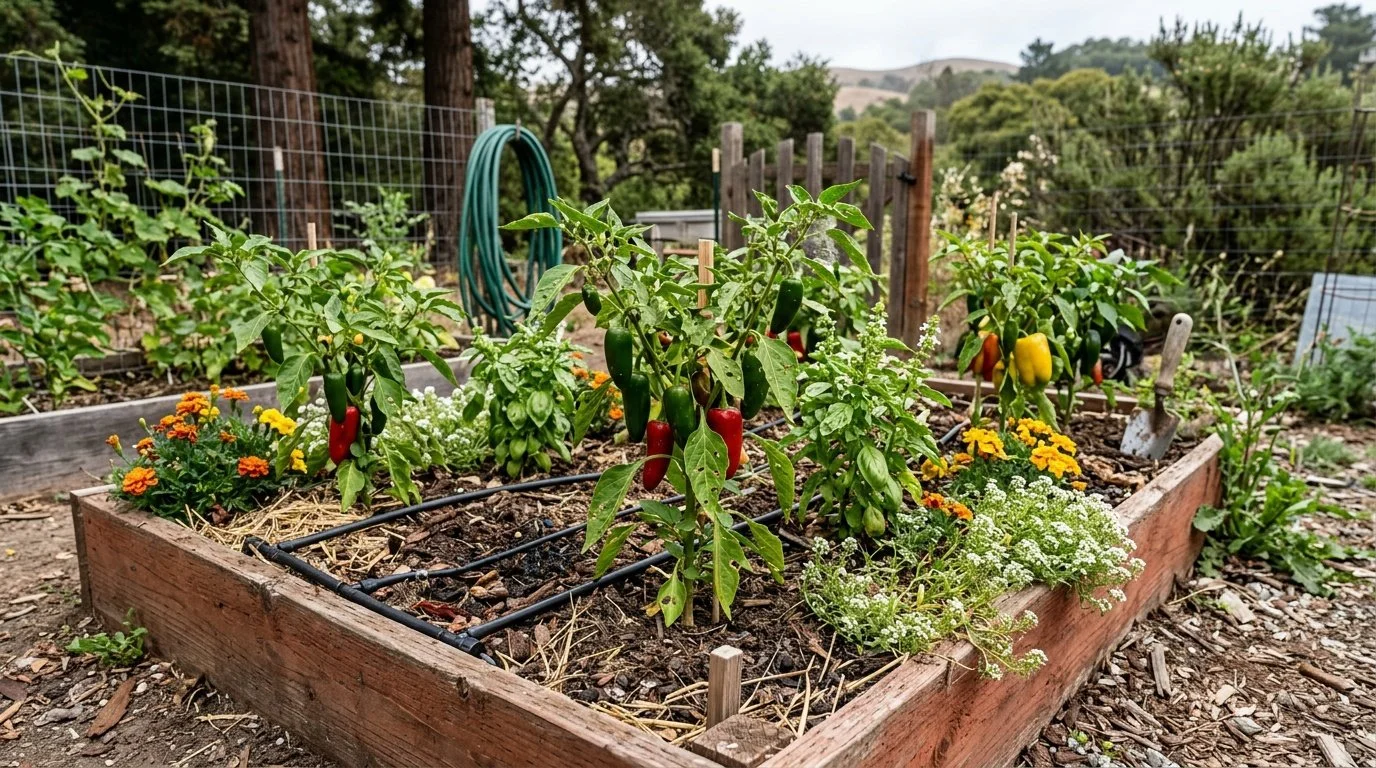
Peppers are among the most popular home garden crops in the U.S. (National Gardening Association survey data) and thrive in California's warm days and mild nights across USDA Zones 9 and 10. Companion planting around peppers can reduce aphid and flea beetle damage by up to 50 percent while boosting pollination rates, giving you more peppers per plant with fewer problems.
Peppers are slower to establish than many garden crops, which makes their companions especially important during the early weeks of the growing season. The right neighbors protect young pepper transplants from wind, attract the pollinators peppers need for good fruit set, and repel the pests that target tender new growth. After two decades of growing peppers in Santa Cruz, these are the 12 companions I rely on every season.
1. Basil
Basil is just as effective as a pepper companion as it is for tomatoes. The aromatic oils that give basil its signature scent, particularly linalool and eugenol, repel aphids, spider mites, and thrips, all of which target pepper plants in California. UC Master Gardeners note that basil planted near tomatoes may help protect them from thrips, and that aromatic plants work by masking a crop's scent rather than by driving pests off.
Best varieties: 'Genovese' basil is the all-around best choice for California pepper gardens. 'Purple Ruffles' provides visual contrast with green pepper foliage and is equally effective at pest deterrence. 'Spicy Globe' basil forms tight mounds perfect for edging pepper beds.
Spacing: Plant basil 10 to 14 inches from pepper stems. Both plants have similar water and nutrient needs, which makes them easy to manage together. In California's drier climate, grouping basil and peppers on the same drip irrigation line works well.
California timing: Transplant basil when you transplant your peppers, after nighttime temperatures are consistently above 55 degrees F. In coastal zones like Santa Cruz, that is usually late April or early May. Inland gardeners can plant both crops in mid-March to early April. growing peppers in California
2. Carrots
Carrots complement peppers by occupying a completely different root zone. Pepper roots grow in the top 12 inches of soil, while carrot taproots reach deeper. This means both crops can share the same bed without competing for water or nutrients. According to UC Master Gardeners, interplanting root and fruiting crops is one of the most efficient uses of raised bed space.
Best varieties: 'Nantes' types are smooth, sweet, and mature in about 70 days. 'Scarlet Nantes' is especially reliable in California soils. 'Thumbelina' is a round carrot variety that works in heavier clay soils common in parts of the Central Valley and Bay Area.
Spacing: Sow carrot seeds 4 to 6 inches from pepper plants, in rows between the peppers. Carrots appreciate the light shade that pepper foliage provides during the hottest months, which prevents the woody, bitter flavor that develops when carrot roots overheat.
California timing: Sow carrot seeds in April alongside your pepper transplants. Coastal gardeners can sow a second round in July for fall harvest. Carrots take 10 to 14 days to germinate, so keep the soil consistently moist during that initial period. growing carrots in California
3. Marigolds
Marigolds provide double duty in the pepper garden. Their roots suppress root-knot nematodes (a documented effect confirmed by UC Integrated Pest Management), and their bright flowers attract pollinators that peppers need for fruit set. Since pepper flowers require insect pollination for the best yields, having marigolds nearby can directly increase your harvest.
Best varieties: French marigolds (Tagetes patula) are the most researched for pest management. 'Petite Mix' stays under 10 inches tall and will not shade pepper plants. Signet marigolds (Tagetes tenuifolia) like 'Lemon Gem' have a lighter, citrusy scent and edible flowers.
Spacing: Plant marigolds 12 to 15 inches from pepper stems, along the outer edge of your pepper bed. A continuous border is more effective than scattered individual plants. In California, marigolds grow fast and fill in quickly, creating a solid barrier by midsummer.
California timing: Transplant marigold seedlings or direct sow seeds in March or April. They can go in 2 to 3 weeks before your pepper transplants since marigolds tolerate cooler temperatures. By the time your peppers are in the ground, the marigolds will already be establishing.
4. Oregano
Oregano is a Mediterranean herb that thrives in the same hot, well-drained conditions that peppers prefer, making it an easy companion in California gardens. UC IPM describes the pepper weevil as a common pest in southern California that survives year-round when winters are mild, so it is not a pressure most Santa Cruz County gardens face.
Best varieties: Greek oregano (Origanum vulgare subsp. hirtum) has the strongest aroma and best pest-repellent properties. 'Hot and Spicy' oregano is especially pungent. Italian oregano is milder but still effective and more versatile in the kitchen.
Spacing: Plant oregano 12 to 18 inches from pepper plants. Oregano spreads by runners and can become aggressive, so consider planting it in a bottomless pot sunk into the bed to contain its growth. One or two oregano plants per pepper bed is usually sufficient.
California timing: Transplant oregano starts in March or April. Oregano is a perennial in California and will return year after year, so place it at the edge of your pepper bed where it will not interfere with annual crop rotation. In coastal zones, oregano stays green through winter.
5. Spinach
Spinach makes an excellent early-season companion for peppers in California. It functions as a living mulch, shading the soil and retaining moisture while your pepper transplants are still small. According to UC IPM, keeping the root zone consistently moist, including the deeper soil layers while plants are still small, helps peppers establish and prevents the water stress that cuts fruit set.
Best varieties: 'Bloomsdale Long Standing' is the most bolt-resistant spinach for California's warming spring days. 'Space' is a smooth-leaf hybrid that handles warmer conditions well. 'Malabar' spinach (actually a different species) thrives in summer heat and can trail beneath pepper plants through the hottest months.
Spacing: Sow spinach seeds 4 to 6 inches from pepper transplants. Since spinach will be harvested before peppers reach full size, the close spacing is temporary. Harvest spinach leaves regularly so they do not compete with the peppers for light as temperatures rise.
California timing: Sow spinach 2 to 3 weeks before transplanting peppers, in March or early April. The spinach will be producing by the time your peppers go in. In coastal zones, spinach may last through June under pepper shade. Inland gardeners should plan to harvest all spinach by late May before heat causes bolting. our complete guide to growing greens in California
6. Dill
Dill is a powerful insectary plant that attracts beneficial insects to your pepper garden. When dill flowers, its umbrella-shaped blooms attract ladybugs, lacewings, parasitic wasps, and syrphid flies, all of which prey on aphids and other pepper pests. UC ANR research on aphid biological control names coriander, a member of the carrot family, alongside sweet alyssum as the insectary crops most commonly used on California's Central Coast to draw predatory insects.
Best varieties: 'Bouquet' dill flowers early and abundantly, maximizing its insectary value. 'Fernleaf' is a dwarf variety (18 inches) that stays compact next to peppers. Avoid 'Mammoth' dill, which can grow 4 feet tall and shade nearby pepper plants.
Spacing: Plant dill 12 to 18 inches from pepper stems. Place it on the north or east side of your pepper plants so it does not block afternoon sun. Let some dill plants flower rather than harvesting all the foliage; the flowers are the main attraction for beneficial insects.
California timing: Direct sow dill seeds in March or April. In California's mild climate, dill can be succession-sown every 3 to 4 weeks through July to ensure continuous flowering throughout the pepper season. Dill bolts quickly in heat, which is actually desirable since the flowers are the goal.
7. Beans (Bush Varieties)
Bush beans are a natural companion for peppers because they fix atmospheric nitrogen into the soil through a symbiotic relationship with Rhizobium bacteria. According to UC Cooperative Extension, legume cover crops and interplantings can contribute 50 to 200 pounds of nitrogen per acre to the soil, which benefits neighboring heavy feeders like peppers.
Best varieties: 'Provider' bush beans are cold-tolerant and produce early, which works well for getting beans established before pepper plants get large. 'Blue Lake 274' is a classic California variety. 'Royal Burgundy' has purple pods that are easy to spot when harvesting among green pepper foliage.
Spacing: Plant bush beans 10 to 12 inches from pepper stems. A row of beans on either side of your pepper row creates a nitrogen-rich corridor. Beans and peppers have similar water requirements, which simplifies irrigation in California's dry summers.
California timing: Sow bean seeds when you transplant your peppers, after soil temperatures reach 60 degrees F. In coastal California, that is typically late April. Inland gardeners can sow in mid-March. Beans germinate in 7 to 10 days and produce pods in about 55 days. our guide to growing beans and peas
8. Sweet Alyssum
Sweet alyssum is one of the most studied insectary plants in California agriculture. UC Davis research has shown that alyssum planted near vegetable crops significantly increases populations of beneficial insects, particularly syrphid flies whose larvae consume large numbers of aphids. For pepper growers, this translates directly to fewer aphids without spraying.
Best varieties: 'Carpet of Snow' is the standard choice for vegetable gardens because it stays low (3 to 4 inches) and spreads quickly. 'Clear Crystal Mix' includes purple and pink shades. Any white-flowered sweet alyssum is effective, and seed is inexpensive and widely available.
Spacing: Scatter alyssum seeds or transplant starts 6 to 10 inches from pepper plants, along bed edges and pathways. Alyssum forms a dense, flowering carpet that also suppresses weeds and reduces soil moisture evaporation, both significant benefits in California's dry climate.
California timing: Sow alyssum seeds in February or March, 4 to 6 weeks before pepper transplanting. This gives the alyssum time to establish and begin flowering before peppers need pest protection. In coastal California, sweet alyssum often persists year-round and reseeds prolifically.
9. Petunias
Petunias are an underused companion plant that deserves a spot in every California pepper garden. Gardeners report that petunias help deter aphids, tomato hornworms, and certain squash bugs, possibly through aromatic compounds in their foliage, though rigorous scientific research on this effect is limited. Their tubular flowers attract hummingbirds, which do consume small insects like aphids and whiteflies as a significant part of their diet.
Best varieties: 'Wave' series petunias spread vigorously and create excellent ground cover. 'Supertunia Vista Bubblegum' is a strong performer in California heat. Any spreading or trailing petunia variety works well as a living mulch beneath pepper plants.
Spacing: Plant petunias 12 to 18 inches from pepper stems, along the front or edges of your pepper bed. Trailing varieties will spread and fill gaps. Petunias and peppers have similar water needs, so they pair well on drip irrigation systems.
California timing: Transplant petunia starts in March or April, around the same time as pepper transplants. Petunias tolerate light frost and can go in a week or two earlier. In mild coastal zones, petunias may overwinter as short-lived perennials. They bloom continuously from spring through fall with regular deadheading.
10. Tomatoes
While some companion planting guides advise against planting peppers near other nightshades, the practical reality in California gardens is that tomatoes and peppers often grow well together, provided you have enough space and practice crop rotation. Both crops prefer the same warm conditions, similar soil pH (6.0 to 6.8), and regular deep watering. UC Master Gardener publications advise against planting nightshade family crops in the same garden area more than two years in a row, and recommend moving each plant family to a different spot each year.
Best approach: Plant peppers on the south or east side of tomato plants so they receive morning sun. Tomatoes grow taller and can provide afternoon shade that actually benefits pepper plants during California's hottest months, preventing sunscald on pepper fruit.
Spacing: Give tomato and pepper plants at least 24 to 36 inches of separation. This allows adequate air circulation to prevent fungal diseases and gives both crops room to spread. Do not crowd them in an attempt to save space.
California timing: Transplant both crops at the same time in spring, after nighttime temperatures stay above 55 degrees F. In my Santa Cruz garden, that is mid-April to early May. The key disease management strategy is rotating the entire nightshade group to a different bed each year. our California tomato growing guide
11. Buckwheat
Buckwheat (Fagopyrum esculentum) is a fast-growing cover crop that doubles as a companion plant. It attracts an enormous range of beneficial insects, including minute pirate bugs and parasitic wasps that attack pepper pests. The UC Davis SAREP cover crop database notes that buckwheat flowers about 30 days after sowing and draws profuse insect visitation, including syrphid flies and predatory wasps, though its flowers also attract lygus bugs.
Best approach: Grow buckwheat in strips or patches between pepper rows rather than as a dense stand. It blooms in just 30 to 35 days from sowing and can be cut back before it sets seed if you do not want volunteer plants. The flowers are white and highly attractive to pollinators.
Spacing: Sow buckwheat seeds in a band 12 to 18 inches from your pepper row. A strip 6 to 12 inches wide is sufficient. Buckwheat grows 2 to 3 feet tall, so place it on the north side of shorter pepper varieties to avoid shading.
California timing: Sow buckwheat in April or May, once soil temperatures reach 55 degrees F. It grows so fast that you can sow successive plantings every 4 to 6 weeks through August. Cut buckwheat at the soil line when it finishes blooming and leave the roots in place to decompose and feed soil biology.
12. Nasturtiums
Nasturtiums serve as a trap crop for aphids, drawing them away from your peppers and concentrating them on a plant you do not mind sacrificing. UC ANR notes that many California gardeners plant nasturtiums as a trap crop to draw aphids away from neighboring crops, though that is garden practice rather than a controlled research result. Nasturtium flowers also attract pollinators and are entirely edible, adding color to salads.
Best varieties: 'Jewel Mix' is compact and bushy, working well in smaller California gardens. 'Empress of India' has dark foliage with vivid red flowers. Trailing varieties like 'Spitfire' can be trained along bed edges or used as ground cover beneath taller pepper plants.
Spacing: Plant nasturtiums 18 to 24 inches from pepper plants, ideally on the outer edge of the bed where they can intercept aphids before they reach your peppers. Check nasturtiums weekly and remove heavily infested leaves to prevent aphid populations from building to levels that overwhelm both plants.
California timing: Direct sow nasturtium seeds in March or early April. Soak seeds overnight before planting for faster germination. In coastal California, nasturtiums bloom from late spring through the first frost (and sometimes beyond). They prefer cool to moderate temperatures and may struggle in extreme inland heat above 100 degrees F. natural pest control for California gardens
What Should You Avoid Planting Near Peppers?
Certain plants create problems when grown near peppers. Knowing what to keep away from your pepper bed is just as important as choosing good companions.
Fennel: Fennel releases allelopathic compounds from its roots that inhibit the growth of many nearby plants, including peppers. UC research confirms that fennel should be isolated from most vegetable crops. Plant fennel in its own container or at the far edge of your garden.
Kohlrabi and other brassicas: Brassicas compete with peppers for nutrients and can stunt pepper growth when planted too close. They also attract different pest complexes, and the cultural practices they need (heavier watering, cooler temperatures) conflict with what peppers prefer.
Apricot trees: A fungal disease called Verticillium wilt can live on apricot tree roots and spread to peppers. According to UC IPM, avoid planting peppers (or any nightshade family crop) within the drip line of apricot trees or in soil where apricot trees previously grew.
Mature dill: While young dill is a fine companion, fully mature dill that has gone to seed can release compounds that slightly inhibit pepper growth. The solution is simple: harvest or cut back dill before it sets seed, and succession-plant new dill every few weeks. crop rotation in small gardens
Timing companions is easier when you know where your peppers are in their season; see our pepper growth stages guide.
Frequently Asked Questions
Do pepper plants need pollinators to set fruit?
Pepper flowers are self-fertile, meaning they contain both male and female parts. However, insect pollination significantly improves fruit set and size. Research from agricultural extension programs shows that pepper plants visited by bees and other pollinators produce significantly more fruit, with improved seed set, larger fruit size, and faster maturation compared to those relying solely on wind and self-pollination. Companion plants that attract pollinators, like sweet alyssum, marigolds, and borage, directly improve your pepper harvest (UC ANR).
Can I plant hot peppers and sweet peppers near each other?
Yes. Despite a persistent garden myth, planting hot peppers near sweet peppers does not make the sweet peppers spicy. A pepper's heat level is determined by its genetics, not by cross-pollination with neighboring plants. According to UC Master Gardeners, peppers cross-pollinate easily, and the effect shows up in plants grown from saved seed the following year rather than in this season's fruit. You would only notice a difference if you saved seeds and grew them the following year.
How do I protect young pepper transplants with companions?
Plant fast-growing companions like spinach, lettuce, or sweet alyssum 2 to 3 weeks before transplanting peppers. These plants create a sheltered microclimate that protects tender pepper transplants from wind and temperature fluctuations. In exposed California gardens, a ring of established companion plants around each pepper transplant acts as a living windbreak during the critical first two weeks after transplanting (UC Master Gardener Program).
Should I remove companion plants if they start competing with my peppers?
Yes. Companion planting requires ongoing management. If a companion plant is visibly shading your pepper plants, competing for water, or growing into the pepper canopy, thin or remove it. Companions are there to support your peppers, not compete with them. Check your pepper garden weekly and trim or harvest companions that are encroaching on pepper space. The goal is a balanced ecosystem, not a crowded one (UC Cooperative Extension).
What is the single best companion plant for peppers in California?
If you can only choose one, plant sweet alyssum. It is low-growing enough that it never competes with peppers for light, it attracts a wide range of beneficial insects, it suppresses weeds, it reduces soil moisture loss, and it blooms continuously from spring through fall in California. UC Davis research on biological pest control consistently highlights sweet alyssum as one of the most effective insectary plants for California vegetable gardens. It is also inexpensive and easy to grow from seed.
Create a Thriving Pepper Garden with the Right Companions
Companion planting transforms a simple pepper patch into a productive, balanced garden ecosystem. You do not need to plant all 12 companions. Start with 2 or 3 from different functional categories (one for pest control, one for pollination, one for ground cover) and observe the results. In my experience, even a few well-chosen companions make a noticeable difference in pest pressure and harvest quality.
For more California-specific growing guides, planting schedules, and practical gardening tips, join our free email newsletter. We share weekly advice to help you grow more food in your California garden, no matter your experience level.
