

12 Best Companion Plants for Strawberries in California
12 Best Companion Plants for Strawberries
A few of the product links in this guide are affiliate links. If you buy through one, Ambitious Harvest may earn a small commission at no extra cost to you, which helps keep these guides free. We only point to gear we would use in our own Santa Cruz garden. As an Amazon Associate, we earn from Read our full disclosure.
California produces roughly 90 percent of the nation's strawberries (USDA/California Strawberry Commission), and the same climate that supports that commercial industry makes home strawberry gardens exceptionally productive in USDA Zones 9 and 10. Companion planting around your strawberry beds can reduce pest damage, attract pollinators for better fruit set, and even improve the flavor and size of your berries.
Strawberries grow low to the ground, which makes them vulnerable to slugs, soil-borne diseases, and competition from weeds. The right companion plants address all three of these challenges while making your strawberry patch more beautiful and productive. After growing strawberries in Santa Cruz for over 20 years (just miles from the commercial fields in Watsonville), these are the 12 companions I trust to protect and enhance my berry harvest.
1. Borage
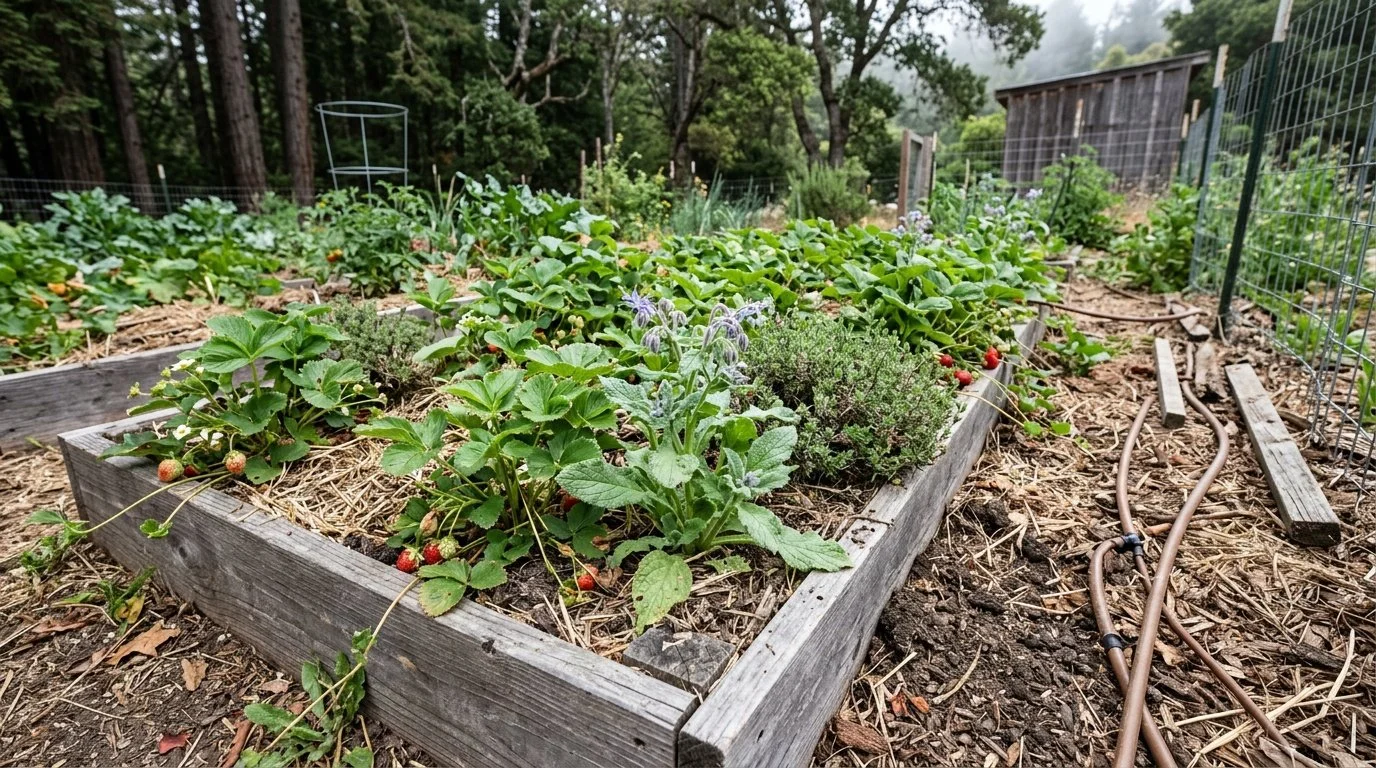
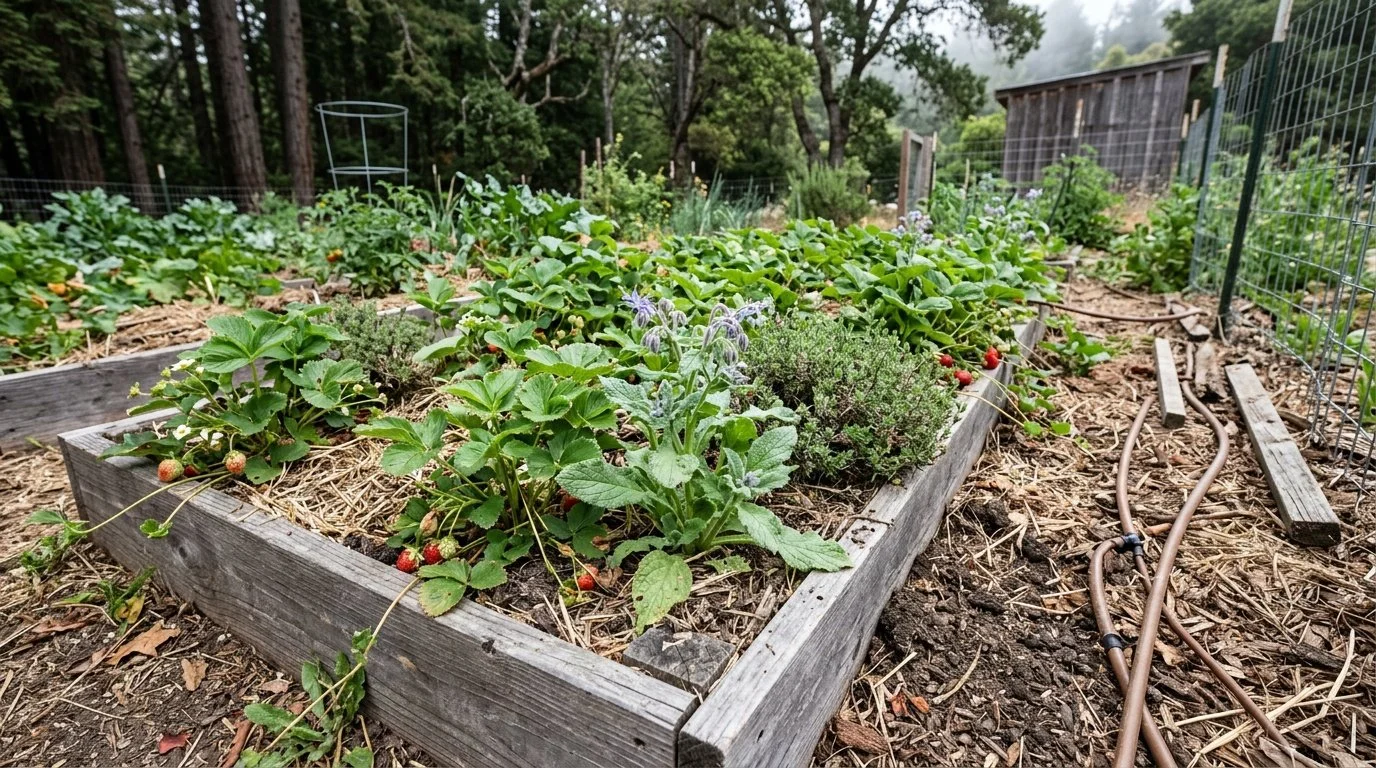
Borage is widely considered the single best companion plant for strawberries. Gardeners have reported for centuries that borage improves strawberry flavor and yield, and there is science to support this tradition. Borage attracts a tremendous number of pollinators, which strawberries need for full, well-formed fruit. UC IPM notes that strawberries are self-pollinating, and that misshapen berries in California gardens usually trace to lygus bug feeding on very small fruit rather than to a lack of pollinators.
Best varieties: Common blue borage is the standard choice. White borage ('Alba') is equally effective. Both self-seed readily in California, so you will likely only need to plant borage once. The flowers are edible and make a beautiful garnish for strawberry desserts.
Spacing: Plant borage 18 to 24 inches from the edge of your strawberry bed. Borage grows 2 to 3 feet tall and wide, so place it at the corners or ends of the bed where it will not shade the low-growing strawberry plants. One or two borage plants per 4-foot bed section is plenty.
California timing: Direct sow borage seeds in February or March. In my Santa Cruz garden, borage planted in late February is blooming by late April, perfectly timed for the start of strawberry season. Borage tolerates light frost and actually prefers cooler spring temperatures. our companion planting guide
2. Thyme
Thyme is a Mediterranean herb that thrives alongside strawberries in California's dry summers. Its dense, low-growing habit creates a living mulch that suppresses weeds, while its aromatic oils help deter common strawberry pests. Research from agricultural institutions in Europe (where companion planting with thyme is traditional) has shown that thyme reduces aphid colonization on nearby plants.
Best varieties: Creeping thyme (Thymus serpyllum) stays under 3 inches tall and spreads to form a fragrant carpet around strawberry plants. English thyme (Thymus vulgaris) grows slightly taller (6 to 8 inches) and produces more flowers. Lemon thyme has a citrusy scent that may offer additional pest-repellent properties.
Spacing: Plant thyme 8 to 12 inches from strawberry plants, in the spaces between rows or along bed edges. Creeping thyme can even be planted between strawberry plants as a ground cover. Both thyme and strawberries prefer well-drained soil and moderate watering.
California timing: Transplant thyme starts in February or March. Thyme is a perennial in all California zones and, once established, requires almost no care. It pairs well with strawberries because both plants prefer similar conditions: full sun, good drainage, and moderate water.
3. Garlic
Garlic is one of the most effective companions for deterring the pests and diseases that plague California strawberries. According to UC IPM, garlic's sulfur compounds have demonstrated antifungal and pest-repellent properties. Strawberry growers have long used garlic to help reduce the incidence of gray mold (Botrytis cinerea), one of the most common strawberry diseases in California's coastal fog zones.
Best varieties: Softneck garlic varieties like 'California Early' and 'Silverskin' are the best choice for most California gardens. They mature quickly and store well. For coastal gardens with milder winters, 'Inchelium Red' is a reliable producer with a pleasant flavor.
Spacing: Plant garlic cloves 6 to 8 inches from strawberry plants, in rows between the strawberry runners or along the edges of the bed. Garlic takes up minimal horizontal space and does not compete with strawberry plants for light.
California timing: Plant garlic cloves in October or November for a June harvest. This timing works perfectly with strawberries: the garlic is growing through winter and spring when strawberries are establishing and fruiting, then clears out in early summer as strawberry runners begin spreading for next year's crop. growing garlic in California
4. Chives
Chives share garlic's allium family pest-repellent properties but are easier to manage as a perennial companion. UC Master Gardeners note that onions can help keep aphids away from neighboring crops, though the effect comes from masking the host plant's scent rather than from sulfur compounds repelling pests. Chive flowers also attract pollinators and beneficial predatory insects.
Best varieties: Common chives (Allium schoenoprasum) produce purple flowers that attract bees and look beautiful alongside strawberries. Garlic chives (Allium tuberosum) have a stronger, more garlicky scent and bloom later in the season with white flowers, extending the period of pest deterrence.
Spacing: Plant chive clumps 8 to 10 inches from strawberry plants, along bed edges or between rows. Chives grow 12 to 15 inches tall and stay upright, so they do not shade strawberry plants. A row of chives along each side of a strawberry bed creates an aromatic border.
California timing: Transplant chive divisions in early spring (February or March) or fall (October). Chives are perennial in all California zones and return year after year with almost no maintenance. Divide established clumps every 3 to 4 years to keep them vigorous.
5. Lettuce
Lettuce and strawberries are natural companions because they share similar growing conditions and do not compete aggressively for space or nutrients. According to UC Master Gardeners, strawberries need 1 to 2 inches of water a week through the growing and fruiting season, soil that stays moist, and continued fertility as the season goes on. Lettuce functions as a living mulch between strawberry plants, shading the soil and helping retain the consistent moisture that strawberries need for sweet, juicy fruit.
Best varieties: 'Buttercrunch' forms compact heads that fit neatly between strawberry plants. 'Red Sails' provides visual contrast with its burgundy leaves. Any loose-leaf lettuce works well; avoid large romaine varieties that may shade strawberry crowns.
Spacing: Plant lettuce seedlings or sow seeds 6 to 8 inches from strawberry crowns. Tuck lettuce into the gaps between strawberry plants where runners have not yet filled in. Harvest outer lettuce leaves regularly to prevent crowding.
California timing: In coastal California, sow lettuce among strawberries almost any time of year. Inland gardeners should focus on fall through spring lettuce plantings, removing lettuce before summer heat causes bolting. The lettuce harvest neatly fills the gap before and after peak strawberry production. growing lettuce in California
6. Spinach
Spinach works alongside strawberries much like lettuce, providing ground cover and making efficient use of the spaces between strawberry plants. Spinach interplants well with strawberries, but it is not a light feeder: UC Cooperative Extension puts spinach nitrogen uptake at 80 to 125 pounds per acre, so plan on feeding the bed for both crops. Its flat, broad leaves shade the soil surface, which helps keep strawberry roots cool and moist during California's warming spring.
Best varieties: 'Bloomsdale Long Standing' is the most bolt-resistant spinach for California and holds well through the transition from cool spring to warm early summer. 'Space' is a smooth-leaf hybrid that tolerates more warmth than traditional varieties. 'Giant Nobel' produces large leaves in a compact footprint.
Spacing: Sow spinach seeds 4 to 6 inches from strawberry crowns, in the gaps between plants. Spinach grows upright enough that it does not smother strawberry runners or shade the berry clusters. Harvest spinach leaves from the outside in, leaving the center to continue growing.
California timing: Sow spinach in September or October for fall and winter harvest, or in February for spring harvest alongside spring-bearing strawberries. Spinach finishes naturally as temperatures warm in late spring, which is exactly when strawberry plants need more sun exposure for ripening fruit. our complete guide to growing greens in California
7. Sweet Alyssum
Sweet alyssum is one of the most effective insectary plants for California strawberry beds. UC Davis biological pest control research has shown that sweet alyssum significantly increases populations of syrphid flies, whose larvae consume large numbers of aphids, one of the most common strawberry pests. The low, spreading growth habit makes alyssum a natural fit alongside low-growing strawberry plants.
Best varieties: 'Carpet of Snow' stays under 4 inches tall and forms dense, fragrant mats. 'Clear Crystal White' has slightly larger flowers. Any white or purple sweet alyssum variety works well; the key is planting enough to create continuous blooming along your strawberry bed edges.
Spacing: Plant sweet alyssum 6 to 8 inches from strawberry plants, along the front edge of the bed or between rows. Alyssum and strawberries grow at roughly the same height, creating a cohesive, attractive planting. Alyssum also makes an excellent living mulch in pathways between raised strawberry beds.
California timing: Sow alyssum seeds in January or February, well before strawberry planting season. In coastal California, sweet alyssum blooms nearly year-round and often reseeds itself. You may only need to plant it once and it will return each year as a volunteer.
8. Marigolds
Marigolds provide critical root-knot nematode suppression for strawberry beds. According to UC Integrated Pest Management, root-knot nematodes are a significant pest of California strawberries, causing stunted growth and reduced yields. French marigold roots exude alpha-terthienyl, which is directly toxic to nematode larvae in the soil.
Best varieties: French marigolds (Tagetes patula) are the most effective for nematode control. 'Petite Mix' stays compact (8 to 10 inches) and does not overwhelm strawberry plants. 'Queen Sophia' produces large, bicolored flowers that attract pollinators. Avoid tall African marigolds that would shade the strawberry bed.
Spacing: Plant marigolds 12 to 15 inches from strawberry plants, along the border of the bed. For maximum nematode suppression, UC IPM notes French marigolds suppress root-knot nematodes best when grown as a solid stand for a full season, not intercropped, and advises cutting or mowing them before they flower to prevent reseeding. For ongoing companion planting, a border of marigolds is beneficial but less intensive.
California timing: Transplant marigold starts in March or April. Time them to begin blooming as strawberry flowers open, ensuring pollinators are attracted to the area during the critical fruit-set period. Marigolds tolerate California heat and bloom continuously from spring through fall.
9. Onions
Onions and their relatives are traditional strawberry companions because their strong scent may confuse and deter pest insects that locate strawberry plants by smell. UC research on allium compounds supports the pest-repellent properties of sulfur-containing vegetables. Onions also help deter slugs, which are a major strawberry pest in coastal California gardens.
Best varieties: 'Yellow Granex' (similar to Vidalia) is a mild, short-day onion that grows well in California's mild winters. Green onions (scallions) like 'Evergreen Hardy White' are quick to mature and fit easily between strawberry plants. Shallots are another good option that takes up little space.
Spacing: Plant onion sets or seedlings 6 to 8 inches from strawberry crowns, in rows between strawberry plants or along the bed edge. Green onions can be planted even closer (4 inches) since they grow vertically and take up minimal space.
California timing: Plant onion sets in October or November for spring harvest, which aligns perfectly with the strawberry growing season. Short-day onion varieties are the best choice for California's mild winters. Green onions can be planted almost any time of year in coastal zones. growing onions in California
10. Yarrow
Yarrow (Achillea millefolium) is a California native wildflower that excels at attracting beneficial predatory insects. UC ANR lists yarrow among the insectary plants that supply nectar and pollen to aphid predators such as lacewings, lady beetles, syrphid flies, and parasitic wasps.
Best varieties: Native California yarrow has white flowers and spreads via rhizomes. Ornamental varieties like 'Moonshine' (yellow) and 'Paprika' (red) are equally effective at attracting beneficials. Any yarrow variety works well; the flat flower heads provide landing platforms for small beneficial insects.
Spacing: Plant yarrow 18 to 24 inches from your strawberry bed, ideally along the edge or at the end of a row. Yarrow can spread aggressively through rhizomes, so give it a defined boundary. A border of yarrow along one side of your strawberry patch provides excellent beneficial insect habitat.
California timing: Transplant yarrow divisions or nursery starts in fall (October) or early spring (February). As a California native, yarrow is perfectly adapted to our climate, requires minimal irrigation once established, and provides year-round habitat for beneficial insects. It is drought-tolerant and thrives in the same sunny conditions that strawberries prefer.
11. Lupines
Lupines are nitrogen-fixing plants native to California that can improve soil fertility for neighboring strawberry plants. UC ANR notes that lupines belong to the pea family, which means they fix nitrogen in the soil and leave it behind for the plants that follow. California native lupines also support native bee populations that are excellent strawberry pollinators.
Best varieties: Arroyo lupine (Lupinus succulentus) is a California native annual that grows well in coastal and inland gardens. 'Russell Hybrids' are showier ornamental varieties that are equally effective at fixing nitrogen. Sky lupine (Lupinus nanus) is a smaller native species that works in compact gardens.
Spacing: Plant lupines 18 to 24 inches from strawberry plants. They grow 2 to 3 feet tall, so place them on the north side of the bed to avoid shading. A few lupine plants at the ends or corners of your strawberry patch provide nitrogen benefits without competing for space.
California timing: Sow lupine seeds in fall (October or November) for spring blooming, which aligns with strawberry flowering season. Native lupines are adapted to California's rainfall pattern and often reseed naturally. They bloom in March through May, attracting pollinators right when your strawberries need them most.
12. Sage
Sage (Salvia officinalis) is a strongly aromatic herb that helps deter slugs and snails, the most damaging pests in coastal California strawberry gardens. UC IPM lists sage among the plants with stiff leaves and highly scented foliage that snails and slugs find less appetizing, so it holds up better in a strawberry bed than tender neighbors do.
Best varieties: Common garden sage is the most effective choice for pest deterrence. 'Berggarten' has broad leaves and a compact habit that works well in small gardens. Purple sage ('Purpurascens') adds visual interest with its deep purple-green foliage. All culinary sage varieties share the same pest-repellent aromatic properties.
Spacing: Plant sage 15 to 18 inches from strawberry plants, along the outer border of the bed. Sage is a perennial shrub that grows 18 to 24 inches tall and wide, so position it where it will not shade the strawberry plants. One sage plant every 2 to 3 feet along the border provides good coverage.
California timing: Transplant sage starts in March or April, or in fall (October). Sage is a Mediterranean native that thrives in California's climate. It is drought-tolerant, deer-resistant, and low-maintenance once established. In my Santa Cruz garden, sage stays green and fragrant year-round.
What Should You Avoid Planting Near Strawberries?
Some plants create problems when grown too close to strawberries. Avoiding these pairings helps protect your strawberry harvest from unnecessary pest and disease pressure.
Brassicas (cabbage, broccoli, cauliflower): These heavy feeders compete with strawberries for nutrients, particularly nitrogen. They also attract pests like cabbage moths that may damage strawberry foliage. UC IPM actually puts brassicas into the strawberry rotation: remove old strawberry plants in late summer, grow a winter crop of cauliflower, cabbage, or another crucifer, then till the residue in and solarize before replanting strawberries.
Fennel: Fennel's allelopathic root exudates inhibit the growth of many nearby plants, including strawberries. Keep fennel isolated in its own container or at the far edge of your garden.
Tomatoes, peppers, and eggplant: These nightshade family crops share several diseases with strawberries, particularly Verticillium wilt. According to UC IPM, Verticillium dahliae persists in the soil and can infect both nightshades and strawberries. Avoid planting strawberries in soil where nightshades grew within the past 3 years.
Mint: While mint's scent may deter some pests, its aggressive spreading habit makes it a poor bed companion for strawberries. Mint will quickly overwhelm a strawberry patch, competing for space and nutrients. If you want mint near your strawberries, grow it in a container placed beside the bed. crop rotation in small gardens
Frequently Asked Questions
Do strawberries really taste better when planted near borage?
Many experienced gardeners report improved strawberry flavor when borage is planted nearby. While the mechanism is not fully understood scientifically, the most likely explanation is that borage attracts pollinators that improve fruit set, resulting in larger, better-developed berries with more concentrated flavor. Improved pollination leads to more uniform seed development across the berry surface, which directly affects size, shape, and sweetness (UC Davis Strawberry Center).
How do I keep slugs away from strawberries in coastal California?
Companion planting is one layer of slug management. Aromatic herbs like sage, thyme, and rosemary planted around your strawberry bed create scent barriers that slugs prefer to avoid. Garlic and onion companions may also deter slugs through their sulfur compounds. Combine companion planting with physical barriers like copper tape around raised beds, and hand-pick slugs during evening patrols. UC IPM recommends an integrated approach rather than relying on any single strategy.
Can I grow strawberries and blueberries together?
Strawberries and blueberries have very different soil pH requirements. Blueberries need acidic soil (pH 4.5 to 5.5), while strawberries prefer slightly acidic to neutral soil (pH 5.5 to 6.8). UC Master Gardeners put the blueberry's desired soil pH at 4.5 to 5.5 and warn that above 5.5 the leaves yellow between the veins, so give blueberries their own bed or container rather than the strawberry bed. If you want both crops, grow them in separate beds or containers where you can manage soil pH independently. They do not interfere with each other when grown nearby in separate beds.
Should I mulch around strawberry companion plants?
Yes, but choose your mulch carefully. Straw is the traditional mulch for strawberries (hence the name) and works well around companion plants too. UC Marin Master Gardeners recommend mulching strawberries to keep the fruit off the ground and hold down Botrytis fruit rot, naming plastic mulch or organic alternatives such as pine needles or oak leaves. Avoid wood chip mulch directly around strawberry crowns, as it retains too much moisture and can promote crown rot in California's winter rains.
How many companion plants should I include in a small strawberry bed?
For a standard 4-by-8-foot raised bed, 2 to 3 companion species is ideal. Choose one pollinator attractor (borage or sweet alyssum), one pest deterrent (garlic, chives, or thyme), and optionally one ground cover or interplant (lettuce or spinach). Avoid overcrowding; strawberries need good air circulation to prevent fungal diseases, which are a significant concern in California's coastal fog zones. Leave enough space for strawberry runners to fill in naturally (UC Master Gardener Program).
Do companion plants help with Verticillium wilt in strawberries?
Companion plants alone cannot cure or fully prevent Verticillium wilt, a serious soil-borne fungal disease in California strawberry production. However, marigolds can suppress the pathogen when grown as a pre-planting cover crop. For Verticillium, UC IPM says rotating to nonhosts can reduce the pathogen in the soil, and that soil solarization and resistant cultivars help minimize problems. Avoiding nightshade family crops (tomatoes, peppers, eggplant) in beds where you plan to grow strawberries is the single most important preventive step.
Create a Healthier Strawberry Patch with Companions
California is strawberry country, and your home garden can produce berries that rival anything you find at the farmers market. Companion planting gives your strawberries natural pest protection, better pollination, and healthier soil without synthetic inputs. Start with borage and one aromatic herb this season, and you will see the difference in your harvest.
For more California-specific growing guides, seasonal planting schedules, and practical gardening tips, sign up for our free newsletter. We share weekly advice to help you grow more food in your California garden.
[EMAIL SIGNUP CTA]
