

10 Best Companion Plants for Cucumbers in California
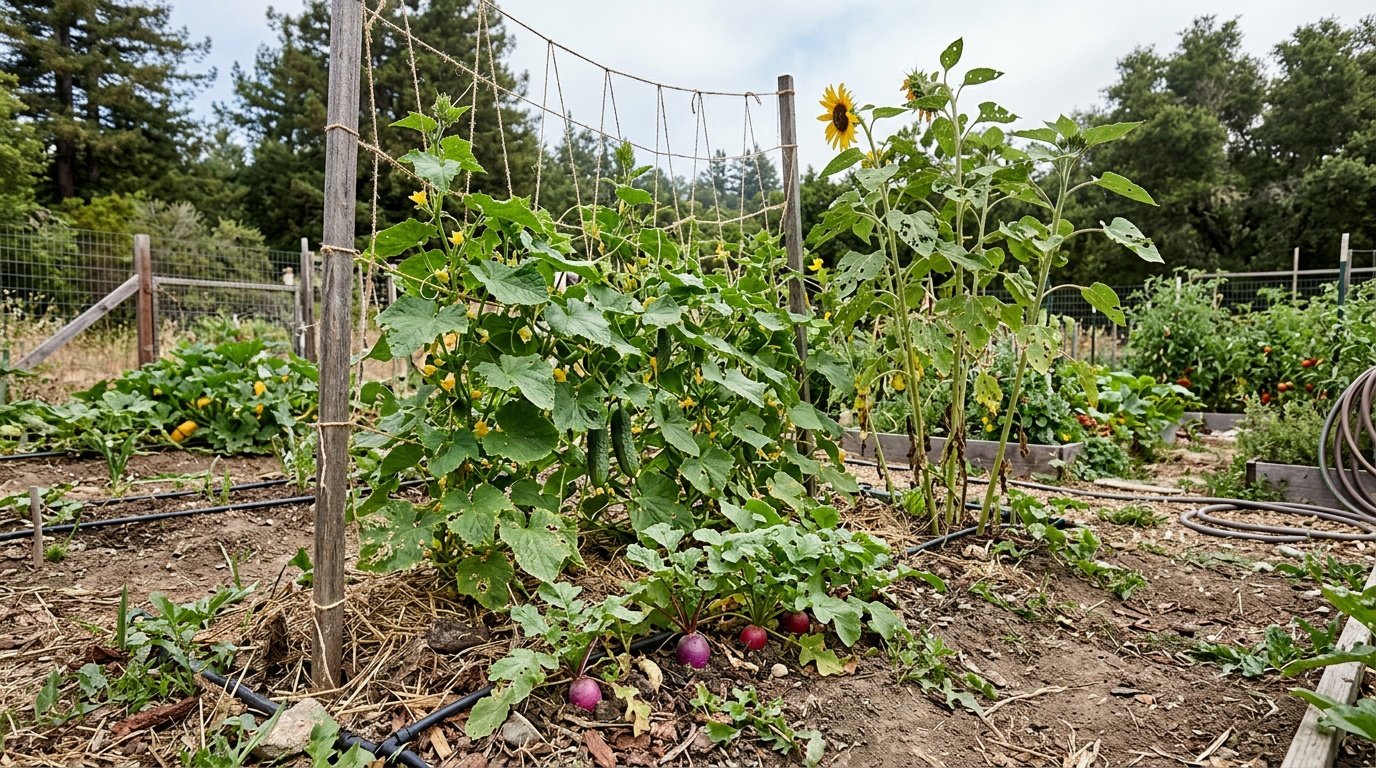
10 Best Companion Plants for Cucumbers
According to UC Integrated Pest Management, cucumbers face significant pest pressure from aphids, cucumber beetles, and spider mites in California gardens, with companion planting shown to reduce pest damage when combined with other cultural controls (UC IPM Pest Notes). Choosing the right companion plants for your cucumber bed can deter pests, attract pollinators for better fruit set, and make more efficient use of your California garden space.
Cucumbers grow quickly in California's warm summers, producing vines that spread across the ground or climb a trellis. That growth habit creates opportunities for smart companion plantings that use the spaces cucumbers leave open. After growing cucumbers in Santa Cruz for over 20 years, I have found these 10 companions to be the most reliable and beneficial in our California climate.
1. Sunflowers
Sunflowers and cucumbers are a natural pairing in the garden. Sunflower stalks can serve as living trellises for cucumber vines, while sunflower heads attract pollinators that cucumbers depend on for fruit set. According to UC Davis, most cucumbers need insect pollination, primarily by bees, and inadequate pollination often leaves fruit misshapen and undersized.
Best varieties: 'Mammoth Russian' grows sturdy, thick stalks that can support lightweight cucumber varieties. 'Lemon Queen' produces multiple flower heads on branching stems, maximizing pollinator attraction. Avoid dwarf sunflower varieties if you plan to use them as trellises; you need varieties that reach at least 6 feet.
Spacing: Plant sunflowers 24 to 30 inches from cucumber hills, on the north side so they do not shade young cucumber seedlings. Once cucumbers begin to vine, gently train them toward the sunflower stalks. Heavier cucumber varieties like slicers may need supplemental support.
California timing: Sow sunflower seeds 2 to 3 weeks before planting cucumbers, in March or early April. This gives sunflowers a head start so their stalks are sturdy enough to support cucumber vines by the time the cucumbers begin climbing in late May or June. vertical gardening techniques
2. Radishes
Radishes are one of the most practical cucumber companions because they serve as a trap crop for flea beetles and a soil loosener. UC Master Gardeners pair radishes with slower crops because the radishes are pulled long before the other plants need the space, not because radish roots loosen the soil. Radishes also germinate and mature so quickly (25 to 35 days) that they are harvested long before cucumbers need the space.
Best varieties: 'Cherry Belle' matures in just 22 days and is nearly foolproof. 'French Breakfast' is slightly longer and handles California's warming spring well. For a pest trap approach, try planting a few extra 'Daikon' radishes and letting them flower; the blooms attract beneficial insects.
Spacing: Sow radish seeds 3 to 4 inches from cucumber seeds or transplants. Radishes stay small and grow quickly enough that they never compete with cucumbers. You can interplant radish seeds directly in the cucumber hill, sowing them in a ring around the cucumber seeds.
California timing: Sow radish seeds at the same time as cucumber seeds, in April or May. The radishes will be ready to harvest before the cucumber vines start spreading. In coastal California, you can succession-plant radishes every 2 weeks through fall.
3. Dill
Dill attracts beneficial predatory insects that feast on common cucumber pests. When dill flowers, its umbrella-shaped blooms attract parasitic wasps, ladybugs, and lacewings. UC ANR research on aphid biological control notes that sweet alyssum and coriander, a member of the carrot family, are the insectary crops most commonly used on California's Central Coast.
Best varieties: 'Bouquet' dill flowers early and profusely, which is exactly what you want for pest management. 'Fernleaf' is a compact variety (18 inches) that works well in smaller California gardens. Both varieties produce edible leaves and seeds for the kitchen.
Spacing: Plant dill 12 to 18 inches from cucumber plants, on the east or south side of the bed where it will receive full sun. Let some dill plants bolt and flower rather than harvesting all the foliage. The flowers are the primary benefit for your cucumber garden.
California timing: Direct sow dill seeds alongside your cucumber seeds in April or May. Dill bolts quickly in California heat, which is actually an advantage here since the flowers attract beneficial insects. Sow new dill seeds every 3 to 4 weeks through July to maintain continuous flowering near your cucumbers. our guide to growing herbs
4. Nasturtiums
Nasturtiums are an effective trap crop for aphids, drawing them away from your cucumber vines. UC ANR notes that many gardeners plant nasturtiums as a trap crop to draw aphids away from neighboring crops, though that is long-standing garden practice rather than a controlled research result. Nasturtiums also repel some species of cucumber beetles through compounds in their foliage, and their trailing habit makes them excellent ground covers beneath cucumber trellises.
Best varieties: Trailing varieties like 'Spitfire' and 'Jewel Mix' create dense ground cover that suppresses weeds and retains soil moisture. 'Empress of India' has striking dark foliage with crimson flowers. 'Alaska' features variegated leaves that brighten the garden.
Spacing: Plant nasturtium seeds 18 to 24 inches from cucumber plants. When cucumbers are grown on a trellis, nasturtiums make an ideal ground cover beneath the trellis, filling the open space that would otherwise grow weeds. Allow nasturtiums to spread but trim them if they start climbing the trellis and competing with cucumbers.
California timing: Direct sow nasturtium seeds in March or April, soaking seeds overnight for faster germination. In coastal California, nasturtiums bloom from late spring through fall. They prefer cooler temperatures and may struggle during extreme inland heat waves, but they recover quickly when temperatures moderate. natural pest control for California gardens
5. Corn
Corn is a classic cucumber companion in the "Three Sisters" planting tradition, where corn provides a trellis, beans fix nitrogen, and squash or cucumbers shade the ground. While the original Three Sisters used squash, cucumbers work well in this system too. UC ANR has documented the agricultural principles behind this Indigenous planting method, noting that the three crops complement each other's nutrient and space requirements.
Best varieties: 'Golden Bantam' sweet corn grows sturdy stalks that can support small-fruited cucumber varieties like 'Lemon' or 'Armenian'. 'Silver Queen' produces tall, strong stalks. For this pairing to work, choose a pickling or small-fruited cucumber rather than a heavy slicer.
Spacing: Plant corn in blocks (not single rows) with 12-inch spacing between stalks. Place cucumber seeds 12 to 18 inches from the outer edge of the corn block. As the cucumbers vine, they will climb the corn stalks. Three to four cucumber plants per corn block is usually the right density.
California timing: Plant corn 2 to 3 weeks before cucumbers to give the stalks time to develop. In coastal California, sow corn in April and cucumbers in late April or May. Inland and desert gardeners can start corn in mid-March. The corn needs to be at least 12 inches tall before cucumber vines start reaching for it.
6. Beans (Bush or Pole)
Beans fix nitrogen from the atmosphere into the soil through their symbiotic relationship with Rhizobium bacteria. According to UC Cooperative Extension, the nitrogen that legume root bacteria fix becomes available to the legume and the soil around its roots, and working the spent plants into the bed afterward renews nitrogen for heavy feeders like cucumbers. Pole beans also make excellent trellis companions when grown alongside cucumbers on the same support structure.
Best varieties: 'Blue Lake' bush beans are reliable and compact. 'Kentucky Wonder' pole beans can share a trellis with cucumber vines. For the traditional Three Sisters approach, 'Scarlet Runner' beans are vigorous climbers with edible flowers and pods.
Spacing: Plant bush beans 8 to 10 inches from cucumber plants. If growing pole beans and cucumbers on the same trellis, alternate them along the trellis with 12-inch spacing. Both crops climb readily, so provide a sturdy support that can handle the combined weight.
California timing: Sow bean seeds at the same time as cucumber seeds, after soil temperatures reach 60 degrees F. In coastal California, that is late April. Inland gardeners can plant in mid-March to early April. Both crops have similar germination requirements. our guide to growing beans and peas
7. Sweet Alyssum
Sweet alyssum is the top insectary plant recommended by UC Davis for California vegetable gardens. Its tiny flowers produce nectar and pollen that support syrphid flies, parasitic wasps, and other beneficial insects. The larvae of syrphid flies are voracious aphid predators, and attracting their adult stage to your cucumber bed with alyssum is one of the most effective biological pest control strategies available.
Best varieties: 'Carpet of Snow' stays under 4 inches tall and forms a dense, white-flowered carpet. 'Easter Bonnet' includes purple and pink shades. Any standard sweet alyssum variety is effective; the key is planting enough to create a continuous flowering border.
Spacing: Scatter alyssum seeds or plant starts 6 to 10 inches from cucumber stems, along bed edges and pathways. Alyssum forms a living mulch that suppresses weeds, reduces soil moisture evaporation, and keeps the soil surface cool, all important benefits in California's dry climate.
California timing: Sow alyssum seeds in February or March, 6 to 8 weeks before your cucumber planting date. This gives alyssum time to establish and begin flowering before cucumber pest pressure begins. In coastal California, sweet alyssum often persists year-round and reseeds itself each spring.
8. Oregano
Oregano's strong aromatic oils make it an effective pest repellent for the cucumber garden. The same compounds that give oregano its pungent flavor (carvacrol and thymol) have documented insect-repellent properties.
Best varieties: Greek oregano has the strongest aroma and most effective pest-repellent properties. 'Hot and Spicy' oregano is especially pungent. Both thrive in California's Mediterranean climate and require less water than cucumbers, so plant them at the edge of the bed where irrigation is lighter.
Spacing: Plant oregano 15 to 18 inches from cucumber plants, along the edge of the bed. Oregano is a perennial in California and will spread over time, so consider planting it in a pot sunk into the soil to contain its growth. One or two plants is sufficient for a standard cucumber bed.
California timing: Transplant oregano starts in March or April. Since oregano is perennial in all California zones, place it at a permanent bed edge where it will not be disturbed by seasonal cucumber planting and rotation.
9. Lettuce
Lettuce is a practical companion that makes excellent use of the shaded ground beneath trellised cucumber vines. As cucumber plants climb and their leaves create an overhead canopy, the dappled shade below becomes ideal for growing lettuce during California's hot months, a time when lettuce in full sun would bolt and turn bitter.
Best varieties: 'Black Seeded Simpson' is a loose-leaf variety that tolerates shade well. 'Red Sails' handles warmth better than most lettuces. For sustained harvest under cucumber vines, grow a mesclun mix and harvest outer leaves regularly.
Spacing: Sow lettuce seeds 6 to 8 inches from the base of trellised cucumber plants. As the cucumber canopy develops overhead, the lettuce benefits from the cooling shade. This works best with vertically grown cucumbers; ground-running cucumber vines will overtake lettuce plantings.
California timing: Sow lettuce seeds alongside cucumber transplants in late April or May. In coastal gardens like mine in Santa Cruz, under-trellis lettuce can produce well into August, much longer than lettuce in full sun. Inland gardeners should focus on spring lettuce that matures before extreme heat arrives. growing lettuce in California
10. Marigolds
Marigolds bring pest protection and pollinator attraction to the cucumber garden. UC IPM does confirm that certain marigolds suppress root-knot nematodes, with French marigolds the most effective, but it also cautions that marigolds planted among vegetables usually do not control nematodes well and work best as a solid planting held for a full season. Above ground, marigold flowers attract bees and other pollinators that cucumbers depend on for fruit development.
Best varieties: French marigolds (Tagetes patula) have the strongest nematode-suppressing effect. 'Petite Mix' stays compact at 8 to 10 inches. Signet marigolds (Tagetes tenuifolia) like 'Tangerine Gem' have fine, ferny foliage and a lighter scent that some gardeners prefer near food crops.
Spacing: Plant marigolds 12 to 15 inches from cucumber plants, along the border of the bed. A continuous row is more effective than scattered individuals. For nematode control, UC IPM says marigolds work best as a solid planting held for an entire season, not intercropped with vegetables, so the bed comes out of marigolds before cucumbers go in.
California timing: Transplant or direct sow marigolds in March or April. They establish quickly and begin blooming 6 to 8 weeks after planting. Marigolds tolerate California heat well and bloom continuously until frost, providing season-long pest management for your cucumbers.
What Should You Avoid Planting Near Cucumbers?
Several common garden plants create problems when planted too close to cucumbers. Avoiding these pairings can prevent disappointing harvests and unnecessary pest pressure.
Potatoes: Cucumbers and potatoes compete heavily for water and nutrients. More importantly, both can be affected by Phytophthora species (P. infestans on potatoes, P. capsici on cucumbers), and planting them near each other in damp conditions increases the risk of disease issues. Cucumbers and potatoes compete heavily for water and nutrients, so give each its own room. For the Phytophthora root rot that does affect cucurbits, UC IPM advises planting in high, well-drained beds, avoiding heavy clay soils, and never letting water saturate the beds.
Melons: While melons and cucumbers are both cucurbits, planting them together concentrates pest pressure from cucumber beetles, squash bugs, and powdery mildew. Separate cucurbits by as much distance as possible in your garden to reduce these shared pest and disease issues.
Aromatic herbs in excess: While some herbs (dill, oregano) benefit cucumbers, strongly aromatic herbs like sage and mint planted in large quantities very close to cucumber plants may inhibit their growth. Use aromatic herbs strategically at bed edges rather than interplanted directly among cucumber vines.
Fennel: As with most vegetable crops, fennel should not be planted near cucumbers. Its allelopathic root exudates inhibit the growth of many nearby plants. Keep fennel in its own container or at the far edge of your garden. our companion planting guide
To time your companion plantings to the crop itself, see our cucumber growth stages guide for the full seed-to-harvest timeline.
Frequently Asked Questions
Can I grow cucumbers and squash near each other?
While cucumbers and squash will not cross-pollinate (they are different species), planting them together concentrates pest pressure from shared enemies like cucumber beetles and squash bugs. UC IPM's answer to shared cucurbit pests is sanitation and covers rather than spacing: pull old cucurbit plants after harvest, keep the garden clear of debris, and use row covers where squash bugs have been a problem, removing them at bloom for pollination. If space is limited, interplant pest-deterrent companions like nasturtiums and marigolds between the two crops to create a buffer that breaks up the pest habitat.
Do cucumbers really need pollinators to produce fruit?
Most cucumber varieties require insect pollination for proper fruit development. According to UC Davis, each cucumber flower needs multiple bee visits for complete pollination. Poorly pollinated cucumbers are often misshapen, curved, or small at one end. Parthenocarpic (seedless) cucumber varieties can set fruit without pollination, but standard garden varieties depend on bees. Companion plants that attract pollinators directly improve your cucumber harvest (UC ANR).
How does growing cucumbers on a trellis change companion planting options?
Trellising cucumbers vertically opens up valuable ground space for companion plants. The shaded area beneath a cucumber trellis becomes ideal for shade-tolerant crops like lettuce, spinach, and sweet alyssum. Trellised cucumbers also have better air circulation, which reduces fungal disease pressure. UC Master Gardeners recommend growing cucumbers vertically in California because a trellis saves space, gives better shaped fruit, reduces contact with soil-borne diseases and pests, and makes harvesting easier.
Will dill cross-pollinate with cucumbers?
No. Dill and cucumbers are in completely different plant families and cannot cross-pollinate. This is a common misunderstanding. The concern about planting dill near cucumbers comes from older companion planting guides that suggested mature dill might inhibit cucumber growth, but this effect has not been confirmed in controlled research. Letting a few dill plants mature and flower is what draws in the pest-eating insects, so leave some to bolt near the cucumbers rather than cutting every plant for the kitchen (UC Cooperative Extension).
What is the best companion for cucumbers in containers?
Sweet alyssum is the best container companion for cucumbers because it stays low, attracts beneficial insects, and does not compete for root space in limited soil volume. Plant a ring of alyssum around the edge of a large container (at least 5 gallons) with the cucumber in the center. Nasturtiums also work in containers but need more space. Avoid large companions like sunflowers or corn in container plantings, as the root competition will reduce your cucumber harvest (UC Master Gardener Program).
Build a Better Cucumber Garden with Companions
Companion planting does not have to be complicated. Start with one or two companions from this list and expand as you learn what works in your specific California garden. In my experience, even simple pairings like cucumbers with sunflowers and sweet alyssum produce noticeably healthier plants and better harvests than cucumbers grown alone.
For more California-specific growing guides, planting schedules, and practical gardening tips, join our free email newsletter. We share weekly advice to help you grow more food in your California garden.
[EMAIL SIGNUP CTA]
