

Vertical Gardening: Growing Upwards to Save Space
A few of the product links in this guide are affiliate links. If you buy through one, Ambitious Harvest may earn a small commission at no extra cost to you, which helps keep these guides free. We only point to gear we would use in our own Santa Cruz garden. As an Amazon Associate, we earn from qualifying purchases. Read our full disclosure.
What Is Vertical Gardening and Why Does It Work So Well in Small Spaces?
Vertical gardening is the practice of growing plants upward on trellises, walls, towers, and other structures rather than spreading them across horizontal ground space. Growing vertically can sharply increase yield per square foot of ground compared to conventional row spacing, because trellised crops use vertical space that would otherwise sit empty planting. For Santa Cruz County gardeners working with compact yards, narrow side lots, or shared outdoor spaces, growing upward is one of the most effective strategies for producing more food in less room.
The Central Coast climate is particularly well-suited to vertical gardening. Our mild temperatures, long growing season, and moderate winds (compared to exposed inland valleys) mean that vertical structures stay productive from early spring through late fall. Vining crops that struggle with ground-level moisture and slug damage in our damp coastal conditions often perform better when lifted off the soil on trellises and supports. This guide covers the structures, crops, and techniques that work best for vertical growing in Santa Cruz County.
What Types of Vertical Structures Can You Build or Buy?
Vertical gardening structures range from simple stakes and string to elaborate living wall systems. The best choice depends on your space, budget, and what you want to grow.
A-frame trellises are one of the most versatile and space-efficient options. Two panels of cattle panel, welded wire, or wooden lattice lean together to form an inverted V shape. Vining crops grow up both sides, and the shaded space underneath provides an ideal microclimate for lettuce and other shade-loving greens. A 6-foot A-frame trellis takes up about 4 feet of ground space but provides 48 square feet of growing surface.
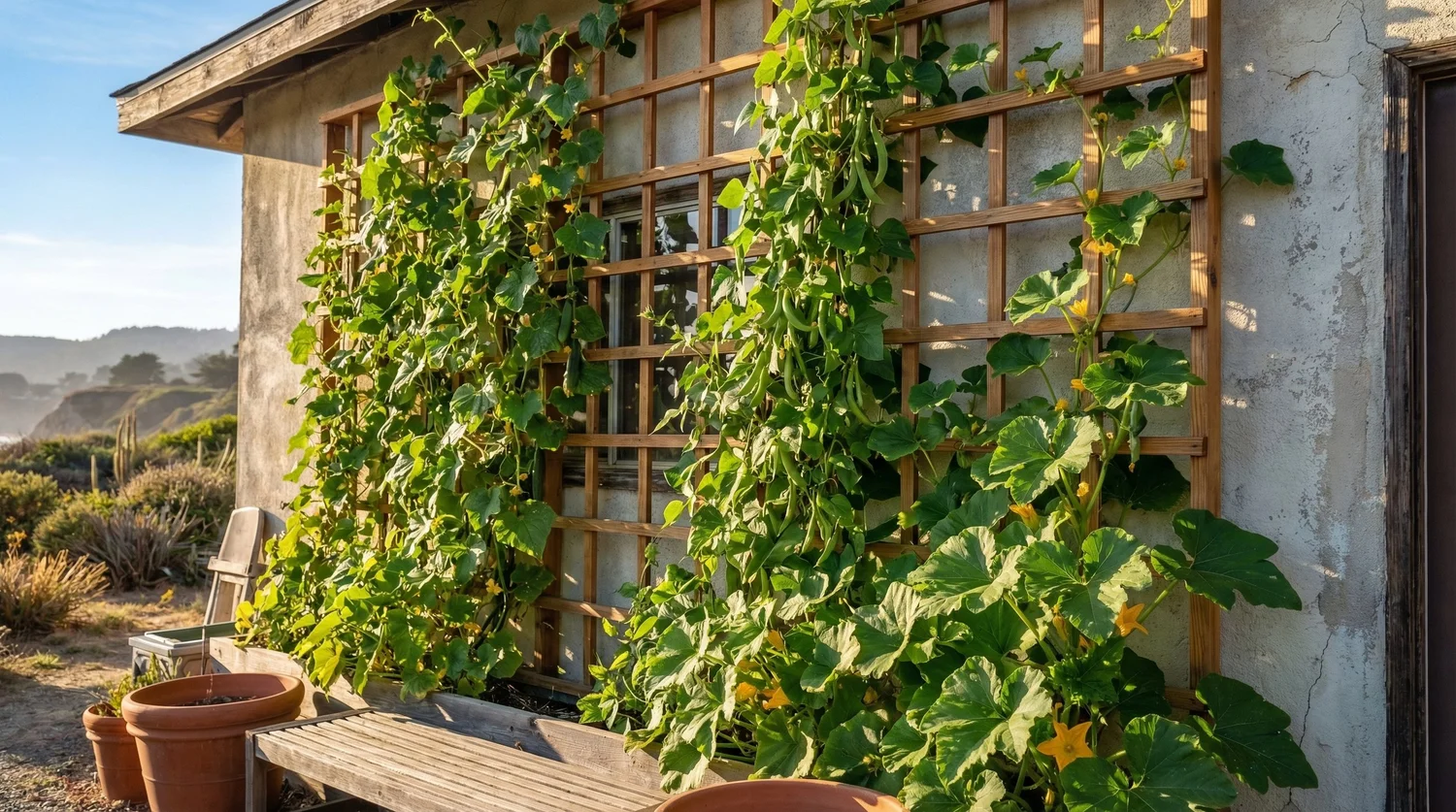
Flat panel trellises mounted against a fence or wall work well for crops that need strong support, like pole beans, cucumbers, and small melons. Cattle panels (16 feet by 50 inches, available at farm supply stores) are extremely durable and can be cut to size with bolt cutters. Attach them to fence posts or a simple wooden frame. Many Santa Cruz gardeners use these along property-line fences to grow food without sacrificing yard space.
Arch trellises create beautiful garden entryways while providing growing space. A cattle panel bent into an arch over a garden path supports pole beans, cucumbers, or lightweight squash varieties. The arch shape is naturally strong and the crops hang down inside the tunnel for easy picking.
String and twine systems are the simplest vertical supports. Run horizontal strings between posts at the top and bottom, then tie vertical twine lines every 12 inches for beans or tomatoes to climb. This method costs very little and can be customized to any space. Use natural jute twine that you can compost at the end of the season.
Tower gardens and vertical planters stack planting pockets in a columnar arrangement. Commercial tower systems use a central reservoir and pump to circulate water and nutrients. DIY versions can be made from stacked pots, PVC pipe with planting holes, or fabric shoe organizers mounted on a wall. These work particularly well for herbs and strawberries.
Living walls and pocket planters attach directly to exterior walls or fences. Felt pocket planters, modular panel systems, and mounted planter boxes create green walls that produce food while adding visual interest to blank surfaces. These are popular for herbs, strawberries, and small leafy greens. Ensure adequate irrigation, as living wall systems dry out quickly.
Which Crops Grow Best Vertically in Santa Cruz County?
The best vertical crops are either natural climbers that grab onto supports themselves or plants compact enough to grow in wall-mounted containers. Our Central Coast climate gives us a wider selection than most regions because our long, mild growing season allows vining crops plenty of time to mature.
Pole beans are the classic vertical crop. They climb aggressively, produce heavily, and fix nitrogen in the soil. 'Kentucky Wonder,' 'Blue Lake Pole,' and 'Rattlesnake' are all reliable in Santa Cruz County. A single 8-foot trellis panel planted with pole beans can produce pounds of beans throughout the summer and into fall.
Cucumbers are natural climbers that produce straighter, cleaner fruit when grown vertically. Train them up a trellis or netting and the cucumbers hang down for easy harvest. 'Marketmore 76' and 'Suyo Long' are excellent varieties for our area. Vertical growing also improves air circulation around the leaves, reducing the powdery mildew that plagues cucumbers in our humid coastal air.
Peas are cool-season climbers perfect for spring and fall vertical growing. Snow peas and sugar snap varieties like 'Oregon Sugar Pod' and 'Sugar Snap' climb 4 to 6 feet and produce prolifically in our mild temperatures. In Santa Cruz, you can plant peas in February for spring harvest and again in September for fall and winter harvest.
Small-fruited squash and melons can grow vertically with adequate support. Smaller varieties like 'Tromboncino' squash, 'Minnesota Midget' melon, and 'Lemon' cucumber do well on sturdy trellises. Larger squash and melon fruits may need individual slings made from old t-shirts or mesh bags to support their weight as they develop.
Indeterminate tomatoes are technically vertical crops when grown on tall stakes, cages, or string systems. The single-stem "Florida weave" method, where plants are pruned to one or two leaders and supported by horizontal strings between stakes, saves significant ground space. This approach works exceptionally well for cherry tomatoes in our climate.
Climbing nasturtiums and sweet peas add color and beneficial insect habitat to vertical structures. Nasturtium flowers and leaves are edible, and sweet peas (the ornamental kind, not edible) attract pollinators. Growing these alongside food crops creates a productive and beautiful vertical garden.
Herbs and strawberries are ideal for tower gardens and wall-mounted systems. Basil, thyme, oregano, parsley, and chives all thrive in vertical planters. Day-neutral strawberry varieties like 'Albion' and 'Seascape' produce fruit continuously in our climate and look gorgeous trailing from tower pockets or wall planters.
How Do You Build a Simple Vertical Garden for a Small Yard?
You do not need carpentry skills or expensive materials to start growing vertically. Here is a straightforward approach that works well in Santa Cruz County's small garden spaces.
The cattle panel trellis is the workhorse of vertical gardening. Purchase a 16-foot cattle panel from a farm supply store (typically $25 to $35). Cut it in half with bolt cutters to create two 8-foot panels. Drive two T-posts into the ground 8 feet apart and wire the panel to the posts. This creates an instant, incredibly strong trellis that will last for years.
For a more attractive option, build a simple wooden frame from 2x4 lumber. Set two 8-foot vertical posts in the ground (use concrete footings or post spikes for stability) and attach horizontal rails at the top and bottom. Staple wire mesh or attach the cattle panel to the frame. Paint or stain the wood to match your home.
For renters and temporary spaces, freestanding structures work without any ground modification. An A-frame trellis can be built from two wooden frames hinged at the top, with no posts set in the ground. Bamboo teepees (four to six 8-foot bamboo poles tied together at the top and spread at the base) provide quick support for beans and lightweight vines.
Position your vertical structure where it will receive the most sun without shading the rest of your garden. In most Santa Cruz yards, this means the north side of garden beds, so the trellis does not block southern sun from reaching lower-growing crops. East-west orientation works well for A-frames, allowing both sides to receive sun throughout the day.
Plant at the base of your structure, spacing according to the crop. Pole beans go 4 to 6 inches apart along the base. Cucumbers need 12 to 18 inches. Tomatoes require 18 to 24 inches. For the first few weeks, you may need to gently guide young vines toward the support until they begin climbing on their own. Pole beans and peas find support naturally with their tendrils. Cucumbers and tomatoes need to be tied or woven through the support.
How Does Vertical Gardening Help With Pest and Disease Management?
Growing plants off the ground provides several pest and disease management benefits that are especially relevant in Santa Cruz County's damp coastal climate.
Improved air circulation is the biggest advantage. Many fungal diseases, including powdery mildew, downy mildew, and botrytis, thrive in stagnant, humid air close to the soil surface. Lifting plants onto trellises exposes foliage to better airflow, helping leaves dry faster after fog or irrigation. UC Integrated Pest Management guidelines emphasize air circulation as a key cultural practice for reducing fungal disease pressure in coastal gardens.
Reduced slug and snail damage is another significant benefit. Slugs and snails are among the most persistent garden pests in Santa Cruz County, especially in coastal and shaded neighborhoods. While these mollusks can climb, they have a much harder time reaching crops growing several feet up a trellis than those sprawling on the ground. Vertical growing does not eliminate slug pressure entirely, but it reduces it meaningfully.
Easier pest monitoring comes naturally when plants grow at eye level rather than ground level. You can spot aphids, caterpillars, and other problems earlier when foliage is spread across a vertical surface rather than tangled in a ground-level mass. Early detection makes organic pest management much more effective.
Cleaner fruit results from vertical growing. Cucumbers, squash, and tomatoes grown on trellises stay off the soil, reducing contact with soilborne pathogens and eliminating the ground rot that often damages fruit resting on damp earth. The produce is also cleaner at harvest, requiring less washing.
One caution: vertical plants are more exposed to wind. In Santa Cruz's windier locations (hilltops, exposed coastal bluffs, and open ridgelines), make sure your structures are firmly anchored and choose wind-resistant crops. A row of pole beans on a well-anchored trellis can actually serve as a windbreak for more tender crops planted on the sheltered side.
What Are the Best Vertical Gardening Strategies for Apartments and Rentals?
Vertical gardening is especially valuable for renters who cannot modify their outdoor spaces permanently.
Balcony railing planters hook over standard railings and provide growing space without using any floor area. Herbs, lettuce, or trailing strawberries turn an unused railing into productive garden space. Ensure planters are securely attached, especially on upper-floor balconies.
Freestanding trellises in containers combine vertical growing with container gardening. Place a large pot (10 to 15 gallons) at the base of a freestanding trellis or obelisk and train a climbing crop up the support. This entire setup can be moved and leaves no permanent marks on the property.
Pallet gardens turn a free shipping pallet into a wall-mounted planter. Staple landscape fabric across the back and bottom, fill the slat spaces with potting mix, and plant herbs or strawberries in the openings. Use heat-treated (HT-stamped) pallets only, as chemically treated pallets may leach harmful substances.
Tension rod and string systems work in covered patios and carports. Run strings from a tension rod or ceiling hooks down to containers at ground level. Train beans, peas, or lightweight vines up the strings to create a living curtain that provides food, shade, and privacy.
How Do You Water and Feed Vertical Gardens?
Vertical gardens have some unique watering and feeding needs compared to conventional beds.
Gravity works against you in vertical systems. Water runs downward, which means the top of a living wall or tower garden dries out faster than the bottom. Self-watering tower systems address this with a pump that circulates water from a bottom reservoir. For simpler setups, water slowly and thoroughly from the top, allowing moisture to soak through each level before adding more.
Drip irrigation on timers is the most efficient way to water vertical gardens. Run drip lines along the base of trellises or attach individual emitters to each pocket in a wall planter. A battery-operated timer on your hose bib automates the process. In Santa Cruz's dry summers, daily morning watering is typical for vertical systems, especially wall-mounted planters with limited soil volume.
Mulch the base of trellis-grown plants just as you would any garden bed. A 2- to 3-inch layer of straw, wood chips, or compost around the base of your vertical crops conserves moisture, moderates soil temperature, and suppresses weeds. This is especially important for vertically grown tomatoes and cucumbers, which have extensive root systems that benefit from cool, moist soil.
Fertilize regularly because vertical crops are often high producers that demand steady nutrition. Liquid fertilizer (fish emulsion, liquid kelp, or a balanced organic blend) applied every one to two weeks keeps vining crops productive throughout the season. Pole beans are an exception; as nitrogen fixers, they need less nitrogen fertilizer than other crops. Focus on phosphorus and potassium for beans to promote flowering and pod production.
Monitor for nutrient deficiency in wall-mounted and tower systems, where limited soil volume means nutrients are depleted quickly. Yellowing leaves, poor fruit set, and stunted growth are signs that your vertical garden needs more feeding. Slow-release organic granules mixed into the planting medium at the start of the season provide a baseline, with liquid feeding as a supplement.
How Can You Combine Vertical and Horizontal Growing for Maximum Production?
The most productive small gardens use vertical and horizontal growing together, creating layers of food production in a compact footprint.
The three-zone approach works well in small Santa Cruz yards. Zone 1 (ground level) includes low-growing crops like lettuce, radishes, and ground-cover herbs. Zone 2 (mid-height, 1 to 4 feet) includes bushy plants like peppers, bush beans, and compact tomatoes. Zone 3 (vertical, 4 to 8 feet) includes climbers on trellises and supports. This layered approach mimics natural plant communities and maximizes light capture at every level.
Use vertical structures as garden dividers to create separate growing areas within a small space. A bean-covered trellis makes an attractive and functional screen between a vegetable bed and a seating area. An arch trellis with cucumbers defines a transition between different parts of the garden while producing food overhead.
Underplant your trellises with shade-tolerant crops. The shade cast by a dense trellis of beans or cucumbers creates a cool microclimate perfect for lettuce, spinach, cilantro, and other crops that bolt in full sun. This doubles the production from the same ground area. In Santa Cruz's coastal neighborhoods, where summer sun can still stress delicate greens, trellis shade is a valuable resource.
Succession plant your vertical structures through the seasons. Start with peas on a trellis in late winter. When peas finish in late spring, plant pole beans or cucumbers to climb the same structure for summer and fall harvest. This keeps your vertical space productive for eight or nine months of the year in our mild climate.
Frequently Asked Questions
What is the easiest vertical crop for beginners?
Pole beans are the easiest vertical crop for beginners. They germinate quickly from direct-sown seed, climb aggressively without much guidance, tolerate a range of soil conditions, and produce heavily over a long season. Plant 'Kentucky Wonder' or 'Blue Lake Pole' seeds at the base of any simple trellis or string support after the last frost date and you will be harvesting within 60 to 70 days.
Can you grow squash vertically in Santa Cruz County?
Yes, but choose small-fruited varieties for best results. 'Tromboncino' zucchini, 'Delicata' winter squash, and small pie pumpkins grow well on sturdy trellises. Larger squash varieties need individual fruit slings (old t-shirts or mesh bags work well) tied to the trellis to support the weight as fruit develops. Use cattle panel or heavy-gauge wire trellises that can handle the load.
How much weight can a trellis support?
A properly installed cattle panel trellis on T-posts can support 100 pounds or more of plant material. Wooden trellises with concrete-set posts are similarly strong. Lightweight options like bamboo teepees and string systems are better suited to lighter crops like peas and beans. Always anchor trellises securely, as a heavy crop load combined with wind can topple an insufficiently supported structure.
Do vertical gardens use less water than traditional beds?
Trellis-based vertical gardens use roughly the same amount of water as horizontal beds because the root zone is in the ground. However, wall-mounted and tower systems with limited soil volume often require more frequent watering. The trade-off is that vertical growing produces significantly more food per square foot, so water use per pound of produce is typically lower than conventional gardening.
What is the best direction to face a vertical garden?
South-facing is ideal for maximum sun exposure in Santa Cruz County. West-facing works well for afternoon sun, which is especially valuable in coastal areas where morning fog is common. Place tall vertical structures on the north side of your garden so they do not shade lower-growing crops. East-facing locations receive morning sun and are suitable for crops that benefit from some afternoon shade.
Can you grow a vertical garden indoors?
Indoor vertical gardens are possible with adequate light. South-facing windows or supplemental grow lights can support herbs, microgreens, and small leafy greens in wall-mounted planters. However, fruiting crops like tomatoes and peppers need more light intensity than most indoor spaces provide. For indoor growing, focus on herbs like basil, mint, and chives, which have lower light requirements and benefit from the warmth indoors.
How long does it take to build a vertical garden?
A simple string trellis takes 30 minutes. A cattle panel trellis on T-posts takes about one to two hours. Building a wooden frame trellis requires half a day. Installing a living wall system with irrigation can take a full weekend. Start simple with your first vertical structure and expand as you learn what works in your specific space and microclimate.
Are vertical gardens good for pollination?
Yes. Flowers on vertical structures are more visible and accessible to pollinators than those hidden in ground-level foliage. Bees, hoverflies, and other beneficial insects find vertically displayed blossoms easily. Interplanting climbing nasturtiums or sweet peas with food crops on the same trellis creates a pollinator-friendly display that improves fruit set on nearby vegetables.
Start Growing Upward This Season
Vertical gardening transforms small spaces into productive growing areas. Even a single trellis with pole beans or cucumbers can add pounds of fresh food to your harvest without taking up additional ground space. In Santa Cruz County's mild climate, vertical structures stay productive for most of the year, making them one of the highest-return investments you can make in your garden.
For research-based guidance on vertical and small-space growing, see UC Master Gardeners' Efficient Use of Space, Growing Vegetables in a Small Space, and UC ANR's Intensive Gardening Methods guide (PDF).
Visit Your Garden Toolkit for planting guides, seasonal checklists, and spacing charts to help you plan your vertical garden layout.
