

12 Vegetables That Handle Frost and Cold Nights in California | Ambitious Harvest Co
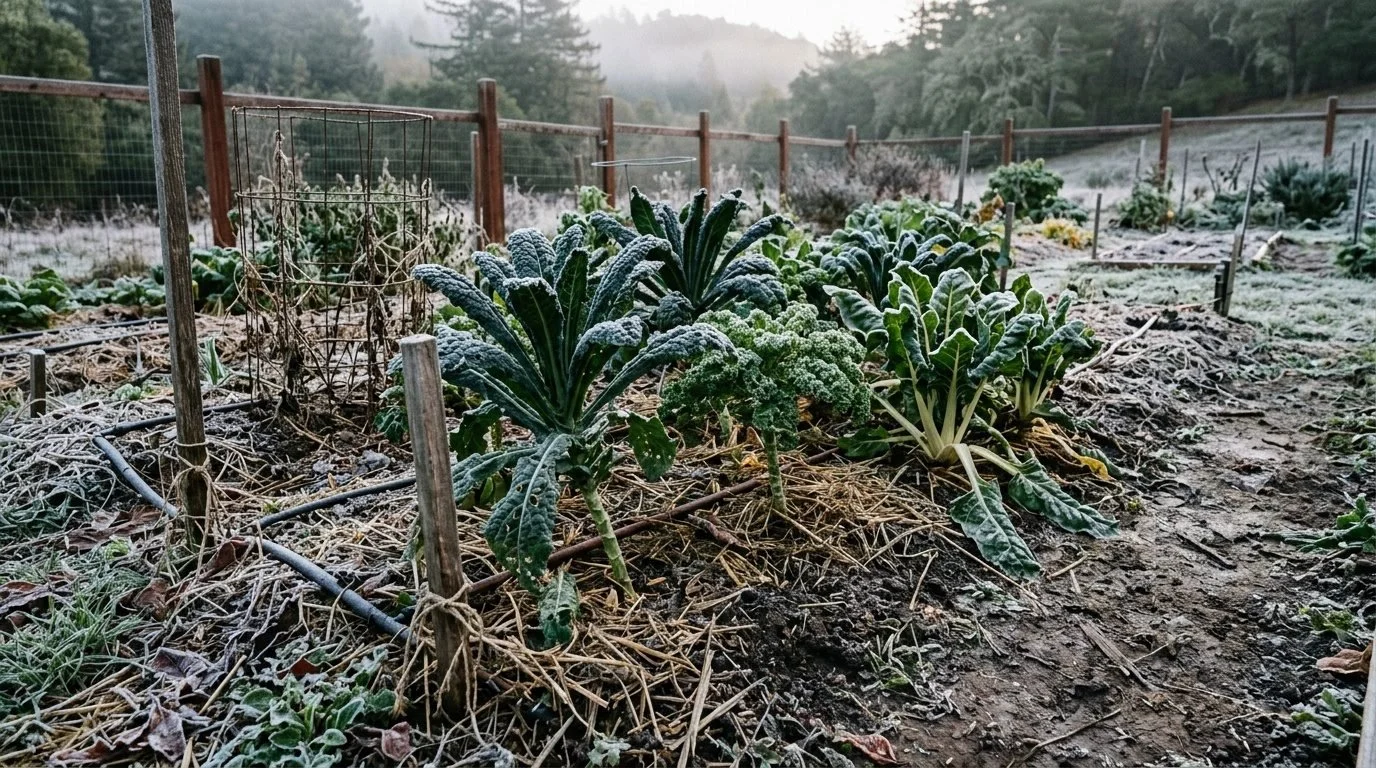
A few of the product links in this guide are affiliate links. If you buy through one, Ambitious Harvest may earn a small commission at no extra cost to you, which helps keep these guides free. We only point to gear we would use in our own Santa Cruz garden. As an Amazon Associate, we earn from qualifying purchases. Read our full disclosure.
12 Vegetables That Handle Frost and Cold Nights in California
UC Cooperative Extension in the Salinas Valley reports that light frosts down to 32F are mostly tolerated by cool season vegetables, and Oregon State Extension groups the toughest of them as cold-hardy enough to withstand heavy frost below 28F. How much cold a plant actually takes depends on how gradually it was acclimated to it. California gardeners across inland valleys, mountain regions, and even coastal areas face frost events that can damage or kill tender crops. These 12 vegetables handle light frost (28-32F), and UC Master Gardeners note that some cold-hardy crops, cabbage and Brussels sprouts among them, taste sweeter after a light frost.
Cold nights are a reality in more California gardens than many people realize. The Sacramento and San Joaquin valleys regularly see frost from November through March. Mountain communities face hard freezes. Even Santa Cruz coastal gardens occasionally dip below freezing during clear, still winter nights. Knowing which crops shrug off cold means you can garden productively 12 months a year instead of shutting down from November to March.
Why Does Frost Damage Some Vegetables and Not Others?
UC Cooperative Extension in the Salinas Valley describes the injury directly: frost damage is primarily caused by dehydration of the plant cells as water moves out of the cell into the intercellular space and freezes, which is why frost injury on a leaf can look like water stress. How far below freezing a crop gets before that happens is not a fixed number. The UC Master Gardener Program of Sonoma County notes that the concentration of sugars and other substances in the liquid portion of vegetation help determine at what point below 32 degrees F vegetative injury will occur, and that cold-weather crops cannot be lumped into one category of cold hardiness.
Flavor is a separate question from survival. UC Master Gardeners of Sonoma County note that some cold-hardy crops, such as cabbage and Brussels sprouts, can become sweeter with a light frost. That is worth planning a harvest around, though it is an observed result in particular crops rather than something every vegetable on this list does.
The difference between a crop that tolerates a light frost and one that shrugs off a hard freeze is significant. Light frost (28-32F) damages tender crops like tomatoes, basil, and squash instantly. Semi-hardy crops like beets, carrots, lettuce, chard, and garden peas tolerate brief dips to 28F. The cold-hardy crops on this list handle heavy frost below 28F, and how far below depends on how gradually the plants were acclimated to the cold.
1. Kale
Kale is one of the toughest leafy greens you can put in a cold garden. Oregon State Extension groups it with the cold-hardy vegetables that withstand heavy frost below 28F. Utah State Extension is more specific about the two stages: young plants are not seriously damaged by temperatures down to 25F, and mature plants are extremely hardy and can withstand very cold temperatures. How far below freezing an established plant actually goes also depends on how gradually it was acclimated to the cold.
In California's inland valleys, kale planted in September or October provides fresh greens through the entire winter. In mountain areas, established plants often survive hard freezes with only cosmetic damage to outer leaves.
Best varieties for cold tolerance: Winterbor (curly type, extremely cold-hardy, bred for winter production), Red Russian (handles hard frost well, tender leaves), Lacinato/Dinosaur (handles hard frost, flavor peaks in winter), and Dwarf Blue Curled Scotch (compact, cold-resistant, sweet after frost).
Planting tips: For winter harvest, plant transplants in August-September in inland valleys, September-October in coastal areas. Kale needs to be well-established before the first hard frost. Young seedlings are less cold-tolerant than mature plants. Space 18-24 inches apart. Mulch around the base of plants with straw to insulate roots. Harvest outer leaves throughout winter, leaving the growing center intact. Kale that survives winter often produces a flush of tender spring growth before eventually bolting. growing kale in California
2. Brussels Sprouts
Brussels sprouts need frost to reach their full flavor potential. Without cold exposure, the sprouts tend to be starchy and slightly bitter. After several hard frosts, they develop a sweet, nutty flavor that is entirely different from the bitter reputation Brussels sprouts have earned from being harvested too early. Oregon State Extension lists Brussels sprouts among the cold-hardy vegetables that withstand heavy frost.
In California, Brussels sprouts are a quintessential winter crop. The long growing season (90-120 days from transplant to harvest) means planting in summer for winter harvest, timing the sprouts to mature during the coldest months for the best possible flavor.
Best varieties for cold tolerance: Long Island Improved (classic, very cold-hardy), Diablo (hybrid, uniform sprouts, good frost tolerance), Jade Cross (compact, early, cold-tolerant), and Red Bull (red-purple sprouts, stunning color intensifies in cold). Gustus is another excellent choice with exceptional flavor after frost.
Planting tips: Start seeds indoors in May-June or transplant in July-August for winter harvest. Brussels sprouts need a long, cool growing period. Space 24-30 inches apart. These are tall plants (2-3 feet) that may need staking in windy locations. Remove lower leaves as sprouts develop to improve air circulation and direct the plant's energy into sprout production. Harvest from the bottom of the stalk upward as sprouts reach 1-1.5 inches. Leave plants in the garden through frost events for maximum flavor development. growing brussels sprouts in California
3. Carrots
Carrots are semi-hardy rather than cold-hardy. Oregon State Extension groups them with the vegetables that tolerate light frost of 28 to 32F and notes that on root crops the tops may die back while the roots survive, and Carrot Production in California (UC ANR Publication 7226) puts it no more strongly than this: carrots may tolerate some frost. The root sitting under the soil is the part that keeps, which is why leaving carrots in the ground through cold weather is a traditional storage technique.
For California inland valley and mountain gardeners, fall-sown carrots that mature in winter produce some of the best-tasting roots you will ever eat. The slow growth in cool soil develops dense, flavorful carrots with deep color.
Best varieties for cold tolerance: Napoli (Nantes type, excellent in cool soil, sweet), Bolero (strong tops, good for overwintering), Mokum (extremely sweet in cold conditions), and Danvers 126 (reliable, cold-tolerant, stores well in the ground). Purple Haze also handles frost well and develops its deepest color in cold weather.
Planting tips: For winter harvest, sow seeds in August-September in inland valleys, September-October in coastal areas. Carrots germinate slowly in cool soil, so keep the seedbed consistently moist. In areas with sustained hard frost, mulch over the carrots with 4-6 inches of straw to insulate the soil and prevent the ground from freezing solid. Pull straw back to harvest as needed throughout winter. Carrots left in the ground too long into spring will eventually bolt, so harvest before warm weather returns. growing carrot in California
4. Spinach
Spinach is one of the most cold-tolerant leafy greens. Spinach Production in California (UC ANR Publication 7212) reports that spinach can withstand low temperatures of 15 to 20F without great injury, that it grows from 40 to 85F with growth most rapid at 60 to 65F, and that freezing weather harms small seedlings and young plants while more mature plants tolerate subfreezing temperatures for weeks. UC Marin Master Gardeners publish the same figures and put the qualifier on plant size rather than on hardening off: it is the intermediate-size plants that handle subfreezing temperatures for weeks.
Winter spinach in California is a revelation for gardeners accustomed to the thin, quick-bolting spring crop. Cold-grown spinach develops thick, dark green leaves with concentrated flavor and nutrients. Growth slows in the shortest days of December and January but resumes as day length increases in February.
Best varieties for cold tolerance: Bloomsdale Long Standing (savoy type, extremely cold-hardy, classic), Giant Winter (bred for overwintering), Space (smooth-leaf, cold-tolerant, easy to clean), Tyee (semi-savoy, excellent disease resistance in cool, damp conditions), and Regiment (good cold tolerance and mildew resistance).
Planting tips: Sow in September-October for winter harvest. Spinach seed germinates from 35 to 85F, with 45 to 75F the optimal range. Direct sow 1/2 inch deep, 2 inches apart. Thin to 4-6 inches. In areas with hard frost below 20F, a simple cold frame or row cover extends production. Spinach under cover can be harvested fresh throughout even the coldest California winters. Begin harvesting outer leaves at 3-4 inches. Plants will resume vigorous growth in early spring before eventually bolting as days lengthen past 14 hours. growing spinach in California
5. Garlic
Garlic is a fall-planted crop that grows through the cold months. Oregon State Extension groups it with the cold-hardy vegetables that withstand heavy frost below 28F. The chilling matters for bulbing, but only for some types: UC Master Gardeners of Contra Costa County explain that hardneck garlic requires 4 to 6 weeks of cold below 40 to 45F to develop a strong bulb, while softneck garlic is less demanding and does not need the extended chill, which makes softneck the better choice where winters are mild.
California's inland valleys and mountain regions provide ideal garlic conditions: cold enough winters for proper vernalization, dry enough summers for curing, and a long enough growing season for bulb development.
Best varieties for cold tolerance: California Early (softneck, reliable across California), Inchelium Red (softneck, excellent cold tolerance and flavor), Music (hardneck, handles very cold conditions), and Chesnok Red (hardneck, outstanding roasting garlic, cold-hardy). Elephant garlic (actually a leek relative) also handles frost well.
Planting tips: Plant individual cloves in October-November, pointed end up, 2 inches deep, 6 inches apart. Mulch with 3-4 inches of straw to insulate roots and moderate soil temperature swings. Green shoots that emerge before frost are normal and tolerate cold well. Do not fertilize in fall. Resume feeding with nitrogen in early spring when growth resumes. Harvest in May-July when lower leaves brown. Cure in a dry, shaded area for 2-3 weeks. Properly cured softneck garlic stores 6-9 months. growing garlic in California
6. Collard Greens
Collards combine frost tolerance with heat tolerance, which makes them one of the most versatile greens for California gardens. Oregon State Extension groups them with the cold-hardy vegetables that withstand heavy frost below 28F, and established plants keep producing right through the winter months.
In California's inland valleys, collards planted in late summer provide fresh greens from fall through spring, bridging the gap between summer and spring garden production. They handle the wide temperature swings between warm fall days and frosty winter nights without complaint.
Best varieties for cold tolerance: Vates (compact, very cold-hardy, standard variety), Champion (improved Vates type, productive), Georgia Southern (tall, large leaves, traditional), and Morris Heading (forms a loose head, excellent cold tolerance). Flash is a newer variety with good cold tolerance and tender leaves.
Planting tips: Transplant in July-August for winter harvest, or direct sow in August-September. Space 18-24 inches apart. Collards are heavy nitrogen feeders. Side-dress with composted chicken manure or fish emulsion every 4-6 weeks. Harvest lower leaves as they reach 8-10 inches, leaving the growing point for continued production. In the coldest California locations, outer leaves may show frost damage while inner leaves remain perfect. Simply remove damaged leaves and the plant continues growing. growing collard greens in California
7. Leeks
Leeks are among the hardiest alliums, and Oregon State Extension puts them in the cold-hardy group that withstands heavy frost below 28F. Their ability to stand in the garden through freezing weather makes them a "harvest as needed" winter vegetable. You can leave leeks in the ground for months after maturity, pulling them for fresh use throughout winter while other fresh vegetables are scarce. UC Cooperative Extension recommends leeks as a reliable overwinter crop for California gardens (UC Master Gardener Program of Monterey Bay).
The flavor of leeks improves with cold exposure. Winter-harvested leeks are milder and sweeter than fall-harvested ones, making them excellent in soups, gratins, and braised dishes during the cold months.
Best varieties for cold tolerance: Musselburgh (Scottish heirloom, exceptional cold hardiness, thick stems), Blue Solaise (French variety, develops blue-purple color in cold, very hardy), Giant Carentan (cold-tolerant, thick shanks), and Bandit (bred for overwintering, handles hard frost well).
Planting tips: Start seeds indoors in January-February for transplanting in spring. Leeks need a long growing season (90-120 days) to develop thick stems. Plant in trenches and hill soil around the stems gradually to blanch (whiten) the shaft. Space 6 inches apart. In areas with hard frost, mulch around leeks with straw for additional insulation. Even in severe cold, leeks usually survive with only outer leaf damage. Pull back mulch and harvest as needed throughout winter and early spring. growing onion and allium in California
8. Parsnips
Parsnips are a semi-hardy root that comes into its own in cold weather. Oregon State Extension groups them with the vegetables that tolerate light frost of 28 to 32F, and notes that on root crops like parsnips the tops may die back while the roots survive. Gardeners here consistently find that parsnips left in cold soil taste sweeter and nuttier than roots pulled early, which is why the harvest usually waits until after the first frosts.
In California's inland valleys and mountain regions, parsnips are a valuable winter root crop that can be left in the ground and harvested fresh throughout the cold months. They handle repeated freeze-thaw cycles without deteriorating.
Best varieties for cold tolerance: Hollow Crown (the standard variety, sweet after frost), Harris Model (smooth, uniform, good flavor), All American (shorter roots, good for heavy soil), and Gladiator (hybrid, very sweet, reliable). Lancer is another good option for California soils.
Planting tips: Sow seeds in April-June for fall and winter harvest. Parsnips need 100-130 days to mature, so patience is required. Seeds germinate slowly (2-3 weeks) and need consistent moisture. Sow 1/2 inch deep in deeply worked soil free of rocks and heavy clods, as obstructions cause forked roots. Thin to 3-4 inches apart. Leave roots in the ground through frost for maximum sweetness. Mulch with straw in areas with hard frost to keep soil workable for harvest. Dig roots as needed from November through March. growing root vegetable in California
9. Cabbage
Cabbage is a classic cold-weather crop. Cabbage Production in California (UC ANR Publication 7208) describes it as having moderately high frost tolerance, and Oregon State Extension groups it with the cold-hardy vegetables that withstand heavy frost below 28F. The outer wrapper leaves protect the dense inner head, acting as natural insulation. Even if outer leaves freeze and become translucent, the head inside usually remains sound.
Winter cabbage in California develops dense, sweet heads that are superior in flavor and storage quality to warm-season cabbage. The slow growth in cool conditions produces tighter heads with more concentrated flavor.
Best varieties for cold tolerance: January King (beautiful purple-green, extremely cold-hardy, developed for winter harvest), Savoy types like Perfection Drumhead (crinkled leaves, very frost-tolerant), Danish Ballhead (dense, stores for months), and Red Acre (compact, cold-hardy red cabbage). Storage No. 4 is bred specifically for late harvest and cold tolerance.
Planting tips: For winter harvest, transplant in July-September. Space 18-24 inches apart. Cabbage is a heavy feeder that needs consistent moisture for head development. Raised beds help with drainage in winter. Side-dress with nitrogen-rich fertilizer when heads begin forming. In areas with hard frost, the outer leaves may freeze and deteriorate, but simply peel them away to reveal the clean, fresh head underneath. Harvest before the head cracks or splits, which can happen during freeze-thaw cycles. Store whole heads in a cool location for 2-4 months. growing cabbage in California
10. Turnips
Turnips are fast-growing, cold-tolerant roots that produce edible greens as a bonus crop. Turnip Production in California (UC ANR Publication 7241) describes turnip plants as frost hardy but says they may suffer injury if subjected to extended periods below 30F, so a run of hard nights matters more than a single one. Oregon State Extension still groups turnips with the cold-hardy vegetables that withstand heavy frost below 28F, which fits: brief frost is one thing and a sustained freeze is another.
For California gardeners, turnips fill the gap between fall and spring production. They mature quickly (40-60 days for most varieties), making them one of the fastest crops for winter harvest from fall plantings.
Best varieties for cold tolerance: Purple Top White Globe (classic, reliable, cold-hardy), Hakurei (Japanese salad turnip, mild, best eaten raw), Golden Ball (yellow flesh, sweet, good cold tolerance), and Seven Top (grown primarily for greens, extremely cold-hardy). Scarlet Queen is a beautiful red-skinned variety with good frost tolerance.
Planting tips: Direct sow in August-October for fall and winter harvest. Turnips mature quickly, so succession plantings every 3-4 weeks extend the harvest. Sow 1/2 inch deep, thin to 4-6 inches apart. Turnips tolerate partial shade, making them useful for late-season plantings when sun angles are low. Harvest roots at 2-3 inches diameter for best texture and flavor. Larger roots can become woody, especially in varieties other than Hakurei. Greens can be harvested anytime, but leave enough foliage for root development. growing root vegetable in California
11. Peas
While not as frost-hardy as kale or cabbage, peas tolerate light frost: Oregon State Extension groups the garden pea with the semi-hardy vegetables that take 28 to 32F. Peas are traditionally among the first crops planted in late winter, with gardeners pushing seeds into cold soil weeks before the last frost date. UC Cooperative Extension confirms that peas grow best in cool conditions and tolerate light frost at all growth stages (UC ANR Vegetable Research and Information Center).
In California's inland valleys, peas planted in January or February grow through frosty conditions and begin producing by March or April. Mountain gardeners can plant as soon as soil is workable in early spring, even if frost continues for weeks.
Best varieties for cold tolerance: Wando (bred specifically for cold and heat tolerance, remarkably adaptable), Alaska (extremely early, handles cold soil), Oregon Sugar Pod II (snow pea, cold-tolerant), and Maestro (shelling type, good cold tolerance). Cascadia is another excellent choice developed for cool maritime conditions.
Planting tips: Direct sow 4-6 weeks before the last expected frost. Peas fix their own nitrogen and do not need nitrogen fertilizer. Inoculate seeds with rhizobium bacteria, especially in beds that have not grown legumes before. Plant 1 inch deep, 2 inches apart. Provide a trellis for climbing types. Pea seeds can rot in cold, wet soil, so ensure good drainage. In the coldest areas, consider starting seeds in biodegradable pots indoors and transplanting with minimal root disturbance. growing pea in California
12. Swiss Chard (Perpetual Spinach)
Oregon State Extension groups chard with the semi-hardy vegetables that tolerate light frost of 28 to 32F, so it sits a step below kale rather than alongside it. The variety known as Perpetual Spinach (actually a chard, not a spinach) is the one that keeps producing all winter in most California climates, offering smooth, spinach-like leaves. In a cold inland garden it earns a row cover on the hardest nights.
In inland valleys, well-mulched chard plants survive the worst winter conditions and explode back into production in early spring. Even in mountain areas, chard under simple row cover or cold frames produces fresh greens all winter.
Best varieties for cold tolerance: Perpetual Spinach (the most cold-hardy chard variety), Fordhook Giant (classic, tolerates repeated frost), and Bright Lights (slightly less hardy but keeps going with mulch protection).
Planting tips: Plant in August-September for winter harvest. Chard planted too late in fall may not establish well enough to handle hard frost. Space 12-18 inches apart. Mulch around plants with 3-4 inches of straw for root insulation. In the coldest areas, a low tunnel of row cover adds 5-10 degrees of frost protection. Harvest outer leaves throughout winter, leaving the center to continue growing. Chard often survives winter in California and produces a second year of harvest before eventually bolting in its second spring. growing chard in California
What Frost Protection Techniques Work Best in California?
Even with frost-tolerant crops, some protection extends the harvest season and keeps plants at peak production. UC Cooperative Extension recommends several approaches calibrated to California's frost patterns (UC ANR, protecting plants in extreme cold).
Mulching. A 4-6 inch layer of straw around root crops and greens insulates the root zone and moderates soil temperature swings. Mulch keeps soil 5-10 degrees warmer than bare ground on frosty nights. Apply before the first expected frost.
Row cover. Lightweight fabric (1.5 oz) draped over hoops creates a microclimate 4-8 degrees warmer than outside air. This simple technique extends the growing season by 4-6 weeks in most California locations. Secure edges with soil or rocks to prevent cold air intrusion.
Cold frames. A bottomless box with a clear lid (glass or polycarbonate) creates a miniature greenhouse effect, adding 10-20 degrees of frost protection. Cold frames are particularly effective for lettuce, spinach, and other low-growing crops. Ventilate on sunny days to prevent overheating.
Water thermal mass. Jugs of water placed among plants absorb heat during the day and release it slowly at night, moderating temperature drops. This low-tech method provides 2-4 degrees of frost protection and costs nothing. Black-painted jugs absorb more daytime heat. season extension California
How Do California's Frost Patterns Differ by Region?
California's frost geography is complex, and understanding your local pattern is essential for timing winter crops. UC Agriculture and Natural Resources maps frost dates across the state's diverse microclimates (UC ANR Climate Smart Agriculture).
Coastal areas (Santa Cruz, Monterey, San Luis Obispo): Frost is rare but possible, typically 5-10 nights per winter with lows of 28-32F. Cold-hardy crops grow through winter with minimal protection. The mildest coastal microclimates may see no frost at all.
Inland valleys (Sacramento, San Joaquin, inland Southern California): Regular frost from November through March, with lows commonly reaching 28-32F and occasionally dipping to 20-25F. Radiation frost (caused by clear, calm nights) is the most common type. Tule fog, while cold, actually insulates against the hardest frost by trapping warmth near the ground.
Mountain and foothill areas (Sierra Nevada, Coast Ranges): Hard frost from October through April, with lows regularly below 20F. Mountain gardeners need the most cold-tolerant crops and should plan on using season extension techniques. Many crops on this list (kale, garlic, leeks, parsnips) survive mountain winters with proper mulching.
Desert areas (Coachella, Imperial Valley, high desert): Surprising frost risk during clear winter nights, when temperatures can drop from 60F to below freezing. The rapid temperature swings are harder on plants than the actual low temperature. Mulching and row cover help moderate these dramatic shifts. understanding California climate zones
Frequently Asked Questions
What vegetables can survive a hard frost in California?
Several vegetables survive hard frost (below 28F) in California gardens. Oregon State Extension puts spinach, garlic, leeks, kale, cabbage, collards, Brussels sprouts and turnips in that cold-hardy group. Spinach is the one with a published figure behind it: UC ANR Publication 7212 reports it withstands 15 to 20F without great injury. Carrots and parsnips are semi-hardy, so their tops may die back while the mulched roots keep in the ground. Oregon State Extension classifies these as cold-hardy vegetables that withstand heavy frost, and with mulching and protection they can be left in the garden through winter.
Does frost actually improve the flavor of winter vegetables?
For some crops, yes. UC Master Gardeners of Sonoma County note that some cold-hardy crops, such as cabbage and Brussels sprouts, can become sweeter with a light frost. That is the specific claim UC makes, and it does not extend automatically to every vegetable on this list. Many California gardeners delay harvest of brassicas and root crops until after the first frosts, which is a reasonable thing to try in your own garden.
When should I plant winter vegetables in California's inland valleys?
For the Sacramento and San Joaquin valleys, plant winter crops in two waves. August through September is ideal for slow-maturing crops like Brussels sprouts, leeks, and cabbage that need 90-120 days to mature. September through October is the window for faster crops like spinach, turnips, kale, and lettuce. UC Cooperative Extension recommends timing plantings so crops are well-established before the first expected frost date, typically mid-November in the Sacramento Valley. Established plants handle frost far better than young seedlings (UC ANR Vegetable Planting Guide).
Can I grow winter vegetables on the California coast?
Absolutely, and coastal California is one of the best places in the country for winter vegetable production. Mild coastal winters with rare frost allow nearly year-round gardening. All 12 crops on this list thrive in coastal winter conditions, and many (like kale, chard, and lettuce) produce continuously through the mild season. Winter is a productive season for many cool-season crops on the coast. A mild coastal winter does not mean fewer pests, though: UC IPM notes that some aphids stay active year-round in the milder central coastal areas of California.
How do I protect seedlings from unexpected frost in California?
Seedlings raised indoors or in a greenhouse are tender because they have been sheltered, which is why UC Master Gardeners of Santa Clara County recommend hardening them off before they go into the garden. UC Master Gardeners of Placer County note that row covers also protect young seedlings until they are robust enough to go uncovered. Water the soil thoroughly before a frost event, as moist soil holds more heat than dry soil. Avoid placing plastic directly on foliage, as it conducts cold and can cause more damage than no cover. Make sure the cover reaches the ground, and remove it in the morning once temperatures rise, so air and sunlight get back to the plant (UC ANR on protecting plants in extreme cold).
What is the difference between frost and freeze in California gardens?
Frost occurs when surface temperatures drop to 32F, forming ice crystals on exposed surfaces. A freeze occurs when air temperature drops below 32F. In California, radiation frost (clear, calm nights allowing heat to radiate upward) is most common, while advective freezes (cold air masses moving through) are rarer but more damaging. UC Cooperative Extension notes that radiation frost is easier to protect against because it affects surfaces first, so covering plants often prevents damage. Advective freezes require more substantial protection because the entire air mass is cold (UC ANR Climate Smart Agriculture).
Should I harvest or leave cold-hardy vegetables in the ground during a freeze warning?
For the crops on this list, leave them in the ground during frost events. These vegetables are selected for their cold tolerance, and harvesting in a panic before frost wastes the flavor improvement that cold exposure provides. The exception is any crop that has been weakened by disease, pest damage, or drought stress, as stressed plants handle cold poorly. Mulch around plants if a hard freeze (below 25F) is forecast, and use row cover for extra protection. Harvest after the frost event if you need the produce, or leave crops in the garden for continued fresh harvest through winter (UC Master Gardener Program).
California's cold nights are an asset, not an obstacle, when you choose the right crops. The vegetables on this list produce some of the best flavors your garden can offer, and many of them taste their absolute best after the frost that sends tender summer crops to the compost pile. Start with a few cold-hardy staples this fall, and you may find that your winter garden becomes your favorite season.
Ready to extend your California growing season? Sign up for the Ambitious Harvest newsletter for seasonal planting reminders, frost date alerts, and variety recommendations tailored to your California climate zone.
