

Growing Blueberries in Santa Cruz County: A Complete Guide
A few of the product links in this guide are affiliate links. If you buy through one, Ambitious Harvest may earn a small commission at no extra cost to you, which helps keep these guides free. As an Amazon Associate, we earn from qualifying purchases. Read our full disclosure.
A blueberry bush can look perfectly at home beside a patio and still struggle in the soil beneath it. In Santa Cruz County, the first decision is often whether to grow in the ground or give the plant a container of acidic mix. Get that choice right, then match the variety to your winter conditions, and the rest of its care becomes easier to understand.
Blueberries need an acidic root zone, steady moisture and good drainage. Our soils and water supplies vary, so test yours before assuming that either needs treatment. Mild coastal summers can suit these plants well; winter chill and available sunshine help narrow the variety choices.
Start with the roots and the variety label. This guide then follows the plant through planting, watering, pruning and the moment when a blue berry is finally sweet enough to pick.
Why Are Blueberries Challenging (and Rewarding) in Santa Cruz County?
A bush can be watered faithfully yet stay yellow and weak if its root zone is unsuitable. That makes testing more useful than adding another scoop of fertilizer. Give the plant the conditions it needs before judging its potential.
The challenges you'll face:
- Soil pH: Test the planting area. Blueberries require pH 4.5 to 5.5; a soil that suits other garden crops may be too alkaline for them.
- Irrigation water: Supplies differ. High alkalinity can make root-zone pH harder to manage; testing is more useful than assuming all local tap water has the same effect.
- Winter chill: Requirements differ among blueberry cultivars. Check the named variety against winter conditions at your site, using local observations and suitable weather data rather than a countywide estimate.
Clay soil: Check actual drainage. A poorly drained root zone can stay saturated around blueberry roots; texture alone does not tell you how the whole bed drains.
Why it's worth the effort:
Incredible flavor: Homegrown blueberries, picked at peak ripeness, taste dramatically better than anything from the store.
A harvest to follow: Different cultivars ripen at different times. A mixture can spread picking across the season, but dates depend on the plants and site.
Beautiful plants: Blueberry bushes offer ornamental value with spring flowers, summer fruit, and stunning fall color.
A crop worth watching: Birds can take ripening fruit, and insect or disease problems still occur. Inspect fruit and foliage rather than expecting a pest-free plant.
Long-lived: Well-cared-for blueberry bushes can produce for 20+ years.
What Are Chill Hours and Why Do They Matter for Variety Selection?
Chill hours are the cumulative hours a plant experiences between 32°F and 45°F during winter dormancy. This cold exposure triggers the hormonal changes that allow the plant to break dormancy, flower, and fruit properly. Without enough chill hours, blueberry bushes may leaf out weakly, flower sporadically, or fail to fruit altogether.
Santa Cruz County Chill Hours by Microclimate
Our county's chill hours vary considerably by microclimate, and warm winters can reduce chill hours significantly compared to long-term averages. Choosing varieties needing less chill than your typical range improves reliability.
Coastal areas: Mild winter conditions favor considering lower-chill cultivars, but exposures differ and winters vary. Check a cultivar's requirements against local observations rather than treating a town as a chill-hour measurement.
San Lorenzo Valley: Valley bottoms, ridges and sheltered slopes have different winter temperatures. Check the planting site rather than assuming every garden in the valley accumulates more chill.
Under redwoods: Assess winter temperatures and available sun separately. Tree cover does not establish a chill-hour total, and deep shade can limit fruit production.
Inland valleys (Scotts Valley, Soquel hills): Variable depending on elevation and cold air drainage patterns. The Santa Cruz Banana Belt areas offer warmer microclimates that can be excellent for blueberries with proper soil preparation.
Pajaro Valley: Choose for the actual site's winter temperatures, soil and exposure. Agricultural surroundings do not establish the conditions in an individual garden.
What Blueberry Types Grow Best in Santa Cruz County?
Not all blueberries are created equal. The type you choose determines whether you'll succeed or struggle in our climate.
Southern Highbush: Your Best Choice
Southern Highbush blueberries were developed specifically for mild-winter climates. They're hybrids between Northern Highbush (the traditional blueberry) and native Southern species, combining good fruit quality with low chill requirements.
Why Southern Highbush works here:
- Chill requirements vary by cultivar; compare its stated requirements with conditions in your garden.
Tolerant of heat and mild winters
Many excellent varieties available
Good fruit size and quality
Most are at least partially self-fertile (though cross-pollination improves yields)
Varieties to compare: Sunshine Blue, Misty, Sharpblue, O'Neal, Jewel, Emerald
Rabbiteye: A Heat-Tolerant Alternative
Rabbiteye blueberries come from the southeastern United States. They can become large shrubs and generally tolerate heat better than many highbush cultivars. They still need reliable moisture; choose a named cultivar and compatible pollination partner rather than treating the type as drought-proof.
Pros for Santa Cruz:
Very heat tolerant
More drought tolerant than other types
Long-lived and vigorous
Some tolerate slightly higher soil pH
Cons for Santa Cruz:
- Check the chill requirement of the named rabbiteye cultivar rather than treating the whole group as suitable or unsuitable for the coast.
Require cross-pollination (need 2+ varieties)
Larger plants need more space
Berries can be grittier textured
Varieties to compare: Pink Lemonade (pink-fruited rabbiteye/highbush hybrid), Climax, Premier
Northern Highbush: check the named cultivar
Northern Highbush cultivars differ in winter-chill requirements and local performance. Before trying Bluecrop, Duke, Elliott or another cultivar, check its requirements and seek evidence from similar growing conditions. Do not rule the entire group in or out on the basis of a Santa Cruz County address.
Why Is Soil pH the Make-or-Break Factor for Blueberries?
For blueberries, pH belongs on the planting checklist, not just the troubleshooting list. Blueberries require acidic soil with a pH between 4.5 and 5.5. If the root zone is too alkaline, the plant may struggle to take up iron and other nutrients even when they are present.
Check your own soil and water
A soil test tells you how far your planting area is from the acidic conditions blueberries need. Water pH alone does not tell you how strongly irrigation will change that soil: alkalinity matters too. If pH keeps rising despite careful care, include your water supply in the investigation.
What happens at wrong pH:
Iron chlorosis: yellow leaves with green veins (the classic California blueberry problem)
Stunted growth
Poor fruit production
Eventual plant death
Testing Your Soil
Before planting, test your soil pH. Options include:
Home test kits: Available at garden centers; adequate for ballpark readings
- Digital pH meters: Accuracy depends on equipment, calibration and sampling. A cheap probe is not automatically more reliable than a properly used test kit.
Professional testing: private analytical labs provide comprehensive analysis. UC Master Gardeners do not run a soil testing service, but UC county offices publish lists of commercial labs
Test both your native soil and any amended planting mix before installing plants.
Two Approaches: Amend or Contain
Option 1: Container growing (often the best choice) Growing in containers with acidic potting mix avoids depending on native soil as the main root medium. You control the pH from the start and can manage it over time. See our companion article on container blueberry growing for details.
In-ground growing makes sense where you can prepare an acidic, well-drained root zone across a useful area. Prepare the bed before buying plants and use a soil test to guide sulfur applications. Filling a hole in poorly drained clay with a different mix does not solve the drainage problem.
Prepare a broad planting area with drainage suited to blueberry roots
Use an amendment plan based on your soil test; coco coir and peat moss are not interchangeable acidifiers
Add sulfur to lower pH (amount depends on current pH, soil texture and buffering)
Mulch to conserve moisture; do not rely on pine needles or oak leaves to correct soil pH
Monitor and maintain pH ongoing
Even with in-ground planting, consider using raised beds or mounded plantings to improve drainage and make pH management easier.
When and How Should You Plant Blueberries in Santa Cruz County?
When to Plant
Best time: Late fall through early spring (November through March) when plants are dormant.
Fall planting advantages: Roots establish during the rainy season; plants are ready to grow vigorously in spring.
Avoid: Planting in summer heat, which stresses transplants.
Site Selection
Sun: Full sun (6+ hours) produces the best fruit. Blueberries can tolerate partial shade but yield less.
Drainage: Essential. Blueberry roots are shallow and susceptible to rot in waterlogged soil. Avoid low spots where water collects.
Wind protection: Helpful but not critical. Strong coastal winds can dry plants and damage fruit.
Microclimate: Choose a sunny location for fruiting. A warm wall may add summer heat, but it does not increase winter chill accumulation.
Container Planting (Recommended for Most Situations)
A roomy container gives you space to manage moisture without the roots drying immediately. A half wine barrel or a substantial pot with open drainage holes is a useful starting point. Choose a mix made for acid-loving plants and check its pH; a homemade percentage recipe cannot guarantee the right result.
Steps:
Ensure container has excellent drainage holes
Fill with acidic potting mix
Plant at the nursery growing depth, following the grower guidance for the plant
Water thoroughly, then check that excess water drains freely
Mulch surface with 2 to 3 inches of pine bark or pine needles
Position in full sun
In-Ground Planting
Hole preparation:
Dig a broad hole no deeper than the prepared root ball
Assess the whole bed rather than replacing soil in an isolated hole
Use the soil preparation plan established from your test results
Apply a soil acidifier containing elemental sulfur according to package directions to achieve pH 4.5 to 5.5
Create a slightly raised mound to improve drainage
Planting:
Set plant so root ball is level with or slightly above surrounding grade
Backfill with prepared mix
Water the root zone thoroughly without leaving it saturated
Apply 3 to 4 inches of organic mulch (pine needles, oak leaves, pine bark)
Keep mulch a few inches from stem
Spacing
Southern Highbush: 4 to 6 feet apart
Rabbiteye: 6 to 8 feet apart
Compact/container varieties: 3 to 4 feet apart
How Should You Water, Feed, and Prune Blueberries?
Watering: The Hard Water Challenge
Blueberries need consistent moisture but not waterlogged soil. They have shallow, fibrous root systems that dry out quickly.
Water can gradually change the pH of a container mix, but supplies differ across the county. Check root-zone pH over time. If you need to investigate irrigation water, ask a laboratory about alkalinity as well as pH before choosing a treatment.
Solutions:
- Investigate before acidifying: There is no fixed vinegar dose for every water supply. Test water alkalinity and root-zone pH, then obtain an appropriate treatment recommendation. UC blueberry soil and water pH guidance.
- Rainwater: Where collection is practical, it may reduce reliance on a high-alkalinity supply. Its quality depends on the collection system, so do not assume it is mineral-free or has a fixed pH.
- Keep the root zone evenly moist: Blueberries have shallow roots. Check moisture where those roots are growing and water before the mix dries deeply; do not stretch intervals to force deep rooting.
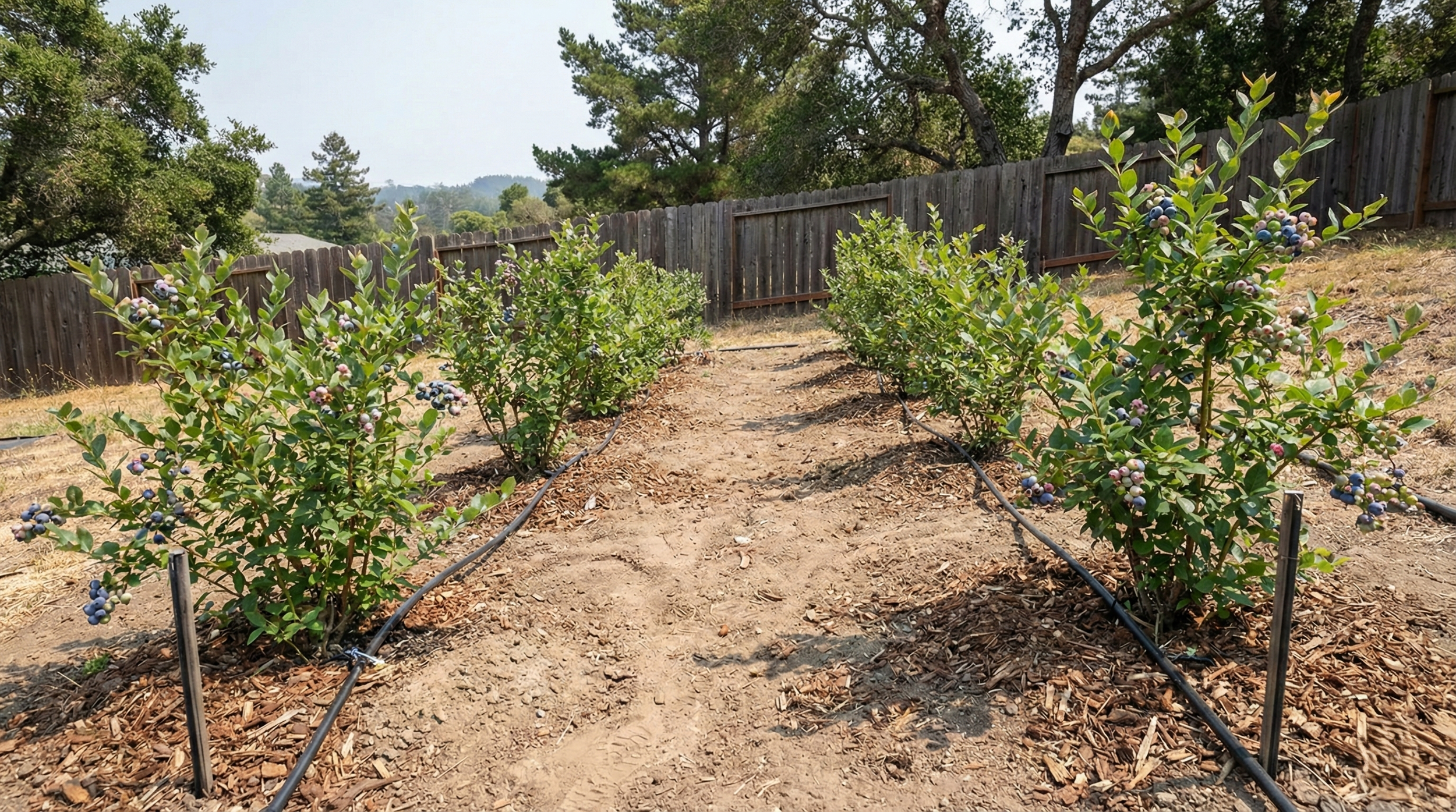
Drip irrigation: Delivers water directly to roots, reducing waste and keeping foliage dry.
Watering schedule:
Established plants: Check moisture in the shallow root zone and across the wetted area. Adjust irrigation to soil, plant size and weather rather than treating an inch-per-week figure as a local schedule.
Container plants: Inspect moisture frequently in warm or windy weather. Pot size and mix change how quickly water is used; water when the root zone needs it, then let excess drain.
Reduce in winter but don't let plants dry out completely
Fertilizing
Fertilizer cannot compensate for unsuitable pH or soggy roots. Once those are in order, use an appropriate acid-loving plant fertilizer at its labeled rate. Small, measured applications are easier on the roots than an extra handful added to a struggling bush.
Fertilizer type: Use fertilizers designed for acid-loving plants (azalea/rhododendron fertilizers work well). Avoid adding lime to an already suitable acidic mix; choose fertilizer from soil information and the label.
Timing:
First application: Early spring as new growth begins
Second application: After fruit set
Avoid unnecessary late-season feeding; follow the product and cultivar guidance
Amount: Follow package directions; err on the side of less. Over-fertilization burns shallow blueberry roots.
Organic options: Labeled organic fertilizers can supply nutrients, but their composition and release rate differ. Bark is useful in mixes and as mulch; do not count it as a substitute for measured fertilizer or a soil test.
Pruning
Pruning keeps productive young wood coming without turning the bush into a thicket. Work through it in late winter: remove damaged growth first, then assess crowding and older canes. A young plant needs much less removal than a mature bush.
When to prune: Late winter while plants are dormant (January through February).
What to remove:
Dead or damaged wood
Weak, spindly growth
Older canes with little productive new growth
Low-hanging branches that touch the ground
Crossing or rubbing branches
Young plants: Remove flower buds the first year to direct energy into root and plant development. Light pruning only.
Mature plants: Renew unproductive wood gradually, retaining vigorous replacement growth. Judge canes by growth and fruiting rather than removing a fixed percentage from every bush.
What Harvest and Yields Can You Expect from Blueberries?
When to Harvest
A berry turning blue is an invitation to taste one, not a signal to strip the bush. Wait for full color, an easy release and sweetness. Pick in several small rounds as the remaining berries catch up.
Harvest season by variety type:
Early harvest: Ask which cultivars have ripened first in gardens with similar conditions.
Midseason harvest: Compare actual harvest records; bloom overlap for pollination is a separate question.
Later harvest: Leave room in the watering and pest-monitoring routine for fruit that ripens after the first bushes finish.
UC Santa Clara guidance describes a May-to-September range across varieties in that county. Use it as a regional possibility, then record the dates in your own garden.
Expected Yields
Young plants (years 1-2): Little to no fruit (focus on plant establishment)
Establishing plants: Crop size rises as roots and productive wood develop. Nursery age is not a reliable yield forecast.
Mature plants: Size, cultivar, pollination, pruning and conditions affect how much you pick. Keep a harvest record rather than budgeting a fixed number of pints per bush.
Yields depend on variety, growing conditions, and care. Container plants typically produce somewhat less than in-ground plants.
Bird Protection
Birds love blueberries as much as you do. Netting is usually necessary to protect your crop.
Options:
Bird netting secured over a frame, with edges closed and regular checks for trapped wildlife
Enclosed cage structures
Reflective tape and scare devices (less effective)
Install netting as berries begin to color, before birds discover your crop.
Where Can You Buy Blueberry Plants Locally?
Check the variety label before choosing the prettiest plant on the nursery bench. The businesses below are places to contact, not a claim of current stock. Ask about low-chill cultivars, mature size and bloom overlap before making a trip.
Local sources to check:
San Lorenzo Garden Center (235 River Street, Santa Cruz): Often stocks edibles including blueberries
Dig Gardens (Santa Cruz and Aptos locations): Focus on unusual and adapted plants
Mountain Feed & Farm Supply (Ben Lomond): Good source for edible plants
Mail-order specialists:
Four Winds Growers: Check the current blueberry catalog and delivery availability.
Raintree Nursery: Good variety selection; ships bare-root
One Green World: Specializes in unusual edibles
Varieties to ask about: Sunshine Blue, Misty, Sharpblue, O'Neal, Jewel, Emerald
How Do Santa Cruz Microclimates Affect Blueberry Growing?
Coastal Gardens (Aptos, Capitola, Live Oak)
Advantages: Moderate temperatures; reduced summer heat stress; natural humidity.
Challenges: Available light and winter chill differ by exposure. Check the site and maintain air circulation where damp conditions persist.
Recommendations:
- Compare lower-chill options such as Sunshine Blue, Misty, Sharpblue with the conditions in your garden; the cultivar label and local results are more useful than a blanket coastal rule.
Choose the sunniest spot available
Container growing recommended for pH control
Good air circulation to prevent fungal problems
San Lorenzo Valley (Boulder Creek, Ben Lomond, Felton)
Potential advantages: A sunny, sheltered valley site may offer useful growing-season warmth. Check its actual winter temperatures separately.
Challenges: Frost risk; some areas heavily shaded by redwoods.
Recommendations:
Compare cultivar performance at a similar site
Avoid deep shade; seek sun pockets
Watch for late spring frosts during bloom
Near Redwoods
Soil near redwoods: Test it rather than assuming the duff creates the right pH. Root competition and summer shade also matter.
Challenge: Deep shade from mature redwoods is too dark for good fruit production.
Recommendations:
Test soil pH; you may need less amendment
Plant in clearings or edges where sun reaches
Morning sun with afternoon shade can work
Pajaro Valley (Watsonville)
Site assessment: In the Pajaro Valley, look at the garden's exposure, drainage and winter temperatures rather than assuming agricultural surroundings guarantee a match.
Challenges: Assess drainage and heat exposure in the planting space; soil texture varies.
Recommendations:
Check individual cultivar suitability
Raised beds or containers for drainage
Afternoon shade helpful in hottest spots
What Does a Blueberry pH Management Schedule Look Like?
Keep a simple record of pH readings, fertilizer and irrigation changes. It is much easier to understand a yellowing bush when you can see what changed over the preceding season. Use this calendar as a reminder to inspect, not an instruction to add sulfur automatically.
Early Spring (February-March):
Test soil pH
If testing shows a need for acidification, follow a soil-specific sulfur recommendation
Refresh organic mulch layer
Resume fertilizing with acid-loving plant food
Late Spring (April-May):
Monitor for chlorosis symptoms
Check pH, moisture and root health if yellow leaves appear; identify the cause before treating
Keep moisture consistent and investigate any pH drift
Summer (June-August):
Monitor irrigation and root-zone pH
Review plant needs and the fertilizer label before any further application
Watch for salt buildup in containers
Fall (September-November):
Test pH if problems occurred
Apply sulfur if needed (allow time for the reaction and retest before adding more)
Add fresh mulch layer before rain season
Reduce watering as rains begin
Winter (December-January):
Prune during dormancy
Plan any variety additions or replacements
Order plants from mail-order nurseries
What Are the Most Common Blueberry Problems?
The most common issues Santa Cruz County blueberry growers face:
- Yellow leaves with green veins: High root-zone pH is one possible cause. Check pH, moisture and root health before selecting a treatment.
No fruit: Wrong variety (not enough chill hours), poor pollination, or plant too young
Leaf edge browning: Salt injury or water stress are possibilities; inspect roots and test before deciding on treatment
Root rot: Overwatering or poor drainage
See our detailed troubleshooting guide for diagnosis and solutions.
Frequently Asked Questions
Can I really grow blueberries at the coast with limited chill hours?
It can work, provided the cultivar fits the site. Compare the UC cultivar information and trial limitations with local winter conditions, and ask about performance in gardens with similar exposure. Low-chill does not mean every mild-winter site will suit the same plant.
Is it better to grow blueberries in containers or in the ground?
A container is a useful option when native soil is difficult to acidify or drainage is poor. It lets you start with a suitable mix, but still needs regular watering and pH checks. In-ground growing can work where the whole root zone is prepared appropriately.
How many blueberry plants do I need?
Most Southern Highbush varieties are at least partially self-fertile, meaning a single plant can produce fruit. However, cross-pollination between two different varieties significantly improves fruit size and yield. For best results, plant at least two different varieties that bloom at similar times.
Why are my blueberry leaves turning yellow?
Yellow leaves with green veins can indicate iron chlorosis, especially in an alkaline root zone. Test pH and check watering and root health before treating. The blueberry pH guidance is one starting reference, not a diagnosis of every yellow leaf.
How long until I get fruit?
Give a new bush time to establish rather than judging it by the first crop. Production builds over several seasons and varies with cultivar, nursery size and care. Removing flowers in the first season can help direct growth into the plant; follow the planting guidance for its condition.
Do I need to cover blueberries for frost protection?
Cold hardiness differs by cultivar and stage. Dormant wood and open flowers do not tolerate the same temperatures. Watch the forecast during bloom and use properly supported frost cloth when protection is needed, following the material directions.
Can I use my tap water on blueberries?
Tap water may be usable; its effect depends on the supply and growing mix. Test before treating water by a kitchen recipe, especially if root-zone pH keeps climbing. UC blueberry soil and water pH guidance explains why water chemistry matters.
When should I plant blueberries?
Fall through early spring (November through March) is ideal. Fall planting allows roots to establish during our rainy season, giving plants a head start for spring growth. Avoid planting during summer heat.
Your Blueberry Growing Checklist
Before you buy:
Identify your microclimate and estimated chill hours
Test your soil pH
Decide on container vs in-ground growing
Select 2+ compatible low-chill varieties
Planting:
Prepare acidic soil mix (pH 4.5 to 5.5)
Choose a full-sun location with good drainage
Plant at correct depth
Apply organic mulch
Water thoroughly and check drainage
Ongoing care:
Water consistently and monitor root-zone pH
Fertilize with acid-loving plant food (spring and early summer)
Monitor soil pH annually
Prune in late winter
Net against birds when fruit colors
Start with a manageable planting
Start with a plant you can observe closely: a sunny position, a suitable acidic mix and a watering routine you can maintain. Keep the nursery label and a record of its first season. Those notes will tell you more about your next plant than a promise of a certain number of pints.
One or two compatible Southern Highbush varieties make a manageable first planting. Watch how quickly the pot dries, when the flowers open and which berries taste best after another day on the bush. Expand when that small planting is growing well.
Leave a few berries to finish ripening between harvests. Learning that difference in sweetness is one of the pleasures of growing the plant within reach of your back door.
Free Gardening Resources
Know Your Microclimate Worksheet: Understand your specific Santa Cruz County growing conditions
Seasonal Planting Calendar: Month-by-month guidance for Santa Cruz County
Water-Wise Gardening Guide: Strategies for managing water in our Mediterranean climate
Garden Troubleshooting Guide: Diagnose and solve common garden problems
