

Acidifying Soil for Blueberries in California: A Step-by-Step Guide
A few of the product links in this guide are affiliate links. If you buy through one, Ambitious Harvest may earn a small commission at no extra cost to you, which helps keep these guides free. We only point to gear we would use in our own Santa Cruz garden. As an Amazon Associate, we earn from qualifying purchases. Read our full disclosure.
If there's one thing that determines blueberry success or failure in California, it's soil pH. Blueberries evolved in the acidic, organic-rich soils of eastern North America, and they simply cannot thrive in the neutral-to-alkaline soils common throughout Santa Cruz County and the greater Bay Area.
This isn't a minor preference. Blueberries require soil pH between 4.5 and 5.5 to access essential nutrients, particularly iron. Plant them in our typical pH 6.5-7.5 soil, and no amount of fertilizer or care will produce healthy plants. The iron is there in the soil, but at the wrong pH, it's chemically locked away from the roots.
This guide explains the science behind pH and blueberry nutrition, walks you through testing and amending your soil, and provides the ongoing management strategies needed to maintain proper acidity in our challenging California conditions.
Why Does Soil pH Matter So Much for Blueberries?
The pH Scale
pH measures how acidic or alkaline a substance is, on a scale from 0 to 14:
Below 7: Acidic
7: Neutral
Above 7: Alkaline (also called "basic")
The scale is logarithmic, meaning each whole number represents a tenfold difference. Soil at pH 6.0 is ten times more alkaline than soil at pH 5.0.
Blueberry pH Requirements
Blueberries have specific pH requirements:
Optimal: pH 4.5-5.5
Acceptable: pH 4.0-5.8
Problematic: pH above 6.0
Severe iron-chlorosis risk: pH above approximately 6.5
Why pH Affects Nutrient Availability
Here's the key concept: soil nutrients don't disappear at wrong pH levels; they become chemically unavailable.
Iron is the classic example for blueberries. At pH 4.5-5.5, iron exists in forms that blueberry roots can absorb. As pH rises above 5.5-6.0, iron increasingly binds with other soil compounds, forming insoluble complexes that roots cannot access. By pH 6.5-7.0, most iron is locked up even though plenty exists in the soil.
This is why adding iron fertilizer to alkaline soil doesn't fix chlorosis. The problem isn't lack of iron; it's that the pH prevents iron uptake. You must fix the pH first.
How Should You Test Your Soil pH?
Before planting blueberries (or troubleshooting existing plants), you need to know your current soil pH.
Testing Methods
Home test kits (color-change type):
Inexpensive and widely available
Accuracy within about 0.5-1.0 pH units
Good for rough baseline; may not catch subtle changes
Digital pH meters:
More precise (within about 0.1-0.3 pH units when calibrated)
Require calibration with buffer solutions
Moderate cost ($15-50 for home use)
Can test repeatedly without buying new kits
Professional laboratory testing:
Most accurate results
Provides complete soil analysis (nutrients, organic matter, etc.)
Costs $15-50 per sample
Results take 1-3 weeks
Recommended before major plantings or when home tests give confusing results
How to Sample Soil
Location: Sample from the root zone where blueberries will grow (or where existing plants are struggling)
Depth: Collect from 4-8 inches deep (where most feeder roots are)
Multiple cores: Take samples from several spots and mix together
Avoid contamination: Remove surface debris, mulch, and any obvious organic matter
Timing: Test before planting (essential), annually in early spring, when problems appear, and 4-8 weeks after applying sulfur amendments
How Do the Acidifying Options Compare?
Several products can lower soil pH. Here's what works, what doesn't, and what to avoid.
Elemental Sulfur: The Best Long-Term Solution
Elemental sulfur is the most effective and economical way to lower soil pH for the long term.
How it works: Soil bacteria convert elemental sulfur to sulfuric acid over time, gradually lowering pH. This is a biological process, so it requires:
Warm soil (works slowly in cold weather)
Adequate moisture
Time (4-8 weeks minimum; longer in cold or dry conditions)
Advantages:
Inexpensive
Long-lasting effect (1-3 years per application)
Safe when applied at recommended rates
Preferred by Extension services for blueberries
Disadvantages:
Slow to work (not immediate)
Requires advance planning before planting
Iron Sulfate: Faster but Shorter-Lived
Iron sulfate (ferrous sulfate) works faster than elemental sulfur because it doesn't require bacterial conversion.
Advantages:
Faster pH reduction than elemental sulfur
Also provides iron directly to plants
Can help with immediate chlorosis symptoms
Disadvantages:
More expensive than elemental sulfur
Effect is shorter-lived
Can stain concrete, hardscape, and clothing
Higher application rates needed
Aluminum Sulfate: NOT Recommended
Avoid aluminum sulfate for blueberries and other food crops. While it does lower pH quickly, aluminum becomes toxic to blueberry roots at the acidic pH levels these plants need. Many experienced growers specifically warn against using aluminum sulfate for blueberries.
Acidic Fertilizers: Maintenance, Not Primary Acidification
Ammonium sulfate and other acid-forming fertilizers provide slight ongoing acidification, but they're not strong enough to be your primary pH-lowering strategy.
Best use: As part of your regular fertilization program to help maintain (not create) acidic conditions.
Sulfuric Acid: Not for Home Gardeners
Commercial blueberry operations sometimes use diluted sulfuric acid for rapid pH adjustment. This is dangerous, requires specialized equipment, and is not practical or safe for home gardens.
How Much Sulfur Do You Need?
Sulfur requirements depend on your starting pH, target pH, and soil type. Clay soils have more buffering capacity and need more sulfur; sandy soils need less. The quantities below refer to elemental sulfur, not formulated blends. Espoma Soil Acidifier contains sulfur and gypsum; do not apply these elemental-sulfur quantities to that blend. Follow a soil-test recommendation and the directions on the actual product label.
Approximate Sulfur Rates for Loam Soil
These rates are approximate guidelines. Always confirm with soil testing.
To reach approximately pH 5.0:
From pH 7.5: 4-5 lbs elemental sulfur per 100 sq ft
From pH 7.0: 3-4 lbs per 100 sq ft
From pH 6.5: 2-3 lbs per 100 sq ft
From pH 6.0: 1-2 lbs per 100 sq ft
Adjustments for soil type:
Clay soil: Add approximately 50% more sulfur (higher buffering)
Sandy soil: Reduce by 25-50% (lower buffering)
Application Notes
Don't apply all at once if you need large amounts. Split into 2 applications, several weeks apart, to avoid burning plants.
Incorporate into soil when preparing a new bed (top 6-8 inches)
For established plants: Apply to soil surface around the drip line and water in thoroughly
Apply well before planting: Ideally 4-8 weeks minimum; fall application for spring planting is ideal
Retest before planting to confirm pH has dropped to target range
How Do You Prepare Soil for Blueberries Step by Step?
For Container Planting (Recommended for Most Situations)
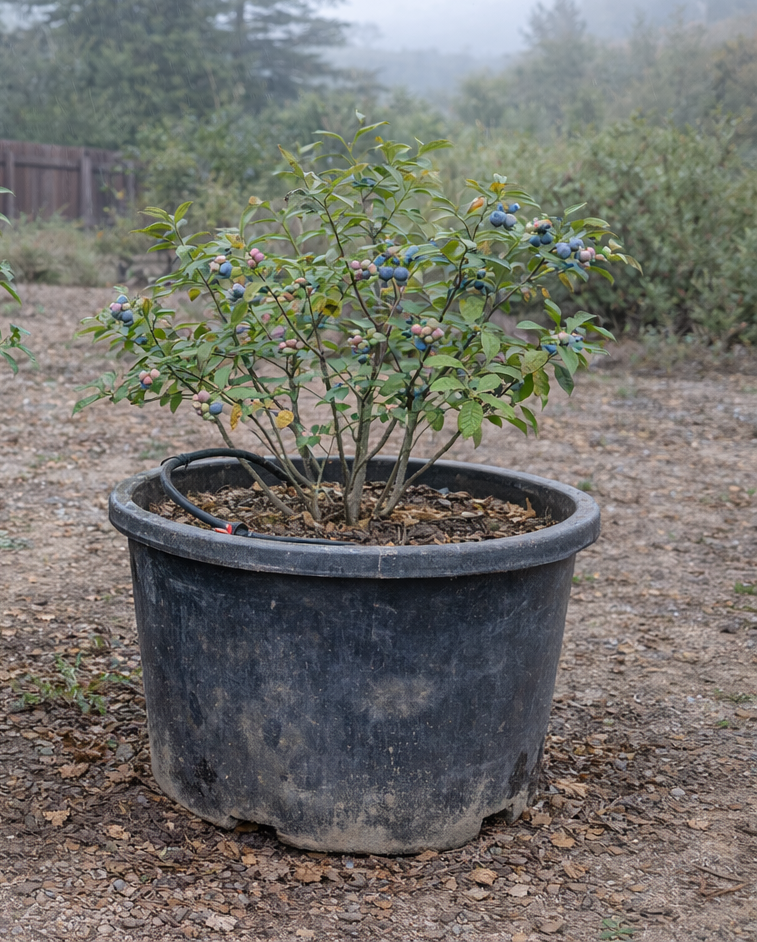
Container growing lets you create perfect soil from the start, bypassing native soil problems entirely.
Step 1: Choose your growing medium
Start with a mix specifically designed for acid-loving plants, or create your own:
DIY acidic container mix:
75% peat moss (naturally acidic, pH 3.5-4.5)
25% compost or aged bark for structure and nutrients
Enhanced drainage mix:
50% peat moss
25% perlite or pumice
15% aged bark
10% coarse sand
Step 2: Test pH of your mix
Even commercial "acidic" mixes may not be quite acidic enough. Test before planting.
Step 3: Adjust if needed
If pH is above 5.5:
Mix in elemental sulfur according to package directions
Wait 2-4 weeks
Retest
Step 4: Plant and mulch
Once pH is confirmed at 4.5-5.5:
Plant your blueberry at correct depth
Apply 2-3 inches of acidic mulch (pine bark, pine needles)
For In-Ground Planting
In-ground planting requires more preparation but can work well with proper soil replacement.
Step 1: Test your native soil
Know your starting point before you dig.
Step 2: Excavate planting area
Dig a wide, shallow hole:
Width: 2-3 feet (wider is better)
Depth: 18 inches
Save native soil separately (you probably won't use much of it)
Step 3: Create acidic planting mix
Mix together:
75% peat moss
25% compost or aged bark
Elemental sulfur (amount based on mix pH test)
Step 4: Fill and settle
Fill hole with acidic mix, creating a slight mound (mix will settle)
Water thoroughly
Allow 2-4 weeks to settle before planting
Step 5: Test again
Confirm pH is 4.5-5.5 before planting. Add more sulfur if needed and wait another few weeks.
Step 6: Plant and mulch
Plant blueberry at correct depth (crown at or slightly above soil level)
Apply 3-4 inches of acidic mulch extending beyond the planting hole
What Does a Real Acidification Example Look Like?
Here's a concrete example of how to prepare a bed for blueberries in challenging conditions.
Starting situation:
Soil type: Clay
Starting pH: 7.2
Bed size: 100 square feet
Target pH: 5.0
Goal: Plant blueberries in spring
Step 1: Calculate sulfur needs
From the table above, going from pH 7.0 to 5.0 in loam requires 3-4 lbs per 100 sq ft. Since this is clay soil (higher buffering), add 50% more:
Estimated need: 4.5-6 lbs elemental sulfur per 100 sq ft
Step 2: Fall application (October)
Apply half the sulfur (about 2.5-3 lbs per 100 sq ft) and incorporate into the top 8 inches of soil. Water in.
Step 3: Winter waiting period
Let sulfur work over winter. Bacterial conversion is slower in cold weather but will continue.
Step 4: Late winter retest (February)
Test soil pH. Let's say it's now 6.2 (dropped 1 full unit).
Step 5: Second application (February/March)
Apply remaining sulfur (another 2.5-3 lbs per 100 sq ft). Work into soil surface where possible.
Step 6: Pre-planting retest (April)
Test again. If pH is now 5.2-5.5, you're ready to plant. If still above 5.5, you may need to wait longer or add more sulfur.
Step 7: Plant and maintain
Plant blueberries, apply acidic mulch, and begin ongoing pH maintenance (acidified watering, annual testing).
How Do Acidic Mulches Support pH Long-Term?
Mulch serves multiple purposes for blueberries: moisture retention, weed suppression, root temperature moderation, and gradual pH support.
Best Mulches for Blueberries
Pine needles:
Naturally acidic
Attractive appearance
Slow to decompose
May be available free from neighbors or parks
Pine bark (fines or shredded):
Acidic and excellent moisture retention
Long-lasting
Widely available commercially
Preferred by many blueberry growers
Oak leaves (shredded):
Mildly acidic
Free if you have oak trees
Decompose faster than pine products
Work well mixed with pine bark
Peat moss as surface mulch:
Very acidic
Expensive for large areas
Can crust over and repel water
Better used in soil mix than as surface mulch
Mulches to Avoid
Hardwood bark and chips: Generally neutral to slightly alkaline; work against your acidification efforts
Fresh wood chips: Tie up nitrogen as they decompose; use only if well-aged
Stone, gravel, rubber: No pH benefit; don't contribute organic matter
Cocoa hull mulch: Neutral pH; toxic to dogs
Mulch Application
Apply 3-4 inches deep
Keep mulch a few inches away from stems
Replenish annually as it decomposes
The decomposing organic matter helps maintain acidity over time
How Do You Deal with Hard Water?
Santa Cruz County municipal water is typically alkaline (pH 7.5-8.5) and mineral-rich. Every time you water, you're slowly pushing your soil pH upward.
Testing Your Water
Before assuming you have hard water:
Test with a pH meter or strips
Check your water district's annual quality report
Well water varies widely; definitely test
Acidifying Irrigation Water
Adding 1 tablespoon white vinegar per gallon of water is the most common home-garden approach.
How to acidify tap water:
Add vinegar to your watering can or bucket
Stir to mix
Test pH with strips (aim for approximately 5.5-6.5)
Adjust ratio as needed for your water source
Use immediately (don't store acidified water long-term)
Alternatives to vinegar:
Citric acid: Approximately 1/4 teaspoon per gallon
Commercial pH-down products: Follow label directions
Important note: Acidified water helps maintain pH but doesn't replace soil sulfur amendments. Vinegar has a short-term effect in soil; elemental sulfur is needed for lasting pH reduction. Use both strategies together.
Collecting Rainwater
Rainwater is naturally slightly acidic (approximately pH 5.6) and free of the dissolved minerals in tap water. It's ideal for acid-loving plants like blueberries.
Options:
Rain barrels connected to downspouts
Larger cisterns for serious collection
Use during rainy season (October-April in Santa Cruz County)
Even partial rainwater use reduces mineral accumulation from tap water.
Reducing Total Water Volume
Less water = less mineral input. Strategies:
Water deeply but less frequently (encourages deep roots)
Improve soil organic matter (better moisture retention)
Maintain thick mulch layer
Use drip irrigation (delivers water to roots efficiently)
How Do You Maintain pH Over Time?
Achieving correct pH once isn't enough. Our alkaline water and soil conditions require ongoing management.
Annual Maintenance Schedule
Early Spring (February-March):
Test soil pH
Apply elemental sulfur if pH is above 5.5
Refresh mulch layer if thin
Resume acidified watering as plants break dormancy
Late Spring/Early Summer (May-June):
Monitor for chlorosis symptoms (yellow leaves, green veins)
Apply foliar chelated iron if symptoms appear
Continue acidified watering through growing season
Fall (September-November):
Test pH again if problems occurred during the season
Apply sulfur if pH needs adjustment (fall applications work over winter)
Add fresh mulch layer before winter rains
Winter (December-January):
Rest period; no pH work needed
Rain naturally leaches some minerals from soil
When pH Drifts Upward
If annual testing shows pH creeping up despite your efforts:
Increase water acidification (use vinegar more consistently)
Apply additional sulfur
Refresh mulch with acidic materials more frequently
Test more often (twice per year)
For containers: Consider repotting with fresh acidic mix, or heavy leaching followed by sulfur application
Signs Your pH Management Is Working
Healthy green leaves throughout the growing season
Vigorous new growth
Good flowering and fruit set
Soil pH tests confirming 4.5-5.5
What Are the Most Common Acidifying Mistakes to Avoid?
Using aluminum sulfate on blueberries: Aluminum becomes toxic at the acidic pH levels blueberries need. Use elemental sulfur instead.
Expecting coffee grounds to acidify soil: Used coffee grounds are nearly neutral in pH. The acid is extracted into the brewed coffee. Grounds are fine as mulch or compost but won't lower pH meaningfully.
Pouring vinegar directly on soil as an amendment: Vinegar is for treating water, not bulk soil application. It's too weak to significantly change soil pH and can damage roots at high concentrations.
Applying too much sulfur at once: Large sulfur doses can burn plant roots. Split applications and wait for results before adding more.
Skipping the testing step: Guessing at pH leads to over-correction or under-correction. Test before treating and after waiting for amendments to work.
Forgetting about water: You can achieve perfect soil pH, but alkaline irrigation water will push it back up. Ongoing water acidification is essential for long-term success.
For a complete guide to growing blueberries in our area, see Growing Blueberries in Santa Cruz. Our California garden soil amendments guide covers broader soil improvement strategies.
Frequently Asked Questions
How long does it take for sulfur to lower pH?
Elemental sulfur requires soil bacteria to convert it to sulfuric acid. This takes 4-8 weeks minimum in warm, moist conditions. In cold weather, the process slows significantly. Plan to apply sulfur well before planting and retest after waiting.
Do coffee grounds acidify soil?
No. Used coffee grounds are nearly neutral (around pH 6.5-6.8) because the acids are extracted into the brewed coffee. Grounds are fine as mulch or compost addition but won't meaningfully lower soil pH. This is a persistent garden myth.
How often should I test soil pH?
At minimum, test annually in early spring before the growing season. Also test 4-8 weeks after any sulfur application to assess effectiveness, and whenever you see signs of nutrient problems (chlorosis, poor growth).
Can soil be too acidic for blueberries?
Yes, though this is rare in California. Soil below pH 4.0 can cause nutrient imbalances and aluminum toxicity. If your soil tests below 4.0-4.5, hold off on acidifying amendments. If significantly below 4.0, a small amount of lime can raise pH to the optimal range.
Will acidifying my blueberry bed affect nearby plants?
Amendments you add to the blueberry planting area stay relatively localized, especially in the short term. However, if you're concerned about nearby plants that prefer neutral soil, create a buffer zone or use containers for your blueberries.
Is peat moss environmentally sustainable?
Peat bogs form slowly and harvesting raises legitimate environmental concerns. Coconut coir is a more sustainable alternative, but it's pH-neutral and requires acidification with sulfur. If using peat, look for products from responsibly managed sources.
What if my pH never seems to drop despite adding sulfur?
Several factors can cause this:
Very high initial pH or presence of free calcium carbonate (limestone) that buffers strongly
Insufficient sulfur applied for your soil type (clay needs more)
Cold or dry conditions slowing bacterial conversion
Alkaline water continuously counteracting your efforts
Testing too soon after application (wait at least 4-8 weeks)
If persistent, consider container growing to bypass native soil entirely.
What soil pH do blueberries need and how do I acidify California soil?
Blueberries need distinctly acidic soil, roughly pH 4.5 to 5.5, which UC ANR notes sits well below the neutral-to-alkaline range common across much of California. To lower pH, work elemental sulfur into the bed several months before planting so soil microbes have time to convert it, then retest. In our region, growing in containers with an acidic mix is often easier. See UC ANR guidance at ucanr.edu.
Why Is Mastering pH the Key to Blueberry Success?
Soil pH management may seem like a lot of work, but it's the foundation of blueberry success in California. Once you understand the principles, the ongoing maintenance becomes routine: test in spring, add sulfur if needed, acidify your water, refresh your mulch.
The investment pays off for decades. A blueberry bush planted in properly acidified soil, maintained with consistent pH management, can produce abundant harvests for 20 years or more. Compare that to the frustration of watching plant after plant decline from chlorosis because the soil chemistry was never addressed.
Start with a soil test. Know your pH. Amend with elemental sulfur, prepare with acidic mixes, and commit to ongoing water acidification. With these fundamentals in place, you'll grow blueberries that are the envy of your neighbors, proving that even California's challenging conditions can't stop a determined gardener armed with the right knowledge.
Free Gardening Resources
Know Your Microclimate Worksheet: Understand your specific Santa Cruz County growing conditions
Seasonal Planting Calendar: Month-by-month guidance for Santa Cruz County
Water-Wise Gardening Guide: Strategies for managing water in our Mediterranean climate
Related Articles
Growing Blueberries in Containers: A California Gardener's Guide
Blueberry Problems in California: Yellow Leaves, No Fruit, and Other Issues
Our system has encountered an error. This exception has been automatically logged and reported. Z686N2C49G9XBDT4R6YM
