

Blueberry Problems in California: Yellow Leaves, No Fruit, and Other Issues
A few of the product links in this guide are affiliate links. If you buy through one, Ambitious Harvest may earn a small commission at no extra cost to you, which helps keep these guides free. We only point to gear we would use in our own Santa Cruz garden. As an Amazon Associate, we earn from qualifying purchases. Read our full disclosure.
Growing blueberries in Santa Cruz County comes with predictable challenges. According to UC Agriculture and Natural Resources, blueberries require soil pH between 4.5 and 5.5, making them one of the most pH-sensitive fruit crops California gardeners can grow. Our alkaline soil, hard water, and mild winters create conditions that can stress these acid-loving plants. The good news? Most blueberry problems have identifiable causes and practical solutions.
This troubleshooting guide covers the most common issues California blueberry growers face. For a comprehensive overview of growing blueberries in our area, see our complete blueberry growing guide, from the near-universal battle with iron chlorosis to pest and disease problems. For each issue, you'll find symptoms to look for, the underlying cause, and step-by-step solutions.
Why Are My Blueberry Leaves Yellow with Green Veins?
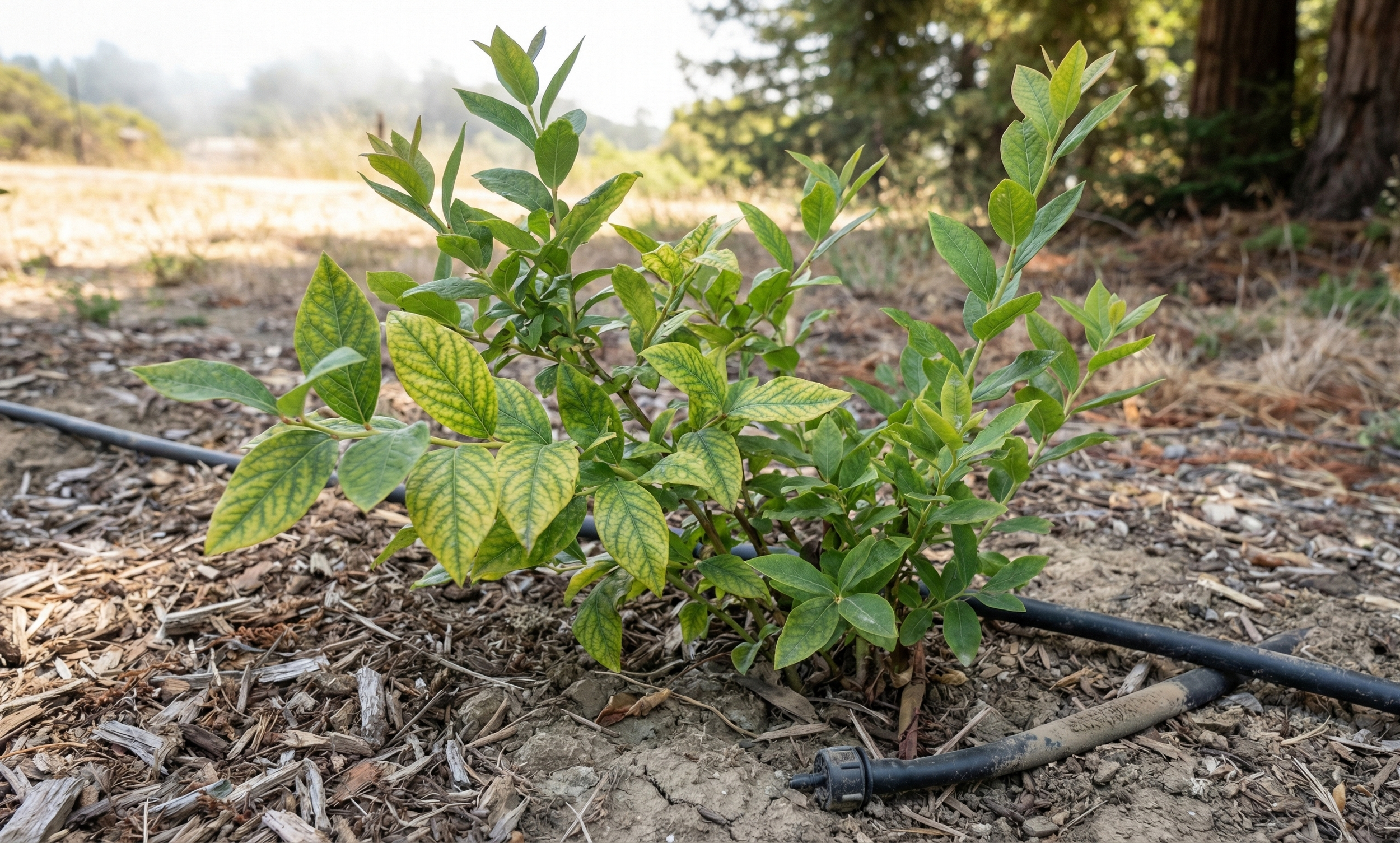
This is the #1 blueberry problem in California. If your blueberry leaves are turning yellow while the veins stay green, you're almost certainly dealing with iron chlorosis, and it's almost certainly caused by soil pH that's too high.
Symptoms
Leaves turn yellow between the veins while veins remain green
Newest leaves (at branch tips) are affected first and most severely
Older leaves may stay green longer
In severe cases, leaves become almost white or develop brown edges
Growth slows; plant looks generally unhealthy
The Real Cause: pH, Not Lack of Iron
Here's what many gardeners don't understand: iron chlorosis isn't caused by a lack of iron in the soil. Most soils have plenty of iron. The problem is that when soil pH rises above 5.5, iron becomes chemically unavailable to blueberry roots, even though it's present in the soil.
Think of it like a locked pantry: the food is there, but the plant can't access it.
pH and iron availability:
pH 4.5-5.5: Iron readily available (optimal range)
pH 5.5-6.0: Iron becoming less available (early chlorosis may appear)
pH 6.0-6.5: Iron significantly limited (chlorosis very likely)
pH 6.5+: Iron largely unavailable (severe chlorosis common)
Diagnosis
Test your soil pH. This is the only way to confirm the cause. Home test kits work for a rough reading; digital meters or professional lab tests are more accurate.
If pH is above 5.5-6.0 and you're seeing yellow leaves with green veins, you've found your problem.
Short-Term Solution: Foliar Iron
For quick relief while you work on pH:
Apply chelated iron as a foliar spray directly to leaves
Use EDDHA or DTPA chelated forms (more effective at high pH than regular iron sulfate)
Follow package directions; typically every 2-3 weeks during growing season
This treats symptoms but doesn't fix the underlying pH problem
Long-Term Solution: Lower Soil pH
For containers:
Test current pH
Add elemental sulfur according to package directions
Wait 4-8 weeks and retest
Repeat if still above 5.5
Consider repotting with fresh acidic mix if pH is very high
For in-ground plants:
Test current pH
Apply elemental sulfur to soil surface around the plant (see our step-by-step guide to acidifying soil)
Water in thoroughly
Wait 4-8 weeks and retest
Repeat applications as needed
Add 3-4 inches of acidic mulch (pine needles, pine bark)
Sulfur application rates (approximate, for loam soil):
To lower pH by 0.5 unit: 0.5-1 lb per 100 sq ft
To lower pH by 1.0 unit: 1-2 lbs per 100 sq ft
Clay soils need more; sandy soils need less
Prevention: Ongoing pH Management
Acidify irrigation water with 1 tablespoon white vinegar per gallon
Apply acidic mulch annually
Use acid-forming fertilizers (ammonium sulfate-based)
Test soil pH at least once per year (early spring)
Why Is My Blueberry Not Flowering or Fruiting?
A blueberry bush that grows leaves but doesn't flower or fruit is frustrating. Several factors can cause this.
Cause 1: Insufficient Chill Hours
The problem: Blueberry varieties have specific chill hour requirements (hours between 32-45°F during winter). If your location doesn't provide enough chill, the plant won't properly break dormancy or set flowers.
Symptoms:
Weak, delayed leaf-out in spring
Few or no flowers
General lack of vigor
Solutions:
Verify your variety's chill requirement against your location
Coastal Santa Cruz often accumulates only a few hundred chill hours
Replace with lower-chill varieties if needed:
Sharpblue (~150-200 hours)
Cause 2: Plant Too Young
The problem: Blueberries take time to establish before producing significant crops.
Timeline:
Year 1-2: Focus on root establishment; minimal fruit (this is normal)
Year 3: First meaningful harvest (1-2 pints)
Year 4-6: Production increases annually
Year 6+: Full production (3-6 pints per mature plant)
Solution: Be patient. Remove flower buds in year 1 to direct energy to roots and growth.
Cause 3: Over-Pruning
The problem: Blueberries fruit on one-year-old wood. Heavy pruning removes the wood that would have produced this year's fruit.
Solutions:
Prune conservatively (remove no more than about 20% of plant per year)
Focus on removing oldest canes (6+ years old), dead wood, and crossing branches
Leave plenty of healthy one-year-old wood
Cause 4: Poor Pollination
The problem: While most Southern Highbush varieties are partially self-fertile, cross-pollination between different varieties significantly improves fruit set, berry size, and yield.
Symptoms:
Flowers appear but don't develop into berries
Few berries despite good flowering
Small berries
Solutions:
Add a second variety with overlapping bloom time (within 50 feet)
Encourage bees with nearby flowering plants
Avoid pesticides during bloom
Hand-pollinate if bee activity is very low
Cause 5: Nutrient Deficiency
The problem: Plants lacking essential nutrients may prioritize survival over reproduction.
Solutions:
Fertilize with balanced acid-loving plant food in spring and after fruit set
Ensure pH is correct (nutrients unavailable at wrong pH)
Test soil if problems persist
Cause 6: Late Frost Damage
The problem: Frost during bloom kills flower buds and developing fruit.
Symptoms:
Flowers turn brown and drop
Partial fruit set (some berries, many empty clusters)
Damage worse on exposed or early-blooming plants
Solutions:
Cover plants with frost cloth when frost threatens during bloom
Plant in locations with good air drainage (avoid low spots where cold air collects)
Choose mid-season varieties over early bloomers in frost-prone areas
What Causes Brown Edges on Blueberry Leaves?
Brown, crispy edges on blueberry leaves can have several causes.
Cause 1: Salt Burn from Hard Water
The problem: Santa Cruz County's hard water contains dissolved minerals. Over time, these accumulate in soil and damage roots.
Symptoms:
Brown, crispy leaf margins
White crusty deposits on soil surface or pot rim
Progressive worsening over the growing season
Solutions:
Flush containers periodically with large volumes of water
Use acidified water (1 tablespoon vinegar per gallon)
Collect and use rainwater when possible
Reduce fertilizer concentration
For containers: repot with fresh mix if salt buildup is severe
Cause 2: Potassium Deficiency
The problem: Insufficient potassium causes marginal leaf scorch, typically starting on older leaves.
Symptoms:
Brown margins on older leaves first
May have reddish or purplish tint
General weak growth
Solutions:
Apply balanced acid-loving fertilizer
Or apply sulfate of potash (potassium sulfate) specifically
Ensure pH is correct (potassium less available at high pH)
Cause 3: Drought Stress
The problem: Blueberries have shallow roots and suffer quickly from dry soil.
Symptoms:
Leaf edges brown and curl
Wilting, especially in afternoon
Poor fruit development
Solutions:
Water more frequently and deeply
Add 3-4 inches of mulch to retain moisture
Install drip irrigation for consistent moisture
For containers: may need daily watering in summer heat
Why Are My Blueberry Leaves Turning Red or Purple?
Red or purple leaves during the growing season signal stress.
Cause 1: Phosphorus Deficiency
The problem: Insufficient phosphorus, often due to cold soil or pH issues.
Symptoms:
Purple-red coloration on older leaves
May affect entire leaf or just undersides
Common in early spring when soil is cold
Stunted growth
Solutions:
If early spring: may resolve as soil warms
Apply balanced acid-loving fertilizer
Check pH (phosphorus less available outside optimal range)
Cause 2: Root Damage or Root Rot
The problem: Damaged roots can't take up nutrients properly.
Symptoms:
Red/purple leaves plus wilting despite moist soil
Yellowing and leaf drop
If you check roots: mushy, dark, or foul-smelling
Solutions:
Improve drainage immediately
Reduce watering frequency
For containers: repot with fresh, well-draining mix
For in-ground: may need to move plant to raised bed or container
Severely rotted plants may not recover
Cause 3: Magnesium Deficiency
The problem: Insufficient magnesium uptake.
Symptoms:
Interveinal yellowing with potential reddish/purplish tints
Older leaves affected first
Often occurs with pH or drainage problems
Solutions:
Apply Epsom salts (magnesium sulfate): 1 tablespoon per gallon water, monthly during growing season
Check and correct pH
Address any drainage issues
Why Are My Blueberries Small or Few?
Cause 1: Poor Pollination
The problem: Inadequate pollen transfer results in small, seedy, or few berries.
Solutions:
Add compatible pollination partner variety (within 50 feet)
Encourage bees: plant pollinator-attracting flowers nearby
Avoid pesticide use during bloom
Cause 2: Old Canes Need Pruning
The problem: Old canes (6+ years) produce smaller, fewer berries.
Solutions:
Remove 1-2 oldest canes annually during winter pruning
Maintain a mix of 1-year, 2-3 year, and 4-5 year canes
Remove weak, spindly growth
Cause 3: Nutrient Issues
Solutions:
Fertilize appropriately (acid-loving fertilizer, spring and after fruit set)
Time second feeding after fruit set to support berry development
Ensure pH allows nutrient uptake
Cause 4: Water Stress During Fruit Development
The problem: Insufficient water during fruit sizing results in small berries.
Solutions:
Water deeply and consistently during fruiting period (typically May-July)
Mulch to retain soil moisture
Consider drip irrigation for consistent delivery
How Do You Prevent Bird Damage to Blueberries?
Birds are the most significant pest for home blueberry growers. They can strip a bush of ripe berries in hours.
Prevention
Netting (most effective):
Cover plants as berries begin to color (before they're ripe)
Use netting with small mesh (less than 1/2 inch)
Support netting away from berries on a frame if possible
Secure edges to ground or container to prevent birds entering underneath
Scare devices (less effective):
Reflective tape, old CDs, fake owls
Birds often habituate to these quickly
May provide temporary deterrent; rotate devices
Timing harvest:
Pick berries as soon as fully ripe
Check daily during harvest season
Don't leave ripe berries on plants overnight
How Do You Control Spotted Wing Drosophila on Blueberries?
This invasive fruit fly is becoming an increasingly serious problem for California berry growers.
Identification
The pest: A small fruit fly that lays eggs in intact, ripening fruit (unlike common fruit flies that target overripe/damaged fruit).
Symptoms:
Small puncture marks on ripening berries
Soft spots on fruit
White larvae visible inside berries when cut open
Small flies (2-3mm) hovering near ripe fruit
Cultural Controls (First Line of Defense)
Harvest frequently: Every 1-2 days during peak ripening
Remove damaged fruit: Don't leave infested berries on plant or ground
Keep area clean: Remove fallen fruit, debris
Refrigerate harvested berries immediately: Cold stops larval development
Monitoring
Set out apple cider vinegar traps to monitor population
Traps: jar with small holes, filled with apple cider vinegar plus drop of dish soap
High trap catches indicate need for additional controls
Chemical Controls (If Necessary)
Spinosad (organic): Apply before infestation, repeat as directed
Pyrethrin (organic): Short residual, requires frequent application
Apply in evening to minimize bee exposure
Follow all label directions
What Is Mummy Berry Disease and How Do You Prevent It?
A fungal disease that can be serious in humid regions but is less common in dry-summer California climates.
Symptoms
Flowers brown and collapse
Berries shrivel and turn grayish-white
Disease Cycle
Mummified berries on ground produce spores in spring
Spores infect new shoots and flowers
Infected fruit develops, then shrivels into new "mummies"
Cycle repeats
Cultural Controls
Remove and destroy mummified berries: Collect and dispose of (don't compost)
Rake under plants before spring: Remove any mummies on ground
Apply fresh mulch: Covers any remaining spores
Improve air circulation: Space plants properly, prune for airflow
Avoid overhead watering: Wet foliage promotes infection
Note for Santa Cruz County
Mummy berry is less common here than in humid eastern regions due to our dry summers. However, it can occur, especially in foggy coastal areas or with overhead irrigation. Good sanitation is usually sufficient prevention.
How Do You Prevent and Treat Blueberry Root Rot?
Root rot from Phytophthora and other fungi is often fatal and easier to prevent than cure.
Symptoms
Yellowing and wilting despite moist soil
Poor growth, plant decline
Leaves may turn red/purple
If roots are examined: brown, black, mushy, or foul-smelling instead of white and firm
Causes
Poor drainage (heavy clay, compacted soil)
Overwatering
Planting too deep
Container without drainage holes
Prevention (Most Important)
Ensure excellent drainage: Raised beds, containers, or heavily amended soil
Don't overwater: Soil should be moist, not waterlogged
Plant at correct depth: Crown at or slightly above soil level
Use containers with drainage holes: Elevate on pot feet
Treatment
Once established, root rot is difficult to treat:
Improve drainage immediately
Reduce watering
Apply appropriate fungicide (limited effectiveness once symptoms appear)
Severely affected plants often don't recover; removal and fresh planting in a different location (or new container with fresh soil) may be necessary
Should You Replace or Rehabilitate a Struggling Blueberry Plant?
Sometimes it's worth saving a struggling blueberry; sometimes replacement makes more sense.
Signs the Plant Can Be Saved
Some healthy green growth remains
Chlorosis is partial (some green leaves)
Root system is mostly intact (check by gently removing from pot or digging carefully)
Problem is clearly environmental (pH, water) and correctable
Signs Replacement Is Better
Severe root rot (most roots mushy or dead)
Chronic chill hour mismatch (wrong variety for your microclimate)
Very high soil pH with free calcium carbite (limestone) that resists acidification
Plant severely stunted for multiple years despite care
Stem cankers or other incurable diseases
Before treating a problem, check whether your bush is simply at an early stage; our blueberry growth stages guide shows the normal timeline.
Frequently Asked Questions
Why are my blueberry leaves yellow but the veins are green?
This is iron chlorosis, caused by soil pH that's too high. At pH above 5.5-6.0, iron becomes chemically unavailable to blueberry roots. Test your soil pH and lower it with elemental sulfur. Apply chelated iron foliar spray for temporary relief while the sulfur works.
My blueberry flowered but didn't produce fruit. Why?
Most likely causes: poor pollination (add a second variety), late frost damage to flowers, or the plant is still young (give it 2-3 years). Less common causes include severe nutrient deficiency or pH problems affecting overall plant health.
What's eating my blueberries before I can harvest them?
Birds are the most common culprit. Install netting as berries begin to color. If you're finding soft, damaged berries with small holes, spotted wing drosophila may be the cause; harvest frequently and remove damaged fruit.
Can I save a blueberry with severe iron chlorosis?
Usually yes, if you correct the pH. Apply chelated iron foliar spray for immediate symptom relief, then add elemental sulfur to lower soil pH. Switch to acidified irrigation water. Recovery may take a full season. Very severe cases in high-pH soil may require replanting in containers with acidic potting mix.
Why are my blueberry leaves turning red in summer?
Red or purple leaves during growing season (not fall) indicate stress, usually phosphorus deficiency, root problems, or magnesium deficiency. Check drainage first (root rot causes similar symptoms), then address nutrition and pH.
Solving Blueberry Problems Is Possible
Most blueberry problems in Santa Cruz County trace back to a few root causes: soil pH too high, wrong variety for our chill hours, or water and drainage issues. Address these fundamentals, and you'll solve the majority of problems before they start.
When issues do arise, systematic diagnosis makes solutions clear. Test your soil pH first - it's the cause of more blueberry problems here than any other factor. Check your variety's chill requirement against your microclimate. Ensure your drainage is adequate and your watering consistent.
With attention to these basics and the specific solutions in this guide, you can grow healthy, productive blueberry plants that reward you with abundant harvests for years to come. The troubleshooting may seem complex at first, but most experienced blueberry growers find that once they master pH management, everything else falls into place.
Free Gardening Resources
Know Your Microclimate Worksheet: Understand your specific Santa Cruz County growing conditions
Seasonal Planting Calendar: Month-by-month guidance for Santa Cruz County
Garden Troubleshooting Guide: Diagnose and solve common garden problems
Related Articles
Growing Blueberries in Containers: A California Gardener's Guide
Acidifying Soil for Blueberries in California: A Step-by-Step Guide
