

How to Grow Blueberries in Pots (California Edition)
A few of the product links in this guide are affiliate links. If you buy through one, Ambitious Harvest may earn a small commission at no extra cost to you, which helps keep these guides free. We only point to gear we would use in our own Santa Cruz garden. As an Amazon Associate, we earn from qualifying purchases. Read our full disclosure.
Blueberries grow exceptionally well in containers because pots allow you to control soil pH precisely, which is the biggest challenge when growing blueberries in California. According to UC Master Gardeners, container blueberries need acidic potting mix (pH 4.5 to 5.5), a pot at least 18 inches deep, and consistent moisture. Sunshine Blue and Misty are the best container varieties for Santa Cruz County, staying compact at 3 to 4 feet tall.
This is not settling for second best. Container-grown blueberries can be incredibly productive, with the added benefits of portability (move them to catch more sun or protect from frost) and easier maintenance (no weeding, controlled watering). Many California blueberry growers who have tried both methods end up preferring containers for their reliability and ease of care.
This guide covers everything you need to know about growing productive, healthy blueberries in containers in our Santa Cruz County climate. If you are also considering growing blueberries in the ground, see our full guide to growing blueberries in Santa Cruz County.
Why Do Containers Work Better for California Blueberries?
The Soil pH Advantage
Blueberries require acidic soil with a pH of 4.5 to 5.5. Most Santa Cruz County soil is neutral to alkaline (pH 6.5 to 7.5), and every time you water with our hard, alkaline tap water, you are raising that pH further. Understanding your local microclimate helps you anticipate how your soil and water conditions will affect container blueberries.
In-ground growing challenges:
Must amend or replace native soil
Surrounding alkaline soil keeps migrating in
Hard water raises pH with every watering
Constant pH monitoring and correction needed
Container growing advantages:
Start with perfectly acidic potting mix
No alkaline soil migration
Easier to manage water pH
Simple to test and adjust soil as needed
Other Container Benefits
Portability: Move plants to maximize sun exposure or protect from frost
Pest control: Easier to manage gophers (which love blueberry roots) and other soil pests
Space efficiency: Grow productive plants on patios, balconies, and small spaces
Drainage control: No worrying about clay soil holding too much water
Easier replacement: If a plant fails, simple to start fresh without excavating garden beds
What Container Should You Choose?
Size Matters: Go Big
Blueberries have shallow, fibrous root systems that spread horizontally rather than diving deep. They need room to spread, and larger containers hold more moisture and buffer temperature swings.
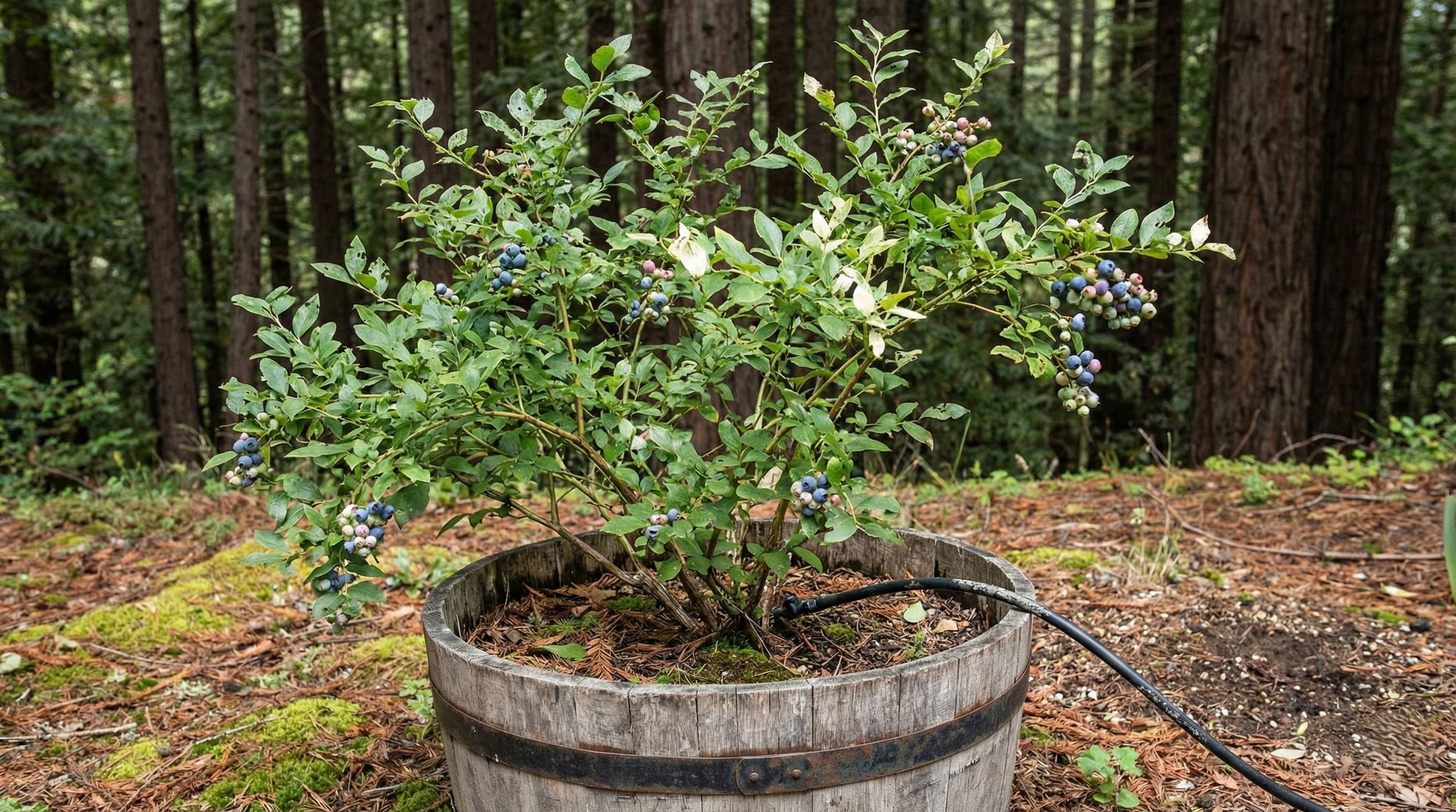
Minimum size: 15 gallons (approximately 18 inches diameter) Recommended size: 20-25 gallons for standard varieties Ideal size: Half wine barrels (about 25 gallons) work exceptionally well
Why bigger is better:
More soil = more stable moisture
Larger root zone = healthier, more productive plant
Better insulation against heat and cold
Fewer repotting struggles as plant matures
Container Material Considerations
Best choices:
Plastic containers:
Lightweight for moving
Retain moisture well
Inexpensive
Do not crack in temperature swings
Look for dark colors that absorb heat in cooler climates
Fabric grow bags:
Excellent drainage
Air prunes roots (prevents circling)
Lightweight
Affordable
Dry out faster (may need more frequent watering)
Half wine barrels:
Attractive and substantial
Good size for mature plants
Natural wood insulates roots
Heavy once filled (plan placement before filling)
May need resealing or lining over time
Glazed ceramic:
Attractive
Retains moisture well
Heavy and expensive
Ensure has drainage holes
Avoid:
Terra cotta:
Wicks moisture rapidly
Dries out too quickly for moisture-loving blueberries
Can crack in temperature swings
Allows mineral buildup on pot surface
Metal containers:
Conduct heat and cold extremes
Can overheat roots in summer sun
Some metals affect soil pH
Drainage Is Non-Negotiable
Whatever container you choose, it must have drainage holes. Blueberry roots rot quickly in waterlogged conditions. If your ideal container lacks holes, drill them yourself (1/2 inch holes, several in the bottom).
Place containers on pot feet or blocks to allow water to drain freely. Do not let pots sit in saucers of standing water.
What Soil Mix Do Container Blueberries Need?
Standard potting mixes are typically pH neutral (around 6.5 to 7.0) and often not acidic enough for blueberries without amendment. You need an acidic mix with a pH of 4.5 to 5.5. UC Master Gardeners recommend amending with peat moss and elemental sulfur to reach the target range. For more on soil amendment strategies, see our California garden soil amendments guide.
Option 1: Buy Pre-Made Acidic Mix
Look for potting mixes labeled for acid-loving plants, azaleas, rhododendrons, or specifically for blueberries.
Good commercial options:
Kellogg Acid Planting Mix
FoxFarm Ocean Forest (naturally acidic, around pH 6.0 to 6.5, may need slight acidification)
E.B. Stone Azalea Mix
Black Gold Acidic Potting Mix
Even commercial "acid" mixes may not be quite acidic enough. Test pH before planting and amend with sulfur if needed.
Option 2: Make Your Own Mix
Creating your own blueberry potting mix gives you complete control over pH and drainage.
Basic acidic blueberry mix:
75% peat moss (naturally acidic, pH 3.5 to 4.5)
25% compost or aged bark
Enhanced mix for better drainage:
50% peat moss
25% perlite or pumice
15% aged bark or compost
10% sand
Sustainability note: Peat moss is the traditional and most effective acidic base, but harvesting raises environmental concerns. Alternatives like coconut coir are pH neutral and require acidification with sulfur or acid fertilizers to reach blueberry range.
Testing and Adjusting pH
Before planting:
Fill container with your mix
Moisten thoroughly
Let sit 24 hours
Test pH (home kits or digital meter)
Adjust if needed:
pH too high: Add elemental sulfur and retest in 2 weeks
pH too low: Add small amount of lime (rare with peat-based mixes)
Target: pH 4.5 to 5.5 before planting
What Are the Best Compact Varieties for Containers?
While most blueberry varieties can grow in containers, compact varieties are easier to manage and more productive per cubic foot of growing space. UC ANR notes that Southern Highbush varieties offer the most promise for California coastal growers because of their low chill requirements.
Top Container Variety Picks
Sunshine Blue (3-4 feet) The top choice for container growing in California. Ultra-low chill (about 150 hours), more pH tolerant than most, self-fertile, and naturally compact. Excellent flavor and reliable production.
Top Hat (18-24 inches) Truly dwarf blueberry that stays under 2 feet. Perfect for small spaces, patios, and decorative containers. High chill requirement (1,000+ hours) limits usefulness in coastal areas. Better for San Lorenzo Valley and mountain locations with cold winters.
Jelly Bean (1-2 feet) Part of the Bushel and Berry series bred specifically for containers. Very compact and productive for its size. Sweet berries on a tiny plant. Low chill requirement makes it suitable for most of our microclimates.
Peach Sorbet (2-3 feet) Ornamental foliage (pink/peach/green variegation) with edible berries. Beautiful container specimen. Low chill requirement (300 hours or less) works well for coastal areas.
Pink Icing (2-3 feet) Another Bushel and Berry variety with striking variegated foliage. Self-pollinating with moderate chill requirement (approximately 500 hours). Best for inland locations.
Misty (4-6 feet, container-manageable) Not truly compact but grows well in larger containers. Low chill (around 300 hours), early fruit, excellent coastal performer. Will need 25+ gallon container.
How Do You Plant Your Container Blueberry?
When to Plant
Best time: Late fall through early spring (November through March) when plants are dormant.
Container plants from nurseries can be planted almost any time, but fall planting gives roots time to establish before summer stress.
Step-by-Step Planting
Prepare your container: Ensure drainage holes are clear. Place pot feet or blocks underneath.
Add soil: Fill container about 2/3 full with your acidic mix.
Remove plant from nursery pot: Gently loosen the root ball. If roots are circling, score them lightly or tease apart.
Position the plant: Set so the top of the root ball is level with or just below the final soil line (about 1 inch from pot rim for watering space).
Fill around roots: Add remaining soil, firming gently.
Water thoroughly: Saturate the soil until water runs from drainage holes. Use acidified water if possible.
Add mulch: Apply 2-3 inches of acidic mulch (pine bark, pine needles) on the surface, keeping it away from the stem.
Where to Place Containers
Sun: 6-8 hours of direct sun for best fruit production. Blueberries can tolerate some afternoon shade.
Protection: South-facing walls provide heat and wind protection. Avoid placement where reflected heat might overheat pots in summer.
Accessibility: Place where you can easily water and harvest. Mature plants in large containers are heavy and hard to move.
Grouping: If you have multiple varieties for cross-pollination, place them near each other (within 30-50 feet) to facilitate bee movement.
How Do You Water Container Blueberries?
Container plants dry out faster than in-ground plants and need more frequent attention. UC Master Gardeners advise watering daily during summer and twice daily during heat waves, keeping soil moist but not muddy.
The California Hard Water Challenge
Our municipal water is typically alkaline and mineral-rich. Every watering slowly works against your acidification efforts.
Strategies to manage water pH:
Acidify tap water:
Add 1 tablespoon white vinegar per gallon
Or use citric acid (1/4 teaspoon per gallon)
Mix before watering each time
Important note: Acidified water helps maintain pH but should not be your only strategy. Soil sulfur and acidic growing media are still needed for long-term pH stability.
Collect rainwater:
Naturally acidic (pH around 5.6)
Free of chlorine and minerals
Set up rain barrels during winter
Even partial rainwater use helps
Use filtered water:
Reverse osmosis removes minerals
Start with nearly neutral water
Still benefits from slight acidification
Watering Frequency
Summer: Every 1-2 days in hot weather. Check daily; soil should stay consistently moist but not waterlogged.
Spring/Fall: Every 2-4 days depending on weather. More when warm and sunny, less when cool and cloudy.
Winter: Less frequent but do not let containers dry out completely. Every 1-2 weeks depending on rainfall and temperatures.
Watering Technique
Water until it runs from drainage holes
Morning watering is best (allows foliage to dry)
Avoid wetting foliage late in day (promotes fungal issues)
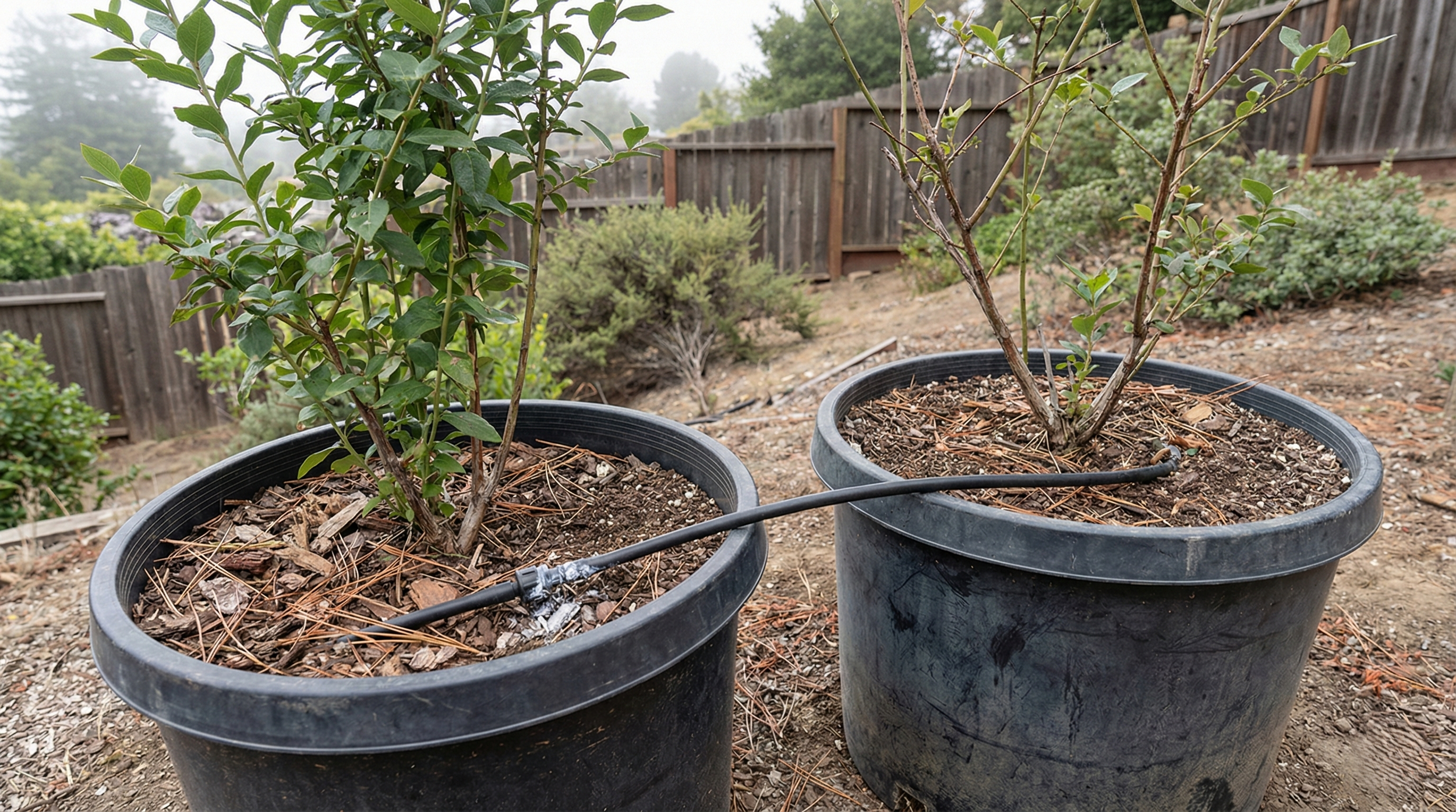
Drip irrigation or soaker attachments provide consistent moisture
Signs of Water Problems
Underwatering: Wilting, dry soil, crispy leaf edges, poor fruit development Overwatering: Yellowing leaves, soggy soil, root rot smell, plant decline
How Should You Fertilize Container Blueberries?
Container plants cannot reach beyond their pot for nutrients and depend entirely on what you provide. UC Master Gardeners caution that blueberry plants are sensitive to excessive fertilizer, which can burn or even kill the plants.
Fertilizer Type
Use fertilizers designed for acid-loving plants (azalea, rhododendron, or specific blueberry fertilizers). These typically contain:
Ammoniacal nitrogen (not nitrate, which raises pH)
Sulfur-coated or acid-forming ingredients
Iron and other micronutrients in chelated form
Good options:
Espoma Holly-tone (organic, granular)
Dr. Earth Acid Lovers (organic, granular)
Jobe's Organics Azalea (granular)
Miracid (water-soluble, synthetic)
Fox Farm Happy Frog Acid Loving (organic, granular)
Avoid:
General purpose fertilizers (often alkalizing)
Anything with calcium or lime listed
Fertilizers with nitrate nitrogen
Fertilizing Schedule
Early spring (February-March): Apply first feeding as new growth begins After fruit set (May-June): Apply second feeding Optional late summer (July): Light feeding to support next year's bud development
Stop fertilizing by August to avoid promoting tender growth that will not harden before winter.
Application Rates
Container plants need less fertilizer than in-ground plants. Follow package directions for container use, or use half the in-ground recommendation.
Signs of over-fertilization:
Salt buildup on soil surface (white crust)
Leaf tip burn
Excessive soft growth
Root damage
Flushing: If you see salt buildup, water heavily until water runs clear from drainage holes to flush excess minerals.
How Do You Overwinter Container Blueberries?
In Santa Cruz County, blueberries in containers rarely need special winter protection. Our mild winters do not threaten the plants themselves, and Southern Highbush varieties are hardy to at least 10-20 degrees F.
Container Protection Considerations
Root zone vulnerability: Container roots are more exposed to temperature swings than in-ground roots. In exceptionally cold snaps (rare for us), roots can be damaged before tops are affected.
Simple precautions:
Move containers against south-facing walls during cold periods
Group containers together for thermal mass
Wrap containers with burlap or bubble wrap for root insulation during frost warnings
Avoid placing containers where they receive runoff from cold roofs or patios
For most Santa Cruz County locations, no winter protection is necessary. Containers against south-facing walls rarely experience damaging cold.
Frost and Flowers
The greater concern is late spring frost damaging flowers. Most years this is not a problem, but if frost threatens during bloom:
Cover plants with frost cloth overnight
Move containers to protected locations (under eaves, against warm walls)
Water soil before frost (moist soil releases heat overnight)
Winter Dormancy Needs
Even our mild winters provide enough chill for low-chill varieties like Sunshine Blue and Misty. Do not move containers indoors during winter (except briefly during freeze warnings); plants need the chill exposure for proper flowering and fruiting.
What Are the Best Container Setups for Different Spaces?
Small Patio (One Large Pot)
Setup: 20-25 gallon container with Sunshine Blue Why it works: Self-fertile, so produces alone; compact size fits tight spaces; ultra-reliable in low-chill coastal areas Care tips: Drip emitter on timer; vinegar-acidified city water; annual pH test in spring
Balcony or Tiny Space
Setup: 10-15 gallon container with Jelly Bean or Peach Sorbet Why it works: Ultra-compact varieties stay small; ornamental appeal; low chill requirements Care tips: Light-colored container to reduce heat; more frequent watering due to smaller soil volume; consider self-watering pot insert
Micro-Orchard in Pots (Extended Harvest)
Setup: Three half barrels with Misty (early), Sunshine Blue (mid), and Peach Sorbet or Legacy (late) Why it works: Cross-pollination improves all three; harvest extends May through August; visual variety Care tips: Position within 30-50 feet of each other; stagger watering needs by pot size; label varieties for pruning records
What Are Container-Specific Problems and Solutions?
Yellow Leaves (Iron Chlorosis)
The problem: Most common container blueberry issue. Leaves turn yellow while veins stay green.
The cause: Soil pH too high, making iron unavailable even if present.
Solutions:
Test soil pH
Apply chelated iron as foliar spray for quick relief
Add elemental sulfur to lower pH long-term
Switch to acidified water
Consider repotting with fresh acidic mix if pH is very high
Salt Buildup
The problem: White crust on soil surface or pot rim; leaf tip burn; general decline.
The cause: Minerals from hard water and fertilizer accumulating over time.
Solutions:
Flush with large volumes of water periodically
Repot with fresh mix if severe
Use acidified or filtered water
Do not over-fertilize
Consider reducing fertilizer strength
Root Circling
The problem: Roots spiral around pot instead of spreading; stunted growth.
The cause: Pot-bound plant not repotted soon enough.
Solutions:
Score and loosen roots when repotting
Use fabric grow bags (air prunes roots)
Move to larger container before severely root-bound
Drying Out Too Fast
The problem: Soil dries within hours; constant wilting; poor production.
The cause: Root-bound plant; container too small; wrong container material; too much sun on container.
Solutions:
Move to larger container
Add mulch to soil surface
Use plastic instead of terra cotta
Shade the container (not the plant) from direct sun
Group containers together
Pot Overheating
The problem: Summer heat cooks roots; poor growth despite adequate water.
The cause: Dark containers in full sun absorb heat; container too small.
Solutions:
Use light-colored containers
Shade containers with cloth or other pots
Use larger containers with better thermal mass
Move away from heat-reflecting surfaces
When Should You Repot Container Blueberries?
Signs You Need to Repot
Watch for these signals:
Roots growing from drainage holes
Water runs straight through (root-bound)
Plant dries out within hours of watering
Declining vigor despite good care
Container falling over (top-heavy)
Timing: Late fall through early spring while dormant.
How to Repot
Choose a container one size larger (3-5 gallons more)
Prepare fresh acidic potting mix
Remove plant carefully; loosen roots
Set in new container at same depth
Fill with fresh mix
Water thoroughly
Soil Refresh
Even if not repotting, refresh the top few inches of soil annually:
Scrape away old mulch and top inch of soil
Replace with fresh acidic mix
Apply new mulch
This removes accumulated salts and adds fresh nutrients.
Blueberries build slowly over their first years; our blueberry growth stages guide shows what to expect season by season.
Frequently Asked Questions
How long will container blueberries live?
With good care, container blueberries can live and produce for 15 to 20 or more years. They are more likely to need repotting or soil refreshing than to die of old age.
Can I bring container blueberries indoors for winter?
Not recommended. Blueberries need winter chill exposure to fruit properly. Our outdoor winter temperatures are fine for container plants. Only bring indoors briefly during rare freeze warnings.
How much fruit can I expect from a container blueberry?
A mature container blueberry (5+ years) typically produces 2 to 4 pints of berries per season, slightly less than in-ground plants. Two or three plants provide a meaningful harvest for fresh eating.
Do container blueberries need pruning?
Yes, but less aggressively than in-ground plants. Remove dead or crossing branches, thin oldest canes after 5-6 years, and maintain a balanced shape. Prune in late winter. UC Master Gardeners recommend annual pruning to maintain the right balance of new and previous season growth.
Can I grow two blueberry plants in one large container?
Not recommended. Competition for water and nutrients stresses both plants. Give each plant its own container.
My container blueberry is not producing fruit. Why?
Most likely causes: plant is too young (wait 2-3 years), insufficient chill hours (wrong variety for your location), poor pollination (add another variety nearby), or pH problems affecting plant health.
How often should I test soil pH in containers?
Test annually in early spring. Also test if you see signs of chlorosis (yellow leaves with green veins) or other problems. Test 4-8 weeks after any sulfur application to assess effectiveness.
What is the best container material for blueberries?
Plastic or fabric grow bags work best for most situations. They retain appropriate moisture, do not overheat, and are affordable. Half wine barrels are excellent if you want something more attractive and do not mind the weight.
Your Container Blueberry Success Story Starts Here
Container blueberries are one of the most reliable ways to grow this delicious fruit in Santa Cruz County. By controlling your soil from the start with an acidic potting mix, managing water pH with simple vinegar additions, and choosing low-chill varieties like Sunshine Blue or the compact Bushel and Berry series, you set yourself up for years of successful harvests.
Start with a single 20-gallon container and a Sunshine Blue plant if you are new to blueberries. Master the basics of pH management and watering, then expand to multiple varieties for cross-pollination and extended harvest. Before long, you will be picking fresh, sun-warmed blueberries from your patio, balcony, or backyard, fruit that tastes far better than anything you can buy at the store.
The investment in good containers, acidic soil mix, and a little attention to pH pays dividends for decades. Your container blueberry planted this fall could still be producing abundant fruit when today's kindergarteners graduate from college.
Free Gardening Resources
Know Your Microclimate Worksheet: Understand your specific Santa Cruz County growing conditions
Seasonal Planting Calendar: Month-by-month guidance for Santa Cruz County
Water-Wise Gardening Guide: Strategies for managing water in our Mediterranean climate
Related Articles
| Variety / Type | Minimum | Recommended |
|---|---|---|
| Top Hat, Jelly Bean Ultra-dwarf (under 2 ft) |
10 gallons | 15 gallons |
| Peach Sorbet, Pink Icing Compact ornamental (2-3 ft) |
15 gallons | 20 gallons |
| Sunshine Blue Semi-dwarf (3-4 ft) |
15 gallons | 25 gallons |
| Misty, Sharpblue, O'Neal Standard SHB (4-6 ft) |
20 gallons | Half barrel (25 gal) |
✓ Switch to acidified water (1 tbsp vinegar/gal)
✓ Apply chelated iron foliar spray for quick relief
✓ Consider repotting with fresh acidic mix
✓ Reduce fertilizer strength
✓ Use filtered or rain water
✓ Repot with fresh mix if severe
