

The Complete Guide to Growing Onions in Santa Cruz County
A few of the product links in this guide are affiliate links. If you buy through one, Ambitious Harvest may earn a small commission at no extra cost to you, which helps keep these guides free. We only point to gear we would use in our own Santa Cruz garden. As an Amazon Associate, we earn from qualifying purchases. Read our full disclosure.
Onions are kitchen essentials that most Santa Cruz gardeners can grow successfully, yet they're one of the crops people struggle with most. The confusion usually comes down to variety selection: plant the wrong day-length type and your onions will never bulb properly, no matter how good your soil or how diligent your care.
Once you understand the day-length factor and choose appropriate varieties, onions become one of the more reliable crops for our climate. Our mild winters and long, cool springs create excellent conditions for onions to develop size before bulbing kicks in, and our dry summers support proper curing.
This guide covers the three ways to start onions (seeds, sets, and transplants), helps you choose the right approach for your goals, and walks through the growing process from planting to harvest.
Why Does Day Length Matter for Onion Growing?
Onions form bulbs in response to day length, and this is the single most important thing to understand about growing them successfully. Different onion varieties are bred to respond to different day lengths.
Long-day onions bulb when days reach 14-16 hours of light. These varieties are designed for northern states (Washington, Oregon, northern California, and above) where summer days are long. In Santa Cruz County, day length reaches about 14.5 hours at summer solstice, which is borderline for long-day varieties. Most long-day onions either won't bulb here or will bulb when still small.
Short-day onions bulb when days reach 10-12 hours of light. These are bred for southern states and areas with mild winters. They work well in Santa Cruz County when planted in fall or early winter.
Intermediate-day (also called day-neutral) onions bulb when days reach 12-14 hours. These are the most versatile for Santa Cruz gardeners and can be planted from fall through early spring.
According to UC ANR, coastal California gardeners should focus on short-day and intermediate-day varieties. This matches what commercial growers in the Pajaro Valley use and what works reliably throughout Santa Cruz County.
What Are the Three Ways to Start Onions?
You have three options for starting onions, each with advantages and tradeoffs.
Seeds: Most variety options, lowest cost, but slowest (120+ days). Good for gardeners who want specific varieties or need large quantities. Requires starting indoors 10-12 weeks before transplanting.
Sets: Small dormant bulbs, fastest to harvest (90-110 days), easiest method. Limited variety selection, slightly higher cost. Can plant directly in the garden.
Transplants: Young plants sold in bundles, good balance of speed and variety. Available at nurseries in late winter, transplant directly to garden. Faster than seed-started, more variety than sets.
Here's how to succeed with each method.
How Do You Grow Onions from Seed?
Starting onions from seed gives you the widest variety selection and lowest cost per plant, but requires patience and indoor growing space.
When to start: Begin seeds indoors in late January to early February, about 10-12 weeks before your planned transplant date. For Santa Cruz, this means transplanting in late March through April.
Equipment needed: Standard seed-starting setup works fine. Use cell trays or flats with quality seed starting mix, and provide a sunny south-facing window or grow lights.
Sowing technique: Onion seeds are small. Sow them 1/4 inch deep, about 4-5 seeds per cell or scatter lightly in flats. Keep soil consistently moist and warm (65-75°F) until germination, which takes 7-14 days.
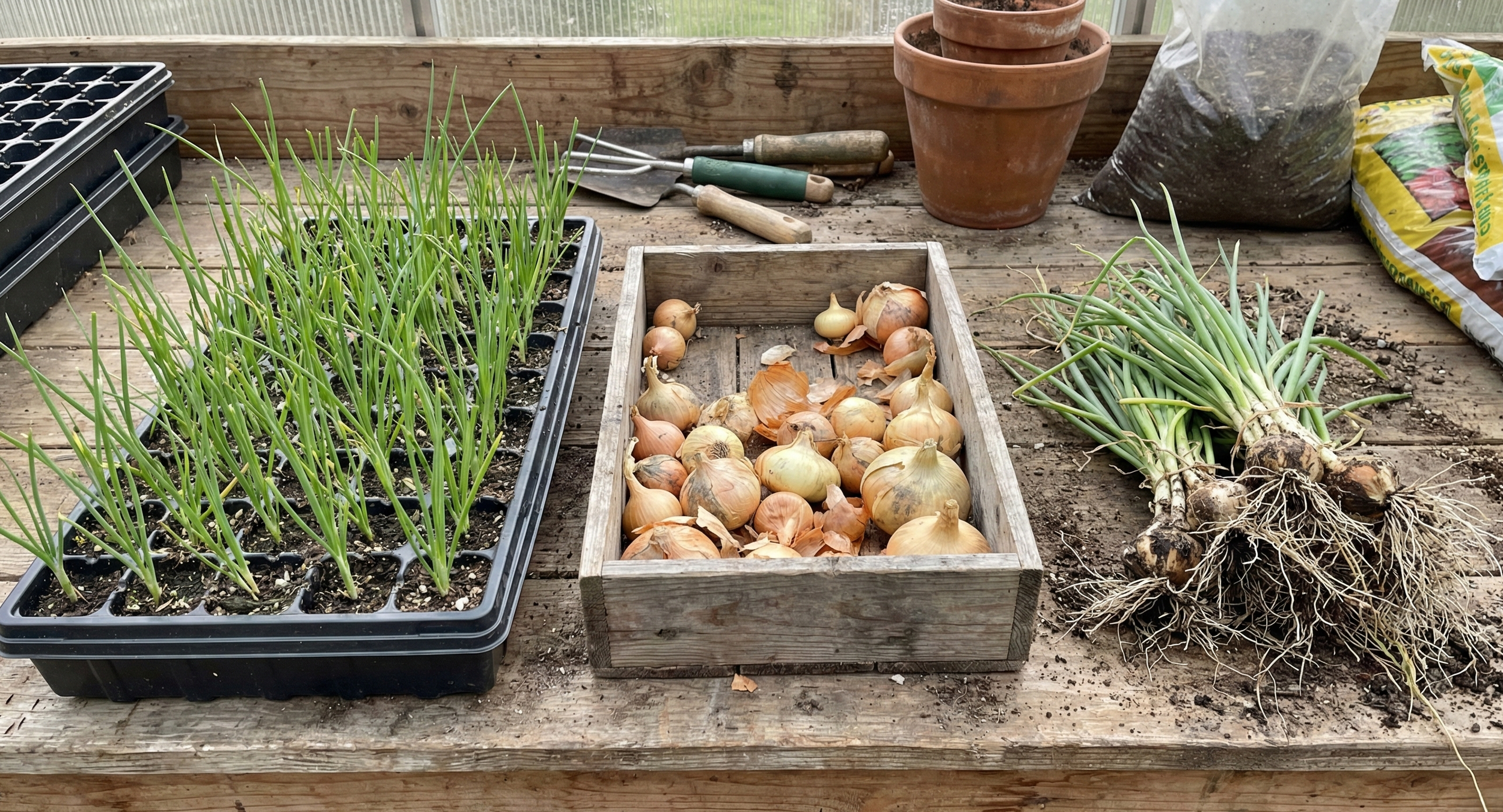
Seedling care: Onion seedlings look like thin grass at first. The key to growing strong transplants is keeping them trimmed. Once seedlings reach 5-6 inches tall, trim them back to 3-4 inches. This encourages root development and thicker stems rather than floppy growth. You can trim multiple times before transplanting. A small fan providing gentle air movement also strengthens stems.
Thinning and feeding: Thin seedlings to one per cell once they're established. Begin feeding with diluted liquid fertilizer (half strength) once true leaves appear. Water from below when possible to reduce disease risk.
Hardening off: Starting about 10 days before transplanting, gradually expose seedlings to outdoor conditions. Begin with a few hours of shade, increasing to full sun over a week. Bring indoors if frost threatens, though hardened onion seedlings tolerate light frost.
Transplanting: When seedlings are pencil-thick (about the diameter of a standard pencil), they're ready for the garden. Plant so the white base is about 1 inch deep, spacing 4-6 inches apart depending on desired bulb size.
How Do You Grow Onions from Sets?
Onion sets are the fastest and easiest route to homegrown onions. These small, dormant bulbs establish quickly and reach harvest size weeks before seed-started plants.
Types of sets: Nurseries typically stock sets in fall (for overwintering) and late winter (for spring planting). Fall sets are usually short-day varieties that grow through winter and bulb in spring. Late winter sets may be short-day or intermediate-day types for early summer harvest.
Where to find sets: San Lorenzo Garden Center, Mountain Feed & Farm Supply, and Scarborough Gardens stock onion sets seasonally. Availability varies, so call ahead during peak planting times.
Free planting guide
Know what to plant, and when, in Santa Cruz County
Join the free Ambitious Harvest email list for seasonal planting reminders and practical Central Coast gardening notes. As a welcome, I will send you the one-page California Seed Starting Cheat Sheet, so you always know what to start indoors, what to sow direct, and the right timing for your zone.
Send me the planting guide
One email field, no name needed. Unsubscribe anytime.
Choosing sets: Select firm, dry sets about the size of a marble or dime. Avoid sets larger than a nickel, which are more prone to bolting (flowering before bulbing). Soft, sprouting, or moldy sets should be passed over.
Planting: Push sets into prepared soil so just the tip shows above the surface. Space 4-6 inches apart for full-sized bulbs, or 2 inches apart if you'll harvest some as scallions to thin the row. Water gently to settle soil around sets.
Timing by microclimate:
Coastal areas: Plant fall sets in October, late winter sets in February
San Lorenzo Valley: Plant fall sets in October (mulch well), late winter sets in late February
Inland valleys/Pajaro Valley: Plant fall sets October-November, late winter sets February-March
How Do You Grow Onions from Transplants?
Nursery transplants offer a middle path: faster than seeds, more variety than sets, and easy to plant directly in the garden.
When to look for transplants: Onion starts typically appear at nurseries from late January through March. San Lorenzo Garden Center and other local nurseries stock bundles of onion transplants during this window.
What to look for: Transplants should be pencil-thick with healthy green tops. Avoid bundles with yellowing, wilted, or damaged leaves. The roots at the base should look white and healthy, not brown or mushy.
Handling transplants: If you can't plant immediately, store transplants in a cool location with roots wrapped in damp newspaper. They'll keep for 1-2 weeks but do best planted promptly.
Planting: Separate individual plants from the bundle. Trim roots to about 1 inch if they're excessively long. Plant so the white portion is 1 inch deep, with green tops exposed. Space 4-6 inches apart. Water well after planting.
How Should You Prepare the Site and Growing Conditions?
Regardless of how you start them, onions need similar growing conditions to produce good bulbs.
Sun: Full sun (6+ hours) produces the largest bulbs. Onions tolerate partial shade better than many crops but bulb size decreases noticeably with less light.
Soil: Loose, well-draining soil high in organic matter. Onions have shallow root systems and compete poorly with weeds, so clean, fertile soil matters. Work in 2-3 inches of compost before planting. Pairing onions with compatible neighbors can also improve results; see our companion planting guide for details.
Soil pH: Onions prefer a pH of 6.0-7.0. Test your soil if unsure, especially if gardening under redwoods where acidic conditions are common.
Watering: Consistent moisture is critical for onion bulb development. Irregular watering leads to double bulbs and poor quality. For more on efficient irrigation methods, see our guide to water-wise gardening. Aim for 1 inch per week through the growing season, delivered through drip irrigation or careful soaker hose. Stop watering when tops begin falling over to allow proper curing.
Fertilizing: Onions are moderate feeders. Apply a balanced organic fertilizer at planting and side-dress with nitrogen-focused fertilizer (like blood meal or fish emulsion) in early spring to support leaf growth. Stop fertilizing once bulbing begins (typically when you can feel bulbs swelling at the soil surface).
Weeding: Keep onion beds scrupulously weeded. Those thin onion leaves can't compete with aggressive weeds. Mulching helps suppress weeds and conserve moisture but should be kept away from the developing bulbs once they start swelling.
Which Varieties Work Best in Santa Cruz County?
These varieties are proven performers for coastal California. Look for them at local nurseries or seed suppliers.
Short-Day Varieties (plant fall-winter, harvest late spring):
'Grano' – Classic Texas variety with mild, sweet flavor. Softball-sized bulbs with excellent eating quality. Short storage life (1-2 months) so use fresh.
'Granex' (Vidalia type) – The original sweet onion. Mild, juicy, excellent raw. Similar storage limitations as 'Grano'.
'Texas Early Grano 1015Y' – Improved 'Grano' selection, known as the "supersweet." Plant fall for May-June harvest.
Intermediate-Day Varieties (most flexible planting window):
'Candy' – Popular intermediate that works well planted fall or late winter. Mild, sweet, medium storage (2-3 months).
'Super Star' – Large white onion with mild flavor and good storage (4-5 months). More tolerant of varied conditions.
'Red Candy Apple' – Red intermediate with sweet flavor. Good raw in salads. 2-3 month storage.
'Yellow Granex' – Widely adapted intermediate, mild and sweet.
Storage Varieties (longer-keeping selections):
'Copra' – The gold standard for storage onions. Pungent flavor, keeps 8-12 months in cool conditions. An intermediate-day type.
'Patterson' – Excellent storage (10+ months), good disease resistance. Another intermediate-day option.
'Redwing' – Red storage onion, 4-6 months storage, intermediate-day type.
Note: Sweet onions and storage onions are different categories. Sweet onions have higher sugar and water content, making them delicious fresh but poor keepers. Storage onions are more pungent but keep for months. Grow both if space allows.
When Should You Harvest and Cure Onions?
Proper harvest timing and curing make the difference between onions that last weeks and those that keep for months.
Harvest signs: Onions are ready when the tops fall over naturally and necks feel soft when squeezed. For overwintering onions planted in fall, this typically occurs in late May through June. For spring-planted onions, expect harvest in early to mid-summer.
Don't rush: Let nature tell you when onions are ready. Forcing tops over before they're ready doesn't speed maturity and can invite disease.
Harvesting technique: Use a digging fork to gently lift bulbs rather than pulling, which can damage necks. On a dry day, lay bulbs on the soil surface or on a screen for initial drying.
Curing: Move onions to a dry, shaded, well-ventilated location for 2-3 weeks. A covered porch, garage, or shed works well. Good air circulation is essential. Once necks are completely dry and papery, trim roots and cut tops to 1 inch above the bulb (or braid if you grew braiding-type varieties).
See our complete guide to Harvesting and Curing Garlic and Onions for detailed storage information.
For what to expect between planting and bulbing, see our onion growth stages guide.
Frequently Asked Questions
My onions flowered instead of forming bulbs. What happened?
This is bolting, usually caused by temperature stress or planting sets that were too large. Onions exposed to sustained cold after they reach a certain size may vernalize and flower instead of bulbing. Using smaller sets and avoiding temperature fluctuations helps prevent bolting.
Why are my onion bulbs flat instead of round?
Onion shape varies by variety (some are naturally flatter), but flat bulbs can also result from shallow planting, compacted soil, or inconsistent watering. Plant in loose soil and maintain even moisture.
Can I grow onions year-round in Santa Cruz?
With succession planting and the right varieties, you can harvest onions through most of the year. Plant fall sets for late spring harvest, spring transplants for summer harvest, and grow quick-maturing scallion types through summer.
What's the difference between scallions, green onions, and spring onions?
Scallions and green onions are the same thing: onions harvested young before bulbing. Spring onions are slightly more mature with a small bulb starting to form. Any onion variety can be harvested as a scallion; dedicated bunching onion varieties never form bulbs and are bred specifically for scallion harvest.
How much space do I need for a meaningful onion harvest?
A 4x8 raised bed can hold 64-96 onions at 4-6 inch spacing. That's roughly a year's supply for many families. Start with whatever space you have since even a dozen onions are worth growing.
Should I remove flower stalks if my onions bolt?
Yes, remove them immediately. Bolted onions won't form good storage bulbs but can still be eaten fresh. Use them within a few weeks since they won't store well.
Why do my onions taste so much stronger than store-bought?
Homegrown onions are often more pungent because commercial sweet onions are bred for mildness and grown in specific sulfur-poor soils. Your soil chemistry and variety selection influence flavor intensity. If you want milder onions, choose sweet varieties and know that they need fresh use rather than storage.
Can I save onions to replant next year?
You can save sets from a harvest, but onions grown from bulbs are more likely to bolt the second year since the bulb already experienced vernalization. It's generally better to start fresh with purchased sets, transplants, or seeds each season.
Free Resources
Seasonal Planting Calendar: Onion planting windows by month and microclimate
Know Your Microclimate Worksheet: Identify your conditions for variety selection
