

Square Foot Gardening: Maximizing Space for Higher Yields
A few of the product links in this guide are affiliate links. If you buy through one, Ambitious Harvest may earn a small commission at no extra cost to you, which helps keep these guides free. We only point to gear we would use in our own Santa Cruz garden. As an Amazon Associate, we earn from qualifying purchases. Read our full disclosure.
How Can You Make the Most of Small Spaces?
Not everyone has room for sprawling garden beds. Maybe you're working with a small backyard in Santa Cruz, a patio in Capitola, or a sunny corner of a Scotts Valley lot. Square foot gardening is a method designed specifically for these situations, maximizing production from limited space through intensive planting and careful organization.
The concept is simple: instead of traditional rows with paths between them (which waste considerable space), you divide growing areas into a grid of one-foot squares and plant each square intensively with a single crop. A compact 4-by-4-foot bed gives you 16 planting squares. That's enough space for a surprising amount of food.
Square foot gardening was popularized by Mel Bartholomew in the 1980s, and millions of gardeners have adapted his methods since. The approach works particularly well in Santa Cruz County, where small lots are common, land costs make every square foot valuable, and our year-round growing season means you can replant squares multiple times per year.
This guide covers how to set up and manage a square foot garden adapted for our local conditions, with realistic expectations about what works and what requires modification.
What Makes Square Foot Gardening Different?
Traditional vegetable gardening uses rows with walking paths between them. This layout makes sense for farms with tractors, but it wastes enormous space in home gardens. Walking paths often consume half or more of the total garden area.
Square foot gardening eliminates most of that wasted space by:
Creating permanent beds you never walk on. All beds are narrow enough (typically 4 feet or less) to reach the center from the sides. This eliminates the need for paths within growing areas.
Planting in blocks rather than rows. Instead of a row of carrots with space on either side, you plant a square of carrots with plants touching on all sides as they mature.
Using a visible grid. The grid isn't strictly necessary, but it helps you visualize planting density and makes succession planting easier to manage. Each square becomes its own mini-garden.
Intensive spacing. Plants grow closer together than traditional row spacing suggests, shading out weeds and maximizing yield per square foot.
Succession planting built into the system. When you harvest one square, you replant it immediately with the next crop. In Santa Cruz's year-round climate, a single square might produce four or more crops annually.
What Are the Benefits for Santa Cruz Gardeners?
Square foot gardening offers particular advantages for gardeners in our area:
Small Lots, Big Production
Santa Cruz County real estate is expensive, and lot sizes trend small. A 4-by-4-foot raised bed fits in almost any yard, on a patio, or even on a sunny driveway corner. Two or three beds can produce a significant portion of a household's vegetables.
Year-Round Succession
Our mild climate allows continuous growing. A square that produces lettuce in winter can grow bush beans in summer, then be replanted with fall brassicas. Traditional single-season gardening wastes our biggest advantage. Square foot gardening's emphasis on replanting squares as they empty fits perfectly with year-round production.
Water Efficiency
Intensive planting means plants shade the soil, reducing evaporation. You water a defined area rather than paths and empty space. In our dry summers, this efficiency matters.
Manageable for Beginners
The grid system makes planning straightforward. New gardeners can visualize exactly how many plants fit where. The small scale reduces overwhelm. If you can manage 16 squares, you can garden successfully.
Reduced Weeding
Dense plantings shade out weeds. The small bed size makes any weeds that do appear easy to spot and remove. Many square foot gardeners report spending minutes per week on weeding rather than hours.
How Do You Set Up a Square Foot Garden?
Choosing a Location
The fundamentals don't change because you're using square foot methods: you still need adequate sun.
Ideal location: 6 to 8 hours of direct sun for the widest crop selection. South or west-facing areas work best.
Workable location: 4 to 6 hours of sun limits you to leafy greens, herbs, and root vegetables. Still productive, just different crops.
Challenging location: Less than 4 hours of direct sun makes vegetable production difficult regardless of method.
In Santa Cruz's foggy coastal areas, prioritize afternoon sun since morning fog often reduces usable morning light.
Bed Size and Construction
The classic 4-by-4-foot bed provides 16 square feet and is reachable from all sides. This is the standard square foot garden size and works well for most situations.
Alternative sizes:
4-by-8 feet (32 squares): Good if you have the space and want more production
3-by-6 feet (18 squares): Fits narrow spaces
2-by-8 feet (16 squares): Works along fences or walls
Any size that's no wider than 4 feet (so you can reach the center without stepping in the bed)
Bed height: 6 to 12 inches is sufficient for most vegetables. Deeper beds (12 to 18 inches) accommodate root vegetables better and provide more root zone for tomatoes and peppers. Taller beds (24 inches or more) reduce bending but require more soil.
Materials: Untreated cedar, redwood, or Douglas fir last longest in our climate. Avoid pressure-treated lumber for vegetable beds. Galvanized metal beds are increasingly popular and last indefinitely. Concrete blocks work but can raise soil pH over time.
The Grid
The visible grid is optional but helpful, especially when starting out. It makes planting density intuitive and helps track what's planted where.
Grid options:
Wooden slats (1-by-2 lumber) laid across the bed in a grid pattern
String or twine stretched between nails on the bed frame
Plastic lattice cut to fit
Simply marking squares with a stick when planting (no permanent grid)
If you use a physical grid, make it removable so it doesn't interfere when you're working in the bed.
Soil Mix
Mel Bartholomew's original "Mel's Mix" recipe calls for equal parts compost, peat moss, and vermiculite. This creates a lightweight, well-draining medium that works well in raised beds.
A more sustainable adaptation for Santa Cruz:
50% quality compost: Provides nutrients and biology. Use a variety of sources if possible (municipal compost, homemade compost, composted manure).
25% coconut coir: A sustainable alternative to peat moss. Provides structure and moisture retention without the environmental concerns of peat harvesting.
25% garden soil or screened native soil: Adds mineral content and microbial diversity that pure "soilless" mixes lack.
Or simply use:
Good quality raised bed mix from a local supplier (Aptos Landscape Supply, Santa Cruz Landscape Supply)
Amended with extra compost
The original Mel's Mix works but is expensive at scale. Most Santa Cruz gardeners adapt based on budget and available materials. The key is well-draining soil that doesn't compact, with plenty of organic matter.
Adding amendments:
Mix in a balanced organic fertilizer at setup
Consider adding worm castings for biological activity
If your soil tests low in any nutrients, address that before planting
How Many Plants Fit Per Square Foot?
The heart of square foot gardening is knowing how many plants fit in each one-foot square. This varies by plant size at maturity.
16 Plants Per Square Foot (4x4 grid within the square)
These are small plants that don't need much space:
Radishes
Carrots (short varieties do best)
Green onions / scallions
Beets (harvest some as baby beets to thin)
Turnips (small varieties)
9 Plants Per Square Foot (3x3 grid)
Medium-small plants:
Spinach
Arugula
Bush beans
Beets (standard spacing for full-size roots)
4 Plants Per Square Foot (2x2 grid)
Medium plants that need more room:
Lettuce (leaf and romaine types)
Chard (harvest outer leaves)
Kale (smaller varieties, or harvest young)
Parsley
Cilantro
Basil
Asian greens (bok choy, tatsoi)
Kohlrabi
2 Plants Per Square Foot
Larger plants that need breathing room:
Large kale varieties
Large chard varieties
Celery
1 Plant Per Square Foot
Full-sized plants that each need a complete square:
Tomatoes (and may benefit from more space)
Peppers
Eggplant
Large head lettuce
Broccoli
Cauliflower
Cabbage
Brussels sprouts
Cucumbers (with vertical trellis)
Summer squash (one plant, may sprawl beyond its square)
Herbs like rosemary and sage
1 Plant Per 2 or More Square Feet
Space hogs that test the limits of square foot gardening:
Winter squash (vining types need much more space or vertical growing)
Melons
Indeterminate tomatoes (better with 2 to 4 square feet each)
Special Considerations
Herbs vary widely. A single rosemary or sage plant needs a full square or more. Cilantro, parsley, and basil fit 4 per square. Chives can squeeze 9 per square.
Tomatoes in square foot gardens work best when:
You choose determinate (bush) varieties that stay compact
You provide strong support (stakes or cages)
You give them at least one full square, preferably more for indeterminate types
You prune to reduce sprawl
Vining crops (cucumbers, pole beans, some squash) work in square foot gardens if grown vertically on trellises. Without vertical growing, they overrun the system.
How Do You Plan Your Grid?
With 16 squares in a 4-by-4 bed, you need to decide what goes where. Here are principles to guide your planning.
Consider Plant Height and Sun
Tall plants go on the north side of the bed so they don't shade shorter plants. This includes:
Trellised cucumbers and beans
Tomatoes on stakes or cages
Tall pepper plants
Sunflowers (if you include them)
Short plants go on the south side where they get full sun without obstruction.
Group by Water Needs
Plants with similar water requirements do better together. In Santa Cruz's dry summers, this matters.
Thirstier plants: Lettuce, chard, celery, cucumbers Moderate needs: Tomatoes, peppers, beans, most brassicas Drought-tolerant: Many herbs (once established), some root vegetables
Consider Companions and Conflicts
Some plants grow better together; others compete or attract shared pests.
Good companions:
Tomatoes with basil
Carrots with onions
Lettuce with radishes (radishes mature fast, lettuce fills in)
Beans with corn and squash (the classic "three sisters," though challenging in small spaces)
Keep apart:
Brassicas (cabbage family) away from each other if possible (shared pests)
Onion family away from beans (they can inhibit each other)
Plan for Succession
In Santa Cruz, you'll replant squares multiple times per year. Think about what follows what:
Spring square: Lettuce → (harvested by June) → Bush beans → (harvested by September) → Fall brassica or garlic
Year-round square: Radishes (spring) → Beans (summer) → Lettuce (fall) → Radishes (winter)
Leave a note or keep a simple journal tracking what's planted where and when it went in.
What Does a Sample 4x4 Layout Look Like?
Here's one possible arrangement for a 16-square bed, designed for a mix of crops with summer and cool-season options:
North row (back, against trellis):
Square 1: Cucumber on trellis (1 plant)
Square 2: Pole beans on trellis (4 plants)
Square 3: Tomato with cage (1 determinate plant)
Square 4: Tomato with cage (1 determinate plant)
Second row:
Square 5: Pepper (1 plant)
Square 6: Pepper (1 plant)
Square 7: Basil (4 plants)
Square 8: Chard (4 plants, harvest outer leaves)
Third row:
Square 9: Lettuce (4 plants)
Square 10: Lettuce (4 plants, different variety for succession)
Square 11: Kale (4 plants)
Square 12: Carrots (16 plants)
South row (front):
Square 13: Radishes (16 plants)
Square 14: Green onions (16 plants)
Square 15: Bush beans (9 plants)
Square 16: Parsley and cilantro (4 plants total)
This gives you tomatoes, peppers, cucumbers, beans, and a variety of greens and herbs, all from 16 square feet.
How Do You Manage Your Square Foot Garden?
Watering
Intensive planting means roots compete for water. In Santa Cruz's dry summers, consistent moisture is essential.
Drip irrigation works well: Run drip lines through the bed or use a grid of drip emitters. This delivers water directly to soil without wetting foliage.
Hand watering works too: The small bed size makes hand watering practical. Water deeply every few days rather than lightly every day.
Mulch helps: A thin layer of straw or compost on the soil surface (around plants, not burying them) reduces evaporation. With intensive planting, plants eventually shade the soil themselves.
Watch for dry spots: Dense plantings can create areas where water doesn't penetrate well. Check soil moisture by sticking your finger an inch or two down.
Fertilizing
Intensive planting depletes nutrients faster than traditional spacing. Plan to feed your square foot garden more frequently.
Compost top-dressing: Add a thin layer (half inch to one inch) of compost between plantings and a few times during the growing season.
Liquid fertilizers: Fish emulsion, kelp extract, or compost tea applied every 2 to 4 weeks during active growth keeps plants fed.
Slow-release organic fertilizers: Granular organic fertilizers worked into the top inch of soil at planting provide steady nutrition.
Watch for deficiency signs: Yellowing leaves, slow growth, or pale color may indicate the need for more fertility.
Weeding
One of square foot gardening's genuine advantages: minimal weeding. Dense plantings shade out most weeds, and the small area makes any weeds easy to spot.
Spend a few minutes each time you visit the garden pulling any weeds while they're small. This prevents them from ever becoming a chore.
Pest and Disease Management
Intensive planting has pest management implications, both good and bad.
Advantages:
Diverse plantings (many crops in a small area) can confuse pests that locate plants by sight or smell
Less bare soil means fewer places for some pests to complete life cycles
Easy to inspect plants thoroughly in a small area
Challenges:
Once a disease appears, it can spread quickly in dense plantings with limited air circulation
Some pests (like aphids) can move easily from plant to plant
Crowded conditions can promote fungal issues in damp weather
Management strategies:
Choose disease-resistant varieties when available
Space plants at recommended densities (don't overcrowd beyond guidelines)
Remove diseased plant material promptly
Ensure adequate air circulation (avoid blocking beds with structures on all sides)
Rotate crops between squares year to year when possible
Succession Planting
This is where square foot gardening truly shines in Santa Cruz's climate. When you harvest a crop, replant that square immediately.
Fast-turnover squares: Radishes (30 days), lettuce (45 to 60 days), and spinach (40 to 50 days) can cycle multiple times per year.
Seasonal transitions: Replace spring lettuce with summer beans. Replace summer tomatoes with fall broccoli. Replace fall brassicas with winter greens.
Keep track: A simple journal or even a photo on your phone helps you remember what was planted where and when.
How Do You Adapt Square Foot Methods for Santa Cruz?
The original square foot gardening system was developed for the eastern United States. Some adaptations improve results here.
Adjust for Our Climate
Year-round growing: Traditional square foot gardening assumes a single growing season. We can grow 12 months a year. Plan for continuous succession rather than one spring planting.
Fog and cool summers: Coastal Santa Cruz has cool summers. Give heat-loving crops (tomatoes, peppers, eggplant) the warmest squares, ideally near south-facing walls or with reflected heat.
Dry summers: Our Mediterranean climate means irrigation is essential from May through October. The original system's light watering recommendations may not be sufficient.
Modify Spacing for Local Conditions
Some standard square foot spacings need adjustment:
Tomatoes: The "one per square" recommendation works for compact determinates but not for full-sized indeterminate varieties. In our climate, give indeterminate tomatoes 2 to 4 square feet and strong support.
Peppers: One per square works for most peppers. In foggy coastal areas, give them your warmest square.
Lettuce: Four per square works but can crowd in summer. Consider 2 per square for large heading varieties or in warm microclimates where bolting is an issue.
Brassicas: One per square for full-sized broccoli or cauliflower is tight. They'll produce, but heads may be smaller than plants with more room.
Don't Be Rigid
Square foot gardening is a framework, not a religion. If a plant needs more space, give it more space. If you want to plant a half-square of something, do it. The grid is a tool for organization, not a constraint that must be followed exactly.
Which Crops Work Best in Square Foot Gardens?
Some crops are ideal for square foot gardening. Others require modification or aren't practical.
Excellent Choices
Salad greens: Lettuce, spinach, arugula, mâche, Asian greens. Fast-growing, compact, and perfect for succession planting.
Root vegetables: Radishes, carrots (short varieties), beets, turnips. Fit the grid system naturally.
Bush beans: Compact, productive, and mature quickly. Perfect for summer squares.
Herbs: Basil, cilantro, parsley, chives. High value in small space.
Peppers: Compact plants that produce well in a single square.
Chard and kale: Cut-and-come-again harvesting means ongoing production from one planting.
Onions and garlic: Fit the grid well, especially green onions.
Workable with Modification
Tomatoes: Require strong support, may need more than one square for large varieties, but can work well with proper management.
Cucumbers: Need vertical trellising to fit the system. Grow up, not out.
Pole beans: Excellent on a trellis at the north end of the bed.
Broccoli, cauliflower, cabbage: Work in one square but produce smaller heads than plants with more room.
Challenging Fits
Winter squash: Vining types need far more space than square foot gardening efficiently provides. Bush varieties exist but are still large.
Corn: Needs blocks for pollination. A few squares of corn won't pollinate well.
Melons: Similar issues to winter squash. Space requirements exceed what the system handles gracefully.
Potatoes: Can work in deep beds but may be easier in separate containers or a dedicated potato bed.
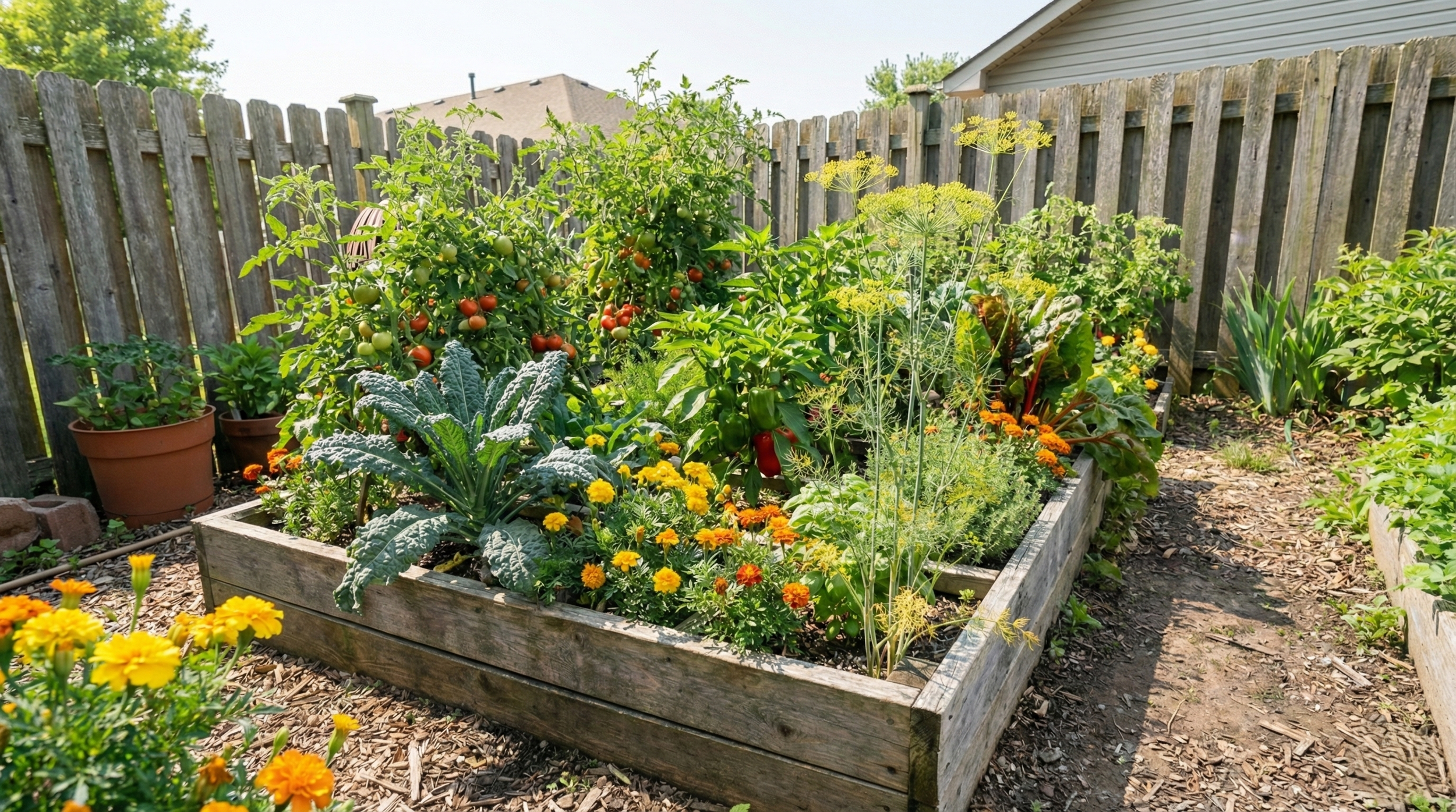
Square-foot beds are living proof that you do not need a big yard to grow your own food.
Frequently Asked Questions About Square Foot Gardening
Is square foot gardening really more productive than traditional gardening?
Per square foot of bed space, yes. You eliminate wasted path space and plant intensively. A 4-by-4 square foot bed (16 square feet of growing space) can produce as much as a traditional garden with 40+ square feet when you count the paths. However, traditional gardening can be just as productive per plant. The advantage is space efficiency, not magic.
The original square foot gardening book recommends a specific soil mix. Do I have to use it?
No. "Mel's Mix" (equal parts compost, peat moss, and vermiculite) works well but is expensive and has environmental concerns (peat harvesting). Many gardeners adapt with local materials: quality raised bed mix, compost-heavy soil blends, or amended native soil. The key requirements are good drainage, plenty of organic matter, and nutrients to support intensive planting. The UC Master Gardener Program provides guidance on square foot gardening, including building raised boxes, filling them with quality growing mix, and using grid systems for optimal plant spacing.
Can I convert an existing raised bed to square foot gardening?
Absolutely. If your existing bed is 4 feet wide or less (reachable from the sides), you can simply add a grid and start using square foot methods. Wider beds can work if you add stepping stones or narrow paths within the bed.
How much food can I actually grow in a 4-by-4-foot bed?
It depends on what you plant and how actively you succession-plant. A well-managed bed with continuous succession planting in Santa Cruz's climate might produce: 50+ pounds of tomatoes, 20+ heads of lettuce, several pounds of beans, continuous harvests of greens, pounds of herbs, and dozens of radishes, carrots, and root vegetables, all from 16 square feet over a year. Results vary widely based on crops chosen and management.
Is square foot gardening good for beginners?
Yes. The organized grid makes planning intuitive. The small scale is manageable and not overwhelming. You can see results quickly. Many gardening educators recommend it as a starting method. Just don't get too rigid about the "rules." Use the system as a helpful framework, not an inflexible requirement.
My square foot garden beds don't produce as well as I expected. What's wrong?
Common issues:
Not enough sun: Square foot gardening doesn't overcome inadequate light.
Underfeeding: Intensive planting requires more fertility. Add compost and fertilize regularly.
Underwatering: Dense plantings compete for water. Water more than you think you need, especially in summer.
Overcrowding beyond recommendations: Planting more densely than spacing guidelines suggest reduces production per plant.
Not succession planting: Leaving empty squares or exhausted plants in place wastes the system's potential.
How do I support tomatoes and other tall crops in a square foot garden?
Sturdy stakes or cages are essential. Standard wire tomato cages often aren't strong enough for full-sized plants. Better options include: heavy-gauge concrete reinforcing wire formed into cylinders, wooden stake and string systems, or commercially available heavy-duty tomato cages. Install support at planting time, not after plants are established.
Can I grow perennial vegetables and herbs in a square foot bed?
You can, but it reduces flexibility. A perennial plant (asparagus, rhubarb, perennial herbs) occupies its square permanently, preventing succession planting in that space. Many gardeners keep perennials in separate beds or dedicated squares along the edge, reserving most of the grid for annual rotation.
Free Gardening Resources
Download these guides to help plan your square foot garden:
Seasonal Planting Calendar - Know when to plant each crop in Santa Cruz County for continuous production.
Companion Planting Guide - Which plants grow well together in close proximity.
Vegetables by Season Guide - Match crops to seasons for best results.
Know Your Microclimate Worksheet - Document your garden's conditions to optimize crop placement.
Related Articles
How Do Small Spaces Deliver Big Results?
Square foot gardening isn't magic. It's a practical system for getting the most food from limited space through intensive planting, organized planning, and continuous succession. The method works particularly well in Santa Cruz County, where small lots are common, land is precious, and our year-round growing season rewards gardeners who replant as soon as they harvest.
Start with a single 4-by-4 bed if you're new to the method. Learn how the spacing works, get comfortable with succession planting, and discover how much you can grow in just 16 square feet. You'll likely want more beds by the end of your first year.
The grid is a tool, not a rule. Use it when it helps, adapt it when it doesn't, and focus on the real goal: growing good food in whatever space you have.
