

Rainwater Harvesting for Santa Cruz County Gardens: How Much Can Your Roof Really Catch?
A few of the product links in this guide are affiliate links. If you buy through one, Ambitious Harvest may earn a small commission at no extra cost to you, which helps keep these guides free. We only point to gear we would use in our own Santa Cruz garden. As an Amazon Associate, we earn from qualifying purchases. Read our full disclosure.
In a typical year, your roof catches more water than your vegetable garden will ever use. The trick is turning that invisible river into a tank you can actually draw from, and doing it in a way that fits Santa Cruz County's rules.
Rainwater harvesting is one of the most powerful ways local gardeners can cut summer irrigation demand. Our Mediterranean climate delivers almost all its rain between November and March, then virtually nothing for the rest of the year. But those winter storms quietly deposit tens of thousands of gallons on local rooftops. With a little roof-to-tank math and an understanding of the county's cistern guidelines, you can see exactly how far that free water can take your garden.
This guide walks you through the numbers: how much water your roof actually collects, what different tank sizes mean for real garden irrigation, and how to set up a system that stays on the right side of local regulations.
The UC Master Gardeners recommend harvesting rainwater to decrease erosion, reduce flooding, and conserve water for garden irrigation.
How Much Water Is on Your Roof?
The math is surprisingly simple. Local water-wise guides use a straightforward rule of thumb:
1 inch of rain on 1 square foot of roof produces approximately 0.62 to 0.63 gallons of water
This conversion factor is the foundation for all rainwater harvesting calculations. Once you know your roof area and local rainfall, you can estimate your potential harvest.
For a 1,000-square-foot roof:
1 inch of rain produces roughly 620 to 630 gallons
In coastal Santa Cruz with about 30 inches of annual rain, that roof can shed around 18,600 to 18,900 gallons per year
In a wetter San Lorenzo Valley microclimate with roughly 50 inches of rain, the same roof could shed 31,000+ gallons
Now connect that to your irrigation needs. From the ET-based calculations in our seasonal watering guides, a 100-square-foot summer vegetable bed using about 4 to 4.5 inches of water per month needs approximately 250 to 300 gallons monthly, or about 800 to 900 gallons over the June through August peak season.
So one 1,000-square-foot coastal roof theoretically produces 20+ summers' worth of water for that single bed, if you could capture and store it all.
Even if storage limitations and timing realities cut that in half, the numbers are still very much in your favor.
How Much Roof Runoff Can You Expect by Zone?
Here's how potential annual runoff scales with roof size across Santa Cruz County's different rainfall zones:
| Roof area | Annual rain | Potential annual runoff | Summers of irrigation for one 100 sq ft veggie bed |
|---|---|---|---|
| 500 sq ft | 30 in (coastal) | ~9,300 gallons | 10–11 summers (theoretical) |
| 1,000 sq ft | 30 in (coastal) | ~18,600 gallons | 20+ summers (theoretical) |
| 1,500 sq ft | 30 in (coastal) | ~27,900 gallons | 30+ summers (theoretical) |
| 1,000 sq ft | 50 in (San Lorenzo Valley) | ~31,000 gallons | 34+ summers (theoretical) |
These numbers assume you could capture and store everything, which isn't realistic. But they illustrate the scale of what's available. Even capturing a small fraction of your roof's output can meaningfully reduce your summer water bills.
The "theoretical summers" column shows how the math works: if your 100-square-foot bed needs roughly 900 gallons over summer, and your roof produces 18,600 gallons annually, you have more than 20 summers' worth of water falling on your roof every single year.
The real questions become: how much can you store, and how do you use it effectively?
What Are the Most Common Tank Sizes and What They Actually Do?
Local permaculture practitioners and water-wise gardeners tend to converge on a few scale tiers that make sense for Santa Cruz County homes. Here's what each level realistically provides.
Rain Barrels (50 to 100 gallons)
Rain barrels are the easiest entry point: inexpensive, simple to install, and often placed under a single downspout.
What fills them: One inch of rain on a 200 to 300-square-foot roof section can fill a 55-gallon barrel in a single storm. In our climate, that means your barrel will fill multiple times over the winter.
What they provide: Realistically, a single barrel offers one to two deep waterings for a 50 to 100-square-foot bed at the start of summer. It's not a complete solution, but it's a very accessible first step that gets you thinking about water as a resource to capture rather than let drain away.
Best use: Hand-watering container plants, small herb beds, or supplementing irrigation for a single garden zone during early summer when the barrel is fullest.
Small Above-Ground Tanks (500 to 2,500 gallons)
This is where rainwater harvesting starts to make a real dent in your summer water use. These typical plastic or slimline tanks are what many local homeowners install beside a house or garage.
What fills them: A 1,000-gallon tank connected to a 500-square-foot section of roof can be filled by roughly four 2-inch storms, which is easy to achieve in a normal Santa Cruz County winter. Most years, you'll fill the tank multiple times over.
What they provide: For a 100-square-foot veggie bed that needs around 800 to 900 gallons over summer, a 1,000 to 1,500-gallon tank can cover almost an entire dry season if used carefully and combined with efficient irrigation practices.
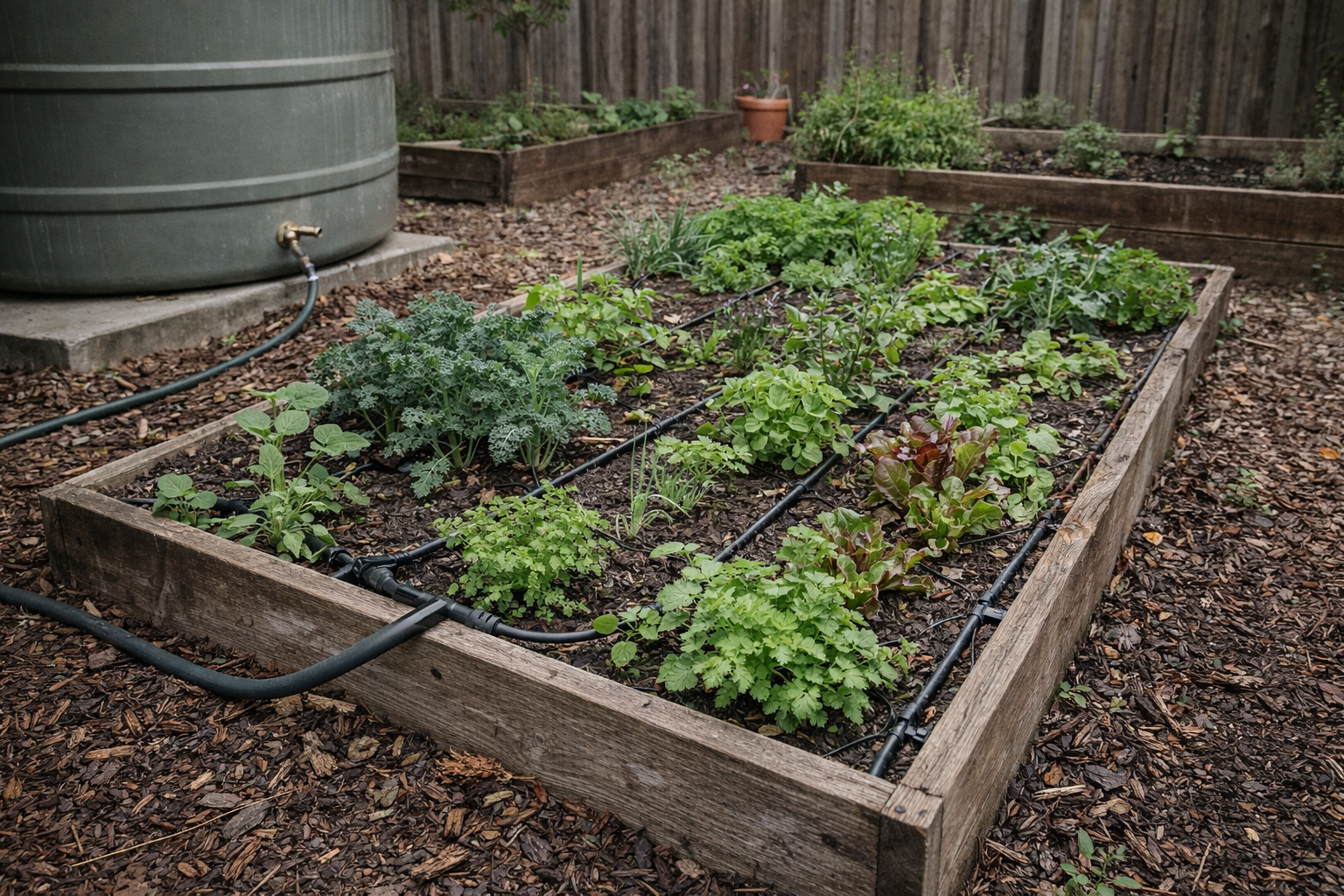
Best use: Drip irrigation for vegetable beds, hand-watering throughout the garden, or gravity-fed systems for fruit trees and ornamentals.
Larger Cisterns (2,500 to 5,000+ gallons)
At this scale, you're looking at supporting multiple garden beds, fruit trees, and ornamental zones, or providing a significant fraction of household non-potable water demand.
What fills them: A 2,500-gallon cistern connected to a 1,000-square-foot roof in coastal Santa Cruz will typically fill completely 7+ times over a normal winter. A 5,000-gallon tank may fill 3 to 4 times, depending on storm spacing and your usage patterns.
What they provide: A 5,000-gallon system can supply several 100-square-foot veggie beds and selected perennials through the entire dry season, especially when combined with heavy mulching and efficient drip irrigation.
Best use: Whole-garden irrigation systems, supporting food production through summer, and reducing dependence on municipal water for landscape needs.
What Does Santa Cruz County Require for Cisterns and Permits?
The county's rainwater harvesting guidance lays out clear thresholds for when you can keep things simple and when you step into full permit territory.
For Outdoor, Non-Potable Systems (Landscape Irrigation Only)
Cisterns up to 5,000 gallons that meet these criteria can usually be handled with relatively simple structural considerations:
Supported directly on grade (not on elevated platforms or pedestals)
Height-to-width ratio of 2:1 or less (meaning the tank isn't excessively tall and narrow)
Used only for non-spray irrigation: drip lines, soaker hoses, or filling watering cans
This covers the vast majority of home rainwater harvesting systems. If you're putting a tank on level ground next to your house and running drip lines to your garden, you're typically in straightforward territory.
When Additional Requirements Apply
Larger or more complex systems trigger additional permitting and engineering requirements:
Tanks larger than 5,000 gallons
Tanks with height-to-width ratios greater than 2:1 (tall, narrow tanks)
Tanks built on slopes, pedestals, or elevated platforms
Any system requiring structural support beyond simple on-grade placement
These systems require engineering review and full building permits, including footing and structural details.
Indoor and Spray Irrigation Uses
Indoor non-potable uses (toilet flushing, laundry) and spray irrigation (overhead sprinklers, misters) connected to rainwater trigger additional plumbing code requirements:
Cross-connection protection to prevent contamination of potable water systems
Clear labeling with signs stating "NONPOTABLE RAINWATER"
For indoor uses, notices at fixtures indicating they're supplied by rainwater
Compliance with California Plumbing Code requirements for non-potable water systems
The county's Water Advisory Commission materials provide additional context on the policy framework behind these requirements.
The practical takeaway: Start with a straightforward, above-ground tank feeding garden irrigation only. This keeps you in the simplest regulatory category while you learn the system. Only step into larger or indoor-connected systems once you're ready to navigate engineering and permitting requirements.
Where Does Rainwater Fit Best in Your Garden?
County guidance and conservation resources are well aligned on how homeowners should start using harvested rain.
Ideal First Uses
Gravity-fed or pumped drip irrigation for ornamentals, fruit trees, and shrubs. This is the sweet spot: efficient water delivery, minimal regulatory complexity, and real water savings.
Hand-watering of vegetable beds, focusing water on soil rather than foliage. This works especially well in early summer when stored rain is freshest and tank levels are highest.
Filling watering cans and buckets for targeted application wherever needed. Simple, flexible, and requires no infrastructure beyond the tank itself.
Soaker hoses for slow, deep watering of garden beds. Low-tech, effective, and well-suited to gravity-fed systems.
Uses Requiring More Caution
Spray irrigation (overhead sprinklers, misters) connected to rainwater requires more careful consideration due to aerosolizing non-potable water. This isn't prohibited, but it triggers additional requirements and isn't the best fit for most residential systems.
Indoor connections (toilets, laundry) or any use that might be confused with potable water must meet plumbing code requirements, cross-connection protection, and clear labeling standards.
Edible crop irrigation is generally fine with harvested rainwater, especially when applied to soil rather than directly to plant foliage. Some gardeners prefer to use rainwater early in the season and switch to municipal water closer to harvest, though this is a personal preference rather than a requirement.
The simple framing: Start with a system that is outdoor-only, non-spray, and under 5,000 gallons per tank. Consult county guidance and professionals before going bigger or tying into indoor plumbing.
What Does a Real Roof-to-Tank Setup Look Like?
Let's bring everything together with a worked scenario that connects climate, roof size, tank capacity, and actual garden irrigation demand.
The Setup
House: 1,000-square-foot roof section in coastal Santa Cruz (approximately 30 inches of annual rain)
Potential annual runoff: 30 inches × 1,000 sq ft × 0.623 gallons per square foot per inch = approximately 18,690 gallons
Tank: 2,500-gallon above-ground cistern on grade, used only for drip irrigation (well within the simple permit threshold)
Garden: 200-square-foot vegetable bed (twice the standard 100-square-foot reference)
The Math
From the ET-based summer calculations in our seasonal watering guides:
100 sq ft uses approximately 250 to 300 gallons per month, or about 800 to 900 gallons over June through August
200 sq ft uses approximately 1,600 to 1,800 gallons over those three peak months
The Result
If the cistern fills over winter (which it easily will, multiple times), a full 2,500-gallon tank could cover an entire summer of irrigation for that 200-square-foot bed on stored rain alone, with some buffer left over for shoulder-season watering or a few thirsty perennials.
That single example shows how your winter rainfall, roof area, and tank size translate directly into fewer summer irrigation days and a smaller municipal water footprint.
Scaling the Example
Smaller system: A 1,000-gallon tank serving a 100-square-foot bed would provide similar full-summer coverage with good margin.
Larger system: A 5,000-gallon tank could support 400+ square feet of vegetables through summer, or provide water for a mix of food production and ornamental landscaping.
San Lorenzo Valley adjustment: With 50+ inches of annual rainfall, the same 1,000-square-foot roof produces roughly 31,000 gallons annually. Even with a smaller tank, you'd fill it more often and have more overflow to direct elsewhere in your landscape.
What Are the Four Principles of Rainwater Harvesting?
Local permaculture educators emphasize that tanks are just one part of a complete rainwater strategy. The broader framework is:
Slow it: Reduce the speed of water moving across your property. This prevents erosion and gives water time to soak in.
Spread it: Distribute water across multiple areas rather than concentrating flow. Swales, berms, and careful grading help here.
Sink it: Encourage water to infiltrate into the soil where plant roots can access it. This is passive rainwater harvesting, no tank required.
Store it: Capture water in tanks, cisterns, or soil moisture for use during dry periods. This is active harvesting.
A complete approach uses all four principles. Even if you never install a tank, slowing and spreading water across your property through thoughtful grading and mulching captures significant moisture in your soil, reducing irrigation needs.
Tanks are most valuable for bridging the gap between wet and dry seasons, storing winter abundance for summer use.
How Do You Get Started with One Downspout, One Tank, and One Bed?
The best way to begin rainwater harvesting is to start small and learn the system before scaling up.
Step 1: Choose one downspout. Identify a downspout that drains a reasonable roof section (200 to 500 square feet is plenty to start) and is located near where you want to use the water.
Step 2: Calculate your potential. Multiply your roof section area by local annual rainfall by 0.623 to estimate annual capture potential. For a 300-square-foot roof section in coastal Santa Cruz: 300 × 30 × 0.623 = approximately 5,600 gallons annually.
Step 3: Match tank to garden. Identify a garden bed or zone you want to irrigate. Use the ET calculations (roughly 250 to 300 gallons per month per 100 square feet for vegetables in summer) to estimate seasonal needs. Size your tank to cover that demand.
Step 4: Start simple. A 55-gallon rain barrel costs under $100 and can be installed in an afternoon. It won't transform your water use, but it will teach you how the system works: how fast tanks fill, how quickly you use stored water, and where the practical challenges lie.
Step 5: Scale when ready. Once you understand the basics, you can upgrade to larger tanks, add collection from additional downspouts, or connect to more sophisticated irrigation systems.
Frequently Asked Questions About Rainwater Harvesting in Santa Cruz County
How much water can I realistically harvest from my roof?
Use the formula: roof area (sq ft) × annual rainfall (inches) × 0.623 = gallons per year. A 1,000-square-foot roof in coastal Santa Cruz (30 inches annual rain) can harvest approximately 18,600 gallons annually. In the wetter San Lorenzo Valley (50 inches), the same roof yields about 31,000 gallons. Actual capture depends on your storage capacity and system efficiency.
What size tank do I need for my vegetable garden?
A 100-square-foot vegetable bed needs roughly 800 to 900 gallons over the June through August summer peak. A 1,000 to 1,500-gallon tank can cover this comfortably. For larger gardens, scale proportionally: a 200-square-foot bed needs about 1,600 to 1,800 gallons, making a 2,500-gallon tank appropriate.
Do I need a permit for a rainwater tank in Santa Cruz County?
For tanks up to 5,000 gallons that sit directly on grade with a height-to-width ratio of 2:1 or less, used only for outdoor non-spray irrigation, permitting requirements are minimal. Larger tanks, elevated installations, or indoor connections require engineering review and building permits. Consult the county's rainwater harvesting guidance for specific requirements.
Can I use harvested rainwater on vegetables?
Yes. Rainwater is excellent for vegetable gardens, especially when applied via drip irrigation or hand-watering directed at the soil rather than foliage. Some gardeners prefer to use rainwater early in the season and switch to municipal water near harvest, but this is personal preference rather than a requirement.
How do I connect a rain barrel to my garden?
Most rain barrels have a spigot near the bottom for attaching a hose. For gravity-fed systems, elevate the barrel on cinder blocks or a platform to increase pressure. A standard garden hose connected to the spigot can feed a soaker hose or drip line in nearby beds. For beds farther from the barrel, you may need a small pump.
Will one rain barrel make a difference?
A single 55-gallon barrel provides modest but real benefit: one to two deep waterings for a small bed, or consistent supplemental water for containers and potted plants. The bigger value is learning the system. Once you see how quickly a barrel fills and empties, you'll have a better sense of whether to scale up.
What happens when my tank overflows?
Plan for overflow from the start. Direct overflow away from foundations toward areas where water can infiltrate: swales, mulched beds, or permeable surfaces. This captures the broader benefit of rainwater even when your tank is full. Never direct overflow toward neighboring properties or public sidewalks.
Is rainwater safe for my plants?
Rainwater is generally excellent for plants. It's naturally soft (low mineral content), slightly acidic (which most plants prefer), and free of chlorine and other treatment chemicals. Some gardeners notice improved plant health when switching from municipal water to harvested rain, particularly for acid-loving plants and seedlings sensitive to water quality.
Free Water-Wise Gardening Resources
Water-Wise Gardening Guide - Comprehensive irrigation strategies, including how rainwater harvesting fits into a complete water-wise approach.
Know Your Microclimate Worksheet - Identify your specific conditions including rainfall patterns that affect harvesting potential.
Seasonal Garden Tasks Checklist - Month-by-month guide including rainwater system maintenance and seasonal preparation.
Seasonal Planting Calendar - Plan your garden to maximize use of stored rainwater during the dry season.
Why Not Capture What's Already Falling?
Every winter, thousands of gallons of water flow off your roof and into storm drains. With relatively modest investment, you can redirect some of that water into storage and use it to grow food through our dry summers.
The math is in your favor. A typical Santa Cruz County roof catches far more water than a typical home garden needs. The limiting factor isn't supply; it's storage and delivery. Even a single rain barrel starts the process of thinking about water as a resource to capture rather than waste.
Start small. Pick one downspout, one tank size, and one garden bed to match. Use the simple formula to see how much of your summer irrigation you can realistically cover with winter rain. As you learn the system, you can scale up, add capacity, and expand to cover more of your garden's needs.
Your roof is already doing the work of collecting water. The question is whether you're putting it to use.
For more on reducing summer water use, see our guide to water-wise gardening in California.
Understanding your local microclimate helps you estimate rainfall and plan your harvesting system more accurately.
Related Guides
This article connects to our complete seasonal watering series:
Year-Round Watering Guide - The complete framework for understanding Santa Cruz County's irrigation rhythm
Winter Watering Guide - When rain does the work (and fills your tanks)
Summer Watering Guide - Peak irrigation season when stored rainwater proves most valuable
