

Pole Beans vs. Bush Beans: Which to Grow
A few of the product links in this guide are affiliate links. If you buy through one, Ambitious Harvest may earn a small commission at no extra cost to you, which helps keep these guides free. We only point to gear we would use in our own Santa Cruz garden. As an Amazon Associate, we earn from qualifying purchases. Read our full disclosure.
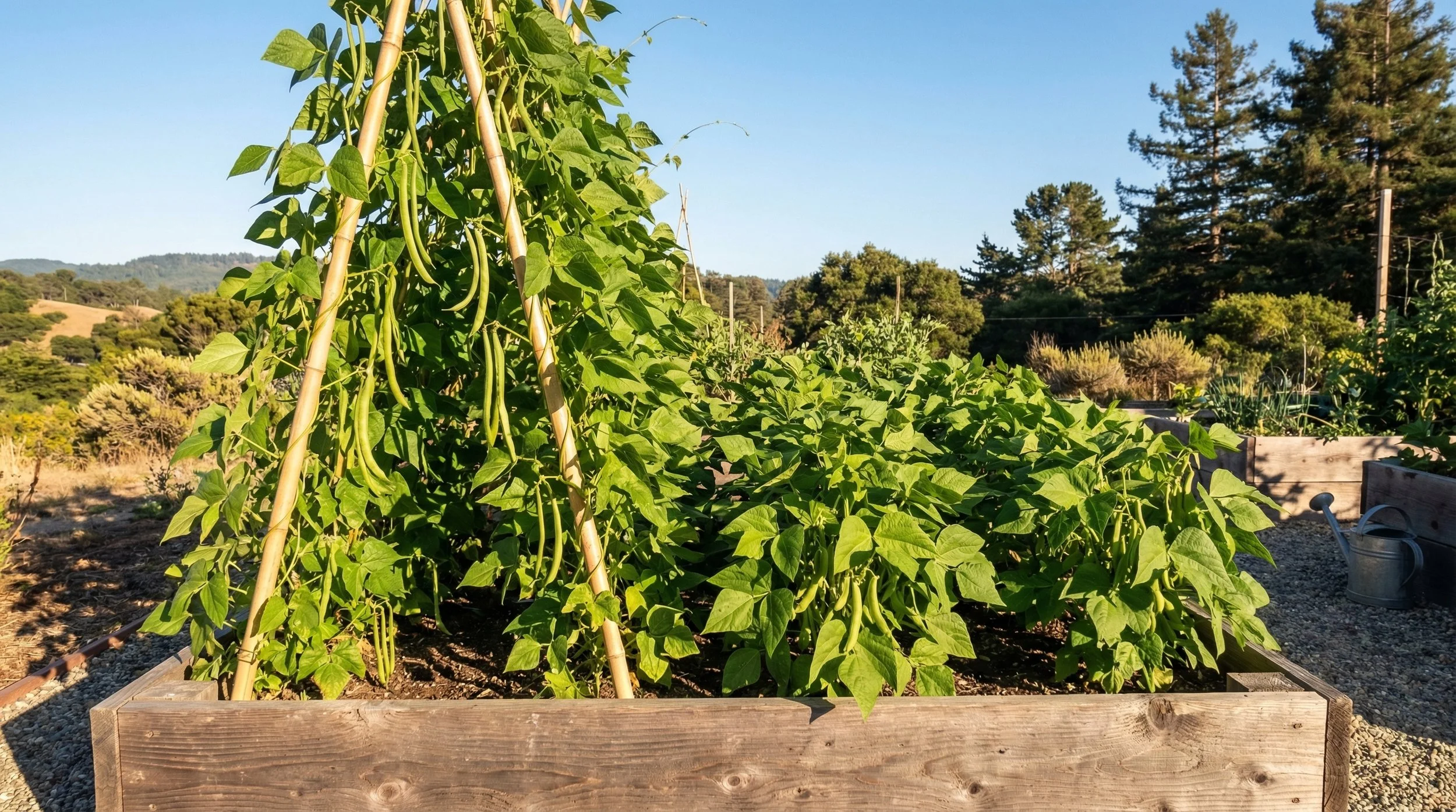
One of the first decisions you will face when planning your bean garden is whether to grow pole or bush varieties. Both have their place in Santa Cruz gardens, and understanding the tradeoffs helps you choose the right type for your space, goals, and growing conditions.
This guide breaks down the practical differences between pole and bush beans so you can make an informed choice. You will learn when each type makes sense, how to get the most from either, and why many experienced gardeners grow both.
The short answer is that neither type is universally better. Pole beans produce more over a longer season but require support structures. Bush beans produce a concentrated harvest and need no support but yield less overall. Your best choice depends on your specific situation.
What Are the Fundamental Differences?
Before we get to the details, here is a quick overview of what distinguishes these two growth habits.
Pole Beans are climbing plants that grow 6 to 10 feet tall. They wrap around supports with twining stems and produce beans along the entire length of the vine. A single planting produces for 8 to 10 weeks or more. They require sturdy support structures but take up less horizontal space.
Bush Beans are compact plants that grow 18 to 24 inches tall without support. They produce beans in a concentrated period of 2 to 3 weeks, then decline. They fit in intensive beds and containers but need succession planting for continuous harvest.
Both types come in snap, shell, and dry bean varieties. For a broader look at growing legumes in our area, see Growing Beans and Peas in Santa Cruz County. The growth habit does not affect flavor or cooking use, only how the plant grows and produces.
What Is the Difference Between Bush and Pole Beans?
Which Type Is Right for Your Garden?
| Factor | Bush Beans | Pole Beans |
|---|---|---|
| Plant Height | 12-24 inches | 6-10 feet |
| Support Needed | None | Trellis required |
| Days to Harvest | 50-60 days | 60-70 days |
| Harvest Window | 2-3 weeks | 6-8 weeks |
| Total Yield | Moderate | Higher per plant |
| Space Efficiency | Horizontal space | Vertical space |
| Container Friendly | Excellent | Possible but tricky |
| Succession Planting | Ideal | Not needed |
Choose Bush Beans If You...
- Have limited vertical space
- Want beans faster
- Are growing in containers
- Plan to can or freeze a batch
- Prefer less maintenance
- Are new to growing beans
Choose Pole Beans If You...
- Have limited ground space
- Want continuous harvest
- Can install a sturdy trellis
- Prefer picking standing up
- Want maximum total yield
- Enjoy heirloom varieties
Yield Comparison
Understanding how yield differs between pole and bush beans helps you plan appropriate space for your household's needs.
Total Yield Per Plant
Pole beans produce significantly more per plant over their longer harvest period. A single healthy pole bean plant can yield 2 to 3 pounds of snap beans over 8 to 10 weeks. Bush beans typically produce 1/4 to 1/2 pound per plant in their concentrated 2 to 3 week harvest window.
Yield Per Square Foot
The comparison becomes closer when you consider space. Pole beans require wider spacing (6 to 12 inches between plants) plus space for support structures. Bush beans can be planted densely (3 to 4 inches apart) in intensive beds (UC Master Gardeners, Santa Clara County).
A 10-square-foot bed of bush beans might produce 8 to 10 pounds in a single harvest. The same space planted with pole beans (fewer plants but longer production) might produce 12 to 15 pounds over the season. However, the pole bean bed needs vertical space and support structures that the bush bed does not.
Succession Planting Consideration
If you succession plant bush beans (planting new seeds every 2 to 3 weeks), total seasonal yield can equal or exceed pole beans. The tradeoff is more planting and seed costs versus building support structures once.
Time to Harvest
Bush beans generally mature faster than pole beans of the same type. Both types need soil temperatures of at least 60 degrees F for reliable germination (UC IPM, Cultural Tips for Growing Beans).
Bush snap beans: 50 to 60 days from planting to first harvest Pole snap beans: 60 to 75 days from planting to first harvest
This 10 to 15 day difference matters in Santa Cruz County for several reasons. In coastal gardens with shorter warm seasons, bush beans get you eating sooner. For fall crops where you are racing against cooling weather, bush beans have a better chance of maturing before production slows.
However, once pole beans start producing, they continue for 2 to 3 months while bush beans finish in 2 to 3 weeks. If you want beans over a long period from a single planting, pole beans deliver.
Space Requirements
Horizontal Space
Bush beans need more ground space than pole beans for equivalent yield. A row of bush beans producing through the season (via succession planting) requires 3 to 4 times the bed length of a single planting of pole beans.
Vertical Space
Pole beans grow 6 to 10 feet tall and need sturdy support. This vertical space is free in most gardens but the support structures add cost and effort. For gardeners with very small plots, going vertical with pole beans maximizes limited ground space.
Container Growing
Bush beans are far better suited to containers. Their compact habit fits standard pots and planters without support structures. Pole beans can be grown in large containers with attached trellises but require much more substantial containers (15+ gallon minimum) and sturdy supports.
Bush Bean Spacing Guide
Optimize Your Planting for Best Results
Traditional Rows
Intensive / Block
Container Planting Guide
Santa Cruz tip: In foggy coastal areas, give plants slightly more space (add 1-2 inches) to improve air circulation and reduce disease pressure from moisture.
Support Requirements
Pole Bean Supports
Pole beans need support structures installed before or at planting time. Common options include:
Tepees: Three or four poles (6 to 8 feet tall) tied together at the top. Simple, attractive, and sturdy in wind. Plant 2 to 3 seeds at the base of each pole.
Trellises: Posts with horizontal wires or netting. Efficient for row planting. Space horizontal supports 12 inches apart so vines have something to grab.
A-frames: Two angled panels meeting at the top. Provides access from both sides for easy harvest.
Existing structures: Fences, arbors, or dead trees can support pole beans. Ensure they can handle the weight of mature, loaded vines.
Pole bean supports must withstand wind and the weight of mature vines loaded with pods, especially after rain. Flimsy supports lead to collapsed plants and damaged crops.
Bush Bean Supports
Bush beans need no support in most conditions. Heavy-yielding plants may flop slightly when loaded with pods, but this rarely affects production or harvest. Some gardeners use low twiggy branches or short stakes for tidiness, but this is optional.
In windy coastal areas, a temporary windbreak (row cover on short hoops) during establishment helps young bush bean plants but is not required once they mature.
Harvest Considerations
Pole Bean Harvest
Harvesting pole beans is easier on your back since much of the crop hangs at eye level or above. You can walk around the support structure and pick without bending. However, some pods hide in the foliage at the top of the trellis and require reaching or a step stool.
The extended harvest period means picking every 2 to 3 days for 2 to 3 months. This is ideal for fresh eating but requires consistent attention throughout the season.
Bush Bean Harvest
Bush bean harvest requires bending or kneeling since plants are only 18 to 24 inches tall. If you have back issues, this can become tiring over a large planting.
The concentrated harvest is both advantage and challenge. You get a lot of beans at once (great for preserving) but must process them promptly. If you miss the window, pods become tough and plants stop producing.
What Are the Best Situations for Each Type?
Choose Pole Beans When:
You want fresh beans over a long period from one planting. Pole beans produce for 8 to 10 weeks, providing a steady supply for fresh eating throughout summer.
You have limited horizontal space. Going vertical maximizes production per square foot of ground.
You want maximum total yield. Pole beans simply produce more beans per plant than bush types.
You have back or mobility issues. Most of the harvest hangs at comfortable height.
You are willing to build and maintain support structures. The initial effort pays off in extended production.
Choose Bush Beans When:
You want a lot of beans at once for canning, freezing, or drying. The concentrated harvest makes preserving efficient.
You prefer succession planting. Planting every 2 to 3 weeks provides continuous harvest without support structures.
You are growing in containers. Bush beans fit standard pots without elaborate support.
You have a short growing window. Under redwoods or in other challenging spots, the faster maturity of bush beans improves your chances of a harvest.
You want minimal setup. No support structures to build, maintain, or store.
You are growing dry beans. The determinate growth of bush types makes it easier to harvest and dry entire plants at once.
How Do You Grow Both Types?
Many experienced gardeners grow both pole and bush beans, using each for its strengths.
Common strategy: Plant bush beans for an early harvest and for preserving. Plant pole beans for continuous fresh eating through summer. The bush beans produce while the slower pole beans are still growing, then the pole beans take over for the rest of the season.
Succession strategy: Plant bush beans every 3 weeks from May through July. Add one planting of pole beans in May for variety and extended harvest.
Space-constrained strategy: Grow pole beans on existing fence or structure for main production. Tuck bush beans into small gaps or containers for additional harvest.
Pole and Bush Varieties for Santa Cruz
Best Bush Varieties
'Provider' (50-54 days): Most reliable for coastal conditions. Germinates in cooler soil, produces heavily in moderate temperatures.
'Contender' (50-55 days): Early and disease resistant. Good all-around choice.
'Blue Lake 274' (54-58 days): Bush version of the classic pole bean. Excellent for preserving.
'Royal Burgundy' (55-60 days): Purple pods, extra cold tolerance for coastal gardens.
Best Pole Varieties
Pole Bean Varieties for Santa Cruz
Top Picks for Our Climate
| Variety | Days | Pod Length | Type | Notes |
|---|---|---|---|---|
| Kentucky Wonder ★ | 65 | 7-9" | Snap | Classic heirloom, great flavor, heavy producer |
| Blue Lake Pole ★ | 60 | 5-6" | Snap | Stringless, excellent for canning and freezing |
| Fortex | 60 | 10-11" | Snap | Extra long pods, stays tender, French filet type |
| Scarlet Runner ★ | 70 | 6-8" | Multi-use | Beautiful red flowers, edible as snap or shell bean |
| Romano | 60 | 5-6" | Snap | Wide, flat Italian-style pods, rich flavor |
| Rattlesnake | 65 | 7-8" | Snap/Dry | Purple-streaked pods, heat tolerant, dual purpose |
★ Local favorites: These varieties consistently perform well in Santa Cruz microclimates. Scarlet Runner beans thrive in our cooler coastal conditions where other beans may struggle.
'Blue Lake FM-1' (60-65 days): The standard for flavor and reliability. Performs well in all Santa Cruz microclimates. Blue Lake and Kentucky Wonder are among the most popular bean varieties recommended by UC Master Gardeners (UC Master Gardeners of Sonoma County).
'Kentucky Wonder' (65-70 days): Heirloom with distinctive old-fashioned flavor. Vigorous producer.
'Fortex' (60-70 days): French filet type with extra-long pods. Gourmet quality.
'Rattlesnake' (73 days): Heat tolerant heirloom for warmer inland areas.
Support Structure Ideas for Santa Cruz Gardens
Wind-Resistant Tepee
Santa Cruz coastal gardens often face afternoon winds. A sturdy tepee design handles wind well:
Use four poles minimum (6 to 8 feet long, 1 to 2 inch diameter). Set poles in a square pattern, 3 feet apart at the base. Push poles 6 to 8 inches into soil and lash together at top. Wrap twine horizontally around the structure at 12-inch intervals to give vines additional grip.
Fence Trellis
If you have an existing fence, attach wire or netting for instant pole bean support. Run horizontal wires at 12-inch intervals or use trellis netting with 4 to 6 inch openings. Plant beans 6 inches from the fence base.
Note: Check that your fence can support the weight. A mature row of pole beans loaded with pods is surprisingly heavy, especially when wet.
Cattle Panel Arch
Bend a 16-foot cattle panel into an arch and secure ends to T-posts. This creates a shaded tunnel with beans hanging down for easy harvest. Attractive and functional, though more expensive than other options.
Making Your Decision
Consider these questions to determine which type suits your situation:
How much space do you have? Small gardens benefit from pole beans' vertical efficiency. Larger gardens have room for succession-planted bush beans.
How do you want to use your harvest? Fresh eating favors pole beans' extended season. Preserving favors bush beans' concentrated harvest.
Will you build support structures? If not, bush beans are your answer.
How long is your growing season? Short-season areas (under redwoods, late starters) do better with fast-maturing bush varieties.
How do you feel about bending to harvest? Back issues point toward pole beans' standing harvest.
There is no wrong answer. Both pole and bush beans grow well in Santa Cruz County. Choose based on your specific needs and preferences, and consider growing both to get the benefits of each.
Where to get seeds: For varieties that do well in our climate, we like Seeds Now, a California company selling non-GMO, open-pollinated, and heirloom seed. (Affiliate link, see our disclosure.)
Whichever type you choose, our bean growth stages guide walks the full journey from seed to pod.
Frequently Asked Questions
Can I grow the same variety as both pole and bush?
No, growth habit is determined by genetics. 'Blue Lake' comes in both pole (FM-1) and bush (274) versions, but these are distinct varieties bred for different habits. You cannot make a bush bean climb or a pole bean stay compact.
Do pole beans taste better than bush beans?
Not inherently. Flavor depends on variety, growing conditions, and harvest timing, not growth habit. Both pole and bush varieties include excellent and mediocre options. 'Blue Lake' is considered excellent in both its pole and bush forms.
Which type is more productive overall?
Pole beans produce more per plant over the season. However, if you succession plant bush beans, total yield can be similar. Pole beans are more productive per square foot when considering vertical space as free.
Can I grow pole beans without building supports?
Pole beans can sprawl on the ground, but this leads to dirty pods, disease problems, and difficult harvest. If you cannot provide support, grow bush beans instead.
Why did my pole beans stop producing after a few weeks?
Pole beans normally produce for 8 to 10 weeks, so stopping early indicates a problem. Common causes include heat stress (over 90 degrees F), water stress, pest damage, or disease. Our Bean and Pea Troubleshooting Guide covers these issues in detail. If you harvest too infrequently and let pods mature, plants also stop producing new flowers.
How many plants do I need to feed my family?
For fresh eating: 10 to 15 pole bean plants or 15 to 20 bush bean plants per person. For preserving: 20 to 30 bush bean plants per quart you want to freeze or can. These are rough estimates that vary with variety and conditions.
Free Resources
Download these helpful guides from Your Garden Toolkit:
Seasonal Planting Calendar: Planting timing for both pole and bush beans in your microclimate.
Companion Planting Guide: What to plant alongside your beans.
