
Succession Planting Beans for Continuous Harvest
A few of the product links in this guide are affiliate links. If you buy through one, Ambitious Harvest may earn a small commission at no extra cost to you, which helps keep these guides free. We only point to gear we would use in our own Santa Cruz garden. As an Amazon Associate, we earn from qualifying purchases. Read our full disclosure.
How Can You Harvest Beans Continuously in a Santa Cruz Garden?
Succession planting, the practice of sowing new batches of the same crop at staggered intervals, transforms a single flush of beans into a steady harvest lasting three months or more. According to UC Master Gardeners of Sonoma County, staggering bean plantings every two to three weeks extends the harvest window significantly compared to a single planting. In Santa Cruz County, our relatively short warm season on the coast makes succession planning even more important, because every week of potential harvest matters.
The difference between a gardener who harvests beans twice and one who picks them from June through October often comes down to planning rather than skill. Once you understand which varieties work for each planting slot and how our coastal temperatures affect timing, succession planting becomes straightforward and deeply rewarding.
What Is the Difference Between Bush Beans and Pole Beans for Succession Planting?
Choosing between bush and pole beans is the first decision in a succession planting plan, and understanding their growth habits determines your entire strategy.
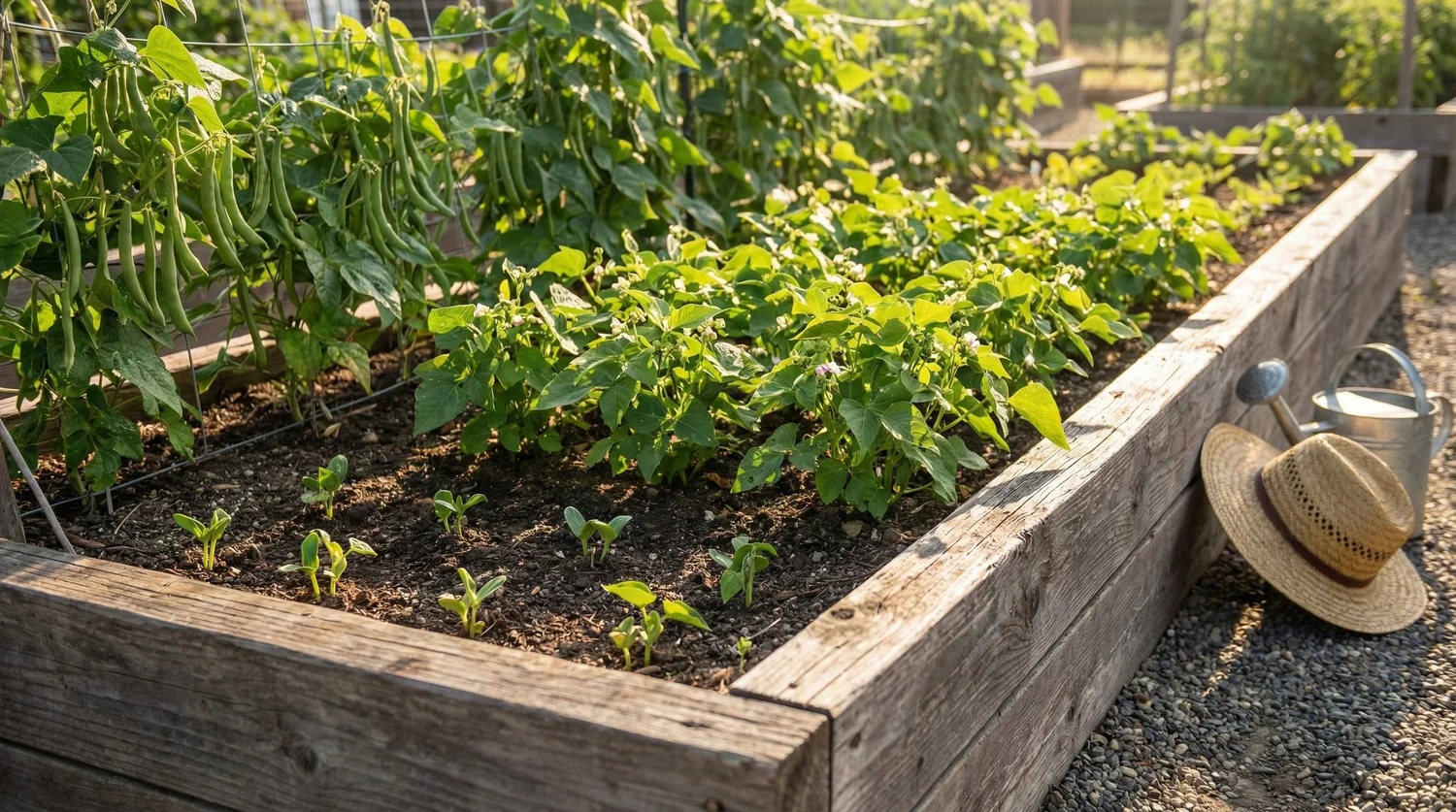
Bush beans grow 18 to 24 inches tall, need no support, and produce their entire crop within a concentrated two to three week window. After that burst of production, the plants are essentially finished. This concentrated harvest makes bush beans the backbone of succession planting because you can sow new batches every two to three weeks, with each planting producing its own burst of pods.
Pole beans grow 6 to 10 feet tall on trellises, take longer to start producing (usually 10 to 14 days later than bush varieties), but then continue producing for six to eight weeks as long as you harvest regularly. A single planting of pole beans acts like its own succession plan. The tradeoff is that they need sturdy support structures and take longer to reach first harvest.
The ideal succession strategy for Santa Cruz combines both types:
- Plant one or two pole bean plantings on trellises for sustained, long-term production
- Plant bush beans in succession every two to three weeks to fill gaps and provide heavy picking days for preserving
- Use bush beans in spaces too small for trellising and as follow-on crops after spring peas finish
Most experienced local gardeners find that two pole bean plantings (one in May, one in late June) supplemented with three to four succession sowings of bush beans provides the most continuous harvest with manageable effort.
When Should You Start and Stop Planting Beans in Santa Cruz?
Timing bean plantings in Santa Cruz County requires understanding a crucial constraint that separates coastal California from warmer inland regions: our soil warms slowly, and our warm season is genuinely shorter than many gardeners expect.
Earliest planting date: Wait until soil temperature reaches 60 degrees Fahrenheit at a 2-inch depth. In coastal Santa Cruz, this typically does not happen until mid-May, sometimes later in fog-prone areas. In warmer inland locations like Watsonville's agricultural flats or the sunny side of Scotts Valley, you might reach 60-degree soil by late April. Bean seeds planted in cold soil rot before germinating, so patience here is not optional. The UC IPM cultural tips for growing beans confirm that soil temperatures below 60 degrees lead to rapid seed decay and poor stands. A simple soil thermometer (available at any garden center for a few dollars) removes the guesswork.
Latest planting date: Count backward from your expected first significant cooling in fall. Beans need 50 to 65 days from sowing to harvest (bush types) or 60 to 75 days (pole types). In coastal Santa Cruz, where temperatures can drop below productive levels by mid-October, your last bush bean sowing should be no later than mid-August. For inland areas that cool earlier, early August is safer. Pole beans should go in by early July at the latest to allow enough harvest time before cold nights slow production.
A realistic Santa Cruz coastal succession calendar:
- Planting 1 (mid-May): Bush beans, first sowing once soil reaches 60 degrees
- Planting 2 (early June): Bush beans, second sowing, plus pole beans on trellis
- Planting 3 (mid to late June): Bush beans, third sowing
- Planting 4 (early to mid-July): Bush beans, fourth sowing, plus second pole bean planting if desired
- Planting 5 (late July to early August): Bush beans, final sowing (fast-maturing variety)
This schedule produces first harvests in early July and continues through mid to late October, depending on fall weather. In warmer years, production extends; in years with early fog and cooling, it contracts. Flexibility is part of coastal gardening.
Which Bean Varieties Work Best for Each Planting Slot?
Not every bean variety performs equally in every planting window. Choosing the right variety for the right slot significantly improves your succession results.
Early-season bush varieties (May through early June): Provider (50 days, cold-tolerant, germinates in soil as cool as 55 degrees) and Contender (49 days, good disease resistance) are the best choices for first plantings.
Mid-season bush varieties (June through July): Blue Lake 274 (54 days, the classic California bush bean), Dragon Tongue (55 days, versatile as snap or dry shell bean), and Royal Burgundy (55 days, purple pods easy to spot in foliage).
Late-season bush varieties (late July through August): Jade (53 days, disease-resistant, tolerant of cooler fall conditions) and Maxibel (50 days, French filet type, harvest pencil-thin).
Pole bean varieties (two plantings, June and early July): Blue Lake Pole (60 days, produces for 6 to 8 weeks), Kentucky Wonder (64 days, heirloom favorite), and Fortex (60 days, exceptional 10 to 11 inch stringless pods).
How Should You Prepare Beds Between Successive Bean Plantings?
Because succession planting means you are sowing into the same general area throughout the season, bed preparation between plantings deserves attention.
After pulling spent bush bean plants (once their concentrated harvest is finished), leave the roots in the soil whenever possible. Like all legumes, beans host nitrogen-fixing rhizobium bacteria in root nodules, and these roots decompose to release nitrogen for the next planting. Simply cut the plants at ground level, add the stems and leaves to your compost pile, and prepare the bed surface for the next sowing.
Add a light layer of compost (half an inch to one inch) between plantings to maintain soil structure and microbial activity. Avoid adding nitrogen fertilizer, especially before planting legumes. Too much available nitrogen in the soil actually inhibits nodule formation, meaning your bean plants will take nitrogen from the soil rather than fixing it from the air. UC Cooperative Extension lists legumes as soil improvement crops, noting that peas and beans fix nitrogen and enhance soil fertility, which reduces the need for purchased fertilizer.
Water the bed thoroughly after preparing it, then sow seeds into moist soil. If summer heat has dried the soil surface, consider watering the day before sowing and planting into the moist layer. Beans germinate best with consistent moisture but rot in soggy conditions, so the goal is evenly moist soil, not saturated.
If you are following spring peas with summer beans on the same trellis, this transition is particularly efficient. The pea roots have already enriched the soil with nitrogen, and the trellis is ready for pole beans. Our guide to growing sugar snap and snow peas covers this relay planting approach in detail.
How Does Santa Cruz's Coastal Climate Affect Bean Succession Planning?
Coastal Santa Cruz presents specific challenges for succession bean planting that inland California gardeners do not face. Naming these limitations leads to better planning and less frustration.
Cool morning fog: From June through September, marine fog frequently keeps morning temperatures below 60 degrees along the immediate coast. Beans grow slowly in cool conditions, and flower pollination can be poor when temperatures stay below 60 degrees during bloom. This means your beans may take 5 to 10 days longer to reach harvest than the "days to maturity" listed on the seed packet, which is based on warmer conditions. Build this buffer into your succession calendar.
Limited heat units: The concept of "heat units" or "growing degree days" measures the cumulative warmth a crop receives over its life cycle. Santa Cruz's coast accumulates heat units more slowly than Watsonville's inland areas or Gilroy's warmer climate. Practically, this means choosing varieties described as "early" or "quick-maturing" for your first and last plantings is more important here than in warmer locations.
Wind: Afternoon onshore winds are common from spring through fall, especially in areas exposed to Monterey Bay. Wind desiccates soil and stresses bean plants, particularly young seedlings. Use windbreaks (fencing, taller crops, or temporary shade cloth) for plantings in exposed locations. Pole beans on trellises are especially vulnerable to wind damage when loaded with pods.
Microclimate advantages: Not everything about coastal succession is challenging. Our moderate temperatures mean beans rarely suffer heat stress, which causes blossom drop in hotter inland areas. While a Fresno gardener might lose their July planting to 105-degree heat, your Santa Cruz beans keep flowering and setting pods in 70 to 75 degree comfort. This consistency actually makes your overall succession more reliable, even if each individual planting produces somewhat less than in a warmer climate.
According to the UC Cooperative Extension in Santa Cruz County, gardeners in fog-influenced microclimates should expect roughly 80 percent of the production that inland coastal gardeners achieve, but over a longer and more consistent season.
How Do You Keep Track of Multiple Succession Plantings?
Managing four to six overlapping bean plantings, each at different growth stages, requires some record-keeping. The gardeners who succeed with succession planting are almost always the ones who write things down.
Simple planning calendar approach:
- Use a wall calendar, garden journal, or phone calendar to mark each sowing date
- Note the variety planted, exact location in the garden, and expected harvest start date (sowing date plus days to maturity plus 7 to 10 days for our coastal conditions)
- Set a reminder two to three weeks after each sowing to plant the next batch
- Record actual harvest start and end dates to refine your schedule for next year
Label each planting in the garden with a simple stake marking the variety and sowing date. When you have three batches of bush beans in various stages, it is easy to lose track of which is which. This becomes especially important when you need to decide whether a planting is finished and ready to be pulled or just taking a brief pause between flush harvests.
After one season of succession planting, review your notes. You will quickly see which varieties performed best in each planting slot, how many days your varieties actually needed in your specific garden, and whether you should adjust your sowing intervals. Most Santa Cruz gardeners find that two-week intervals work better than three-week intervals for bush beans, because our moderate temperatures produce a gentler, more spread-out harvest from each planting rather than the intense burst you see in hotter climates.
What Harvest Techniques Maximize Continuous Production?
How you harvest directly affects how long each planting continues to produce. This is true for both bush and pole beans, though the effect is more dramatic with pole varieties.
Harvest every two days during peak production. Bean plants are programmed to produce seeds for reproduction. When you pick pods before the seeds inside fully mature, the plant responds by producing more flowers and pods. If you let pods mature on the vine (becoming swollen with visible bean shapes inside), the plant receives the signal that it has successfully reproduced and slows or stops new pod production.
Harvest at the right stage: Pick when pods are firm, crisp, and the seeds inside are just barely visible as small bumps. Pods should snap cleanly when bent. Use two hands (hold the stem, pull the pod) to avoid breaking branches. If pods become overmature, harvest them anyway to keep the plant producing. Leaving overmature pods on the vine is the fastest way to shut down production.
If you find yourself overwhelmed, beans preserve beautifully. Blanch whole pods for 3 minutes, plunge into ice water, drain, and freeze in a single layer on a sheet pan before bagging. Properly blanched and frozen green beans retain quality for 8 to 12 months.
How Do You Transition from Spring Peas to Summer Beans?
One of the most efficient succession strategies for Santa Cruz gardens is the pea-to-bean relay, using the same bed and trellis for cool-season peas followed by warm-season beans. This approach maximizes both space and soil fertility.
The relay timeline:
- September through October: Plant peas (sugar snap or snow peas) on your trellis
- November through April: Peas grow and produce through the cool season
- Late April through May: As pea production winds down, remove spent pea vines but leave roots in soil
- Mid-May through June: Plant pole beans at the base of the same trellis
- July through October: Harvest pole beans from the same structure
This relay works because pea roots leave behind nitrogen-rich nodules that decompose and feed the following beans. While beans also fix nitrogen, they benefit from the improved soil structure and fertility that the pea crop built. UC Cooperative Extension rotation guidance points the other way: rotate by plant family so pest and disease cycles get broken, which means following beans with a different family rather than with more legumes.
One caution: if your peas had significant disease issues (particularly root rot or fusarium wilt), do not plant beans in the same location immediately. These diseases can affect both crops. In that case, move your beans to a different bed and plant something non-leguminous (lettuce, brassicas, or a cover crop) in the disease-affected bed. Our troubleshooting guide covers disease identification and rotation strategies.
Where to get seeds: For varieties that do well in our climate, we like Seeds Now, a California company selling non-GMO, open-pollinated, and heirloom seed. (Affiliate link, see our disclosure.)
Succession timing gets easier once you know how long each planting takes to move through its cycle; see our bean growth stages guide.
Frequently Asked Questions
How far apart should succession bean plantings be?
For bush beans in Santa Cruz's coastal climate, sow a new batch every 14 to 18 days. The moderate temperatures here produce a more gradual harvest from each planting compared to hotter climates, so tighter spacing between plantings prevents gaps. For inland areas with warmer conditions, every 18 to 21 days works because each planting produces its concentrated burst faster. UC Master Gardeners of Sonoma County suggest sowing green beans at one to two week intervals for a continuous harvest.
Can you plant beans in the same spot every year?
It is better to rotate bean plantings to different beds each year. Growing beans (or any legume) in the same location repeatedly increases the risk of soilborne diseases like fusarium wilt and root rot. A three-year rotation is ideal, meaning beans return to the same bed only every third year. According to the UC Master Gardeners of Placer County, crop rotation is the single most effective non-chemical disease management strategy for vegetable gardens, reducing pathogen buildup in the soil.
Why do my bean seeds rot instead of germinating?
Seed rot almost always results from planting in soil that is too cold or too wet. Bean seeds need soil temperatures of at least 60 degrees Fahrenheit for reliable germination, and in saturated soil, they absorb too much water and decay before the embryo can grow. In Santa Cruz's coastal gardens, resist the urge to plant before mid-May. UC IPM advises that snap beans need soil temperatures of 60 degrees or higher, because seeds rot quickly and growth slows in cooler soil, so a soil thermometer is worth using before you sow.
Do pole beans really produce longer than bush beans?
Yes, substantially. A healthy pole bean planting produces for six to eight weeks continuously, while bush beans concentrate their harvest into two to three weeks. The tradeoff is that pole beans require trellising and take 7 to 14 days longer to begin producing. For Santa Cruz gardens, one or two pole bean plantings supplemented by succession-sown bush beans provides the best combination of extended production and heavy harvest days for preserving. UC Master Gardeners note that pole beans bear over a long season and produce a larger crop, while a bush bean plant bears over only a two or three week period.
What should I plant after my last bean crop of the season?
As your final bean planting finishes in October, it is the perfect time to plant cool-season crops or cover crops. Fava beans are an excellent follow-on, continuing the nitrogen-building cycle through winter while producing edible pods. Other good options include peas, lettuce, brassicas (broccoli, kale, cabbage), or a non-legume cover crop like cereal rye. UC Cooperative Extension notes that winter cover crops protect soil from erosion, add organic matter when turned in, suppress winter weeds, and can fix nitrogen for spring planting.
How many bean plants do I need to feed my family?
A general rule is 10 to 15 bush bean plants per person for fresh eating, with each succession planting providing about two weeks of regular picking. For a family of four wanting beans from June through October, plan on roughly 60 bush bean plants spread across four or five succession sowings, plus 8 to 10 pole bean plants for sustained production. The UC Master Gardener Program puts the approximate yield of bush snap beans at 15 pounds per 15-foot row, which works out to roughly 10 pounds per 10 feet of row, and it lists no separate figure for pole beans.
Is it too late to start succession planting if it is already July?
Not at all. A July sowing of fast-maturing bush beans (Provider at 50 days, Maxibel at 50 days, or Jade at 53 days) will produce a harvest in September. You can squeeze in one more sowing in late July for an October harvest on the coast. You will not get the full multi-month succession experience, but even two plantings two weeks apart extends your bean season significantly. UC Master Gardeners of Sonoma County recommend sowing crops like green beans at one to two week intervals so the harvest keeps coming instead of arriving all at once.
Should I remove flowers from young bean plants?
No. Unlike some crops where pinching early flowers redirects energy to vegetative growth, beans generally perform best when allowed to flower and set pods on their natural schedule. Removing flowers from bush beans is counterproductive because their concentrated flowering period is brief and essential to their harvest. For pole beans, you might see a few early flowers before the vine is fully established, but these rarely set pods successfully anyway, and the plant self-regulates.
Build Your Bean Succession Plan
Succession planting transforms beans from a brief seasonal treat into a months-long staple of your Santa Cruz garden. The planning takes an afternoon, the seed investment is minimal, and the reward is picking fresh beans from June through October rather than scrambling to process a single overwhelming harvest. Start with two or three succession sowings your first year, note what works, and expand from there.
For more seasonal planting guides, variety recommendations, and crop-planning tools designed for Santa Cruz County, visit Your Garden Toolkit.
Keep Reading:
