

Organic Pest Identification Guide for Santa Cruz Gardens
A few of the product links in this guide are affiliate links. If you buy through one, Ambitious Harvest may earn a small commission at no extra cost to you, which helps keep these guides free. We only point to gear we would use in our own Santa Cruz garden. As an Amazon Associate, we earn from qualifying purchases. Read our full disclosure.
Something is eating your plants. Leaves have holes, stems are chewed, or your seedlings have vanished overnight. Before you reach for any product, the first step is always identification. Knowing exactly which pest you are dealing with determines whether you need to act at all, and if so, what action will actually work.
This guide covers the 15 most common garden pests in Santa Cruz County, organized by the type of damage they cause. (For a quick-reference overview, see Common Garden Pests in Santa Cruz County and How to Beat Them.) For each pest, you will find what the damage looks like, how to confirm the culprit, when they are most active in our area, and the most effective organic control methods backed by UC Integrated Pest Management (IPM) research. The goal is not a pest-free garden (that does not exist in nature), but a garden where pests are managed at levels that do not significantly reduce your harvest.
Key Takeaway: Accurate identification is the foundation of effective pest management. Many garden "pests" are actually beneficial or neutral, and even real pests often do not require intervention if natural predators are present.
How Do You Figure Out What Is Eating Your Plants?
Before scrolling through pest lists, use this diagnostic approach to narrow down the possibilities quickly.
Step 1: Examine the Damage Pattern
Holes in leaves: Chewing insects (caterpillars, beetles, earwigs, slugs) or snails
Sticky residue or black mold on leaves: Sucking insects (aphids, whiteflies, scale) that excrete honeydew
Stippled or bronzed leaves: Spider mites or thrips
Wilting despite adequate water: Root pests (gophers, root maggots) or soil-borne disease
Entire seedlings gone: Slugs, snails, cutworms, birds, or rabbits
Fruit damage: Birds, earwigs, squirrels, or specific fruit pests
Step 2: Check the Timing
When does the damage appear? Overnight damage (especially to seedlings) points to nocturnal feeders like slugs, snails, earwigs, or cutworms. Daytime damage is more likely from caterpillars, beetles, or vertebrate pests. Go out with a flashlight after dark to catch nocturnal pests in the act.
Step 3: Look for the Pest
Check the undersides of leaves, along stems, at the base of plants, and in the top inch of soil. Many pests hide during the day and feed at night. Look for frass (insect droppings), slime trails (slugs and snails), or webbing (spider mites).
Step 4: Consider the Season
Pest populations follow seasonal patterns in Santa Cruz County. Aphids peak in spring. Caterpillars are worst in late spring and summer. Slugs and snails are active year-round in our moist coastal climate but are most damaging in the cool, wet months. Knowing the seasonal context helps narrow your identification.
Sucking Insects: Aphids, Whiteflies, and Scale
Aphids
Aphids are the most common garden pest in Santa Cruz County and one of the easiest to manage. These small, soft-bodied insects (1/16 to 1/8 inch) cluster on new growth, flower buds, and the undersides of leaves. They come in green, black, red, and gray depending on the species. Aphids feed by piercing plant tissue and sucking sap, excreting a sticky substance called honeydew that often attracts ants and supports the growth of black sooty mold.
Damage: Curled or distorted new growth, yellowing leaves, sticky residue, and black mold on leaf surfaces.
When they appear: Spring through early summer (March through June), with populations typically peaking in April and May before natural enemies catch up.
Organic control:
A strong blast of water from the hose dislodges aphids and is the most effective first response. Repeat every few days.
Encourage natural predators: ladybugs, lacewing larvae, syrphid fly larvae, and parasitic wasps all feed on aphids. See Attracting Beneficial Insects to Your Santa Cruz Garden for planting strategies. According to UC IPM, natural enemies are the most important factor in aphid population control in gardens.
Insecticidal soap spray (diluted per label directions) kills aphids on contact. Spray undersides of leaves where aphids cluster. Reapply after rain or irrigation.
Manage ants, which protect aphid colonies from predators. Sticky barriers on tree trunks prevent ant access.
When to leave them alone: If you see ladybug larvae (small, dark, alligator-shaped insects) or syrphid fly larvae (green, slug-like) on your plants, natural predators are already working. Give them a week or two before intervening. A small aphid colony is food for beneficial insects and does not significantly harm healthy plants.
Whiteflies
Whiteflies are tiny (1/16 inch), white, moth-like insects that fly up in a cloud when disturbed. They feed on the undersides of leaves, especially on tomatoes, peppers, squash, and many ornamentals. Like aphids, they produce honeydew and attract sooty mold.
Damage: Yellowing leaves, sticky honeydew, reduced plant vigor. Heavy infestations can weaken plants significantly.
When they appear: Summer through fall in Santa Cruz County, as they prefer warm conditions. Greenhouse whiteflies can be active year-round in sheltered locations.
Organic control:
Yellow sticky traps catch adult whiteflies and help monitor population levels.
Insecticidal soap or neem oil sprays applied to the undersides of leaves. Thorough coverage is essential.
Remove heavily infested leaves to reduce the population.
Encourage natural enemies, particularly Encarsia formosa (a tiny parasitic wasp that is commercially available for greenhouse use).
Scale Insects
Scale insects look like small bumps on stems and leaves rather than recognizable insects. Soft scales produce honeydew; armored scales do not. They are most common on fruit trees, citrus, and ornamental shrubs in Santa Cruz County.
Damage: Yellowing leaves, branch dieback, sticky honeydew (soft scale), and overall decline in plant vigor.
Organic control:
Horticultural oil spray (applied during the dormant season for deciduous trees, or as a light summer spray) smothers scale insects. According to UC IPM, properly timed oil sprays are the most effective organic treatment for scale.
Scrub individual scales off with a soft brush or cloth dipped in rubbing alcohol.
Encourage parasitic wasps, which are the primary natural enemies of many scale species.
Chewing Insects: Caterpillars, Beetles, and Earwigs
Tomato Hornworms
These large (up to 4 inches), bright green caterpillars with white diagonal stripes and a horn-like projection on their rear end are the larvae of the five-spotted hawk moth. They feed voraciously on tomatoes, peppers, and eggplant.
Damage: Rapid defoliation, large irregular holes in leaves, and occasionally feeding on green fruit. A single hornworm can strip a significant portion of a tomato plant in a few days.
When they appear: Late spring through summer (May through August).
Organic control:
Hand-picking is the most effective method. Check plants in early morning when caterpillars are most visible. Look for dark droppings (frass) on leaves below feeding damage, then look up to find the caterpillar.
If you find a hornworm covered with small white cocoons, leave it in the garden. Those cocoons belong to braconid wasps, a parasitic wasp that kills the caterpillar and provides future biological control.
Bacillus thuringiensis (Bt) spray is effective against all caterpillars when applied to leaves before feeding damage is severe. According to UC IPM, Bt kurstaki is a selective biological insecticide that acts as a gut toxin to the larvae of moths and butterflies, so it will affect caterpillars you want as well as the ones you do not.
Cabbage Worms and Cabbage Loopers
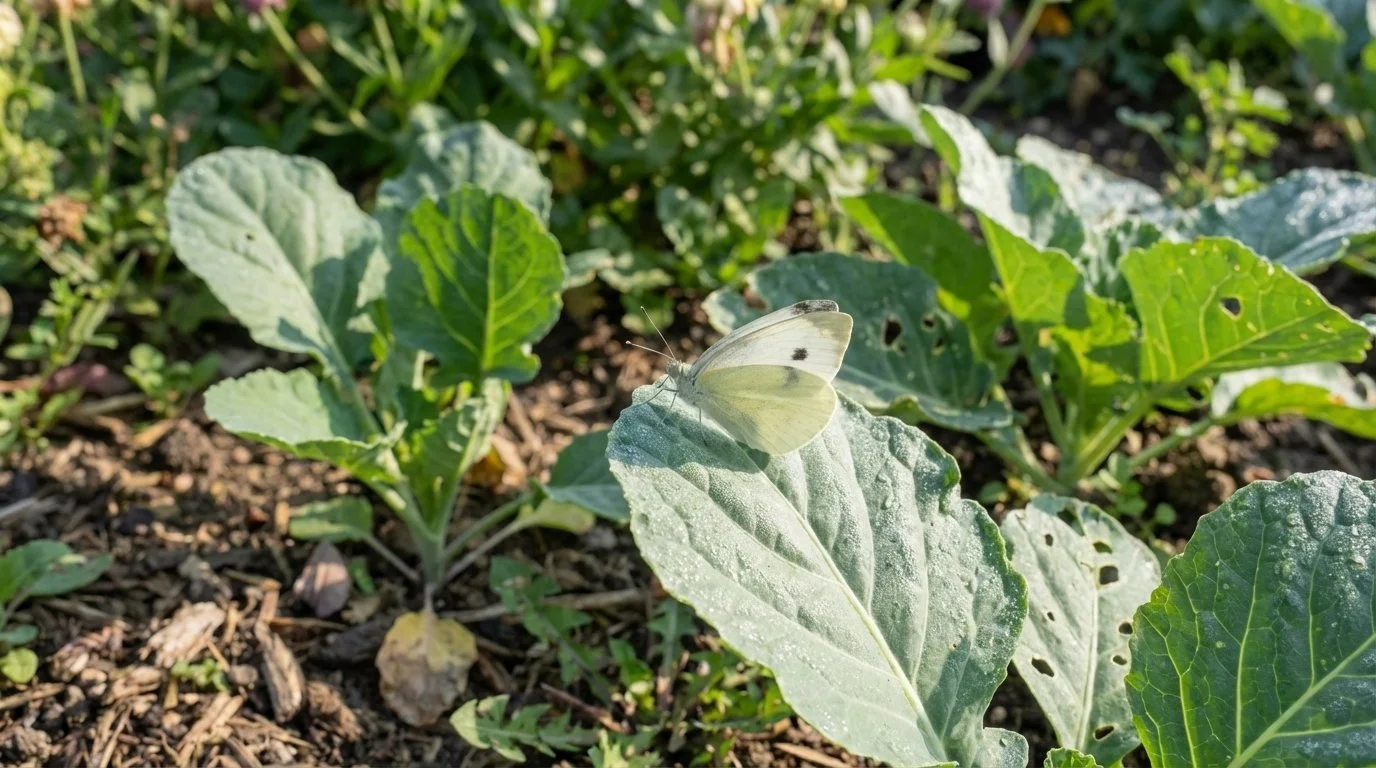
These green caterpillars (the larvae of white butterflies and brown moths, respectively) are the primary pests of brassicas (broccoli, cabbage, cauliflower, kale, Brussels sprouts) in Santa Cruz County. Imported cabbageworms are velvety green with a faint yellow stripe. Cabbage loopers are smooth green and "loop" as they crawl.
Damage: Irregular holes in leaves, frass on leaves, and boring into broccoli and cauliflower heads.
When they appear: Year-round in our mild climate, with peaks in spring and fall.
Organic control:
Floating row covers (lightweight fabric) placed over brassica beds immediately after planting are the most effective prevention. They physically exclude the adult butterflies and moths from laying eggs on your plants.
Bt spray applied every 1 to 2 weeks during active caterpillar season.
Hand-pick caterpillars and eggs (look for tiny yellow or white eggs on the undersides of leaves).
Flea Beetles
Tiny (1/16 inch), shiny, dark beetles that jump when disturbed. They chew small round holes in leaves, giving them a "shotgun" appearance. Eggplant, radishes, and brassica seedlings are their preferred hosts.
Damage: Small round holes in leaves, especially on young plants. Severe damage can kill seedlings. Established plants usually outgrow flea beetle damage.
When they appear: Spring (March through May), coinciding with seedling transplanting season.
Organic control:
Row covers are the most effective protection for seedlings.
Delay transplanting until plants are larger and more tolerant of damage.
Yellow sticky traps near affected plants catch adult beetles.
Diatomaceous earth dusted on dry leaves creates a physical barrier, but must be reapplied after rain or irrigation.
Earwigs
Earwigs are elongated, dark brown insects (about 3/4 inch) with distinctive pincers on their rear end. They are nocturnal and omnivorous, feeding on both plant material and other insects. In coastal gardens with moist conditions, earwigs can be significant pests of seedlings, soft fruits, and flower petals.
Damage: Irregular holes in leaves and petals, damage to soft fruits (especially strawberries), and feeding on seedlings. Damage occurs at night.
When they appear: Active year-round in Santa Cruz County's mild, moist climate, with populations peaking in spring and summer.
Organic control:
Trapping is highly effective. Roll up sections of newspaper, cardboard, or short pieces of garden hose and place them near affected plants in the evening. Earwigs crawl inside seeking shelter. Collect and dispose of traps each morning.
Shallow containers of vegetable oil with a drop of soy sauce attract and drown earwigs (a low-sided tuna can works well). Set out in the evening near problem areas.
Reduce daytime hiding spots by clearing mulch, debris, and boards from around vulnerable plants. This conflicts with moisture conservation, so target cleanup around the most affected crops.
Slugs and Snails: The Coastal Garden's Constant Companions
Slugs and snails are likely the most persistent and damaging pests in Santa Cruz County gardens. For a deeper look at managing these pests in our foggy climate, see Slug and Snail Control in Foggy Santa Cruz Gardens. Our cool, moist coastal climate provides ideal year-round conditions for these mollusks. They feed at night and on cloudy, damp days, leaving behind silvery slime trails as evidence.
Damage: Irregular holes in leaves (often with smooth edges), scraped surfaces on fruit, and complete disappearance of young seedlings. Slime trails on and around damaged plants confirm slug or snail activity.
When they appear: Year-round, but most active and damaging from fall through spring when moisture levels are highest. Summer activity depends on irrigation and fog.
Organic control:
Iron phosphate bait (Sluggo, Sluggo Plus) is the most effective organic control. Scatter pellets around vulnerable plants according to label directions. Iron phosphate is safe around children, pets, and wildlife, and breaks down into iron and phosphorus that are absorbed by the soil. UC IPM describes iron phosphate baits as safer around children, pets, and wildlife than metaldehyde, though they work more slowly, taking several days to a week to kill rather than about a day.
Hand-picking at night. Go out with a flashlight an hour after dark and collect slugs and snails directly. This is most effective after rain or irrigation when they are most active.
Copper barriers. Copper tape or flashing around raised bed edges creates a mild electrical charge that deters slugs and snails. Effective for protecting contained areas but not practical for large garden spaces.
Beer traps. Shallow containers of beer sunk into the ground attract and drown slugs. Less effective than iron phosphate but useful as a monitoring tool to assess population levels.
Remove daytime hiding spots. Boards, pots, dense ground covers, and thick mulch provide shelter for slugs and snails during the day. Reducing these hiding spots near vulnerable plants lowers the local population.
Spider Mites: The Tiny Pest You Might Not See
Spider mites are nearly invisible to the naked eye (less than 1/50 inch) but can cause significant damage to a wide range of garden plants. They are most problematic during hot, dry weather and in dusty conditions.
Damage: Fine stippling (tiny pale dots) on leaves, overall bronzing or yellowing, and fine webbing on the undersides of leaves and between branches. Hold a white piece of paper under a branch and tap it. If tiny specks fall onto the paper and start crawling, you have spider mites.
When they appear: Summer, especially during hot spells. More common in inland parts of Santa Cruz County than on the foggy coast.
Organic control:
A strong spray of water on the undersides of leaves knocks mites off and disrupts their webbing. This is often sufficient for minor infestations.
Predatory mites (Phytoseiulus persimilis and others) are commercially available and provide excellent biological control. Release them at the first sign of spider mite activity.
Avoid dusty conditions, which favor spider mite outbreaks. Keep pathways watered or mulched.
According to UC IPM, broad-spectrum insecticides actually make spider mite problems worse by killing their natural predators. Avoid pyrethroid sprays near areas with spider mite history.
Soil Pests: Cutworms, Root Maggots, and Symphylans
Cutworms
Cutworms are fat, smooth caterpillars (the larvae of various moth species) that curl into a C-shape when disturbed. They live in the soil during the day and emerge at night to feed at the base of plant stems, often cutting seedlings off at ground level.
Damage: Young plants severed at or just below the soil surface, apparently overnight. This is the signature of cutworm feeding.
When they appear: Spring, when new seedlings and transplants are most vulnerable.
Organic control:
Cardboard or newspaper collars placed around transplant stems at planting time. Push the collar 1 inch into the soil and extend it 2 inches above. Toilet paper tubes cut in half work well.
Dig around the base of damaged plants to find and destroy cutworms hiding in the soil.
Bt spray applied to the soil surface and lower stems in the evening.
Root Maggots
The larvae of small flies that lay eggs at the base of brassicas (cabbage root maggot) or onions (onion maggot). Maggots feed on roots, causing wilting, stunted growth, and plant death in severe cases.
Damage: Plants wilt despite adequate watering. Pulling up an affected plant reveals tunneled or rotted roots with small white maggots.
When they appear: Spring through early summer.
Organic control:
Row covers placed over brassica and onion beds at planting time prevent adult flies from laying eggs. This is the most reliable preventive measure.
Beneficial nematodes (Steinernema feltiae) applied to the soil attack root maggot larvae. Water them in immediately after application.
Rotate crop families each year to avoid planting in soil with overwintering pupae.
Garden Symphylans
Symphylans are small (1/4 inch), white, centipede-like creatures that live in the soil and feed on fine root hairs. They are a significant but often unrecognized pest in Santa Cruz County, particularly in the rich, organic soils of the Pajaro Valley. UC IPM describes garden symphylans as soil pests that feed on roots and slow plant growth, with infestations spreading slowly and concentrating where soil fumigation was skipped or ineffective.
Damage: Poor plant growth, stunted development, and reduced yields despite good soil conditions and adequate water. Plants may appear nutrient-deficient because damaged roots cannot absorb nutrients effectively. Dig around affected plants and look for small, fast-moving white creatures in the top 6 inches of soil.
Organic control:
There is no highly effective organic treatment for symphylans. Cultural controls include flooding beds (symphylans cannot tolerate waterlogged soil), allowing beds to dry out thoroughly between irrigations, and cultivating soil to disrupt their habitat.
Raised beds with new soil can provide a symphylan-free growing environment if in-ground gardening is severely affected.
Vertebrate Pests: Gophers, Deer, Rabbits, and Birds
Gophers
Pocket gophers are the most destructive vertebrate pest in Santa Cruz County gardens. They tunnel underground, eating plant roots and bulbs and creating fan-shaped mounds of fresh soil. A single gopher can destroy an entire garden bed from below.
Damage: Plants wilting or dying suddenly (roots eaten from below), crescent-shaped mounds of fresh soil, and sometimes plants being pulled underground entirely.
Organic control:
Gopher wire baskets installed beneath raised beds or around individual plants are the most reliable long-term solution. Use galvanized hardware cloth (1/2-inch mesh) formed into baskets and buried at planting time.
Trapping with Macabee or Victor gopher traps placed in active tunnels is effective but requires some skill and persistence. UC ANR has detailed guides on proper gopher trap placement.
Owls. Installing an owl box encourages barn owls, which are the most effective natural gopher predators. A single barn owl family can consume over 3,000 rodents per year, according to the Barn Owl Research Foundation.
Deer
Deer are common in the Santa Cruz Mountains, Bonny Doon, and areas adjacent to open space. They browse on a wide range of garden plants, with particular fondness for roses, fruit trees, beans, lettuce, and many flowers.
Organic control:
Fencing (at least 7 to 8 feet tall) is the only fully reliable deer deterrent. Shorter fences work if angled outward or combined with a double-fence system.
Deer-resistant plant selection reduces damage. County UC Master Gardener programs publish deer-resistant plant lists, and UC IPM cautions that these lists are general guides only, since plants deer avoid in one part of California may be eaten in another.
Motion-activated sprinklers and commercial deer repellent sprays provide partial deterrence but need regular rotation to remain effective.
Birds
Birds are both beneficial (insect eaters) and destructive (fruit and seedling eaters) in the garden. Crows, jays, and finches are the primary culprits in Santa Cruz County gardens.
Organic control:
Bird netting over fruiting crops (berries, tomatoes, stone fruits) is the most effective protection. Secure netting tightly to prevent birds from becoming tangled.
Reflective tape, old CDs, and predator decoys (owl or hawk shapes) provide temporary deterrence but birds habituate to them quickly. Move and rotate deterrents regularly.
Row covers protect newly seeded beds from bird scratching and seedling browsing.
The IPM Approach: A Framework for Pest Decisions
UC Integrated Pest Management (UC IPM) is a science-based approach that emphasizes prevention, monitoring, and using the least-toxic effective control. It is not about eliminating all pests. It is about managing them at acceptable levels.
The IPM Decision Process
Identify the pest accurately. Many "pests" are actually harmless or beneficial. Do not spray until you know exactly what you are dealing with.
Monitor regularly. Check your garden at least weekly for pest activity. Early detection makes management much easier.
Determine if action is needed. A few aphids on a healthy plant do not require intervention. A cloud of whiteflies on weakened seedlings does. UC IPM calls this the "action threshold."
Start with the least-toxic option. Physical controls (hand-picking, water blasts, row covers, traps) come first. Biological controls (encouraging natural enemies) come second. Targeted sprays (insecticidal soap, Bt, neem oil) come third. Broad-spectrum products are a last resort.
Evaluate results. Did your chosen method work? Record what you did and the outcome in your garden journal for future reference.
Frequently Asked Questions
What is eating my seedlings overnight?
The most likely culprits in Santa Cruz County gardens are slugs, snails, earwigs, or cutworms. Go out with a flashlight an hour after dark to catch them in the act. Slime trails indicate slugs or snails. Clean-cut stems at ground level suggest cutworms. Ragged holes in leaves point to earwigs.
Should I buy ladybugs to release in my garden?
Purchased ladybugs often fly away within hours. According to UC IPM, it is more effective to attract native beneficial insects by planting nectar-rich flowers (alyssum, yarrow, coriander, fennel) and avoiding broad-spectrum pesticides. Native ladybugs, lacewings, and parasitic wasps will find your garden if you provide habitat and food.
Is neem oil safe to use?
Neem oil is considered a low-toxicity organic pesticide, but it can harm beneficial insects if applied when they are active. UC IPM puts the low bee activity window at sunset to midnight, so spray neem oil after sundown rather than at first light, and keep it off open flowers entirely. Avoid spraying on blooming plants.
What are the small white butterflies in my garden?
Those are likely imported cabbageworm butterflies. If you are growing brassicas (broccoli, kale, cabbage, cauliflower), they are laying eggs on your plants. Cover brassica beds with floating row covers to exclude them, or hand-pick the green caterpillars that hatch from their eggs.
My tomato plant has a large green caterpillar with a horn. What is it?
That is a tomato hornworm, the larva of the five-spotted hawk moth. Hand-pick it. If it has small white cocoons attached to its back, leave it alone. Those cocoons are parasitic wasp pupae that will provide future biological control of hornworms in your garden.
What is eating holes in my plant leaves?
Match the damage to the culprit. Ragged, large holes with a slime trail point to snails or slugs. Clean notches along leaf edges suggest earwigs. Tiny shot-hole pinpricks usually mean flea beetles, while winding tunnels inside the leaf are leafminers. In coastal Santa Cruz gardens, snails and earwigs top the list. UC IPM offers photo guides at ipm.ucanr.edu to confirm before you treat.
Why are my leaves ragged or lacy but I can't see any bug?
Many leaf chewers feed only after dark and hide by day. Slugs, snails, earwigs, and young caterpillars all work the night shift, then tuck under mulch, pots, or leaf litter by morning. Head out after dark with a flashlight and check the undersides and soil line. UC IPM notes that nighttime scouting at ipm.ucanr.edu is the surest way to catch these hidden feeders.
Build Your Pest Defense Toolkit
Related Reading
Common Garden Pests in Santa Cruz County and How to Beat Them
For free printable pest identification resources, visit Your Garden Toolkit.
