

15 Vegetables That Produce the Most Food per Square Foot
15 Vegetables That Produce the Most Food per Square Foot
According to the National Gardening Association, a well-maintained home vegetable garden produces an average return of $600 in produce for every $70 invested in seeds and supplies, but the actual value depends heavily on what you grow (NGA 2023 National Gardening Survey). Some crops return 10 to 20 times their cost per square foot, while others barely break even. This list ranks the 15 most productive vegetables by yield per square foot, with real-world data on pounds harvested and grocery store cost comparisons.
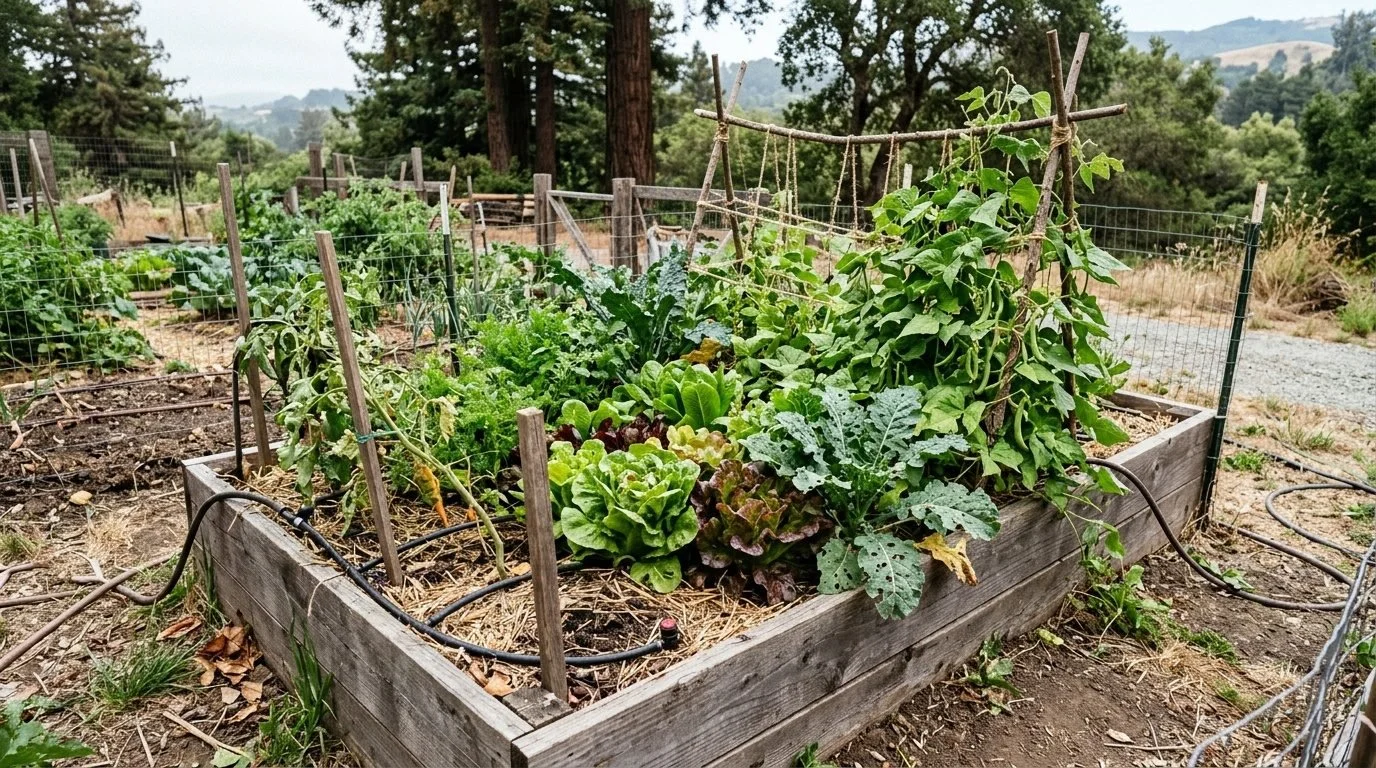
I have tracked yields in my Santa Cruz garden for years, and the numbers consistently show that certain crops dramatically outperform others in food production per square foot. California's long growing season amplifies these results because many of the highest-producing crops can be grown over a longer period than in colder climates. If you want to maximize the amount of food your garden produces, prioritize these 15 vegetables.
1. Tomatoes (Indeterminate)
Indeterminate tomatoes are the single most productive vegetable per square foot in a California garden. A single well-managed indeterminate tomato plant can produce roughly 10 to 20 pounds of fruit over a season, and UC Master Gardeners rate tomatoes among the highest-yielding crops per foot of row. Grown on a stake or cage using about 4 square feet of ground space, that translates to roughly 3 to 5 pounds per square foot.
Yield estimate: 3 to 5 pounds per square foot per season. At an average California grocery store price of $2.50 to $4.00 per pound for vine-ripe tomatoes, a single plant can return $25 to $80 worth of fruit.
Best high-yield varieties: 'Early Girl' is the California standard and produces reliably across all zones. 'Sun Gold' cherry tomatoes are outrageously productive, often yielding 15+ pounds per plant. 'San Marzano' is the best paste tomato for canning and produces heavy yields of meaty fruit. 'Cherokee Purple' offers heirloom flavor with solid production.
Maximize production: Prune suckers below the first flower cluster to direct energy into fruit. Stake or cage plants to keep fruit off the ground. In coastal California, choose varieties that set fruit in cooler temperatures. Feed with calcium-rich fertilizer to prevent blossom end rot and keep plants producing longer. our California tomato growing guide
2. Zucchini and Summer Squash
Zucchini is famously, almost comically productive. A single zucchini plant can easily yield 6 to 10 pounds of fruit over the season, and compact bush varieties do it in about 9 square feet of space. That works out to roughly 1 to 2 pounds per square foot, but the real value is that one plant provides all the zucchini most families can use.
Yield estimate: 1 to 2 pounds per square foot per season from a bush variety, with 6 to 10 pounds per plant. At $1.50 to $2.50 per pound retail, a single plant returns $10 to $25.
Best high-yield varieties: 'Black Beauty' is the production workhorse. 'Costata Romanesco' is an Italian heirloom with superior nutty flavor and good yields. 'Patio Star' produces well in compact spaces. 'Golden Zucchini' adds variety and is equally productive.
Maximize production: Harvest when fruits are 6 to 8 inches long. Leaving oversized zucchini on the plant signals it to slow production. Pick every 2 to 3 days during peak season. In California, plant in April and again in July for production from June through November.
3. Pole Beans
Pole beans are one of the most space-efficient vegetables because they grow vertically, producing 3 to 4 times more food per square foot of ground space than bush beans. According to UC Agriculture and Natural Resources, pole beans produce 1 to 2 pounds per plant, but you can fit 8 to 9 plants per square foot of trellis base.
Yield estimate: 2 to 4 pounds per square foot of ground space when grown on a trellis. At $2.50 to $4.00 per pound retail, a 4-foot trellis section returns $20 to $60.
Best high-yield varieties: 'Fortex' produces exceptionally long pods and heavy yields over 8 to 10 weeks. 'Kentucky Wonder' is the California classic. 'Blue Lake Pole' has excellent flavor and production. 'Rattlesnake' is heat-tolerant and keeps producing in hot inland summers.
Maximize production: Pick beans every 2 to 3 days to keep plants producing. Beans left to mature on the vine signal the plant to stop flowering. Provide a sturdy trellis at least 6 feet tall. In California, beans produce from May through October with succession planting. our guide to growing beans and peas
4. Cucumbers
Cucumbers are heavy producers when grown vertically on a trellis. A single cucumber plant grown on a trellis can yield 10 to 15 pounds of fruit over the season. Grown on a trellis using about 2 square feet of ground space, that is 5 to 8 pounds per square foot, making cucumbers one of the most efficient crops by weight.
Yield estimate: 5 to 8 pounds per square foot when trellised. At $1.00 to $2.00 per pound retail, a single trellised plant returns $10 to $30.
Best high-yield varieties: 'Marketmore 76' is reliable and disease-resistant with heavy production. 'Diva' is a seedless type that produces abundantly. 'Suyo Long' is an Asian variety with exceptional yields on a trellis. 'Lemon' cucumber is a popular heirloom that produces dozens of round, mild fruits.
Maximize production: Trellis cucumbers to save space and improve air circulation. Pick fruit when it is 6 to 8 inches long (or smaller for picklers). Consistent watering is critical because cucumbers are 95% water and produce bitter fruit when stressed. In California, plant in April and again in June. growing cucumbers in California
5. Cherry Tomatoes
Cherry tomatoes deserve a separate entry from slicing tomatoes because their per-square-foot production is extraordinary, and their grocery store cost is significantly higher. A single 'Sun Gold' or 'Sweet 100' plant can produce 200 to 300 individual tomatoes weighing a combined 10 to 20 pounds. At retail prices of $4 to $6 per pint, a single plant can return $50 to $150 worth of fruit.
Yield estimate: 3 to 5 pounds per square foot per season. At $4.00 to $6.00 per pint (about 12 ounces), the return per square foot is the highest of any vegetable on this list.
Best high-yield varieties: 'Sun Gold' is the undisputed champion for production and flavor. 'Sweet 100' and 'Sweet Million' produce enormous clusters. 'Juliet' is a grape type that yields heavily and resists cracking. 'Supersweet 100' produces over an exceptionally long season in California.
Maximize production: Grow on a single stake, pruning to one or two main stems. Feed regularly with balanced fertilizer. In coastal California, cherry tomatoes often produce from June through December. Never refrigerate harvested cherry tomatoes, as cold temperatures destroy flavor compounds. our California tomato growing guide
6. Peppers
Peppers produce impressively relative to their compact size. A single bell pepper plant yields 6 to 10 peppers per season, and hot pepper plants can produce 50 to 100 or more individual peppers. In about 2 square feet per plant, peppers return 1 to 3 pounds per square foot.
Yield estimate: 1 to 3 pounds per square foot per season. Bell peppers retail at $2.00 to $4.00 each, so 6 to 10 peppers from one plant returns $12 to $40. Hot peppers produce even more individual fruits per plant.
Best high-yield varieties: 'Shishito' is phenomenally productive, yielding 50+ peppers per plant in California's long season. 'Jimmy Nardello' is a sweet Italian frying pepper that produces abundantly. 'Carmen' is an early, productive roasting pepper. For heat, 'Thai Dragon' and 'Serrano' are prolific producers. growing peppers in California
Maximize production: Pick peppers at the green stage to encourage more production, or let them ripen to red for sweeter flavor but fewer total peppers. Peppers benefit from calcium and magnesium. In California, the long warm season means peppers can produce from June through November.
7. Lettuce (Cut-and-Come-Again)
Lettuce may not seem like a high-yield crop by weight, but the cut-and-come-again harvest method and rapid succession planting make it one of the most productive crops per square foot over a full California growing season. Loose-leaf lettuce regrows several times after cutting before it needs replanting, which is why cut-and-come-again harvesting stretches each planting.
Yield estimate: 1 to 2 pounds per square foot per planting, with 3 to 4 cuttings per planting and 3 to 4 plantings per year in California. That totals 3 to 8 pounds per square foot annually. At $3 to $5 per head retail, the value adds up quickly.
Best high-yield varieties: 'Black Seeded Simpson' is the fastest producer. 'Red Sails' regrows well after cutting. Mesclun mixes provide diverse harvests. 'Salanova' types are bred for one-cut harvesting of perfect individual heads.
Maximize production: Use cut-and-come-again harvesting, cutting at 1 inch above the soil line. Replant as soon as a patch finishes. In California, lettuce grows from September through May in most zones, and year-round in coastal fog belts. Space plants just 4 inches apart for leaf lettuce to maximize density. growing lettuce in California
8. Kale
Kale is the marathon runner of productive vegetables. While it does not produce the highest single-harvest weight, its continuous production over 6 to 10 months in California makes its total yield per square foot remarkable. A single kale plant can produce 2 to 4 pounds of leaves over its long productive life.
Yield estimate: 2 to 4 pounds per square foot over a full growing cycle (one plant per square foot at 12-inch spacing). At $3 to $5 per bunch retail, a 4-plant row returns $25 to $80 over the season.
Best high-yield varieties: Lacinato (dinosaur) kale produces the most usable leaf per plant. 'Red Russian' is very productive with tender, sweet leaves. 'Dwarf Blue Curled' stays compact but produces steadily. 'Premier' kale is exceptionally fast-growing and cold-hardy.
Maximize production: Harvest outer leaves from the bottom up, always leaving 6 to 8 inner leaves to keep the plant growing. Never harvest the central growing point. Feed monthly with nitrogen-rich fertilizer. In California, kale planted in September can produce through the following July in coastal zones. our complete guide to growing greens in California
9. Swiss Chard
Swiss chard shares kale's marathon-producer quality but has the added advantage of being more heat-tolerant. Chard can produce 3 to 5 pounds of leaves and stems per plant over an 8 to 10 month growing season in California, continuing through summer heat that would cause spinach to bolt immediately.
Yield estimate: 3 to 5 pounds per square foot over the full growing cycle. At $2.50 to $4.00 per bunch retail, each plant returns $15 to $40.
Best high-yield varieties: 'Fordhook Giant' is the heaviest producer with massive leaves and thick white stems. 'Bright Lights' produces well and adds stunning color. 'Rhubarb' chard has rich flavor and deep red stems. 'Perpetual Spinach' chard is actually a leaf beet that produces enormous quantities of tender greens.
Maximize production: Harvest outer stems at the base, leaving inner leaves to grow. Each plant can be harvested weekly for months. Chard tolerates heat, cold, partial shade, and some drought, making it one of the most forgiving productive crops. Plant in March for spring through fall harvest, and in August for fall through spring harvest. our complete guide to growing greens in California
10. Radishes
Radishes may seem like a surprising entry on a highest-yield list, but their extraordinary speed changes the math. At 25 to 30 days from seed to harvest, you can grow 5 to 6 successive crops in the same square foot over a California cool season. Radishes are among the fastest vegetable crops from seed to table, ready in as little as 22 to 30 days.
Yield estimate: 0.5 to 1 pound per square foot per planting, with 5 to 6 plantings possible per year. That totals 3 to 6 pounds per square foot annually. Radishes retail at $1.50 to $3.00 per bunch, and specialty varieties like watermelon radish command $4 to $6 per pound.
Best high-yield varieties: 'Cherry Belle' matures in 22 days and can be planted at 2-inch spacing (16 per square foot). 'French Breakfast' is mild and attractive. 'Watermelon' radish takes longer (60 days) but commands premium prices at farmers' markets. Daikon radishes produce 1 to 2 pounds per root.
Maximize production: Sow new seeds every 10 to 14 days from September through May. Radishes grow well interplanted between slower crops, using space that would otherwise sit empty. Thin seedlings to proper spacing within a week of germination for best root development.
11. Green Onions
Green onions produce year-round in California with minimal space, water, or care. UC Master Gardeners note that green onions are ready to harvest about 60 to 80 days from seed, and the real productivity comes from their ability to regrow after cutting. A single planting of bunching onions can provide 3 to 4 harvests before needing replanting.
Yield estimate: 1 to 2 pounds per square foot per year with multiple harvests. At $1 to $2 per bunch retail (and often $3 for organic), the returns add up steadily over a full year of production.
Best high-yield varieties: 'Evergreen Hardy White' is the most reliable regrowable bunching onion. 'Tokyo Long White' produces impressively long, tender stalks. 'Guardsman' is fast-growing and bolt-resistant. You can also regrow store-bought green onions by planting the root ends.
Maximize production: Plant at 2-inch spacing (about 36 per square foot). Cut at 1 inch above soil level and the plant regrows in 2 to 3 weeks. In California, green onions grow in all seasons. Keep a dedicated square foot in production year-round for a continuous supply.
12. Eggplant
Eggplant is a heavy producer in California's warm climate, and it is especially productive in inland and desert zones where summer heat drives strong growth. A single eggplant plant can yield 8 to 15 fruits weighing a combined 5 to 10 pounds over the season, all from about 3 square feet of space.
Yield estimate: 2 to 3 pounds per square foot per season. At $1.50 to $3.00 per pound retail (and $4 to $6 per pound for specialty varieties like Japanese eggplant), each plant returns $8 to $30.
Best high-yield varieties: 'Ichiban' is a Japanese type that produces 20+ long, tender fruits per plant. 'Black Beauty' is the classic and very productive. 'Orient Express' produces early and heavily. 'Rosa Bianca' is a beautiful Italian variety that commands premium farmers' market prices.
Maximize production: Pick eggplant when the skin is still glossy, not dull. Dull skin means the fruit is overripe and full of seeds, which signals the plant to slow production. In California, eggplant produces from July through October in coastal zones and June through November inland. Provide consistent water and calcium to prevent blossom drop.
13. Bush Beans
While pole beans produce more per square foot, bush beans make the list because they produce fast and allow multiple succession plantings in a California season. Bush beans produce about 0.5 to 1 pound per plant and mature in roughly 50 days from seed. With 4 to 9 plants per square foot and 2 to 3 plantings per year, the total yield is substantial.
Yield estimate: 1 to 2 pounds per square foot per planting, with 2 to 3 plantings per year in California for a total of 2 to 6 pounds per square foot annually. At $2.50 to $4.00 per pound retail, annual returns reach $5 to $24 per square foot.
Best high-yield varieties: 'Provider' is the most reliable producer in California. 'Jade' has long, straight pods and heavy yields. 'Contender' produces early and tolerates some cold. 'Dragon Tongue' is a beautiful wax bean with excellent production.
Maximize production: Plant succession crops every 3 to 4 weeks from April through August. Pull spent plants immediately and replant. Bush beans do not need trellising, which makes succession planting faster and easier. Inoculate seeds with rhizobium for better nitrogen fixation and higher yields. our guide to growing beans and peas
14. Spinach
Spinach is a cool-season powerhouse that produces quickly and can be succession-planted for continuous harvest through California's long mild winter. UC IPM notes spinach grows best between 40 and 75 degrees F, fastest around 60 to 65, and goes from seed to harvest in 40 to 50 days, which allows several successive plantings per cool season.
Yield estimate: 1 to 2 pounds per square foot per planting at dense 4-inch spacing. With 3 to 4 plantings per cool season, that totals 3 to 8 pounds per square foot annually. At $3 to $5 per bunch or $5 to $8 per pound for baby spinach retail, the returns are excellent.
Best high-yield varieties: 'Bloomsdale Long Standing' is the classic with thick, savoyed leaves and slow bolting. 'Space' is bred for compact growing and disease resistance. 'Giant Winter' produces large leaves and tolerates cold. 'Tyee' is exceptionally slow to bolt and handles California's warm spells.
Maximize production: Plant at 4-inch spacing for baby spinach or 6-inch for full-size leaves. Use cut-and-come-again harvesting, cutting at 1 inch above the soil. Succession plant every 3 weeks from September through March. In coastal California, spinach grows well from October through May. Provide afternoon shade in spring to delay bolting.
15. Herbs (Basil, Cilantro, Parsley)
Herbs may not produce pounds of food, but their yield-per-square-foot in terms of dollar value is among the highest of any crop. Herbs are among the most valuable crops by area because fresh grocery herbs are so expensive, so a small home patch replaces steady purchases through the season. A single square foot of basil can replace $100 or more of grocery store basil over a California season.
Yield estimate: 0.5 to 2 pounds per square foot per season by weight, but $50 to $150+ per square foot in grocery store equivalent value. Fresh basil retails at $2 to $3 per small bunch (about 1 ounce), making it one of the most expensive items in the produce section by weight.
Best high-yield varieties: 'Genovese' basil produces the most leaf mass. 'Italian Giant' parsley has huge leaves on vigorous plants. 'Calypso' cilantro is slow to bolt. Combine all three in a single square foot for a diverse, high-value herb patch that produces continuously with succession planting.
Maximize production: Pinch basil stems above leaf pairs to promote branching. Succession-plant cilantro every 2 to 3 weeks because it bolts quickly. Harvest parsley from the outside, leaving the center to keep growing. In California, basil produces from May through November, parsley year-round, and cilantro from September through May. our guide to growing herbs
How Do You Calculate Yield per Square Foot?
To calculate your garden's productivity, divide total harvest weight by the number of square feet each crop occupies. Include the vertical footprint for trellised crops (measure only the ground space, not the trellis area). Track your harvests by weighing produce before bringing it inside. Over a full season, these numbers help you make data-driven decisions about what to plant next year.
Keep in mind that yields vary based on soil quality, water, fertilizer, variety selection, and California zone. Coastal gardens may produce less heat-loving fruit (like tomatoes and peppers) but can grow cool-season crops for a longer period. Inland and desert gardens produce more warm-season crops but have shorter cool-season windows. The annual totals often balance out.
For more on doing a lot with a little, see why a big yard is not a requirement for growing food.
Frequently Asked Questions
What is the single most productive vegetable for a California garden?
Indeterminate tomatoes produce the most food per square foot in California, yielding roughly 3 to 5 pounds per square foot per season in a well-managed home garden. Cherry tomatoes offer the highest dollar-value return because of their premium retail price. A single well-managed tomato plant on a stake can return $25 to $100 worth of fruit over a California growing season.
How much money can you save by growing your own vegetables?
The National Gardening Association estimates that a well-maintained home garden returns about $600 in produce per year for $70 in seed and supply costs. In California, where the growing season is longer than the national average, returns can be even higher. Focus on high-value crops like tomatoes, herbs, peppers, and salad greens for the best financial return on your gardening investment.
Does intensive spacing reduce yield per plant?
Closer spacing does slightly reduce individual plant yields, but it increases total yield per square foot, which is what matters in a productive garden. Intensive spacing (planting at the closer end of the recommended range) increases total production per unit of ground area compared to traditional row spacing, as long as you provide adequate water and fertility.
Which vegetables have the best cost-to-grow versus store-price ratio?
Herbs offer the highest return on investment, with grocery store basil costing $2 to $3 per ounce while seeds cost pennies. Cherry tomatoes, peppers, and specialty greens also have excellent ratios. UC Cooperative Extension notes that crops you harvest frequently (like cut-and-come-again greens) and those with high retail prices (like organic produce) provide the best financial returns for home gardeners.
How does California's climate affect vegetable yield compared to other states?
California's long frost-free season (250 to 365 days depending on zone) allows 2 to 3 crops per year in the same space, effectively doubling or tripling annual yield per square foot compared to regions with shorter growing seasons. UC Agriculture and Natural Resources confirms that California gardeners can achieve year-round production with proper crop rotation between warm-season and cool-season vegetables.
Is raised bed gardening more productive than in-ground gardening?
Raised beds typically produce 1.5 to 2 times more per square foot than traditional in-ground row gardens, largely due to intensive spacing, improved soil, and better drainage. The higher yields come from intensive spacing (no walking rows), improved soil quality, better drainage, and warmer soil temperatures in spring. In California, raised beds also provide better drainage during winter rains, which is important in clay-heavy soils common in many parts of the state.
Growing your own food is one of the smartest investments you can make, especially in California where the climate supports year-round production. Start with the top 5 crops on this list for maximum return, track your yields, and adjust your planting plan each season based on what your family actually eats. Sign up for our free California planting guide to get customized planting schedules and yield-tracking worksheets.
[EMAIL SIGNUP CTA]
