

Growing Cucumbers in Santa Cruz County: Crisp Harvests Despite Cool Summers
A few of the product links in this guide are affiliate links. If you buy through one, Ambitious Harvest may earn a small commission at no extra cost to you, which helps keep these guides free. We only point to gear we would use in our own Santa Cruz garden. As an Amazon Associate, we earn from qualifying purchases. Read our full disclosure.
Can You Really Grow Great Cucumbers in Santa Cruz County's Cool Summers?
Cucumbers are one of the most rewarding warm-season vegetables you can grow, but Santa Cruz County's cool coastal summers present genuine challenges that gardeners in warmer climates never face. UC Cooperative Extension research on cucumber production in coastal California shows that variety selection and microclimate management are the two factors that most determine success, with parthenocarpic (self-fertile) varieties outproducing traditional types by 40 to 60 percent in fog-influenced gardens where pollinator activity is reduced. With the right approach, crisp, homegrown cucumbers are absolutely achievable here.
The reality is that cucumbers need more warmth than Santa Cruz County's coast reliably provides. But "more warmth" is a solvable problem. Through smart variety choices, strategic site selection, and a few season-extension techniques, gardeners across our area grow excellent cucumbers every year. The key is working with our climate rather than pretending it does not exist.
Which Cucumber Varieties Perform Best in Cool Coastal Conditions?
Variety selection is the most important decision you will make for cucumber success in Santa Cruz County. The difference between a variety suited to our climate and one that is not can be the difference between a bountiful harvest and a frustrating failure.
Parthenocarpic varieties: the coastal gardener's best friend. Parthenocarpic cucumbers set fruit without pollination, which is a critical advantage in foggy coastal areas where bee activity is unreliable. These varieties produce all-female flowers that develop into seedless fruits regardless of weather conditions or pollinator presence. Top choices include 'Tasty Jade' (a long, mild-flavored Asian type), 'Corinto' (a classic slicer with excellent disease resistance), and 'Picolino' (a mini cucumber perfect for snacking). If you garden within the fog belt, a parthenocarpic variety should be your primary planting.
Short-season slicers. For standard slicing cucumbers, choose varieties that mature in 55 to 65 days rather than the 70 to 80 day varieties common in seed catalogs. 'Marketmore 76' is a reliable, disease-resistant slicer that matures in about 60 days and handles cooler temperatures better than many alternatives. 'Straight Eight' is another dependable short-season choice. These varieties need pollination but perform well in inland Santa Cruz County gardens where bee activity is more consistent.
Pickling cucumbers. If you want to make pickles, 'National Pickling' and 'Calypso' are proven performers in our climate. Pickling varieties tend to be vigorous producers that tolerate cooler conditions better than many slicing types. They also mature faster, typically in 50 to 58 days, giving them an advantage in our shorter warm season.
Asian cucumbers. Long, thin-skinned Asian varieties like 'Suyo Long' and 'Chinese Yellow' are surprisingly well-suited to Santa Cruz County gardens. They tend to be more cold-tolerant than standard American slicing types and produce prolifically on trellised vines. The thin skin means no peeling is needed, and the flavor is mild and crisp. These varieties are vigorous climbers that make excellent use of vertical space.
Lemon cucumbers. These round, yellow, heirloom cucumbers are popular at Santa Cruz County farmers markets and grow well in our climate. They are more cold-tolerant than standard slicers, produce abundantly, and have a mild, slightly sweet flavor with no bitterness. 'Lemon' cucumber is essentially the only variety available, and it is a good one.
How Do You Start Cucumbers Indoors for an Earlier Harvest?
Starting cucumbers indoors gives you a 3 to 4 week head start on the season, which can significantly extend your harvest window in Santa Cruz County's relatively short warm period.
Timing. Start seeds indoors 3 to 4 weeks before your planned transplant date. For most Santa Cruz County gardens, this means starting seeds in mid to late April for transplanting in mid to late May. Do not start too early. Cucumber seedlings that become rootbound or overgrown before transplanting establish poorly and may never reach full productivity.
Seed starting method. Sow seeds 1/2 inch deep in 4-inch biodegradable pots filled with seed-starting mix. Use peat pots, cow pots, or newspaper pots that can be planted directly into the ground, as cucumbers strongly dislike root disturbance. Place pots on a heat mat set to 75 to 85 degrees for fastest germination, which typically occurs in 3 to 7 days at these temperatures. Without bottom heat, germination is slower and less reliable.
Growing seedlings. After germination, move seedlings to the brightest available light (a south-facing window or grow lights). Keep soil moist but not waterlogged. Cucumber seedlings grow fast and should be transplanted before they develop more than 3 to 4 true leaves. Larger seedlings suffer more transplant shock and establish more slowly than younger ones.
Hardening off. Gradually expose seedlings to outdoor conditions over 7 to 10 days before transplanting. Start with a few hours of filtered sun in a sheltered location and gradually increase exposure to direct sun and wind. Bring seedlings inside if nighttime temperatures drop below 50 degrees. Cucumbers are very sensitive to cold, and even a brief exposure to temperatures below 45 degrees can set plants back significantly.
When and Where Should You Plant Cucumbers in Santa Cruz County?
Site selection matters more for cucumbers than for almost any other vegetable in Santa Cruz County. The right microclimate can make cucumbers easy. The wrong one makes them nearly impossible.
Soil temperature requirements. Do not transplant cucumbers until soil temperature consistently reaches 65 degrees at a 4-inch depth. In coastal Santa Cruz, this may not happen until late May or early June. Inland gardens and south-facing slopes warm earlier. Cucumbers planted in cold soil sit dormant, become susceptible to root diseases, and often never recover to full vigor. A soil thermometer is an essential tool for timing cucumber planting.
Choose the warmest microclimate available. In a coastal Santa Cruz garden, plant cucumbers against a south-facing wall or fence that radiates stored heat. In the San Lorenzo Valley, choose a sunny, open exposure rather than a shady canyon bottom. In Watsonville and Pajaro Valley gardens, most sunny locations will work well. The goal is to maximize heat accumulation during our relatively mild summer days.
Raised beds and heat retention. Raised beds warm faster and stay warmer than in-ground plantings, giving cucumbers a meaningful advantage. Dark-colored raised beds or beds backed by a wall that absorbs and radiates heat are particularly effective. Some Santa Cruz County gardeners lay black landscape fabric around cucumber plants to absorb solar heat and warm the root zone. These techniques add several degrees of warmth that can make the difference between mediocre and excellent cucumber production.
Wind protection. Coastal winds chill cucumber foliage and reduce the effective temperature around the plant. A windbreak on the prevailing wind side (typically northwest in Santa Cruz County) creates a warmer, calmer microclimate. This can be a fence, hedge, row of tall corn, or even a temporary wall of staked shade cloth. The improvement in cucumber growth behind a windbreak can be dramatic.
Spacing. Space bush-type cucumbers 2 to 3 feet apart. Vining types need 3 to 4 feet between plants if trellised, or 4 to 6 feet if allowed to sprawl on the ground. Trellising is strongly recommended for all vining types (see below).
Why Should You Trellis Cucumbers in Santa Cruz County?
Trellising cucumbers is even more beneficial in Santa Cruz County than in warmer climates, and the reasons go beyond simple space savings.
Better air circulation reduces disease. In our humid coastal and foggy conditions, powdery mildew and downy mildew are constant threats to cucumber foliage. Trellised cucumbers have dramatically better air circulation around their leaves, which keeps foliage drier and slows the spread of fungal diseases. According to UC IPM, improved air circulation through trellising can delay powdery mildew onset by 2 to 4 weeks compared to ground-grown plants.
More warmth and light. Trellised cucumbers position their foliage to catch more direct sunlight, which is important in our climate where every bit of solar warmth helps. Vertical growing also exposes more leaf surface to moving air, which paradoxically warms the plant on sunny days even while improving disease-preventing air circulation.
Cleaner, straighter fruit. Cucumbers grown on the ground often develop pale spots where they rest on soil, and they may curve or flatten on one side. Trellised fruits hang freely and grow straight, with even color all around. They are also easier to spot and harvest, which reduces the problem of overlooked giant cucumbers that slow production.
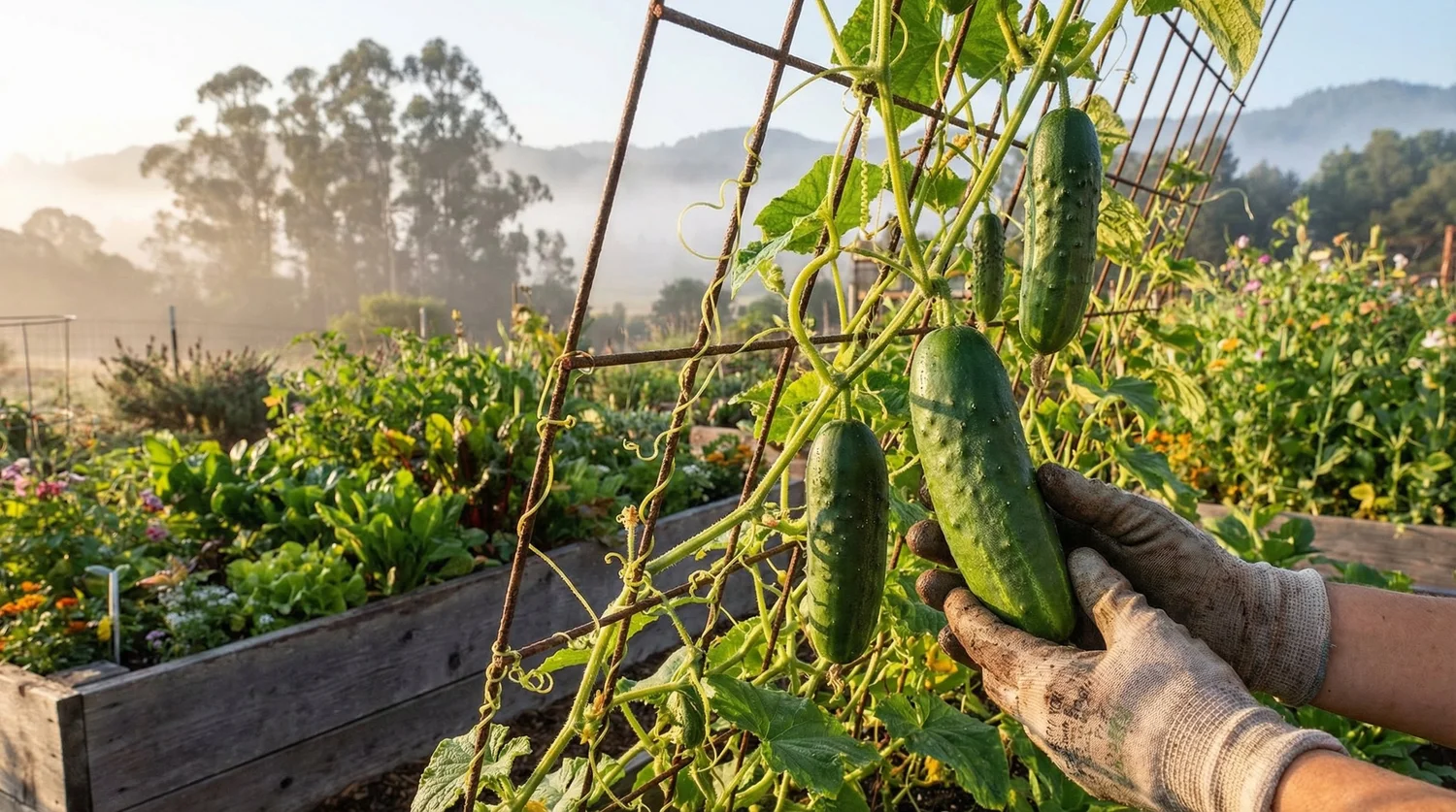
Trellis options. A simple A-frame trellis made from two cattle panels leaned together works excellently for cucumbers. String trellises (vertical twine strung from an overhead horizontal support) are common in market gardens and work well for home use. A section of welded wire fencing attached to sturdy posts is another effective option. Whatever design you choose, make it at least 5 to 6 feet tall for vining varieties. Cucumbers climb using tendrils and will attach to most support structures without training.
How Do You Handle Pollination Challenges in Foggy Weather?
Pollination is the most commonly cited challenge for cucumber growers in coastal Santa Cruz County, and it is a legitimate concern. Standard (monoecious) cucumbers produce separate male and female flowers on the same plant and require insect pollination to set fruit. When fog suppresses bee activity, pollination rates drop.
Understanding the problem. Cucumber flowers open in the morning and are receptive for only one day. If no pollinators visit a female flower during its single day of receptivity, the tiny fruit at its base withers and drops. During extended foggy periods, this can result in repeated failed fruit set despite healthy, vigorous vines. Gardeners see plenty of flowers but no cucumbers, which is understandably frustrating.
Parthenocarpic varieties solve the problem. As mentioned above, parthenocarpic cucumber varieties produce fruit without pollination. If poor pollination has been a persistent problem in your garden, switching to parthenocarpic varieties eliminates the issue entirely. This is the simplest and most reliable solution for coastal gardens.
Hand pollination. For standard varieties, hand pollination is straightforward and effective. In the morning, when flowers are fully open, identify a male flower (on a plain stem with no fruit at the base) and a female flower (with a small cucumber-shaped swelling at its base). Remove the male flower, peel back its petals, and dab the pollen-covered center directly onto the stigma in the center of the female flower. Alternatively, use a small paintbrush to transfer pollen. Each female flower needs only one pollination event to set fruit.
Attracting pollinators. Plant flowering herbs and flowers near your cucumber bed to attract and retain pollinators. Borage, sweet alyssum, and lavender are particularly effective at drawing bees. Avoid using any insecticides, even organic ones, during cucumber flowering. Our native bumble bees and other wild pollinators are generally more active in cool, foggy conditions than European honeybees, so supporting native pollinator populations is especially valuable for coastal gardeners.
What Are the Most Common Cucumber Problems in Santa Cruz County?
Cucumbers face specific challenges in our climate that differ from the problems described in most general gardening resources.
Powdery mildew. This is the most destructive disease on cucumbers in Santa Cruz County. White, powdery patches appear on leaves, eventually killing them and reducing the plant's ability to produce and ripen fruit. Choose resistant varieties, trellis for air circulation, and apply preventive potassium bicarbonate sprays starting when the first flowers appear. Once mildew is established, it cannot be eliminated, only slowed.
Cool weather stunting. Cucumbers grown in temperatures consistently below 60 degrees grow slowly, produce poorly, and are susceptible to root diseases. If your garden tends to be cool, use black plastic mulch or landscape fabric to warm the soil, plant in raised beds, and consider row cover tunnels that create a warmer microenvironment. Remove row cover when flowers appear so pollinators can access them, unless you are growing parthenocarpic varieties.
Bitter fruit. Bitterness in cucumbers is caused by the compound cucurbitacin, which increases under stress conditions: irregular watering, extreme temperatures, and overmature fruit. The solution is consistent watering, harvest at the proper size (before yellowing begins), and growing bitter-free varieties. Most modern hybrid slicers have been bred with very low cucurbitacin levels. 'Marketmore 76' and parthenocarpic varieties like 'Corinto' rarely produce bitter fruit.
Misshapen fruit. Crooked, bulging, or pinched cucumbers usually indicate pollination problems (partial pollination), water stress, or nutrient deficiency. Ensure consistent watering, adequate fertilization, and good pollination (or use parthenocarpic varieties) to produce straight, uniform fruits.
Cucumber beetles. These small spotted or striped beetles chew on leaves and flowers and can transmit bacterial wilt disease. Monitor for beetles and use row cover on young plants. Hand-pick beetles in the morning when they are sluggish. Kaolin clay spray (Surround) applied to foliage creates a physical barrier that deters feeding. Cucumber beetle pressure in Santa Cruz County is moderate compared to warmer regions but worth monitoring.
How Do You Maximize Cucumber Production Through the Season?
Getting the most from your cucumber plants requires attention to watering, feeding, and harvesting throughout the growing season.
Consistent watering is non-negotiable. Cucumbers are roughly 95 percent water, and they need a steady supply to produce crisp, mild-flavored fruit. Provide 1 to 2 inches of water per week through drip irrigation or soaker hoses. Water stress at any point during fruit development results in bitter, misshapen, or stunted cucumbers. Mulch around plants with straw or compost to maintain even soil moisture.
Fertilize regularly. Cucumbers are moderate to heavy feeders. Work compost and balanced organic fertilizer into the soil before planting. Side-dress with additional fertilizer when vines begin to run and again when the first fruits are set. A liquid organic fertilizer (fish emulsion or kelp) applied every 2 weeks during peak production keeps plants vigorous and productive. Yellowing older leaves often indicate nitrogen deficiency.
Harvest early and often. Pick slicing cucumbers at 6 to 8 inches and pickling types at 2 to 4 inches. Check plants every day or two during peak production, as cucumbers grow remarkably fast in warm weather. Leaving overripe cucumbers on the vine signals the plant to slow flower and fruit production. Consistent harvesting keeps the plant focused on producing new flowers and fruits.
Extend the season. In Santa Cruz County, cucumber production typically winds down in September or October as temperatures cool and powdery mildew takes hold. To squeeze out extra weeks of harvest, make a second planting of a fast-maturing variety in mid-June. This succession planting comes into production in August, when your first planting may be declining, and carries production into early fall with fresh, vigorous plants.
How Do Cucumbers Fit Into a Squash Family Garden Plan?
Cucumbers share the cucurbit family with squash, melons, and pumpkins. Growing them together requires some planning to manage shared diseases and space.
Shared disease challenges. Cucumbers and zucchini are both susceptible to powdery mildew, and the disease can spread between them. Space cucumber and squash plantings as far apart as practical and choose disease-resistant varieties of both. Trellising cucumbers while growing squash on the ground helps because the two crops occupy different vertical planes with different airflow patterns.
Cross-pollination myths. Cucumbers cannot cross-pollinate with squash or pumpkins. They are different genera entirely (Cucumis versus Cucurbita). You can grow cucumbers, zucchini, butternut squash, and pumpkins in the same garden without any cross-pollination effects on fruit quality. This is a common misconception that limits many gardeners unnecessarily.
Rotation. Do not plant cucumbers where any cucurbit grew the previous year. Rotate with non-cucurbit crops like tomatoes, beans, or brassicas to break disease cycles. A 3-year rotation is ideal, meaning any given bed grows cucurbits only one year out of every three.
For a closer look at what happens between sowing and picking, our cucumber growth stages guide breaks down the whole cycle.
Frequently Asked Questions
Why are my cucumber plants flowering but not producing fruit?
The most common cause in Santa Cruz County is poor pollination due to limited bee activity during foggy or cool weather. Standard cucumber varieties need insect pollination to set fruit. Try hand-pollinating female flowers (the ones with tiny cucumbers at the base) using pollen from male flowers. For a permanent solution, switch to parthenocarpic varieties that produce fruit without pollination. Also note that male flowers appear first and naturally fall off. Wait for female flowers to appear before worrying.
Can cucumbers grow in partial shade?
Cucumbers need at least 6 hours of direct sun, and 8 hours is better, especially in our cool climate. Partial shade reduces fruit production, slows growth, and increases disease susceptibility. If your garden gets less than 6 hours of sun, cucumbers will struggle. In this situation, grow cucumbers in containers that you can position in the sunniest spot, or focus on shade-tolerant crops and buy your cucumbers at the farmers market.
How many cucumber plants does a family need?
Two to three healthy, well-managed cucumber plants produce enough cucumbers for most families to eat fresh. If you want to make pickles, plan for 5 to 6 plants of a pickling variety. A single vigorous cucumber vine can produce 10 to 20 pounds of fruit over the season. Better to start with fewer plants and manage them well than to plant too many and struggle to keep up with watering and harvesting.
What causes the white powdery coating on my cucumber leaves?
That is powdery mildew, the most common cucumber disease in Santa Cruz County. It thrives in our conditions of warm days, cool nights, and moderate humidity. Choose resistant varieties, trellis for air circulation, avoid overhead watering, and apply preventive fungicide sprays if needed. Severely affected leaves can be removed to slow the spread, but the disease will eventually progress as the season continues. Succession planting with fresh plants is the best long-term strategy.
Should I remove the first flowers from my cucumber plant?
Some gardeners pinch off the first few female flowers to encourage the plant to develop a stronger root system and vine before directing energy into fruit production. This can improve overall season-long production, especially in our cooler climate where early-season growth is slower. If your plant is vigorous and growing well, removing the first 2 to 3 female flowers is a reasonable practice. If the plant seems to be struggling, let it fruit when it is ready.
Can I grow cucumbers in a container?
Yes, with the right setup. Use a container at least 5 gallons in size (larger is better) with drainage holes. Bush varieties like 'Spacemaster' or 'Patio Snacker' are bred for container growing. Provide a small trellis for the vine to climb. Container cucumbers need daily watering in warm weather and regular fertilization. Position the container in the warmest, sunniest spot available, ideally against a south-facing wall for reflected heat.
Are there any cucumber varieties that handle cold weather better than others?
Armenian cucumbers (which are technically a type of melon) are among the most cold-tolerant "cucumbers" you can grow. Asian varieties like 'Suyo Long' also tolerate cooler conditions better than standard American slicers. Parthenocarpic varieties do not need warmth for pollination, giving them a functional advantage in cool weather even if their growth rate slows. For the coldest coastal microclimates, consider growing cucumbers under a hoop tunnel with row cover for the first month to boost warmth.
When is it too late to plant cucumbers in Santa Cruz County?
Mid-July is the practical cutoff for planting cucumbers in most Santa Cruz County gardens. Plants started after mid-July will not have enough warm days to reach full production before temperatures cool in fall. For the latest possible planting, choose the fastest-maturing variety available (50 to 55 days to harvest) and start with transplants rather than direct-sown seeds to save 2 to 3 weeks. Inland gardens with warmer fall conditions have slightly more flexibility than coastal locations.
Enjoy Crisp Cucumbers All Summer
Growing cucumbers in Santa Cruz County takes a bit more strategy than in warmer climates, but the reward is worth the effort. Choose parthenocarpic or short-season varieties, plant in the warmest microclimate your garden offers, trellis for air circulation and warmth, and harvest frequently. With these adjustments, you will enjoy a steady supply of crisp, homegrown cucumbers from midsummer into fall.
Need help planning your complete vegetable garden? Visit Your Garden Toolkit for planting calendars, variety guides, and growing resources tailored to Santa Cruz County conditions.
