

Growing Meyer Lemons in the San Lorenzo Valley
A few of the product links in this guide are affiliate links. If you buy through one, Ambitious Harvest may earn a small commission at no extra cost to you, which helps keep these guides free. We only point to gear we would use in our own Santa Cruz garden. As an Amazon Associate, we earn from qualifying purchases. Read our full disclosure.
Short answer first: the San Lorenzo Valley is a poor fit for citrus in the ground. Redwood shade, acidic soil, and cold-air frost pockets all work against a Meyer lemon. There is a real workaround, but it is a container on a sunny ridge, not a tree in the canyon.
Quick verdict: Difficult in the ground, possible in a pot. The valley floor and shaded canyons of Felton, Ben Lomond, and Boulder Creek give citrus too little sun, too much cold, and the wrong soil. If you want a Meyer here, grow a dwarf tree in a container on your sunniest ridge or south wall, and move or protect it through winter. Plant it in the ground in a canyon and you are likely to be disappointed.
This page covers a hard microclimate. For the county-wide picture of which citrus suits where, see the hub, best citrus varieties for Santa Cruz microclimates.
Why the SLV fights citrus
Three things in the San Lorenzo Valley line up against a Meyer lemon, and they are worth naming plainly. First, shade. Much of the valley sits under tall redwoods and on steep canyon walls that block direct sun for large parts of the day, and citrus needs full sun to ripen fruit at all. Second, soil. Redwood duff and the forest floor can push the native soil strongly acidic and often poorly drained, below the slightly acidic, free-draining range citrus prefers. Third, cold. The canyons are textbook cold-air drainage channels; on a clear winter night the cold air slides downhill and pools on the valley floor, dropping well below what the coast or the Banana Belt ever see. A Meyer lemon can shrug off a light coastal frost, but repeated hard freezes in a canyon bottom will damage or kill an in-ground tree. None of this is fixable by trying harder in the wrong spot, which is why this guide leads with the workaround rather than pretending the canyon floor will work.
The real workaround: a dwarf tree in a pot
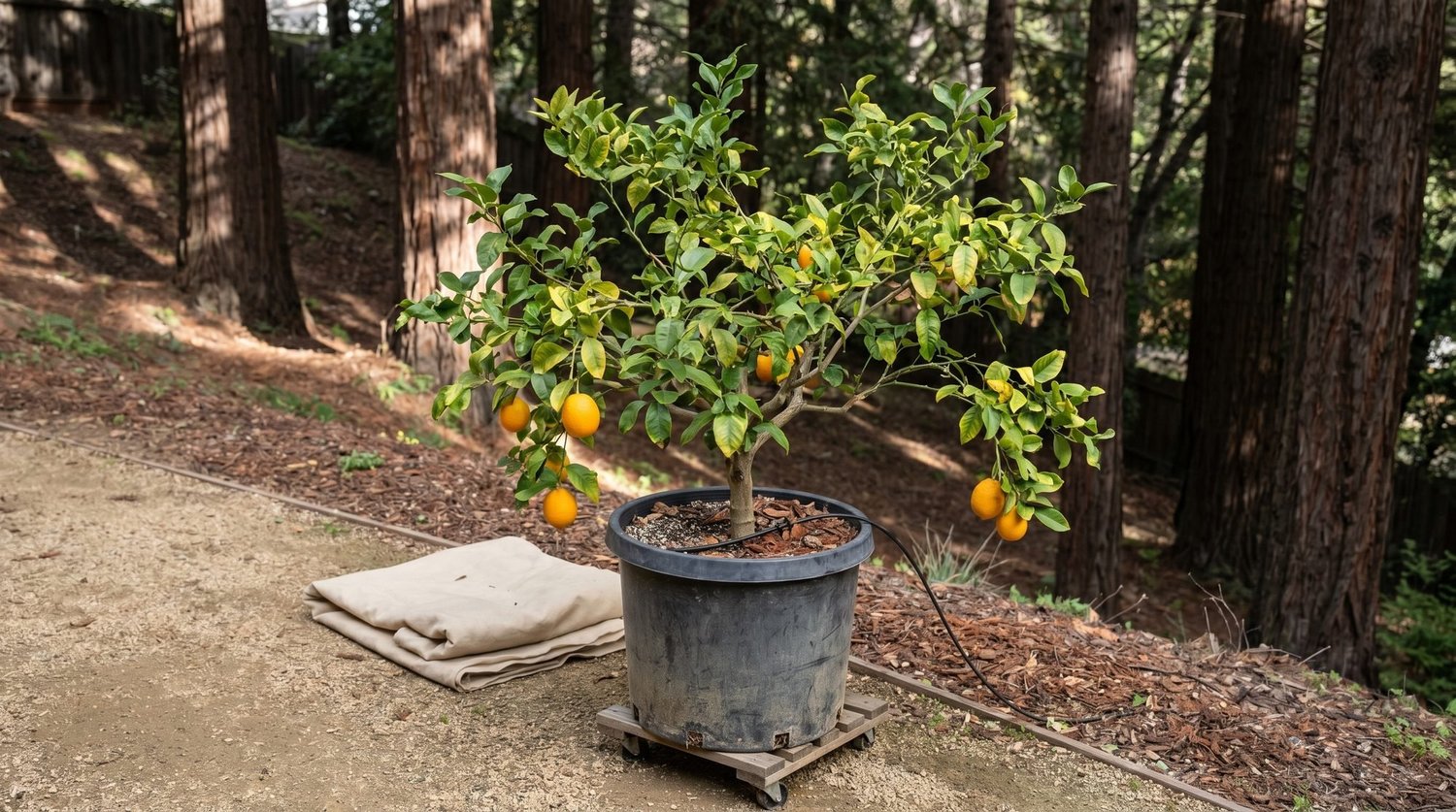
A container solves all three problems at once. It lets you set the tree wherever the most sun lands, it gives you full control of soil and drainage, and it makes the tree movable when frost threatens. A dwarf Meyer stays small enough to wheel into a garage, a covered porch, or against the warm side of the house on the coldest nights. This is not a compromise so much as the right tool for a hard microclimate.
Finding your sunniest, warmest spot
The SLV is not uniform. Our companion guide, gardening the San Lorenzo Valley, sunny ridges versus shaded canyons, makes the key point: a south-facing ridge or an open clearing behaves completely differently from a shaded canyon floor a hundred feet below. A ridge gets real sun and sheds cold air downhill, while the canyon bottom is dark and frost-prone. If you have a ridge, a hilltop clearing, or a sunny south wall, that is where your potted Meyer belongs. If your whole property is deep in redwood shade in a canyon, accept that citrus is not your crop and look at the shade-tolerant edibles in our guide to vegetables that thrive in redwood shade instead.
Caring for a potted Meyer in the SLV
Sun: Give it every hour you can. A potted tree should sit in the brightest, longest-sun spot on the property, and you can rotate or relocate it as the sun angle shifts through the year.
Water: Containers dry faster than ground, but SLV air is cool and often damp under the trees, so check before you water. Let the top inches dry, then soak until it drains from the bottom. Never leave the pot in a saucer of standing water.
Cold: This is the make-or-break factor. Watch the forecast through winter and act before it freezes. Move the pot to shelter, or wrap it with frost cloth and string lights, whenever a clear cold night threatens to drop into the high twenties.
What to expect
- Smaller yields and slower ripening than a Banana Belt or even fog belt tree, because total sun is limited.
- A real chance of cold damage in any winter you forget to protect the tree.
- Good fruit nonetheless if you nail the sun and the frost protection, just less of it.
- A high-maintenance plant compared with nearly anywhere else in the county. Going in with that expectation is the way to enjoy it.
Common problems in the SLV
- Frost damage on the valley floor: the number-one killer here. Keep the tree potted and movable, and protect it on cold nights.
- Few or no fruit: usually too much shade. Move the pot to the sunniest spot you have, even if that means a ridge or driveway edge.
- Yellowing and poor growth in ground soil: acidic, poorly drained native soil locks up nutrients. This is exactly why the container with citrus mix is recommended.
- Root rot from cool damp conditions: overwatering in shade. Check soil before watering and ensure the pot drains freely.
Local tip: Do not try to make the canyon floor grow citrus. Put a dwarf Meyer in a large pot of fast-draining mix, set it on your sunniest ridge or against a south wall, and commit to moving or covering it on freezing nights. If your land has no sunny spot at all, this is one crop worth letting go of, and your shaded ground will do far better with redwood-tolerant edibles instead.
Frequently asked questions
Can I grow a Meyer lemon in the ground in Boulder Creek or Felton?
In most spots, no. Canyon shade, acidic soil, and cold-air frost pockets make in-ground citrus a poor bet on the valley floor. A potted dwarf on a sunny ridge is the workable route.
My SLV property is all redwood shade. What now?
If you have no sunny ridge, clearing, or south wall, citrus is probably not your crop. Put your effort into shade-tolerant edibles instead; our redwood-shade vegetable guide is the better starting point.
How cold does it really get in the canyons?
Cold air drains downhill and pools on the valley floor on clear nights, dropping well below coastal lows and into the range that damages citrus. That is why a movable potted tree, not an in-ground one, is the safe choice.
Is it worth the trouble at all?
If you love Meyer lemons and have a sunny spot, yes, with realistic expectations: smaller yields, slower ripening, and winter protection every year. If that sounds like too much, it is a fair crop to skip in this microclimate.
