

Are Organic Pesticides Always Safe to Use?
The word “organic” can make a bottle seem reassuring. It still needs a careful read. Suitability for organic gardening does not mean a pesticide is harmless to people, plants, pollinators or other wildlife. Choose a response to the pest you have, then assess the exact product and its permitted use.
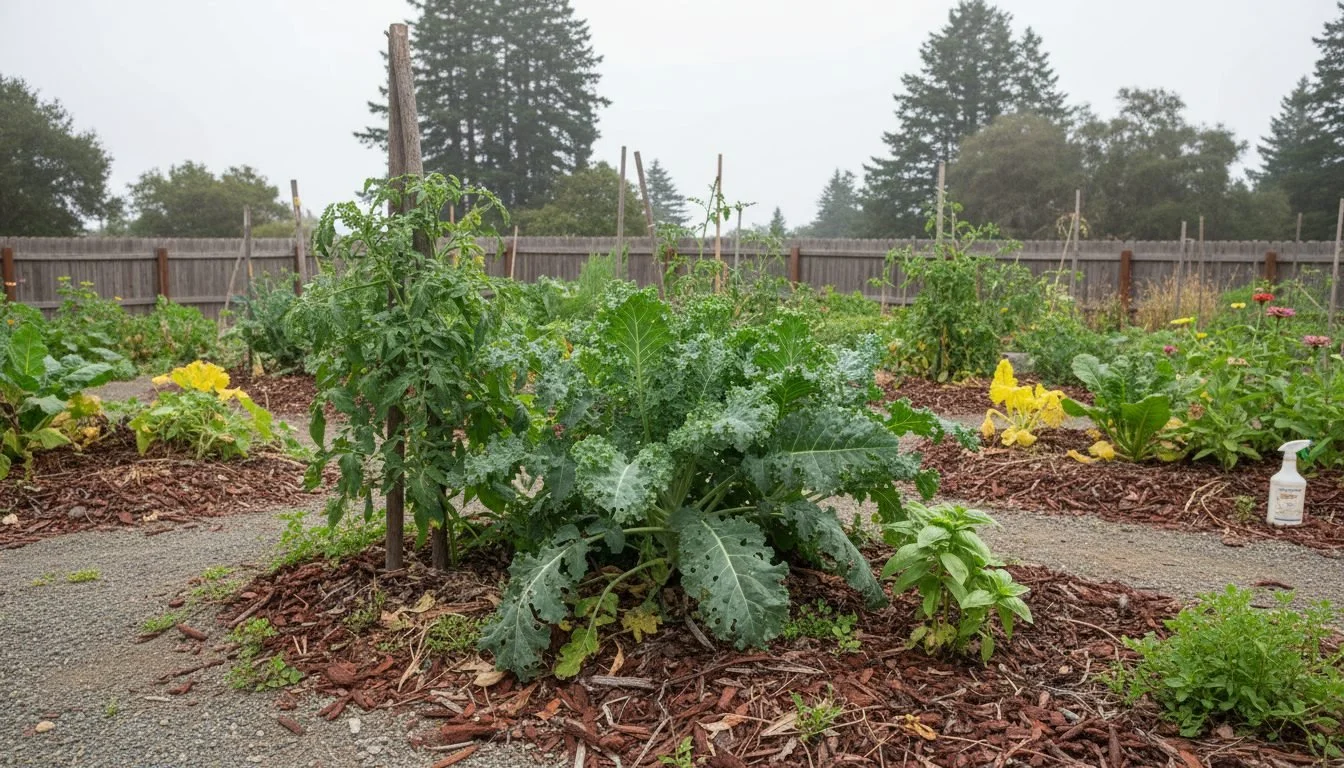
That approach leaves room for useful tools without making every damaged leaf a reason to spray. In a Santa Cruz vegetable bed, watching the new growth and identifying the feeder can be more informative than choosing a bottle by the wording on the front.
What the organic wording tells you
EPA’s explanation of organic-use labeling connects terms such as “For Organic Gardening” with National Organic Program standards. It distinguishes that information from pesticide safety information. The designation is not a replacement for the directions and precautions elsewhere on the package.
Nor does “organic” simply mean that every ingredient is natural. Organic production standards address which substances and uses are permitted. An OMRI Listed seal concerns a product's suitability under organic standards; it does not give permission to use any amount on any plant.
Identify the problem before choosing a treatment
Look for the insect or other cause, not just its damage. Is a leaf being eaten now, or are you looking at old holes? Are there natural enemies nearby? Is the plant continuing to grow?
UC IPM recommends identifying pests and choosing methods compatible with natural enemies and pollinators. Depending on the problem, monitoring, changes in plant care or a suitable physical control may be enough. A cover or hand-picking is useful only when it fits the crop and pest; there is no single treatment sequence for every garden problem.
If a pesticide is needed, compare options for that situation. “Organic” and “synthetic” are not reliable stand-ins for a comparison of formulation, exposure and restrictions.
Read the whole label before opening the product
EPA says pesticide labels define permitted uses and precautions. Find the plant or site restrictions, application rate, interval and method. Check the required protective equipment, environmental directions and when people or pets may return. For food crops, check that use is allowed and follow any harvest restrictions.
Use the exact product directions, including whether it is ready to use or requires mixing. Do not transfer a rate from another formulation with a similar name. California's DPR product and label database is a place to check registration information.
Keep the product in its original labeled container. If you cannot read the instructions, resolve that before applying it. Guessing is especially unhelpful when a small amount of concentrate and a much larger amount of ready-to-use spray can look similar.
Why spinosad needs more than an evening rule
UC IPM’s lawn-insect guidance describes spinosad as naturally derived but warns of effects on bees and some beneficial insects for several days after application. That is a reason to examine the particular label and use, not to assume every spinosad product has identical exposure or timing instructions.
A cool evening does not cancel a restriction on flowering plants, drift or pollinator exposure. Consider nearby flowers and where spray might travel as well as the plant you intend to treat. Follow the current label even if an older gardening tip gives a simpler rule.
This week: choose one product already on your shelf and find its permitted uses, environmental precautions and storage directions. Make a note of anything you need to clarify before using it again.
Common questions about organic pesticides
Does organic mean safe for children and pets?
No blanket assurance follows from that word. The product’s precautions govern handling, exposure and return to treated areas. Store it as directed and out of unintended reach.
Is spinosad safe for bees once the sun goes down?
Time of day alone is not an answer. Read UC’s caution about spinosad and follow the exact product's pollinator and application restrictions.
Are all natural-source pesticides equally risky?
No. The organism exposed, amount, formulation and application all matter. Compare products for the identified problem rather than assigning a single rating to the whole category.
How can I make a better treatment decision?
Identify the problem, decide whether intervention is needed, and consult crop-specific guidance. If using a pesticide, follow all label directions, not just the rate printed on the front.
Keep your garden notes with resources from Your Garden Toolkit.
