

Keyhole Gardening: Combining Composting and Gardening in One Bed
What Is Keyhole Gardening and Why Is It Ideal for Santa Cruz County?
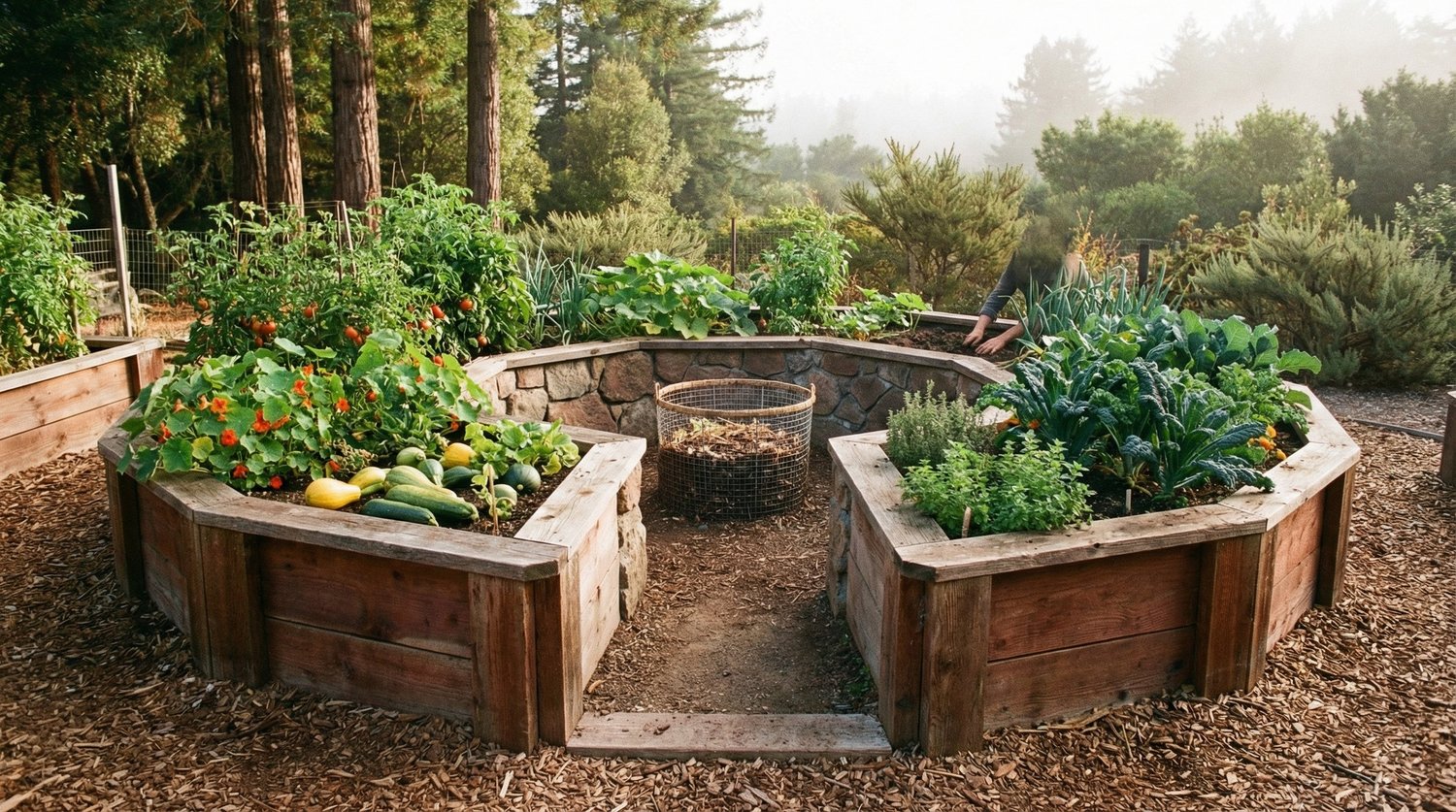
Keyhole gardening is a raised bed design that combines active composting with vegetable growing in a single, circular structure. Developed by humanitarian organizations for water-scarce regions, keyhole beds feature a central compost basket that continuously feeds nutrients to surrounding planting areas. UC research on integrated composting systems shows that beds with in-place composting can reduce fertilizer inputs by 50 to 70 percent while improving soil water retention. In Santa Cruz County, where water conservation matters and many gardeners want to simplify their growing systems, keyhole beds offer a remarkably efficient all-in-one solution.
The design is straightforward: a circular raised bed, typically 6 feet in diameter, with a pie-slice-shaped notch (the "keyhole") cut from one edge to the center. A wire mesh or slotted basket sits at the center, and you fill it with kitchen scraps, garden trimmings, and other compostable materials. As these materials break down, nutrients and moisture seep outward into the surrounding soil, creating a self-fertilizing growing environment. This guide covers how to build, plant, and maintain a keyhole garden suited to our Central Coast conditions.
How Does the Compost Basket Actually Work?
The central compost basket is what makes a keyhole garden different from any other raised bed. Understanding how it functions helps you get the most from this system.
The basket is essentially a vertical composting column placed at the heart of your growing bed. It is typically made from wire mesh, hardware cloth, or a perforated PVC pipe, standing about 3 to 4 feet tall and 12 to 18 inches in diameter. You add kitchen scraps, coffee grounds, crushed eggshells, garden trimmings, and other organic material directly into this basket throughout the growing season.
As the materials decompose, two things happen. First, nutrient-rich liquid (compost tea, essentially) percolates outward through the basket walls and into the surrounding bed soil whenever you add water to the basket. Second, earthworms and other soil organisms migrate between the basket and the bed, distributing decomposed organic matter and improving soil structure throughout the growing area.
This creates a continuous, slow-release fertilization system. Unlike conventional composting, where you build a pile, wait for it to finish, and then apply the compost, a keyhole garden delivers nutrients in real time as materials break down. The result is a steady supply of nutrition that keeps plants fed without the boom-and-bust cycle of periodic fertilizer applications.
In Santa Cruz County's mild climate, decomposition happens year-round. Even during our cooler winter months, temperatures rarely drop low enough to halt microbial activity in the compost basket. This means your keyhole garden self-fertilizes in every season, supporting the year-round growing that our climate makes possible.
The basket also functions as a watering well. When you pour water into the compost basket, it distributes outward through the bed, delivering moisture directly to the root zone. This is more efficient than surface watering, which loses water to evaporation. During our dry summers, directing water into the basket rather than over the soil surface can reduce water use by 20 to 30 percent compared to conventional raised bed watering.
How Do You Build a Keyhole Garden Bed?
Building a keyhole garden is a satisfying weekend project that requires no specialized skills. The materials are readily available in Santa Cruz County, and the construction is forgiving. It does not need to be perfect to work well.
Choose your location. Keyhole beds perform best in a spot that receives at least six hours of direct sunlight. In Santa Cruz, a south-facing location protects the bed from north winds and maximizes sun exposure. The bed should be on relatively level ground and close enough to your kitchen that you will actually walk out and add scraps to the compost basket regularly. Convenience is critical because the system only works if you keep feeding it.
Mark your circle. Drive a stake at the center of your planned bed. Tie a 3-foot length of string to the stake and use it as a compass to mark a 6-foot-diameter circle on the ground. Then mark the keyhole notch: a wedge-shaped path about 2 feet wide leading from the circle's edge to the center.
Build the walls. The outer wall of a keyhole bed can be made from many materials:
- Stacked stone or broken concrete (urbanite): Free or inexpensive, attractive, and durable. Santa Cruz has many sources of salvaged stone and concrete through local reuse groups and construction sites.
- Corrugated metal roofing: Curves easily into a circle, lasts for years, and gives a clean modern look. Available at hardware stores.
- Untreated lumber: Redwood or cedar boards bent or cut to form the circle. More expensive but attractive and long-lasting in our climate.
- Cinder blocks or bricks: Sturdy and widely available. Stack them without mortar for easy adjustment.
- Woven branches or bamboo: A natural-looking option using materials you may already have on your property. Bamboo is abundant in Santa Cruz County.
Build the wall 2 to 3 feet high. It does not need to be uniform or perfectly round. The raised height makes the bed accessible for gardeners who have difficulty bending, which is one of the design's original benefits.
Install the compost basket. Form a cylinder from hardware cloth or welded wire mesh (half-inch openings work well). Make it about 12 to 18 inches in diameter and tall enough to extend 6 to 12 inches above the top of the finished bed. Place it at the center of the circle. Some builders line the bottom few inches of the basket with burlap or landscape fabric to slow drainage and keep the composting materials contained while still allowing liquid to seep out.
Fill the bed in layers. This is where keyhole gardening overlaps with lasagna gardening principles:
- Bottom layer (6 to 8 inches): Coarse materials like small branches, twigs, wood chips, and dried corn stalks. These create air pockets for drainage and break down slowly over time, contributing long-term organic matter.
- Middle layer (4 to 6 inches): Dried leaves, straw, cardboard, or newspaper. These carbon-rich materials help balance the nitrogen from the compost basket.
- Top layer (8 to 12 inches): A blend of quality garden soil and finished compost. This is your planting layer.
Water each layer as you build to settle the materials and kickstart decomposition. The bed will settle over time, so fill it slightly higher than you think you need.
What Should You Plant in a Keyhole Garden?
A keyhole garden creates distinct growing zones based on proximity to the compost basket. Understanding these zones helps you place crops where they will perform best.
The inner ring (within 12 inches of the basket) receives the most nutrients and moisture. This is prime real estate for heavy feeders like tomatoes, peppers, squash, and cucumbers. These crops benefit from the continuous nutrient supply and consistent moisture that seep from the basket. In Santa Cruz County, a single tomato plant in the inner ring of a well-maintained keyhole bed can be remarkably productive because it never lacks for nutrition.
The middle ring receives moderate nutrients and is ideal for crops with average feeding needs. Lettuce, chard, kale, beans, and most herbs do well here. The nutrient levels are sufficient for strong growth without the excess nitrogen that can make leafy greens taste bitter or cause legumes to produce leaves instead of pods.
The outer ring receives the least direct nutrition from the basket and tends to be slightly drier. Root vegetables like carrots, beets, and radishes perform well here because they do not need heavy feeding and actually produce better roots in less-rich soil. Herbs that prefer lean conditions, such as rosemary, thyme, and oregano, also thrive on the outer edge.
A well-planted keyhole garden in Santa Cruz County might include two tomato plants and a pepper near the basket, surrounded by a ring of lettuce, chard, and basil, with root vegetables and Mediterranean herbs around the outer edge. This arrangement mirrors natural plant communities where nutrient levels decrease with distance from the source.
Seasonal rotation works well in keyhole beds. Plant warm-season crops (tomatoes, peppers, squash) in the inner ring from spring through fall. When they finish, replace them with cool-season crops (broccoli, cauliflower, cabbage) that also appreciate rich soil. The outer ring can support cool-season root vegetables and greens through our mild winters.
How Do You Maintain the Compost Basket?
The compost basket requires regular attention, but the work is minimal compared to maintaining a separate compost pile and garden bed independently.
Feed the basket regularly. Add kitchen scraps (fruit and vegetable peels, coffee grounds, tea bags, crushed eggshells) every few days. Alternate with dry materials like shredded paper, dry leaves, or straw to maintain a balance of nitrogen-rich and carbon-rich inputs. Avoid adding meat, dairy, oils, or pet waste, which can attract rodents and create odor problems.
Add water to the basket whenever you water the bed. Pour a gallon or two directly into the compost basket. This moisture accelerates decomposition and carries dissolved nutrients outward into the bed soil. In our dry summers, this dual-purpose watering is especially efficient because it hydrates both the compost and the growing area simultaneously.
The basket contents will settle as materials decompose. This is normal and desirable. It means the system is working. Simply keep adding fresh materials to replace what has broken down. Over the course of a growing season, you may add hundreds of pounds of kitchen scraps and garden waste to the basket, all of which converts to plant food.
Once or twice a year, partially empty the basket and spread the finished compost from the bottom onto the bed surface as a top dressing. This redistributes the concentrated nutrients and makes room for fresh materials. Late fall is a good time for this in Santa Cruz, as the finished compost serves as a winter mulch and soil amendment.
Pest management around the basket: The compost basket can attract fruit flies in warm weather. A layer of dry straw or shredded paper on top of fresh scraps helps suppress them. In Santa Cruz County, raccoons and rodents may investigate the basket. A fitted lid made from hardware cloth, heavy enough that animals cannot lift it, prevents problems while still allowing rain to enter.
How Does Keyhole Gardening Conserve Water?
Water efficiency is one of the keyhole garden's strongest advantages, and it is especially relevant in Santa Cruz County, where dry summers and occasional drought restrictions make every gallon count.
The raised bed design prevents water from running off across flat ground. Water stays within the walls and soaks downward into the root zone. The layers of organic material in the bed act like a sponge, absorbing and holding moisture far more effectively than mineral soil alone.
Watering through the compost basket delivers moisture below the soil surface, where roots can access it. Surface evaporation, which can account for 30 to 50 percent of water loss in conventional gardens, is dramatically reduced when water enters from the center of the bed rather than being sprinkled across the top.
The decomposing organic matter in both the basket and the bed layers continuously improves the soil's water-holding capacity. As organic materials break down, they create humus, a spongy substance that holds many times its weight in water. Over several seasons, a keyhole bed develops soil that stays moist longer between waterings than any conventional raised bed.
Mulching the bed surface further reduces water loss. A 2- to 3-inch layer of straw, wood chips, or dried leaves over the planting area keeps the top layer of soil cool and moist. Combined with basket watering, mulching can cut your water use by 40 to 60 percent compared to an unmulched, surface-watered garden of similar size.
UC research on water-efficient garden designs consistently highlights raised beds with organic matter as a top strategy for reducing irrigation needs in Mediterranean climates like ours. The keyhole garden takes this principle to its logical conclusion by building the organic matter source directly into the bed.
What Are the Advantages and Drawbacks of Keyhole Gardens?
Like any garden design, keyhole beds have both strengths and limitations. Understanding both helps you decide whether this approach fits your situation.
Advantages:
- Combines composting and growing in one system, saving space and time
- Self-fertilizing design reduces or eliminates the need for purchased fertilizer
- Excellent water efficiency through subsurface moisture delivery
- Raised height (2 to 3 feet) makes gardening accessible for people with mobility limitations
- Circular design is space-efficient, with no wasted corners
- Year-round composting in Santa Cruz County's mild climate keeps the system active in every season
- Built from inexpensive or salvaged materials
- Attractive and unique garden feature that generates conversation
Drawbacks:
- The circular shape does not fit efficiently into rectangular yards or alongside straight fences
- Building the initial structure requires more effort than setting up a simple rectangular raised bed
- The compost basket needs regular feeding to keep the system working
- The bed cannot be easily relocated once built
- Total growing area within a 6-foot circle is roughly 22 square feet (minus the basket and keyhole path), which is less than a 4-by-8-foot rectangular bed
- Nutrient distribution is uneven, with the inner ring receiving much more than the outer ring
For most Santa Cruz County gardeners, a keyhole bed works best as part of a mixed garden design rather than the sole growing area. One keyhole bed paired with a few rectangular raised beds or in-ground rows gives you the benefits of integrated composting alongside more conventional growing space.
How Do You Adapt Keyhole Gardening to Santa Cruz County Soils?
Santa Cruz County has diverse soils, from heavy coastal clay to sandy loam in the river valleys to the acidic soils of the redwood-covered mountains. The keyhole garden's raised bed design works with any soil type because you build above it rather than in it.
On heavy clay soils (common in the Westside and coastal areas), the coarse bottom layer of branches and wood chips creates drainage that prevents waterlogging. On sandy soils (found along the coast and river valley areas), the organic matter from continuous composting acts like a sponge, holding both moisture and nutrients. On mountain soils with high acidity from redwood needle decomposition, the keyhole bed creates a neutral growing environment above the acidic native soil when filled with quality garden soil and finished compost.
Regardless of your soil type, place a layer of cardboard at the base of the bed before filling it. This suppresses weeds and grass from growing up into the bed while allowing roots to eventually penetrate downward and earthworms to migrate upward. The cardboard breaks down within a season, by which time the bed soil has established its own ecosystem.
Frequently Asked Questions
How big should a keyhole garden be?
The standard keyhole garden is 6 feet in diameter, which allows you to reach the compost basket from any point along the outer wall without stepping into the bed. This size provides roughly 22 square feet of planting area. You can build smaller (4 feet) or larger (8 feet) beds, but keep in mind that larger diameters make it harder to reach the center. The 6-foot standard is a well-tested size that balances growing space with accessibility.
What materials can you put in the compost basket?
Add fruit and vegetable scraps, coffee grounds, tea bags, crushed eggshells, shredded paper, dry leaves, small garden trimmings, and straw. Avoid meat, dairy, oils, cooked food with sauces, and pet waste. Alternate nitrogen-rich materials (fresh scraps) with carbon-rich materials (dry leaves, shredded paper) to maintain a balanced decomposition process and minimize odors.
Does a keyhole garden smell bad?
A properly maintained keyhole garden should not produce noticeable odors. Foul smells indicate that the compost basket has too much nitrogen-rich material (food scraps) without enough carbon (dry leaves, paper, straw). Add more dry materials and mix gently. A layer of straw or shredded paper on top of fresh scraps also helps contain odors. Avoid adding meat or dairy, which are the main sources of unpleasant smells.
How long does a keyhole garden last?
The structure itself lasts for years, depending on the wall material. Stone, concrete, and metal walls are essentially permanent. Wooden walls made from cedar or redwood last 10 to 15 years. The wire mesh compost basket may need replacement every 5 to 7 years. The bed soil improves over time as long as you keep feeding the basket, so an older keyhole bed actually performs better than a new one.
Can you build a keyhole garden in a shady spot?
The composting function works in any light condition, but vegetable production requires sunlight. A keyhole bed in partial shade (four to six hours of sun) can grow leafy greens, herbs, and root vegetables successfully. For full sun crops like tomatoes and peppers, you need at least six hours of direct light. If your yard has mixed conditions, orient the keyhole notch toward the shadiest side so the main growing area faces the sun.
Is keyhole gardening the same as lasagna gardening?
They share the layering principle but differ in design and function. Lasagna gardening is a method of building soil through stacked layers of organic materials in any bed shape. Keyhole gardening uses a specific circular raised bed design with a central compost basket for ongoing nutrient delivery. You can use lasagna gardening methods to fill a keyhole bed, making the two approaches complementary rather than identical.
How much does it cost to build a keyhole garden?
Costs vary widely depending on wall materials. A keyhole garden built from salvaged urbanite (broken concrete), free pallets, or stacked fieldstone can cost under $50, mainly for the wire mesh basket and quality soil. Using new materials like corrugated metal, cedar lumber, and bagged potting mix, expect to spend $150 to $300. The ongoing cost is essentially zero because the compost basket provides free fertilizer from kitchen waste.
Do keyhole gardens attract rats or other pests?
The compost basket can attract rodents if it contains meat, dairy, or cooked food scraps. Stick to vegetable scraps, fruit peels, coffee grounds, and dry materials to minimize pest interest. A hardware cloth lid on the basket prevents animals from accessing the contents. In Santa Cruz County, where raccoons are common, a weighted or secured lid is a smart precaution. The composting process itself actually attracts beneficial organisms like earthworms that improve the entire bed.
Build a Keyhole Garden This Season
A keyhole garden is one of the most elegant solutions for gardeners who want to grow food efficiently while reducing waste, conserving water, and building incredible soil. The design works beautifully in Santa Cruz County's climate, where mild temperatures keep the composting process active year-round and the long growing season lets you harvest from the bed in every month.
For research-based guidance on keyhole gardens and composting systems, see UC Master Gardeners' Keyhole Gardening resource, Keyhole Garden for Worms, and UC's raised bed design guide.
Visit Your Garden Toolkit for bed planning templates, seasonal planting guides, and composting resources to help you design your keyhole garden.
