

Growing Under the Redwoods: Gardening in Shade and Acidic Soil
A few of the product links in this guide are affiliate links. If you buy through one, Ambitious Harvest may earn a small commission at no extra cost to you, which helps keep these guides free. We only point to gear we would use in our own Santa Cruz garden. As an Amazon Associate, we earn from Read our full disclosure.
Growing vegetables under redwood trees seems impossible at first. The deep shade, acidic soil, and moisture competition from massive trees don't exactly scream "vegetable garden."
But here's the truth: you can absolutely grow food under redwoods. You just need to completely rethink what "gardening" means.
Forget about tomatoes (unless you have a sunny clearing). Forget about melons and peppers. Instead, embrace the crops that thrive in cool, shaded, moist conditions, crops that bolt and struggle everywhere else in Santa Cruz County but flourish in your unique microclimate.
Under the redwoods, you're growing a different garden. Not a lesser garden. A different one.
What Makes the Redwood Understory Unique?
The Shade
Dappled to full shade depending on canopy density
2-6 hours of direct sun in most areas
Some spots get no direct sun
Seasonal variation (more light in winter when sun is lower)
Clearings and edges have more light
The Temperature
10-15°F cooler than sunny areas nearby year-round
Summer: 75-85°F when sunny areas hit 95-100°F
Winter: 40s-50s (cooler than sunny ridges)
Very stable temps (minimal day/night swings)
Frost possible in valleys but rare under dense canopy
The Soil
High organic matter (decomposing needles and duff)
Excellent structure and moisture retention
Rich, dark, spongy texture
Shallow roots from redwoods (competition)
The Moisture
Higher humidity than sunny areas
Soil stays moist longer
Less evaporation
Can be too moist in poorly drained spots
Other Characteristics
40-50 inches rainfall annually (plus fog drip)
Sheltered from wind
Cooler, calmer microclimate
Wildlife (deer, slugs, banana slugs)
| Sun category | Hours of direct sun | Good crops |
|---|---|---|
| Full sun | 6 to 8+ hours | Tomatoes, peppers, squash (only in clearings). |
| Part sun | 4 to 6 hours | Brassicas, peas, bush beans, carrots, beets, strawberries. |
| Part shade | 2 to 4 hours | Lettuce, arugula, spinach, chard, Asian greens, parsley, cilantro. |
| Full shade | 0 to 2 hours | Very limited; maybe mâche, miner’s lettuce, and a few shade-tolerant herbs. |
What Is Redwood Soil Like?
This is critical. Redwood soil is not normal soil.
pH is Low (Acidic)
Redwood needles create acidic decomposition
pH typically 5.5-6.5
Some crops tolerate it, others don't
| Soil pH | Typical redwood-area value | Best crops |
|---|---|---|
| 4.5 to 5.5 | Too acidic for most vegetables | Ideal for blueberries and huckleberries |
| 5.5 to 6.5 | Common under redwoods | Tolerant greens and herbs; many vegetables benefit from light liming |
| 6.0 to 7.0 | Target range for vegetables | Most vegetables, especially in raised beds or amended soil |
How to Raise pH
Add lime (calcium carbonate): test first, add gradually
Wood ash (potassium carbonate): use sparingly
Compost (helps buffer pH)
Re-test annually and adjust
Don't Fight It Entirely
Some crops (blueberries) love acidic soil
Others tolerate it fine
Raised beds with imported soil bypass the issue
The Good News About Redwood Soil
Incredible organic matter content
Excellent structure
Fantastic moisture retention
Rich in nutrients (once pH is addressed)
| Crop group | Under deep redwoods | In a 4 to 6-hour clearing |
|---|---|---|
| Lettuce and salad greens | Excellent; summer “superpower.” | Excellent. |
| Shade-tolerant herbs | Excellent (parsley, cilantro, mint, lemon balm). | Excellent. |
| Brassicas, peas, root crops | Usually too little light. | Good with 4 to 6 hours of sun. |
| Tomatoes, peppers, melons, corn | Not worth trying. | Possible only with 6 to 8 hours and careful variety choice. |
What Crops Thrive Under Redwoods?
Shade-Tolerant Greens (Your Specialty)
Lettuce
You have one of the best microclimates for summer lettuce in all of Santa Cruz County:
Grows when sunny areas can't (summer)
Succession plant spring through fall
All varieties work
Try: Buttercrunch, Red Sails, Tom Thumb, Merlot
Arugula
Loves cool, moist shade
Bolt-resistant in your conditions
Peppery, flavorful
Self-seeds readily
Try: standard arugula, Astro
Spinach
Thrives in cool shade
Slower to bolt than sunny areas
Spring and fall crops both excellent
Try: Space, Bloomsdale
Chard
Tolerates shade better than most crops
Year-round possible
Colorful and productive
Try: Bright Lights, Fordhook Giant
Asian Greens
Quick-growing
Cool-season specialists
Try: Joi Choi, Tatsoi, Red Kingdom mizuna
Mâche (Corn Salad)
Loves cool, moist shade
Winter crop
Delicate, nutty flavor
Try: Vit
Mustard Greens
Tolerates shade well
Spicy, flavorful
Try: Red Giant, Mizuna
Herbs for Shade
Parsley
Thrives in part shade
Biennial (2-year life)
Excellent production
Try: Italian Flat Leaf, Curled
Cilantro
Slower to bolt in shade
Cool, moist conditions ideal
Succession plant
Try: standard cilantro, Slow Bolt
Chervil
Loves shade and cool conditions
Delicate, anise flavor
Rare in most gardens because it needs these conditions
Try: standard chervil
Mint
Thrives in moist shade
Can be invasive (contain it)
Many varieties
Try: spearmint, peppermint
Lemon Balm
Tolerates shade
Spreads readily
Lemony flavor
Try: standard lemon balm
Crops That Work With 4-6 Hours Sun
If you have a clearing or edge area with 4-6 hours of direct sun:
Peas
Tolerate part shade
Cool season is your strength
Spring and fall crops
Try: Sugar Snap, Oregon Giant
Beans (Bush)
Some production possible with 4-6 hours sun
Won't be as productive as full sun
Try: Provider, Bush Blue Lake
Brassicas
Broccoli, cauliflower, kale, cabbage
Need 4-6 hours minimum
Your cool temps are perfect
Try: DiCicco broccoli, Lacinato kale
Root Vegetables
Carrots, beets, radishes
Slower growth but possible with some sun
Radishes fastest
Try: Scarlet Nantes carrot, Easter Egg radish
Strawberries
Tolerate part shade (4-6 hours)
Won't be as productive as full sun
Worth trying in sunnier spots
Try: Albion, Seascape
Shade-Loving Perennials and Natives
Blueberries
Need some sun (4-6 hours)
Excellent for redwood understory with clearings
Try: Bluecrop, Duke, Elliot
Huckleberries
Native understory berry
Loves shade and acidic soil
Forage or cultivate
Evergreen huckleberry (Vaccinium ovatum)
Salal
Native understory plant
Edible berries
Very shade-tolerant
Gaultheria shallon
Rhubarb
Tolerates part shade
Loves cool conditions
Perennial
Try: Victoria
Native Edibles
Miner's lettuce (Claytonia): native green
Wood sorrel: tart, lemony
Thimbleberry: native berry
Wild ginger: culinary use (sparingly)
What Crops Will Not Work Under Redwoods?
Unless you have a sunny clearing with 6-8 hours of direct sun:
Tomatoes: Need 6-8 hours minimum, love heat
Peppers: Need 6-8 hours, need heat
Eggplant: Need full sun and heat
Squash: Need full sun
Cucumbers: Need 6-8 hours sun
Melons: Need full sun and heat
Corn: Need full sun
Don't waste time on these. If you have a sunny clearing, plant them there. Otherwise, focus on what thrives.
What Are the Best Strategies for Redwood Gardens?
Map Your Light
This is the most important task:
Track sun exposure for potential garden areas:
Note hours of direct sun (not dappled)
Track at different times of year (summer vs. winter)
Identify your sunniest spots (4-6 hours is usable)
Note which spots get morning vs. afternoon sun
Find your clearings and edges
Light categories:
Full sun (6-8+ hours): Tomatoes, peppers possible
Part sun (4-6 hours): Brassicas, peas, beans, root vegetables
Part shade (2-4 hours): Lettuce, greens, herbs
Full shade (0-2 hours): Very limited options
Embrace Your Advantages
Summer lettuce: You can grow lettuce in July and August when nobody else can. This is a superpower. Lettuce bolts when temperatures exceed about 80°F, but your shade keeps temps in the 70s. Succession plant lettuce every 2-3 weeks from April through September.
Extended cool-season harvest: Your cool temps mean cool-season crops produce longer. Spring greens last 4-6 weeks longer than sunny areas. Fall greens start producing earlier.
No bolting: Crops that bolt instantly in sun (arugula, spinach, cilantro) are stable in your shade. This means longer harvests and better quality.
Stable temperatures: No 30-degree day/night swings. No 100°F heat waves. Predictable, steady growing conditions.
Manage Challenges
Acidic Soil:
Test pH annually
Add lime to raise pH to 6.0-7.0 for vegetables
Or use raised beds with imported soil
Or grow acid-loving crops (blueberries)
Competition from Redwoods:
Redwood roots are shallow and extensive
Raised beds bypass root competition
Or plant 10+ feet from trunk
Redwoods win any water competition
Too Much Moisture:
Some spots stay too wet
Add drainage if needed
Raised beds help
Choose well-drained spots
Limited Crop Options:
Accept you can't grow everything
Focus on your strengths (greens, shade-tolerant crops)
Use sunny clearings for sun-loving crops
Don't fight your microclimate
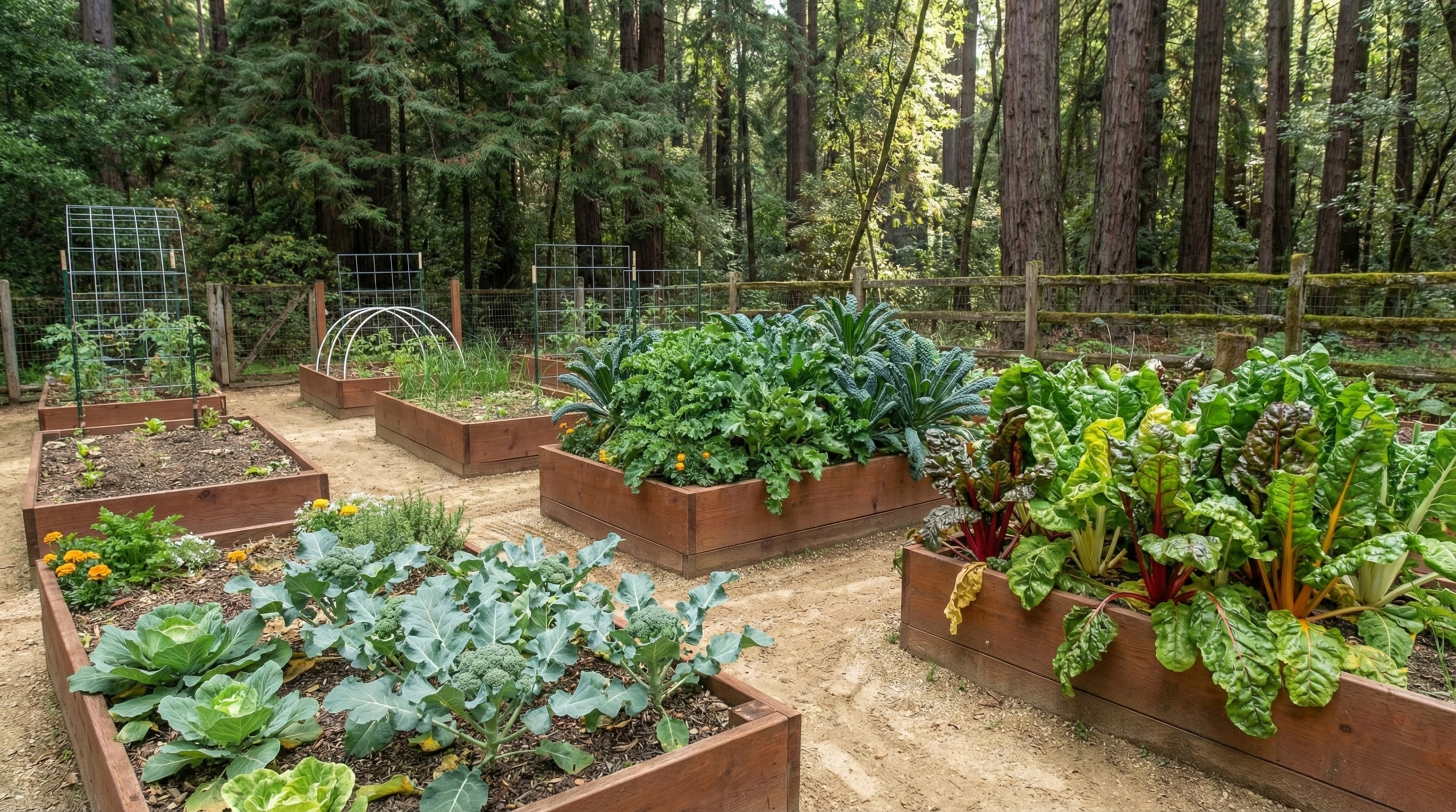
Should You Use Raised Beds in Redwood Gardens?
Why raised beds work well:
Bypass acidic soil (import neutral pH soil)
Avoid root competition from redwoods
Better drainage
Warm faster in spring
Easier to manage
How to build:
12-18 inches tall minimum
Use untreated wood or composite
Fill with quality soil mix (not redwood duff)
Add compost annually
Line bottom with cardboard (blocks redwood roots)
What Does a Redwood Garden Calendar Look Like?
Spring (March through May)
Direct seed: lettuce, greens, peas, radishes
Transplant: brassicas (if you have 4-6 hours sun)
Plant: strawberries (in sunnier spots)
Harvest: overwintered greens
Summer (June through August)
Direct seed: Lettuce (your superpower)
Succession plant: greens, arugula
Transplant: fall brassicas (late summer)
Harvest: greens, herbs, berries
Fall (September through November)
Direct seed: lettuce, greens, cool-season crops
Transplant: garlic (if sunny enough)
Harvest: fall greens, late berries
Prepare: winter beds
Winter (December through February)
Direct seed: mâche, winter lettuces
Harvest: winter greens (with protection)
Plan: next year's garden
Maintain: clean up, mulch
Which Varieties Work Best in the Redwood Understory?
Lettuce (Anything)
Buttercrunch: reliable, bolt-resistant
Red Sails: loose-leaf, easy
Tom Thumb: compact butterhead
Merlot: red lettuce
Winter Density: romaine for cool weather
Greens
Red Russian kale: cold-hardy
Bright Lights chard: colorful
Space spinach: bolt-resistant
Joi Choi bok choy: quick
Tatsoi: rosette shape
Herbs
Italian Flat Leaf parsley
Standard cilantro
Chervil
Spearmint
Lemon balm
If You Have 4-6 Hours Sun
Sugar Snap peas
Lacinato kale
DiCicco broccoli
Scarlet Nantes carrot
What Wildlife and Pests Should You Expect Under Redwoods?
Deer: Major issue in redwood areas (they travel through forests)
Fencing essential for vegetables
8 feet tall minimum
Deer-resistant crops help but nothing is deer-proof
Slugs and Banana Slugs: Your cool, moist conditions equal slug paradise
Hand-pick (especially banana slugs; they're big)
Beer traps
Copper tape on raised beds
Iron phosphate baits
Gophers: Present but maybe less dense than open areas
Wire baskets for valuable plants
Raised beds with hardware cloth bottom
Birds: Appreciate your forest edge
Not usually a problem
May eat some berries
Local Resources for Redwood Gardeners
Nurseries and Supplies
Mountain Feed and Farm Supply (9550 Highway 9, Ben Lomond) carries seeds, plants, soils, and raised bed supplies suited to San Lorenzo Valley conditions.
Scarborough Gardens (33 El Pueblo Road, Scotts Valley) can advise on shade-tolerant varieties and soil amendments for acidic conditions.
San Lorenzo Garden Center (235 River Street, Santa Cruz) has a full selection including shade-tolerant starts and soil amendments.
Seeds
Renee's Garden Seeds is based in Felton and specializes in varieties suited to our local conditions, including shade-tolerant greens.
Kitazawa Seed Company offers excellent Asian vegetable varieties that thrive in cool, shaded conditions.
Education
UC Master Gardeners of Monterey Bay offers classes, garden tours, and a help line for troubleshooting shade gardening and soil pH questions.
For detailed information on improving acidic redwood soil, see our California garden soil amendments guide. Our Santa Cruz microclimates guide can help you understand the specific conditions in your area.
Frequently Asked Questions About Gardening Under Redwoods
Can I grow tomatoes under redwood trees?
Not unless you have a sunny clearing with 6-8 hours of direct sunlight. Tomatoes need full sun and heat, and deep redwood shade won't provide that. If you have an edge area or clearing that gets 6+ hours of direct sun (not dappled), tomatoes are possible there. Otherwise, focus on shade-tolerant crops like lettuce, greens, and herbs that actually thrive in your conditions. Don't fight your microclimate.
What vegetables grow in shade under redwoods?
Lettuce and salad greens are your superpower. You can grow lettuce in July and August when sunny gardens can't because their plants bolt in heat. Also excellent: arugula, spinach, chard, Asian greens (bok choy, tatsoi, mizuna), mâche, and mustard greens. Shade-tolerant herbs include parsley, cilantro, chervil, mint, and lemon balm. With 4-6 hours of sun, add peas, brassicas (kale, broccoli), and root vegetables.
How do I fix acidic soil under redwoods?
Redwood needle decomposition creates acidic soil (pH 5.5-6.5) while most vegetables prefer pH 6.0-7.0. Test your soil pH annually. Add lime (calcium carbonate) gradually to raise pH, or use wood ash sparingly. Compost helps buffer pH over time. Alternatively, build raised beds with imported neutral-pH soil to bypass the issue entirely, or grow acid-loving crops like blueberries that thrive in your existing conditions.
Do blueberries grow well under redwoods?
Yes! Blueberries love acidic soil, making them perfect for redwood gardens. They need 4-6 hours of sun, so plant them in clearings or edge areas rather than deep shade. Varieties like Bluecrop, Duke, and Elliot work well. Native huckleberries (Vaccinium ovatum) are even more shade-tolerant and grow as understory plants naturally. Blueberries are one of the best uses of your acidic soil conditions.
Why does lettuce grow better under redwoods in summer?
Your cool shade (10-15°F cooler than sunny areas) prevents bolting, the process where lettuce sends up a flower stalk and turns bitter in heat. While sunny gardens struggle with 95-100°F temperatures in summer, your redwood garden stays 75-85°F. This temperature stability allows succession planting lettuce from April through September. You have one of the best summer lettuce conditions in Santa Cruz County.
How do I deal with slugs in a redwood garden?
Your cool, moist conditions are slug paradise. Use multiple strategies: hand-pick slugs (especially large banana slugs) in early morning or evening; set beer traps; apply copper tape around raised beds; use diatomaceous earth around plants; and maintain good drainage since slugs love waterlogged areas. Raised beds help because you can protect the perimeter. Accept some slug pressure and grow enough to share.
Should I use raised beds for redwood gardening?
Raised beds work exceptionally well under redwoods. They bypass acidic soil (fill with neutral-pH mix), avoid root competition from redwood trees (line the bottom with cardboard), provide better drainage, and warm faster in spring. Build beds 12-18 inches tall minimum using untreated wood or composite materials. Fill with quality soil mix, not redwood duff. Add compost annually to maintain fertility.
What's the best time of year to garden under redwoods?
Year-round growing is possible, but summer (June through August) is actually your strongest season for lettuce and greens since you avoid the bolting that plagues sunny gardens. Spring and fall are excellent for succession planting greens and cool-season crops. Winter works for cold-hardy greens like mâche with some protection. You lose some winter light as days shorten, but your stable temperatures allow extended harvests compared to exposed areas.
Free Redwood Gardening Resources
Download these free guides for gardening under redwoods in Santa Cruz County:
Know Your Microclimate Worksheet: Map sun exposure, shade patterns, and microclimates in your redwood garden. Essential for identifying your sunniest spots and placing crops strategically.
Seasonal Planting Calendar: Month-by-month planting guide. Focus on cool-season timing since your shade extends the viability of spring and fall crops through summer.
Vegetables by Season Chart: Quick reference for what to plant when. Shade-tolerant greens and herbs are available nearly year-round in redwood microclimates.
Gopher Control Guide: Gophers are present in redwood areas. Learn about hardware cloth under raised beds, trapping, and protecting valuable plants.
Additional Resources
Why Should You Embrace a Different Kind of Garden?
Gardening under redwoods means completely rethinking what a vegetable garden looks like.
It's not rows of tomatoes ripening in the sun. It's not peppers and eggplant.
It's fresh lettuce in August when inland gardeners have none. It's greens that never bolt. It's cool, lush, productive gardens growing in conditions where most people see only ferns and redwood duff.
Your microclimate is unique. Not worse, different.
Work with it. Plant what thrives. Accept what won't. And enjoy the crops that flourish in your cool, shaded, redwood forest garden.
You have something special. Use it.
