

Best Mulberry Varieties for Coastal California (And Which to Plant in Santa Cruz County)
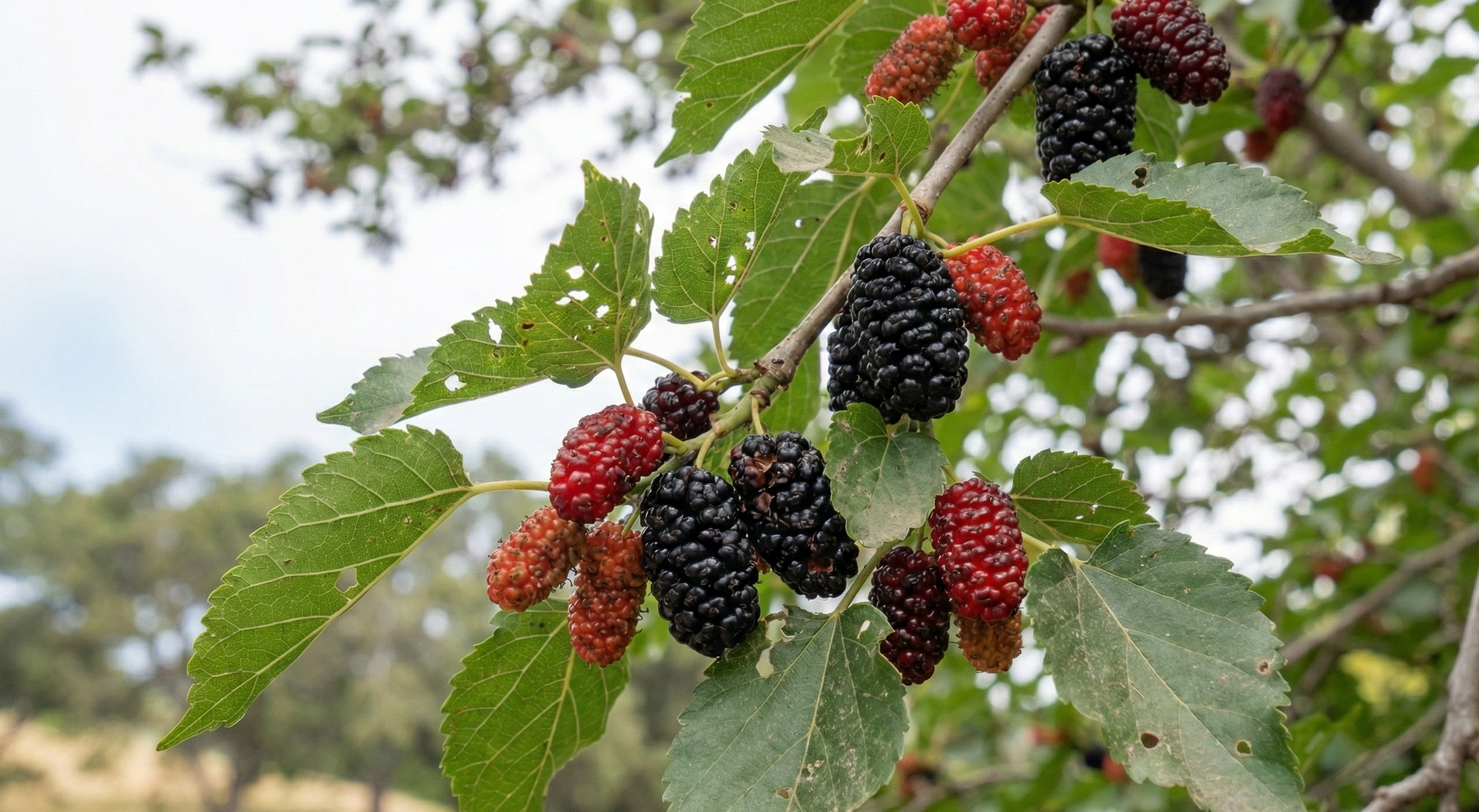
Some links in this guide are affiliate links. If you buy through them, we may earn a small commission at no extra cost to you. Read our full disclosure.
Mulberries might be the easiest "exotic" fruit you can grow in Santa Cruz County, but variety choice matters more than most people realize.
Some mulberries become 40-foot shade trees with mild, very sweet fruit, while others stay compact and produce intensely flavored berries closer to blackberries in complexity. The California Rare Fruit Growers note significant variation in fruit quality, tree size, and climate adaptation across mulberry species. Mulberries adapt to a wide range of soils and climates. UC Cooperative Extension notes they grow in a variety of soil conditions and suit coastal plantings as long as they are sheltered from wind. Choosing the right variety for your space and taste preferences makes the difference between a productive backyard tree and a regrettable landscape mistake.
This guide highlights mulberry varieties that perform well in mild-winter, coastal climates like Santa Cruz County and explains how they differ in flavor, size, and growth habit.
What Are the Main Mulberry Species?
CRFG lists three main mulberry species, plus hybrids and a few related species. Before we get to specific varieties, understanding the main mulberry species helps you make sense of what nurseries are selling and what will work in your garden.
White Mulberry (Morus alba)
CRFG describes white mulberry as extremely adaptable and vigorous, tolerant of drought, pollution, and poor soil. Fruit color ranges from white to pink to red to black depending on variety, and flavor is typically very sweet with low acidity. CRFG is explicit that fruit color does not identify the species, so a dark-fruited tree sold as a black mulberry may well be a Morus alba cultivar. Ask the nursery for the species, not the fruit color.
The catch: unnamed seedling white mulberries can produce bland, insipid fruit. Named cultivars are essential for good eating quality.
Black Mulberry (Morus nigra)
CRFG notes that black mulberry is widely regarded as having the best-tasting fruit of all mulberry species, combining sweetness and acidity for complex, berry-like flavor. Trees are naturally smaller and slower-growing than white mulberries, CRFG calls black mulberry the smallest of the three species, sometimes reaching 30 feet, where white mulberry can reach 80.
Black mulberries prefer mild winters and are well-suited to coastal California. They're the connoisseur's choice for flavor.
Red Mulberry (Morus rubra)
Native to eastern North America, red mulberry is less commonly grown in California. Many "red" mulberries in the nursery trade are actually rubra × alba hybrids, which combine the adaptability of white mulberry with improved flavor. 'Illinois Everbearing' is the most famous example.
Himalayan Mulberry (Morus macroura)
This species includes some of the most prized long-fruited varieties. Cultivar guides note that 'Pakistan' and similar long-fruited mulberries are more accurately classified as Morus macroura, though they're often sold under Morus alba in the nursery trade.
The Santa Cruz Takeaway
Black mulberries and Pakistan-type (Morus macroura) varieties are especially well-suited to our mild coastal climate. Cold-hardy alba/rubra hybrids like 'Illinois Everbearing' also perform well and extend your harvest season. Any of these will outperform random seedling trees.
What Makes 'Pakistan' and Long-Fruited Honey Mulberries Special?
If you want the largest, sweetest mulberries possible, the Pakistan-type varieties deliver.
What They Are
'Pakistan' (also sold as 'Shahtoot' or 'King White' depending on the strain) is a long-fruited mulberry originally from the Indian subcontinent. Cultivar references group it under Morus macroura, not true Morus alba, though you'll often see it labeled as white mulberry in nurseries.
CRFG describes 'Pakistan' as producing extremely large, elongated fruits 2½ to 3½ inches long with firm texture and sweet, well-flavored flesh. The tree is adapted to mild-winter areas and "usually performs satisfactorily in cooler areas" according to CRFG.
Why 'Pakistan' Works in Santa Cruz
The large, firm fruit is sweet and well balanced rather than sharply tart, which appeals to people who dislike sour berries. Children especially love them. The tree is vigorous and heat-tolerant but also performs in cooler coastal climates as long as winters aren't severely cold, which they never are here.
In warmer Santa Cruz microclimates like Scotts Valley, sunny San Lorenzo Valley slopes, or south-facing walls, 'Pakistan' should do best. CRFG recommends it for mild-winter areas and notes it usually performs satisfactorily in cooler ones, so expect it to fruit near the coast too, just less freely.
Considerations Before Planting
Size: 'Pakistan' is vigorous. Plan for a large, spreading tree. CRFG describes 'Pakistan' as vigorous and spreading, so give it room rather than counting on pruning to hold it small.
Fruit handling: The soft, juicy fruit is more perishable than some hybrids. This is a backyard fresh-eating tree, not one for shipping or long storage.
Best for: Gardeners who want maximum sweetness and impressive fruit size, and who have room for a larger tree or commitment to regular pruning.
Why Are Black Mulberries Considered the Flavor Champions?
If flavor is your priority over fruit size, black mulberries (Morus nigra) are the gold standard.
Why Black Mulberries Taste Better
CRFG states that black mulberry fruits are large and juicy, with the best flavor of all mulberry species, combining sweetness and acidity in a way that white mulberries rarely achieve. The flavor is often compared to blackberries or wine grapes: complex, rich, and deeply satisfying.
Trees are naturally smaller and slower-growing than white mulberries or Pakistan types, staying well short of the size a white mulberry reaches. This makes them ideal for smaller yards where a full-size mulberry would overwhelm the space.
Varieties to Consider
'Black Beauty'
Cultivar guides describe 'Black Beauty' as a compact black mulberry with very rich flavor and heavy bearing. It's one of the most widely available named black mulberry varieties and a reliable choice for Santa Cruz gardens.
Good for small-to-medium yards where you want top flavor and a manageable tree.
'Persian' / Generic Black Mulberry
Many nurseries sell "Persian mulberry" as a catch-all for Morus nigra selections. CRFG notes that black mulberries have been known to bear fruit for hundreds of years. If you can't find a specifically named cultivar, a generic black mulberry from a reputable nursery will still produce excellent fruit.
Why Black Mulberries Fit Santa Cruz
Our mild winters and warm (but not scorching) summers are ideal for black mulberries. They dislike very cold winters but aren't heat-hungry desert trees either. The dense, spreading habit and moderate height are assets in smaller coastal backyards where space is at a premium.
Best for: Gardeners who prioritize flavor over fruit size, have smaller yards, or want a more manageable tree that doesn't require constant pruning to control.
What Are 'Illinois Everbearing' and Other Long-Season Hybrids?
If you want mulberries over the longest possible season with maximum reliability, hybrid varieties deliver.
What 'Illinois Everbearing' Is
Cultivar guides describe 'Illinois Everbearing' as a hybrid between Morus alba and Morus rubra, combining the adaptability of white mulberry with improved flavor from the red mulberry parent. It's notably precocious (fruits young), cold-hardy (to Zone 4, far colder than we ever see), and produces over a remarkably long season.
CRFG calls 'Illinois Everbearing' a vigorous but somewhat smaller tree that produces high-quality, sweet, almost seedless fruit over an extended season. Where other mulberries fruit in a concentrated flush over a few weeks, 'Illinois Everbearing' can produce for months.
Why It Works in Santa Cruz
Extended harvest: In suitable climates, fruit ripens over weeks or months rather than all at once. This means fresh mulberries for longer without the pressure to process huge harvests quickly.
Adaptability: The hybrid background makes it tolerant of a wide range of conditions. It works in both cooler, foggy westside locations and warmer inland microclimates.
Reliability: This is a proven performer that rarely disappoints. If you're unsure what will work in your specific microclimate, 'Illinois Everbearing' is a safe bet.
Tradeoffs
Growth can be vigorous; you'll want to manage size through winter pruning if space is limited. Fruit quality is excellent but not quite as intense as the very best black mulberries. It trades a bit of flavor intensity for reliability and extended production.
Best for: Gardeners who want a long harvest season, aren't sure about their microclimate, or prefer a proven, adaptable variety over more specialized options.
Which Compact and Dwarf Varieties Work for Small Spaces?
Not everyone has room for a 30-foot tree. Fortunately, compact mulberry varieties make it possible to grow mulberries in small yards, side gardens, and even large containers.
Key Compact Varieties
'Gerardi Dwarf' (also sold as 'Dwarf Everbearing')
Cultivar guides describe 'Gerardi Dwarf' as a small mulberry topping out around 8-10 feet, with black fruit and good productivity in small spaces. It's one of the most commonly available true dwarf mulberries.
Other Dwarf Selections
Various "Dwarf Everbearing" offerings in the nursery trade are compact alba or hybrid types that fruit on young wood. These can be grown in large containers with proper care.
Why Dwarf Mulberries Matter for Santa Cruz
Many Santa Cruz properties have limited space: small lots, side yards, townhouse gardens, or rental situations where permanent large trees aren't practical. Dwarf mulberries fit these constraints while still producing meaningful harvests.
They also work well in large containers on a sunny deck or patio, provided you can keep up with watering and occasional root pruning. A 20-gallon or larger container (much bigger than the fabric bags linked above) with consistent irrigation can support a productive dwarf mulberry for years.
Caveats About Dwarf Varieties
Naming confusion: Names are sometimes muddled in the nursery trade. 'Dwarf Everbearing,' 'Gerardi Dwarf,' and similar names may or may not refer to the same plant depending on the source. Buy from reputable nurseries that can tell you the actual species and background.
Smaller yields: Yields per tree will be smaller than full-size mulberries, but still ample for a small household. One dwarf tree won't bury you in fruit the way a mature 'Pakistan' will.
Best for: Small yards, container gardens, renters, or anyone who wants mulberries without committing to a large tree.
What Other Varieties Are Noteworthy for Coastal California?
Beyond the core recommendations above, several other varieties deserve mention for specific situations.
'Tehama' (Giant White)
CRFG describes 'Tehama' as a large-fruited white mulberry from Tehama County with very sweet, succulent, almost melting fruit and an attractive large-leaved tree. Best adapted to mild-winter areas. A good choice if you want white mulberry fruit quality without the bland flavor of unnamed seedlings.
'Shangri-La'
Cultivar guides list 'Shangri-La' as a vigorous mulberry with very large leaves and sweet black fruit, suitable for warm climates. Often grown in the Southeast but also sold in California. Worth considering if you find it at a local nursery.
'Silk Hope,' 'Oscar,' and Other Cold-Hardy Hybrids
These hybrids were selected for cold hardiness, which coastal California never demands. There is no extension record of how they perform here, so treat them as experiments rather than safe bets. They're nice options if you want to share scion wood with friends in colder regions or if you find them more readily available than other varieties.
The Bottom Line on "Other" Varieties
These are nice-to-have options after you've considered the core choices: Pakistan-type for maximum sweetness and size, black mulberry for best flavor, 'Illinois Everbearing' for longest season and reliability, and dwarf varieties for small spaces. If you're planting your first mulberry, start with one of those before exploring the more obscure options.
How Do You Match Varieties to Santa Cruz Microclimates?
Santa Cruz County's diverse microclimates mean that variety selection should account for your specific location.
Cool, Foggy Coastal Areas
Westside Santa Cruz, Live Oak, Aptos near the beach, areas close to the bay
Best bets:
Black mulberry ('Black Beauty' or similar) - handles cool conditions, moderate size
'Illinois Everbearing' - adaptable, reliable in variable conditions
Dwarf varieties for small gardens
'Pakistan' can work but may be less productive than in warmer spots
Why these work: These areas get marine influence, fog, and cooler summer temperatures. Black mulberries and adaptable hybrids handle these conditions well. Pakistan-type mulberries will still fruit but may produce less abundantly than in warmer microclimates.
Warmer Inland Pockets
Scotts Valley, San Lorenzo Valley sunny slopes, Soquel hills, south-facing walls anywhere
Best bets:
Pakistan-type mulberries - will thrive with extra heat
'Illinois Everbearing' - reliable everywhere
Vigorous alba/hybrid types
Any variety, really; you have flexibility
Why these work: Extra warmth means Pakistan-type mulberries will produce at their full potential. You have the widest variety selection in these warmer microclimates. Consider afternoon shade for containers on very hot patios.
Small Yards and Container Gardens
Anywhere with space constraints
Best bets:
'Gerardi Dwarf' or similar compact selections
Black mulberry trained low with regular pruning
'Pakistan' held back with light annual winter pruning (requires commitment)
Why these work: Dwarf varieties are bred for small spaces. Black mulberries are naturally more compact. Even vigorous varieties can be held back with light annual winter pruning, though CRFG warns that heavy cuts bleed and heal poorly.
Which Mulberry Varieties Should You Avoid?
A few common mistakes to avoid when shopping for mulberry trees.
Fruitless and Ornamental Mulberries
CRFG notes that many "fruitless mulberry" trees sold for shade are male clones of Morus alba. They produce pollen but no fruit. UC Cooperative Extension names 'Stribling', 'Kingan', and 'Urban' as male, fruitless selections of white mulberry, planted to avoid fruit drop.
If you want fruit, steer clear of anything labeled "fruitless," "non-fruiting," or strictly ornamental. These trees will never produce mulberries no matter how well you care for them.
Unnamed Seedlings
Seedling white mulberries can be hardy and vigorous but often produce bland or highly variable fruit. That volunteer mulberry in your neighbor's yard might fruit heavily, but the fruit might not be worth eating.
Choose named cultivars for reliable quality. The difference between a good named variety and a random seedling can be dramatic.
Street Trees and Unknown Volunteers
Mulberries self-seed readily, and you'll find volunteer trees throughout Santa Cruz County. While these can produce edible fruit, quality is unpredictable. If you're going to commit garden space to a mulberry, plant a known good variety rather than gambling on an unknown seedling.
Where Can You Find Mulberry Varieties Locally?
Mulberries aren't as widely available as apples or citrus, but good sources exist for California gardeners.
Specialty Nurseries and Mail-Order
Look for nurseries that clearly list species and cultivar names ('Pakistan,' 'Illinois Everbearing,' 'Black Beauty,' 'Gerardi Dwarf') rather than generic "mulberry tree." Reputable sources include:
Bay Laurel Nursery (Atascadero): Good variety selection, ships within California
One Green World (Oregon): Wide selection, ships bare-root
Local Nurseries
Call ahead to check availability:
San Lorenzo Garden Center (Santa Cruz)
Sierra Azul Nursery (Watsonville)
Dig Gardens (Santa Cruz)
CRFG Chapters and Scion Exchanges
The California Rare Fruit Growers organization is an excellent resource for unusual fruit varieties. The Monterey Bay chapter covers our area and often has mulberry scion wood or small plants available through members. CRFG's mulberry reference page lists many cultivars and is useful when shopping.
Scion exchanges let you graft rare varieties onto existing rootstock, which is how many unusual mulberries spread among enthusiast growers.
How Should You Start Building a Mulberry Collection?
If you're planting your first mulberry, don't overthink it. Here's a practical starting point:
For most Santa Cruz gardeners, start with:
One Pakistan-type mulberry for large, honey-sweet fruit (if you have room for a bigger tree or commitment to pruning)
OR
One black mulberry ('Black Beauty' or similar) for the best flavor in a more compact tree
Then consider adding:
'Illinois Everbearing' if you want extended harvest season and proven reliability
A dwarf variety if you have limited space or want to experiment with container growing
This approach gives you excellent fruit quality, manageable tree sizes, and extended harvest without overwhelming your garden with mulberry trees. Once you discover how much you love fresh mulberries (and you will), you can always add more varieties.
Frequently Asked Questions
What's the sweetest mulberry variety?
Pakistan-type mulberries ('Pakistan,' 'Shahtoot,' 'King White') are prized for very large, firm, sweet fruit. CRFG describes 'Pakistan' as sweet with a fine balance of flavors rather than sharply tart.
What's the best-tasting mulberry variety?
That depends on your definition of "best." For complex, berry-like flavor with balanced sweetness and tartness, black mulberry (Morus nigra) varieties like 'Black Beauty' are considered the finest. For pure sweetness, Pakistan-type wins.
Which mulberry variety stays smallest?
'Gerardi Dwarf' and similar dwarf selections stay around 8-10 feet. Black mulberries are naturally more compact than white mulberries, which CRFG says can reach 80 feet. Any variety can be kept smaller with regular pruning.
Can I grow multiple varieties in a small yard?
Yes. Plant a dwarf variety in a container and a compact black mulberry in the ground, or keep larger varieties small through regular winter pruning. Prune in winter and keep cuts small. CRFG advises against heavy pruning because mulberries bleed at the cuts, and cuts over two inches across generally do not heal.
Do different mulberry varieties need to cross-pollinate?
No. Mulberries are self-fertile or produce fruit parthenocarpically (without pollination). You only need one tree to get fruit, though multiple varieties extend your harvest season and give you different flavors to enjoy.
Which variety is best for containers?
'Gerardi Dwarf' or similar compact varieties are easiest in containers. Any variety can be container-grown with aggressive pruning, but dwarf types require less ongoing maintenance.
I can only plant one mulberry. Which should it be?
In Santa Cruz County, 'Pakistan' if you want maximum sweetness and large fruit (and can manage a bigger tree), or 'Black Beauty' (black mulberry) if you want the best flavor and a more compact size. Either is an excellent choice.
Free Gardening Resources
Know Your Microclimate Worksheet: Understand your specific Santa Cruz County growing conditions
Seasonal Planting Calendar: Month-by-month guidance for Santa Cruz County
Garden Troubleshooting Guide: General problem-solving for vegetable and fruit gardens
