

Growing Matilija Poppy in Santa Cruz County: California's Spectacular (and Spreading) Native
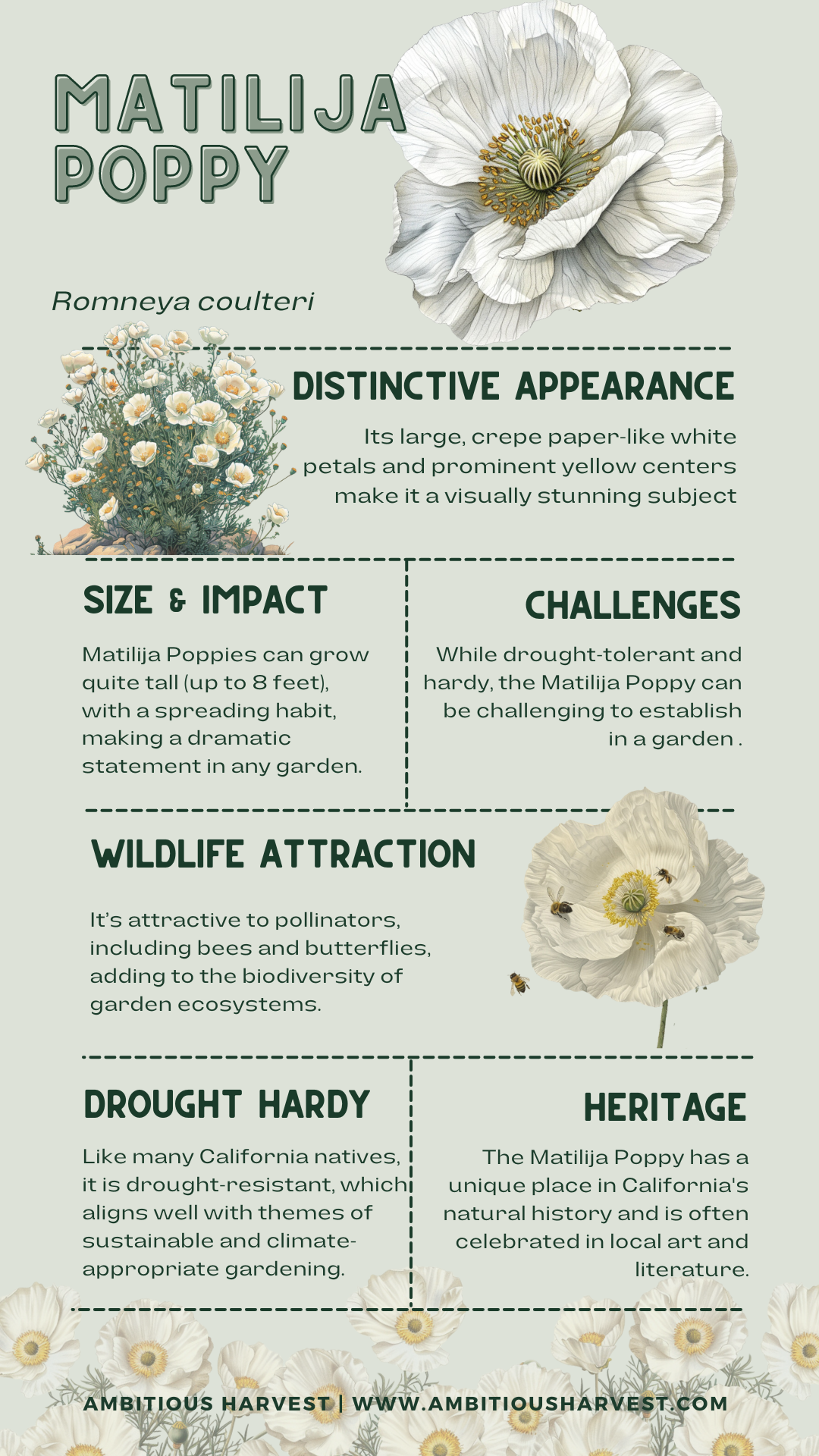
The first time you see a matilija poppy in bloom, you understand why gardeners take risks to grow it. The flowers are extraordinary: six inches across, with tissue-paper-white petals surrounding a golden center of stamens. They look like something from a dream, floating above silvery blue-green foliage on stems that can reach eight feet tall.
According to Calscape, matilija poppy (Romneya coulteri) produces the largest flowers of any California native plant. It's drought-tolerant once established, fire-resistant, and beloved by pollinators. It belongs in Santa Cruz County landscapes. Learn more about the benefits of native garden design for our region.
But here's what you need to know before planting: matilija poppy spreads. Aggressively. Through underground rhizomes that can travel ten feet or more from the mother plant. What starts as one modest plant can become a colony that takes over a garden bed, pops up in your lawn, and emerges in your neighbor's yard.
This isn't a reason not to grow matilija poppy. It's a reason to plant it thoughtfully, in the right location, with realistic expectations about its behavior.
What Should You Know Before Planting Matilija Poppy?
Let's address the spreading issue directly because it's the single most important consideration for Santa Cruz gardeners.
How it spreads: Matilija poppy sends out underground rhizomes (horizontal root stems) that can extend ten feet or more from the parent plant. New shoots emerge from these rhizomes, often in unexpected locations. The rhizomes are thick and brittle, and any piece left in the ground can regenerate into a new plant.
When spreading becomes a problem:
In small, tightly designed gardens with defined borders
Near structures, patios, or hardscape that can be lifted by vigorous roots
In mixed beds where the poppy will crowd out other plants
Near property lines where it can spread into neighboring yards
When spreading is manageable or desirable:
On dry slopes where you want erosion control and naturalized coverage
In large, open areas where the plant has room to roam
In wild or naturalized gardens where a spreading colony is the goal
Against structures with deep foundations that roots can't penetrate
The bottom line: If you have a small, carefully curated garden, matilija poppy may not be your plant. If you have space for it to spread or a location where you can contain it, the spectacular blooms are worth the commitment.
Where Does Matilija Poppy Thrive in Santa Cruz County?
Matilija poppy is native to Southern California's chaparral and coastal sage scrub communities, but it grows beautifully throughout Santa Cruz County in the right conditions. Understanding your Santa Cruz microclimate is key to choosing the best spot. Las Pilitas Nursery notes that it adapts well to gardens throughout California when given proper drainage and sun.
Best Locations
Sunny mountain ridges and chaparral zones: The hot, dry conditions of Boulder Creek's sunny ridges, Ben Lomond's exposed hillsides, and Bonny Doon's sandstone areas mimic matilija poppy's native habitat. Plants grown here tend to be more restrained in their spreading than those in richer, wetter conditions.
Dry slopes: Matilija poppy excels on slopes where irrigation is impractical and erosion control is needed. Its deep root system stabilizes soil effectively.
Large properties with room to naturalize: If you have half an acre or more of sunny, well-drained land, matilija poppy can form a stunning naturalized colony.
Challenging Locations
Coastal fog zones: Matilija poppy tolerates coastal conditions but may not bloom as prolifically where summer fog is heavy and temperatures stay cool. It needs heat to flower its best.
Under redwoods or in shade: Not appropriate. Matilija poppy requires full sun (at least 6 hours of direct sunlight) and dislikes the moist, acidic conditions under redwoods. See our Growing Under the Redwoods guide for better options for shaded areas.
Small urban gardens: Proceed with extreme caution. The spreading habit is difficult to contain in typical residential lot sizes without physical barriers.
Near vegetable gardens or irrigated areas: Consistent irrigation promotes aggressive spreading. Keep matilija poppy in dry zones of your landscape.
How Do You Plant Matilija Poppy?
Choosing the Right Spot
Sun: Full sun is essential. At least 6 hours of direct sunlight, preferably more.
Soil: Well-drained to sharply drained. UC ANR notes that matilija poppy thrives in poor, gravelly, or sandy soils. Rich, amended garden soil encourages aggressive spreading and can lead to root rot.
Space: Plan for a mature spread of 8 to 10 feet or more. Plant at least 15 feet from structures, property lines, and plants you want to protect.
Containment planning: If you want to limit spread, choose a location bounded by hardscape (concrete driveway, foundation) on at least two sides. Alternatively, install root barriers at planting time.
When to Plant
Fall is the best planting time in Santa Cruz County, typically October through December. This allows root establishment during the rainy season. Spring planting (February through March) also works but requires more attention to watering during the first summer.
Planting Steps
Dig a hole twice as wide as the root ball and the same depth. Do not amend the soil. Matilija poppy performs better in native soil.
Remove the plant carefully from its container. Matilija poppy has brittle roots that resent disturbance, which is one reason established plants are tricky to transplant.
Set the plant at the same level it grew in the container. Backfill with native soil.
Water deeply to settle the soil. Apply 2 to 3 inches of gravel or rock mulch (not organic mulch, which retains too much moisture near the crown).
Water regularly through the first year to establish roots. After establishment, reduce watering significantly.
Installing Root Barriers
If you're planting matilija poppy in a space where spreading must be controlled, install root barriers at planting time. It's much harder to add them later.
Use commercial root barrier material at least 24 inches deep (30 inches is better). The material should extend 2 to 3 inches above ground level to prevent rhizomes from growing over the top.
Install barriers in a circle around the planting area or along edges where you want to prevent spread. Leave at least 6 feet of diameter inside the barrier for the plant to grow.
Be aware that root barriers reduce but may not eliminate spreading. Check barrier edges annually and cut any rhizomes attempting to grow around them.
How Do You Care for Matilija Poppy?
Watering
First year: Water deeply once weekly during the dry season (April through October) to establish roots.
Established plants: Little to no supplemental water. Matilija poppy is extremely drought-tolerant once established. In fact, overwatering is the most common cause of poor performance and death. If your plant looks stressed in summer, check for root rot before adding water.
Exception: In Santa Cruz County's hottest, driest microclimates during extended heat waves, occasional deep watering (once monthly at most) during the first few summers keeps plants healthy.
See our Water-Wise Gardening Guide for more drought-tolerant landscaping strategies.
Pruning
Cut back hard in late fall or early winter, after flowering is complete and foliage has died back. Cut stems to 6 to 12 inches from the ground.
This annual cutback is important. It keeps plants vigorous, prevents woody, bare-legged growth, and reduces fire fuel.
Don't prune in spring or you'll remove developing flower buds.
Fertilizing
Don't fertilize matilija poppy. It evolved in poor soils and performs worse with added fertility. Fertilizing encourages weak, floppy growth and more aggressive spreading.
Managing Spread
Despite your best planning, matilija poppy will likely send up shoots where you don't want them.
Remove unwanted shoots promptly: Dig out unwanted shoots as soon as they appear, getting as much of the rhizome as possible. Mowing repeatedly can weaken unwanted colonies.
Physical barriers: A concrete driveway, sidewalk, or building foundation creates an effective barrier that rhizomes can't penetrate.
Acceptance: In the right location, accepting the spread and allowing a naturalized colony may be the best approach.
How Does Matilija Poppy Fit Into Fire-Wise Landscaping?
Matilija poppy is classified as fire-resistant when properly maintained, making it appropriate for defensible space in Santa Cruz County's fire-prone areas. According to CAL FIRE guidelines, plants with high moisture content and low volatile oils contribute to fire-resistant landscaping.
Fire-resistant characteristics:
The plant has high moisture content in leaves and stems during the growing season. It contains low volatile oil content compared to many chaparral shrubs. The annual cutback removes dead material that would otherwise become fire fuel.
Placement in fire zones:
Zone 1 (0 to 5 feet from structures): Not recommended. Keep this zone free of plants.
Zone 1 (5 to 30 feet from structures): Can be appropriate with caveats. Keep plants cut back annually. Remove all dead material. Don't plant directly against structures where roots might lift foundations. Maintain space between plants and remove grass or other fine fuels from around the base.
Zone 2 (30 to 100 feet): Excellent choice for this zone. The deep roots help stabilize slopes while the fire-resistant foliage reduces fuel load compared to grass or brush.
Important: Cut back matilija poppy annually. If allowed to accumulate dead woody growth, it becomes a fire hazard rather than fire-resistant.
What Do Matilija Poppy Blooms Look Like?
After all the warnings about spreading, let's appreciate what makes matilija poppy worth growing: the flowers.
Size: Individual flowers reach 5 to 6 inches across, occasionally larger. They're the largest flowers of any California native plant.
Appearance: Six pure white petals with a crinkled, tissue-paper texture surround a center of bright golden-yellow stamens. The effect is often compared to a fried egg (hence the common name "fried egg flower").
Fragrance: Light, sweet fragrance that attracts bees from considerable distance.
Bloom time: Late spring through early summer, typically May through July in Santa Cruz County. Individual flowers last several days. A healthy plant produces dozens of blooms over the flowering season.
Repeat blooming: After the main flush, sporadic blooms may continue through summer, especially if the plant receives occasional deep watering.
What Is the Pollinator Value of Matilija Poppy?
Calscape documents matilija poppy flowers as important resources for pollinators, particularly native bees.
The large flowers with abundant pollen attract bumble bees, sweat bees, and many other native bee species. The open flower structure makes pollen easily accessible.
Butterflies visit for nectar, though the flower structure makes access more difficult than for bees.
Flowering coincides with the active season for many native pollinators, providing food when they need it most.
See our Pollinator-Friendly Gardens Guide for more plants that support beneficial insects.
What Are the Best Companion Plants for Matilija Poppy?
Matilija poppy combines beautifully with other drought-tolerant natives that can coexist with its spreading habit.
California sagebrush (Artemisia californica): Silver foliage complements the blue-green of matilija poppy leaves and the white flowers beautifully.
California buckwheat (Eriogonum fasciculatum): Long-lasting cream to rust flowers bloom around the same time.
Toyon (Heteromeles arbutifolia): Provides year-round structure and winter berries behind matilija poppy's summer show. See our Toyon Facts Infographic for more on this versatile native.
Cleveland sage (Salvia clevelandii): Purple flowers create stunning contrast with white matilija poppy blooms.
Manzanita (Arctostaphylos): The red bark and pink flowers of manzanita complement matilija poppy's foliage. See our Manzanita Guide for variety recommendations.
California poppy (Eschscholzia californica): The orange and white color combination is spectacular in late spring. See our California Poppy Guide.
Avoid planting with: Delicate plants that can't compete with matilija poppy's spreading roots. Anything in a defined bed that you want to keep tidy.
How Do You Propagate Matilija Poppy?
Why Propagation Is Tricky
Matilija poppy is notoriously difficult to propagate, which is ironic given how aggressively it spreads once established.
Seeds: Have very low germination rates without special treatment. Even with fire or smoke treatment (which breaks dormancy), germination is unreliable.
Root cuttings: More successful than seed, but disturbing the roots often sends the parent plant into decline.
Division: Difficult because the brittle roots don't tolerate disturbance well.
Transplanting volunteers: Often unsuccessful. The extensive root system makes it hard to get enough root mass to support the plant.
The Practical Approach
For most gardeners, buying a nursery-grown plant is far easier than propagation. Container-grown plants establish more reliably than field-dug specimens.
If you want to try propagation:
Root cuttings in winter: Take 3 to 4 inch sections of root in late winter while the plant is dormant. Plant horizontally, 2 inches deep in well-draining mix. Keep barely moist. Shoots may emerge in 2 to 3 months.
Smoke treatment for seeds: Soak seeds in liquid smoke solution overnight before planting. This mimics the fire that triggers germination in the wild.
Where Can You Buy Matilija Poppy in Santa Cruz County?
Native plant sales and specialty nurseries carry matilija poppy seasonally.
California Native Plant Society, Santa Cruz Chapter holds spring and fall plant sales at Cabrillo College Horticulture Center. Matilija poppy is often available, and volunteers can advise on suitability for your garden.
UCSC Arboretum seasonal plant sales include California natives. Their staff can discuss appropriate placement.
Sierra Azul Nursery (2660 E. Lake Avenue, Watsonville) specializes in California natives and carries matilija poppy.
For online sources, Las Pilitas Nursery ships throughout California and has extensive information on matilija poppy's requirements and behavior.
Calscape lists nurseries carrying matilija poppy by region.
Frequently Asked Questions About Matilija Poppy
How invasive is matilija poppy really?
In ideal conditions (sunny, well-drained soil with occasional water), very aggressive. Rhizomes can travel 10 feet or more from the parent plant, sending up new shoots. However, "invasive" isn't quite the right term since it's native to California. It's aggressive but not ecologically harmful. In poor, dry soil with no irrigation, spreading is more moderate. The key is matching the plant to an appropriate location rather than fighting its nature.
Can I grow matilija poppy in a container?
Not successfully long-term. The extensive root system needs room to spread, and containerized plants decline after a year or two. If you want to try, use the largest container possible (half-barrel minimum) and accept that it's a temporary arrangement.
Why isn't my matilija poppy blooming?
Several possibilities: The plant is too young (may take 2 to 3 years to bloom from a small nursery start). It's not getting enough sun (needs at least 6 hours of direct sunlight). It was pruned in spring, removing flower buds. It's being overwatered, which promotes foliage at the expense of flowers. Or it's stressed from transplant shock, which can delay blooming for a year or more.
Can I cut matilija poppy flowers for arrangements?
Yes, but they're short-lived in a vase (2 to 3 days maximum). For best results, cut in early morning when flowers are just opening. Sear the cut end with a flame or dip in boiling water for 30 seconds to seal the milky sap. Place immediately in water. Even with this treatment, don't expect them to last as long as commercial cut flowers.
Will matilija poppy damage my foundation or hardscape?
The rhizomes are strong and can lift lightweight pavers or thin asphalt. However, they typically can't penetrate concrete foundations, driveways, or thick patio slabs. Plant at least 5 to 6 feet from structures as a precaution, and use that hardscape boundary to naturally contain spread on one side.
Is matilija poppy deer resistant?
Generally yes. Deer don't typically browse matilija poppy, likely due to the plant's slightly bitter, milky sap. In areas with extreme deer pressure and limited food, some browsing may occur on young plants.
How do I get rid of matilija poppy if it spreads where I don't want it?
Removing established matilija poppy is difficult. Cut down all top growth and dig out as much root as possible. Any rhizome pieces left will resprout. Repeated cutting of new shoots (every few weeks) eventually exhausts the root system, but this can take a full growing season or longer. Covering the area with heavy black plastic after cutting can help by blocking light. Herbicides can work but require repeated applications to kill the extensive root system.
Does matilija poppy need fire to germinate?
In the wild, yes. Fire (or smoke) triggers seed germination by breaking down compounds in the seed coat. In cultivation, smoke treatment or scarification can improve germination, but rates are still low. This is why purchasing established plants is the practical approach for most gardeners.
Free Gardening Resources
Water-Wise Gardening Guide. Strategies for drought-tolerant landscaping including aggressive spreaders like matilija poppy.
Know Your Microclimate Worksheet. Determine if your conditions suit matilija poppy's needs.
Seasonal Tasks Checklist. Year-round maintenance including fall cutback timing for matilija poppy.
Related Articles
California Lilac (Ceanothus) Guide: Another spectacular California native for water-wise gardens
Manzanita: California's Beautiful Native Shrub: A perfect companion plant for matilija poppy
Fire-Wise Gardening in Santa Cruz County: Complete defensible space guidance
Is Matilija Poppy Worth the Commitment?
Matilija poppy isn't a plant for every garden or every gardener. It demands space, tolerates neglect better than care, and will spread beyond whatever boundaries you imagine.
But in the right place, nothing else compares. Those enormous white flowers glowing against blue-green foliage in the late spring sun are worth every compromise the plant demands.
Give it a sunny slope, poor soil, and room to roam. Cut it back hard every winter. And then step back and let it do what it evolved to do: spread across the California landscape in a display of wild, unstoppable beauty.
