

Why Manzanita Is the Crown Jewel of California Native Gardens
Some links in this guide are affiliate links. If you buy through them, we may earn a small commission at no extra cost to you. Read our full disclosure.
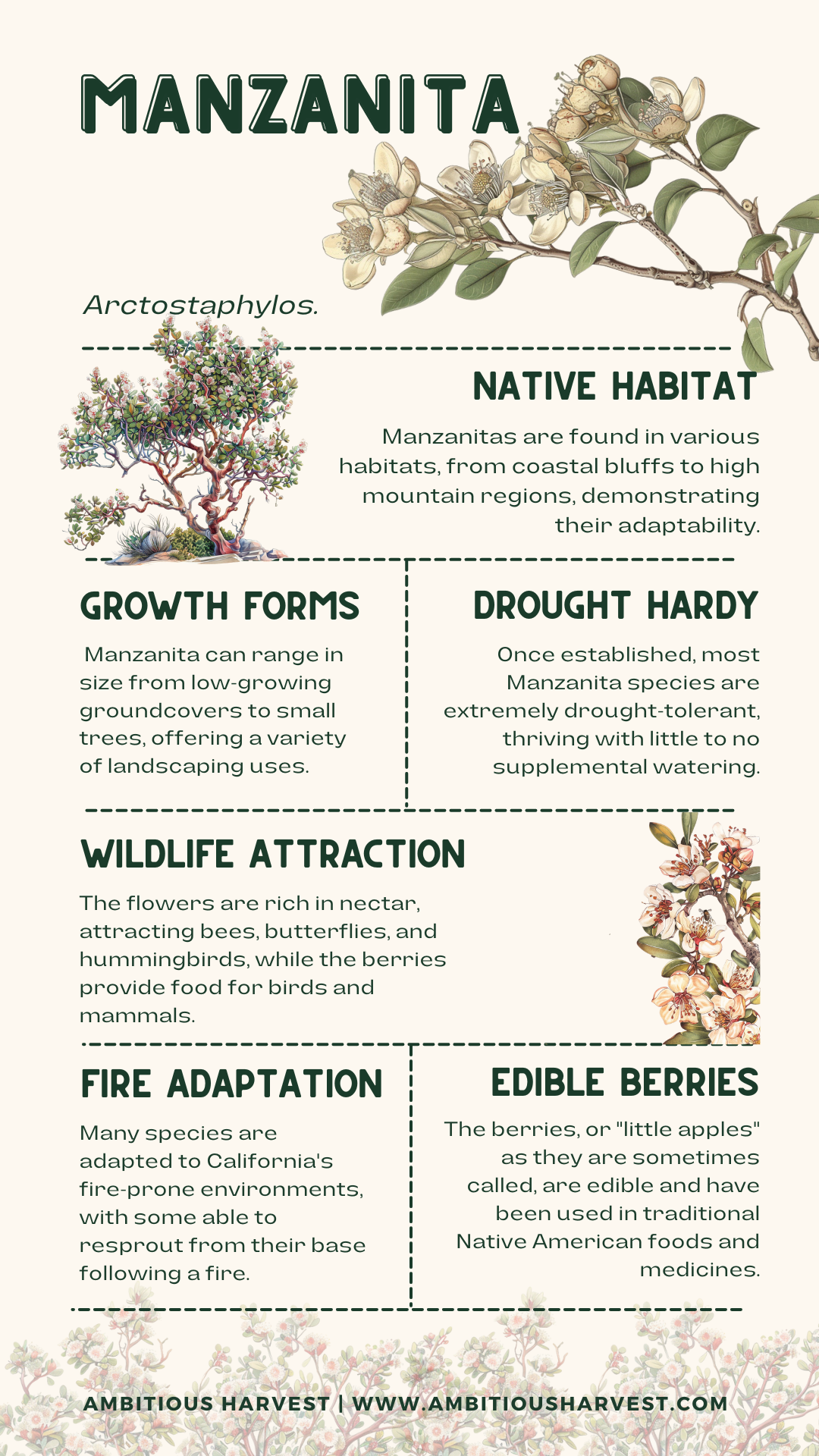
No plant captures the essence of California's wild landscapes quite like manzanita. Those sculptural, twisting branches with their smooth mahogany bark, the clusters of delicate urn-shaped flowers in late winter, the silvery-green foliage that stays handsome year-round: manzanita is a living work of art (UC Master Gardener Program of Sonoma County).
For Santa Cruz County gardeners, manzanita offers something increasingly valuable: year-round beauty with very little or no supplemental water once established in well-draining soil (UC Master Gardener Program of Sonoma County). In a region facing ongoing drought concerns and water restrictions, a plant this stunning that thrives on rainfall alone in suitable sites is nothing short of a gift.
But manzanita is more than just drought-tolerant. When most gardens are dormant in January and February, manzanita bursts into bloom, covering itself with clusters of pink or white bell-shaped flowers that provide critical nectar and pollen for early native bees and hummingbirds (UC Master Gardener Program of Napa County). Later, the small apple-like berries (the name "manzanita" means "little apple" in Spanish) feed birds and other wildlife (UC Master Gardener Program of Napa County).
With over 60 species native to California, ranging from ankle-high groundcovers to small trees, there is a manzanita for virtually every garden situation (California Native Plant Society). The challenge is not finding reasons to grow manzanita; it is choosing which species to plant.
What Is Manzanita?
Manzanitas belong to the genus Arctostaphylos, which translates from Greek as "bear grape," a reference to bears' fondness for the berries (UC Master Gardener Program of Napa County). These evergreen shrubs are members of the heath family (Ericaceae), related to blueberries, rhododendrons, and madrone (UC Master Gardener Program of Sonoma County).
The most striking feature is the bark. Smooth and cool to the touch, it ranges from deep mahogany to bright cinnamon-red, often peeling in thin layers to reveal fresh bark beneath (UC Master Gardener Program of Napa County). The twisting, sculptural branch structure creates year-round interest, especially when backlit by morning or evening sun.
The leaves are typically small, oval to round, and range from bright green to silvery gray-green depending on species (UC Master Gardener Program of Sonoma County). Most are thick and leathery, adaptations that help conserve water; some species have leaves that stand more vertically, reducing sun exposure and further minimizing water loss (UC Master Gardener Program of Napa County).
Flowers appear in late winter to early spring (roughly December through March in Santa Cruz County), forming drooping clusters of small, urn-shaped blooms in white to shades of pink (UC Master Gardener Program of Napa County). The flowers are rich in nectar, making manzanita one of the most important early-season food sources for pollinators (UC Master Gardener Program of Napa County).
The berries that follow resemble tiny apples and ripen from green through red to brown. They are mealy and bland to human taste but important food for birds and mammals from small rodents up to bears (UC Master Gardener Program of Napa County).
Which Manzanita Species Grow Best in Santa Cruz Gardens?
Choosing the right manzanita for your garden depends on the size and form you need, your specific microclimate, and aesthetic preferences (UC Master Gardener Program of Sonoma County).
Large Shrubs and Small Trees (6 to 15+ feet)
Manzanita (Arctostaphylos manzanita): The classic large manzanita can grow around 6 to 15 feet tall as a sculptural shrub with red bark and pinkish flowers in late winter (Calscape). The cultivar 'Dr. Hurd' is widely grown for its tree-like form and exceptional bark color (UC Davis Arboretum All-Stars).
Pajaro Manzanita (Arctostaphylos pajaroensis): Native to the hills around Watsonville and the Pajaro Valley, this species typically grows about 4 to 8 feet tall with especially beautiful mahogany bark and pink winter flowers, and is well adapted to local conditions (California Flora Nursery). Cultivars such as 'Paradise' and 'Warren Roberts' are popular landscape selections derived from local populations (Theodore Payne Foundation).
Brittleleaf Manzanita (Arctostaphylos crustacea): This variable species is native in parts of the Santa Cruz Mountains and can grow roughly 3 to 8 feet tall with attractive bark and good drought tolerance (Calscape).
Medium Shrubs (3 to 6 feet)
Howard McMinn Manzanita (Arctostaphylos densiflora 'Howard McMinn'): One of the most widely planted garden manzanitas, 'Howard McMinn' typically grows about 4 to 6 feet tall and up to 7 feet wide with glossy green leaves and abundant pink flowers; it is noted for reliability and tolerance of garden conditions (UC Landscape Plant Irrigation Trials).
Sentinel Manzanita (Arctostaphylos densiflora 'Sentinel'): 'Sentinel' has a more upright, vase-shaped habit, usually about 6 to 8 feet tall and wide, with a relatively narrow young form that suits screens and smaller garden spaces (Calscape).
Austin Griffiths Manzanita (Arctostaphylos 'Austin Griffiths'): A hybrid that usually reaches 8 to 15 feet with glossy sage-green foliage and large clusters of pale pink flowers, noted for strong drought tolerance and adaptability in many California gardens (Calscape).
Low Groundcovers (Under 2 feet)
Emerald Carpet (Arctostaphylos 'Emerald Carpet'): A low, spreading groundcover that typically grows around 8 to 14 inches tall and 4 to 6 feet wide, with bright green foliage and small white flowers, considered more tolerant of garden conditions than many species (UC Davis Arboretum All-Stars).
Point Reyes Manzanita (Arctostaphylos uva-ursi 'Point Reyes'): A tough groundcover generally 6 to 12 inches tall that spreads about 10 to 12 feet, very drought-tolerant and well suited to coastal conditions (Calscape).
Monterey Carpet (Arctostaphylos hookeri 'Monterey Carpet'): A local native selection around 1 foot tall that spreads about 4 to 5 feet, with bright green leaves and white to pink flowers; excellent for slopes and coastal sites (Calscape).
John Dourley (Arctostaphylos 'John Dourley'): A hybrid groundcover reaching around 2 feet tall and 6 feet wide, with new growth in bronze or copper tones that mature to gray-green and pink flowers in winter (UC Davis Arboretum All-Stars).
How Do You Grow Manzanita in Santa Cruz County?
When to Plant
Fall (roughly October through December) is the ideal planting time for manzanita in Santa Cruz County, because roots can establish during the cool, rainy season while top growth is minimal (UC Master Gardener Program of Sonoma County). By the following summer, plants have developed enough root mass to handle drought conditions with minimal supplemental water.
Early spring (February through March) is a second-best option; plants will need more careful irrigation through their first summer, but establishment is usually successful if drainage is good (UC Master Gardener Program of Napa County).
Avoid planting manzanita in summer, when transplant stress, heat, and drought combine to make establishment much more difficult (UC Master Gardener Program of Sonoma County).
Site Selection by Microclimate
Coastal areas (Aptos, Capitola, Live Oak, Santa Cruz beaches): Many manzanitas and low forms of Arctostaphylos uva-ursi perform well in foggy, coastal conditions and tolerate some salt-laden air (Calscape). Point Reyes manzanita and Emerald Carpet are particularly good in these conditions, and they combine nicely with taller shrubs such as Blue blossom ceanothus for layered structure.
San Lorenzo Valley chaparral (Boulder Creek, Ben Lomond sunny exposures): Sunny slopes in the San Lorenzo Valley closely mimic chaparral conditions where many manzanitas naturally occur, making this prime manzanita territory if drainage is excellent (UC Master Gardener Program of Napa County). Pajaro manzanita, Howard McMinn, and tree-form species can thrive here when planted on slopes or mounds.
Under the redwoods (Felton, shaded canyons): Most manzanitas need full sun and struggle in deep shade, but some selections of Arctostaphylos uva-ursi and low forms like Emerald Carpet tolerate partial shade, especially with morning sun and afternoon shade (UC Master Gardener Program of Sonoma County). Avoid heavily shaded canyon bottoms with saturated winter soils.
Inland valleys (Scotts Valley, Soquel hills): These moderate conditions suit many manzanita species; slightly warmer temperatures than the immediate coast may encourage faster growth, provided soils drain well (Calscape).
Pajaro Valley (Watsonville): Pajaro manzanita is native to this area and performs exceptionally well here, with its cultivars bred and selected from local populations (California Flora Nursery). The warmer conditions also suit many other species, but good drainage is essential.
The Critical Importance of Drainage
Manzanitas evolved on rocky slopes, sandy soils, and other sites where water moves quickly through the root zone. In heavy clay or poorly draining soil, roots stay too wet, and plants usually decline from root rot (UC Master Gardener Program of Sonoma County).
A simple drainage test (digging a hole about a foot deep, filling it with water, and checking whether it drains within roughly an hour) is a practical way to gauge if a site is suitable without major modification (UC Master Gardener Program of Napa County).
Sandy or gravelly soil: Ideal. Plant with confidence.
Loamy soil with good drainage: Usually fine. Plant on a slight mound if uncertain.
Clay soil: Challenging. Consider planting on slopes where water drains away, creating raised beds with native soil and gravel, or choosing a different plant.
Planting Instructions
Manzanita is sensitive to transplanting, but careful technique improves success:
Select small plants: Choose small, container-grown plants from reputable native nurseries and avoid specimens with badly circling roots (UC Master Gardener Program of Sonoma County). One-gallon or smaller sizes establish most reliably.
Dig the right hole: Dig a hole about twice as wide as the root ball but no deeper. Plant slightly high so the root ball sits an inch or two above surrounding grade to improve drainage.
Do not amend the soil: Backfill only with native soil. Do not amend with compost or fertilizer, because manzanitas evolved in lean conditions and often perform worse in rich, amended soil (UC Master Gardener Program of Sonoma County).
Position the crown correctly: Keep the crown at or slightly above soil level. Create a temporary watering basin for the first year.
Use the right mulch: Use gravel or rock mulch kept several inches away from the stem rather than organic mulch (UC Master Gardener Program of Napa County).
Watering: Establishing, Then Backing Off
Manzanitas need regular water while establishing, then very little once roots have colonized surrounding soil (UC Master Gardener Program of Sonoma County).
First month: Deep watering about twice weekly
First fall/winter: Rely mostly on rainfall
First summer: Deep watering about once every 7 to 14 days
Second summer: About once or twice monthly
Third year and beyond: Often no irrigation at all in appropriate sites
Water deeply and infrequently. Allow soil to dry between waterings. Avoid overhead irrigation on foliage. Stop watering when fall rains begin.
Fertilizing and Pruning
Do not fertilize manzanita. These plants evolved in nutrient-poor soils and generally perform worse with added fertilizer, which can cause lush, weak growth that is more disease-prone and less drought-tolerant (UC Master Gardener Program of Sonoma County).
Pruning needs are modest:
Remove dead branches back to healthy wood
Lightly shape young plants to direct structure
Limb up tree-form species only after they are well established if you want to showcase bark (UC Master Gardener Program of Napa County)
Avoid heavy pruning and shearing, which manzanitas do not tolerate well.
What Problems Should You Expect When Growing Manzanita?
Root rot from overwatering or poor drainage is the most common cause of failure in garden manzanitas; there is no cure once extensive root rot sets in, so prevention through careful siting and lean watering is essential (UC Master Gardener Program of Sonoma County; UC Master Gardener Program of Napa County).
Transplant failure is common with larger specimens; smaller plants (one-gallon or smaller) planted in fall have significantly better success rates (UC Master Gardener Program of Napa County).
Leaf gall aphids can cause distorted growth on some species but rarely harm established plants; pruning out affected tips is usually enough (UC Master Gardener Program of Sonoma County).
Phytophthora ramorum (sudden oak death) can infect manzanita as an associated host, so buying plants from reputable nurseries and avoiding movement of plant material from quarantined areas is wise (UC ANR).
Fire considerations: Because manzanita's dense, resinous foliage can burn intensely, fire-wise landscaping guidelines suggest using it in a mid-zone (often called Zone 2, roughly 30 to 100 feet from structures) and maintaining plants to reduce dead material near buildings (UC ANR Fire in California).
Lifespan: Many chaparral manzanitas are not extremely long-lived, often persisting for a few decades before declining, with lifespan varying widely by species and site.
What Are the Ecological Benefits of Manzanita in Your Garden?
Manzanita is one of the most ecologically valuable plants you can add to a Santa Cruz garden, especially for winter habitat, because its early blooms support pollinators and its fruit and structure support birds and other wildlife (UC Master Gardener Program of Napa County; UC Master Gardener Program of Sonoma County).
Companion Planting Ideas
Manzanita combines beautifully with other drought-tolerant natives:
Ceanothus (California lilac) for spring color contrast
Toyon for fall/winter berry interest
Coffeeberry for evergreen structure
Buckwheats for summer flowers and pollinators
Sticky monkeyflower for bright orange/yellow accents
California fuchsia for late summer hummingbird food
Native sages for fragrance and pollinator support
These combinations create chaparral gardens, winter-interest plantings, pollinator habitats, and slope-stabilizing landscapes that thrive with minimal irrigation once established, making manzanita an ideal anchor plant for a native garden design in Santa Cruz (UC Master Gardener Program of Napa County).
Design Tips
Highlight the bark by siting tree-form manzanitas where morning or evening sun can backlight the branches
Use groundcover manzanitas on slopes too steep to mow or irrigate
Mass plantings of three or more of the same cultivar create more visual impact than single specimens
Underplant with native bulbs or low groundcovers that tolerate dry shade once the manzanita canopy develops
Leave space for the mature size since manzanitas do not respond well to heavy pruning
Where Can You Find Manzanita Plants in Santa Cruz County?
Several local sources carry manzanita species:
Sierra Azul Nursery (Watsonville): Excellent selection of California natives including multiple manzanita species and cultivars, often including Pajaro manzanita. Their demonstration garden showcases plants in landscape settings. sierraazul.com
Far West Nursery (Aptos): Carries California natives, often including manzanita. farwestnursery.com
CNPS Santa Cruz Chapter Plant Sales: The California Native Plant Society holds spring and fall plant sales at Cabrillo College with locally appropriate native species, including manzanitas. cruzcnps.org
UCSC Arboretum Plant Sales: Seasonal sales featuring California natives and Mediterranean-climate plants. The Arboretum's collection includes exceptional manzanitas. arboretum.ucsc.edu
Dig Gardens (Santa Cruz and Aptos): Curated selection of natives. diggardens.com
Calscape.org: The California Native Plant Society database helps you identify which manzanita species are native to your specific area and provides detailed growing information. calscape.org
Frequently Asked Questions About Growing Manzanita
Why did my manzanita die suddenly after looking healthy for a year or two?
This almost always indicates root rot from overwatering or poor drainage. Manzanitas can tolerate some stress initially, declining slowly as roots fail, then collapse suddenly when the root system finally gives out. If your plant died despite looking healthy, examine your watering practices (probably too frequent) and soil drainage (probably inadequate). For future plantings, choose a site with faster drainage and water less frequently.
What is the best manzanita for a small garden?
For limited space, groundcover types like Emerald Carpet, John Dourley, or Monterey Carpet provide manzanita beauty without overwhelming a small garden. If you want an upright shrub, 'Sentinel' grows to about 6 to 8 feet tall and wide with a vase-shaped, relatively narrow young form.
Can I grow manzanita in clay soil?
It is challenging, but not impossible. The key is ensuring water does not sit around roots. Plant on a slope where water drains away, create a raised mound of native soil and gravel, or build a raised bed. Never plant manzanita in a low spot where water collects. Even with modifications, clay soil manzanitas need extra attention to watering (less is more) during establishment.
How do I limb up a manzanita to show the bark?
Wait until your plant is well-established (at least three to five years old). In late fall or early winter, selectively remove the lowest branches by cutting cleanly at the branch collar (the slight swelling where the branch meets the trunk). Remove no more than one-third of the branches in a single year. Work gradually over several years to expose the bark while maintaining the plant's natural form.
Why is my manzanita not flowering?
Young plants often take several years to begin flowering. If your plant is older, consider light levels (manzanitas need full sun to flower well), nutrition (too much fertilizer promotes leaves over flowers), and stress (drought-stressed plants may skip flowering). Some variation is also normal since certain years bring heavier bloom than others.
Are manzanitas fire-safe for landscaping?
It depends on placement. Manzanitas' dense, resinous foliage can burn intensely, so they are not ideal for Zone 1 (0 to 5 feet from structures) or Zone 0 (the immediate perimeter). However, they can work well in Zone 2 (30 to 100 feet from structures) as part of a reduced-fuel landscape. Keep plants well-maintained, remove dead material, and consider the specific recommendations for your fire hazard zone.
Can I propagate manzanita from cuttings?
Yes, but it is not easy. Take semi-hardwood cuttings in late summer or early fall, treat with rooting hormone, and provide bottom heat and high humidity. Rooting can take several months, and success rates are variable. Most home gardeners find it easier to purchase nursery-grown plants.
How long do manzanitas live?
Lifespan varies widely by species and growing conditions; many garden manzanitas persist for a few decades, and some live considerably longer. Some specimens in ideal conditions have lived considerably longer. With proper siting and minimal disturbance, your manzanita should provide decades of beauty.
Why Is Manzanita California's Living Sculpture?
Manzanita is more than a plant; it is a piece of California's wild soul brought into the garden. That sculptural bark, those winter flowers humming with bees, the year-round evergreen presence: nothing else quite captures the essence of our state's native landscapes.
Yes, manzanita asks for good drainage and careful establishment. It rewards overwatering with death and resents being moved once settled. But honor its preferences, and you will have one of the most beautiful, drought-tolerant, wildlife-supporting plants possible.
Start this fall with a small container plant from a reputable native nursery. Choose a sunny spot with excellent drainage. Plant high, mulch with gravel, water carefully through the first summer, then step back and let your manzanita do what it has done for millennia: thrive in California with nothing but rainfall and sunshine.
By next winter, you will have flowers. By next summer, you will have hummingbirds admiring that beautiful bark right alongside you.
Related Articles
Free Manzanita Growing Resources
Download these guides to help you successfully grow manzanita and other water-wise plants:
Water-Wise Gardening Guide: Comprehensive strategies for reducing water use in your Santa Cruz garden while keeping plants thriving.
Know Your Microclimate Worksheet: Identify your garden's specific growing conditions to choose the right manzanita species for your location.
Fire-Wise Gardening Guide: How to create beautiful, productive gardens that also protect your home, including guidance on plant placement in defensible space zones.
