

Fire-Wise Gardening 101: Protecting Your Home and Garden in Santa Cruz County
A few of the product links in this guide are affiliate links. If you buy through one, Ambitious Harvest may earn a small commission at no extra cost to you, which helps keep these guides free. We only point to gear we would use in our own Santa Cruz garden. As an Amazon Associate, we earn from qualifying purchases. Read our full disclosure.
Why Fire-Wise Gardening Matters Here
After the CZU Lightning Complex fires in 2020, many of us in Santa Cruz County started thinking differently about our landscapes. What we plant, where we plant it, and how we maintain our gardens can make a real difference in protecting our homes.
If you grow food, preparing your vegetable garden for fire season is a useful start. Native status, drought tolerance, and adaptation to dry summers do not establish fire resistance.
The Three Zones of Defensible Space
Ambitious Harvest recommends keeping Zone 0, the first 5 feet around buildings, decks, and attached structures, free of all vegetation, including planted containers, combustible mulch, and other combustible materials. Zone 1 extends from 5 to 30 feet, and Zone 2 from 30 to 100 feet, or to the property line if closer. CAL FIRE describes these zones. Zones 1 and 2 are legally required where California defensible-space law applies. As of October 12, 2026, statewide Zone 0 regulations are not yet legally required statewide; check your local fire district for stricter rules and current requirements.
Zone 0: The Ember-Resistant Zone (0-5 feet)
This is the most critical zone, the immediate area against your home where embers are most likely to ignite materials and spread fire to your structure. Research consistently shows that embers traveling ahead of the main fire are the primary cause of home ignition, not direct flame contact.
Goals:
Use hardscape and non-combustible materials
Eliminate all dead plant material
Remove anything that could catch an ember and ignite
What belongs here:
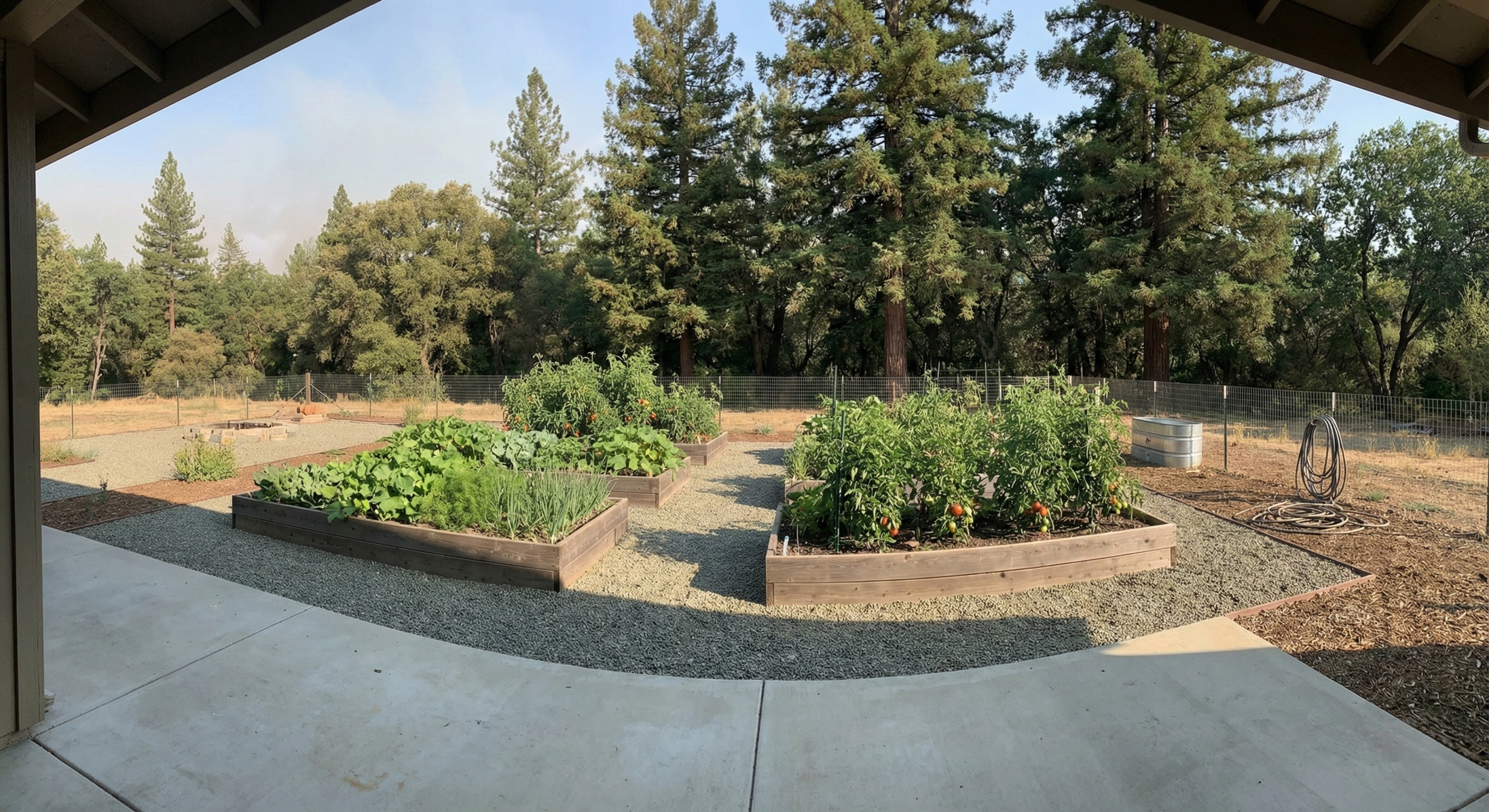
Gravel, stone, or concrete
Brick or paver patios
No vegetation or planted containers
Non-combustible rock mulch only
What doesn't belong:
Wood mulch or bark
Dead plants or leaves
Stored firewood
Wooden trellises against the house
Dense shrubs touching walls or windows
Plastic furniture or combustible storage
For current statewide guidance, see CAL FIRE's defensible-space page and the Board of Forestry for pending Zone 0 rules. The existing CAL FIRE guidance link remains available. The February 2025 advisory FAQ is historical background; use the current Board page for regulation status.
Zone 1: Lean, Clean, and Green (5-30 feet)
This zone creates separation between your home and larger vegetation. The goal is reducing fire intensity and flame length.
Goals:
Create "lean" conditions with reduced fuel
Keep plants "clean" of dead material
Maintain "green" with adequate irrigation
Guidelines:
Space shrubs apart (at least twice their height in distance)
Remove lower branches from trees (limb up to 6-10 feet, or one-third of tree height for smaller trees)
Keep grass mowed to 4 inches maximum
Remove dead branches, leaves, and debris regularly
Create fuel breaks with pathways, patios, or driveways. Fire-wise fencing and structures can also serve as effective fuel breaks
Evaluate site-suitable plants, placement, and maintenance outside Zone 0
Tree spacing:
10 feet between tree canopies on flat ground
More separation on slopes (fire travels faster uphill)
Zone 2: The Reduced Fuel Zone (30-100 feet)
This outer zone focuses on reducing fire intensity before it reaches your inner zones. The Fire Safe Council of Santa Cruz County provides local guidance on maintaining this zone.
Goals:
Reduce overall fuel load
Create horizontal and vertical spacing
Interrupt fire's path
Guidelines:
Remove dead wood and debris
Space trees so canopies don't touch
Remove "ladder fuels" (vegetation that allows fire to climb from ground to tree canopy)
Create islands of vegetation rather than continuous fuel
Maintain access for firefighters
What Makes a Plant Fire-Resistant?
No plant is fireproof, but some characteristics make plants less likely to ignite and spread fire. Keep in mind that siting and maintenance matter as much as species choice. Even a "fire-resistant" plant becomes hazardous if it's dead, drought-stressed, or poorly maintained.
Free planting guide
Know what to plant, and when, in Santa Cruz County
Free planting guide
Know what to plant, and when, in Santa Cruz County
Join the free Ambitious Harvest email list for seasonal planting reminders and practical Central Coast gardening notes. As a welcome, I will send you the one-page California Seed Starting Cheat Sheet, so you always know what to start indoors, what to sow direct, and the right timing for your zone.
Send me the planting guide
One email field, no name needed. Unsubscribe anytime.
Join the free Ambitious Harvest email list for seasonal planting reminders and practical Central Coast gardening notes. As a welcome, I will send you the one-page California Seed Starting Cheat Sheet, so you always know what to start indoors, what to sow direct, and the right timing for your zone.
Send me the planting guide
One email field, no name needed. Unsubscribe anytime.
Look for plants that are:
High in moisture content
Low in oils and resins
Slow to accumulate dead material
Low-growing or easily pruned
Avoid plants that are:
Highly aromatic (often means high oil content)
Prone to accumulating dead leaves and branches
Tall with dense, dry canopies
Known fire hazards like juniper, cypress, eucalyptus, acacia, broom, pampas grass, and large masses of ornamental grasses
How Should You Evaluate Plants Outside Zone 0?
Native status, Mediterranean origin, drought tolerance, and dry-summer adaptation do not establish fire resistance. UC ANR recommends evaluating mature size, density, waxes, oils or resins, litter, spacing, location, and maintenance. All plants can burn.
Choose site-suitable plants that you can maintain, and do not assume lavender or rockrose is low-oil or inherently safer. Our groundcover guide provides horticultural context.
Simple Steps to Get Started
You don't have to redo your entire landscape at once. Start with these high-impact actions:
Clear the first 5 feet around your home. Remove all vegetation, planted containers, combustible mulch, and debris throughout the first 5 feet. Use gravel, stone, or concrete here instead.
Remove dead material. Dead leaves, branches, and spent flowers are the easiest fuel to eliminate.
Create spacing. Look at your shrubs and trees. Can fire easily jump from one to the next? Add gaps where you can.
Rethink your mulch. Wood mulch close to the house can be a fire risk. Consider gravel or decomposed granite within Zone 1, especially closer to the house.
Make a maintenance plan. Fire-wise gardening is ongoing. Proper summer irrigation for fire safety is part of the routine. Plan to clear debris in late spring (before fire season) and again in fall (after the dry season).
Beauty and Safety Can Coexist
A maintained garden can remain colorful and useful outside Zone 0. Native and drought-tolerant plants may suit the site, but those traits are not fire-safety ratings. Combine plant care with appropriate spacing, home hardening, and local guidance.
The key is working with our environment rather than against it. That's what Santa Cruz gardening is all about.
Go deeper · Recommended guide
Firewise Food Garden Kit
Make your food garden part of your defensible space plan.
$14.99View the guide
Frequently Asked Questions About Fire-Wise Gardening in Santa Cruz County
What are the three zones of defensible space in California?
Ambitious Harvest recommends keeping Zone 0, the first 5 feet around buildings, decks, and attached structures, free of all vegetation, including planted containers, combustible mulch, and other combustible materials. Zone 1 extends from 5 to 30 feet, and Zone 2 from 30 to 100 feet, or to the property line if closer. CAL FIRE describes these zones. Zones 1 and 2 are legally required where California defensible-space law applies. As of October 12, 2026, statewide Zone 0 regulations are not yet legally required statewide; check your local fire district for stricter rules and current requirements.
What plants are fire-resistant in Santa Cruz County?
No plant list provides a reliable fire-safety rating. UC ANR recommends evaluating traits, placement, and care. Do not treat lavender, rockrose, or another species as inherently safer based on origin or generalized oil content.
How much defensible space do I need around my home in Santa Cruz County?
Where PRC 4291 applies, California requires management in Zones 1 and 2 to 100 feet or the property line if closer. Statewide Zone 0 rules are not yet legally required as of October 12, 2026. AH recommends a vegetation-free and combustible-material-free first 5 feet now. Confirm local requirements with your fire district.
Are succulents fire-resistant?
Succulents store water but are not fireproof or a rated barrier. Keep all succulents and planted containers outside Zone 0, and remove dry material and control spread.
What should I avoid planting near my home for fire safety?
Avoid highly flammable plants near your home, including juniper, cypress, ornamental grasses (especially pampas grass), eucalyptus, acacia, broom, and plants with high oil content like rosemary in large masses. Also avoid plants that accumulate dead material or have fine, dry foliage. Keep wood mulch, bark, and combustible materials away from the first 5 feet around your home.
How often should I maintain my defensible space?
Defensible space requires ongoing maintenance. Clear dead plant material and debris at least twice a year, in late spring (before fire season) and fall (after the dry season). Keep grass mowed to 4 inches maximum, remove dead branches regularly, and ensure irrigation is working properly. In high-risk areas of Santa Cruz County, more frequent maintenance may be needed during dry years.
Can I still have a vegetable garden in a fire zone?
A vegetable garden can fit into defensible space outside Zone 0, but moisture does not make it a firebreak or guarantee safety. Inspect crop residue, mulch, trellises, bed frames, irrigation, and nearby fuels; remove spent plants promptly. Drip irrigation supports routine root-zone watering, not fire defense.
What did the CZU Lightning Complex fires teach us about defensible space?
The 2020 CZU Lightning Complex fires showed that homes with proper defensible space and ember-resistant zones had a much better chance of survival. Embers traveling ahead of the fire were the primary cause of home ignition, not the fire front itself. This reinforced the importance of clearing Zone 0 completely and maintaining clean, spaced vegetation in Zones 1 and 2, especially in Boulder Creek, Ben Lomond, Bonny Doon, and other mountain communities. If you are recovering from fire damage, see our guide on restoring your garden post-wildfire.
Are drought-tolerant plants also fire-safe?
Drought tolerance does not directly establish fire resistance. Assess mature size, spacing, oils or resins, litter, dead material, and care. See CAL FIRE's guidance and UC ANR.
Free Fire-Wise Gardening Resources
Download these guides to help create a safer landscape:
Fire-Wise Gardening Guide. Comprehensive guide to fire-resistant landscaping for Santa Cruz County.
Water-Wise Gardening Guide. Many fire-resistant plants are also drought-tolerant; this guide covers both.
Know Your Microclimate Worksheet. Understanding your property's specific conditions helps you plan effective fire-wise landscaping.
Garden Troubleshooting Guide. Solutions for common garden problems, including maintaining healthy, fire-resistant plants.
