

California Lilac: The Drought-Proof Shrub That Blooms Blue
A few of the product links in this guide are affiliate links. If you buy through one, Ambitious Harvest may earn a small commission at no extra cost to you, which helps keep these guides free. We only point to gear we would use in our own Santa Cruz garden. As an Amazon Associate, we earn from qualifying purchases. Read our full disclosure.
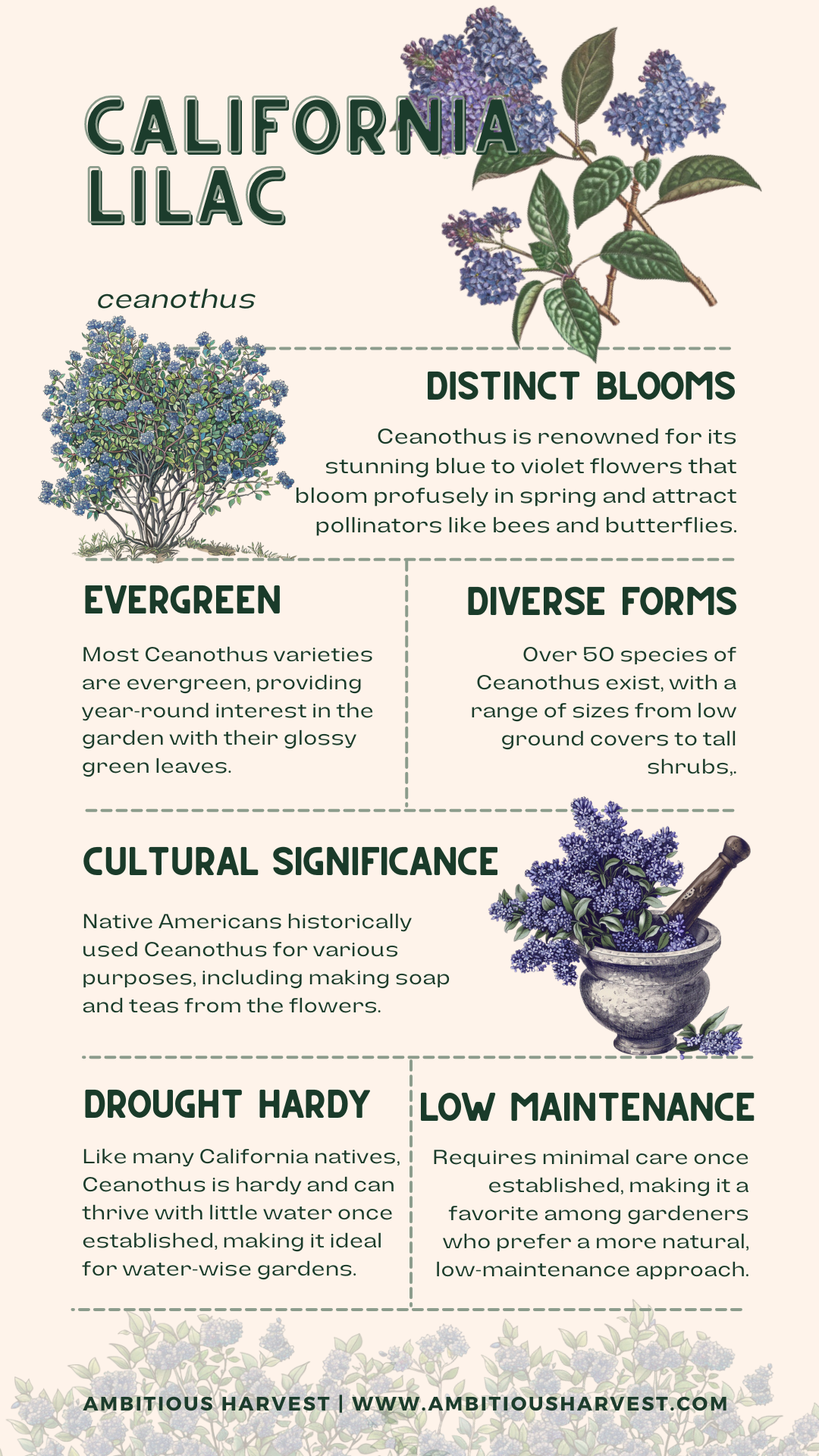
Ceanothus (California lilac) is a drought-tolerant, nitrogen-fixing native shrub that produces dense clusters of blue, purple, or white flowers from March through May. The USDA Forest Service counts 55 species in the genus, 38 of them restricted to the California floristic province, ranging from low ground covers to small trees reaching 20 feet. In Santa Cruz County, ceanothus thrives in full sun with no supplemental irrigation once established, typically within two growing seasons.
For Santa Cruz County gardeners, California lilac offers an irresistible combination: drought tolerance, year-round evergreen foliage, explosive spring blooms, and tremendous value for pollinators. These plants evolved right here in California's Mediterranean climate, making them perfectly adapted to our wet winters and dry summers. Once established, most species need no supplemental water at all.
Ceanothus is a genus of about 50 to 60 species native primarily to the West Coast of North America, with roughly 40 species in California and others extending north into Oregon and south into Baja California. In the wild, they grow on dry slopes, chaparral, and open woodland. There is a California lilac for a low groundcover on a slope, for a mid-sized shrub in a mixed border, and for a large specimen to anchor a landscape. And unlike many ornamental shrubs that demand regular irrigation, fertilizer, and fussing, Ceanothus thrives on benign neglect.
What Is California Lilac?
What Makes Ceanothus Special
California lilacs belong to the buckthorn family (Rhamnaceae), not the true lilac family, despite their common name. The resemblance comes from their clustered, fragrant flowers, though Ceanothus blooms are typically smaller and more densely packed than true lilacs.
Most garden Ceanothus sold in California, including cultivars like Ray Hartman, Dark Star, Julia Phelps, and Yankee Point, are evergreen shrubs that hold their glossy foliage year-round. A smaller number of species and cultivars are deciduous and behave differently under hard pruning. The Royal Horticultural Society notes that evergreen Ceanothus generally do not tolerate hard pruning into old wood, while deciduous types can be cut back more strongly.
Like lupines, Ceanothus species are nitrogen-fixers. Symbiotic bacteria in their root nodules convert atmospheric nitrogen into a form that enriches the soil. This ability allows them to thrive in the nutrient-poor, well-drained soils where they naturally occur, and it means they actually improve conditions for neighboring plants. The UC Master Gardeners of Napa County note that Ceanothus performs this feat through its symbiotic relationship with Frankia bacteria in its root nodules. This is also why they don't need (and shouldn't receive) supplemental fertilizer.
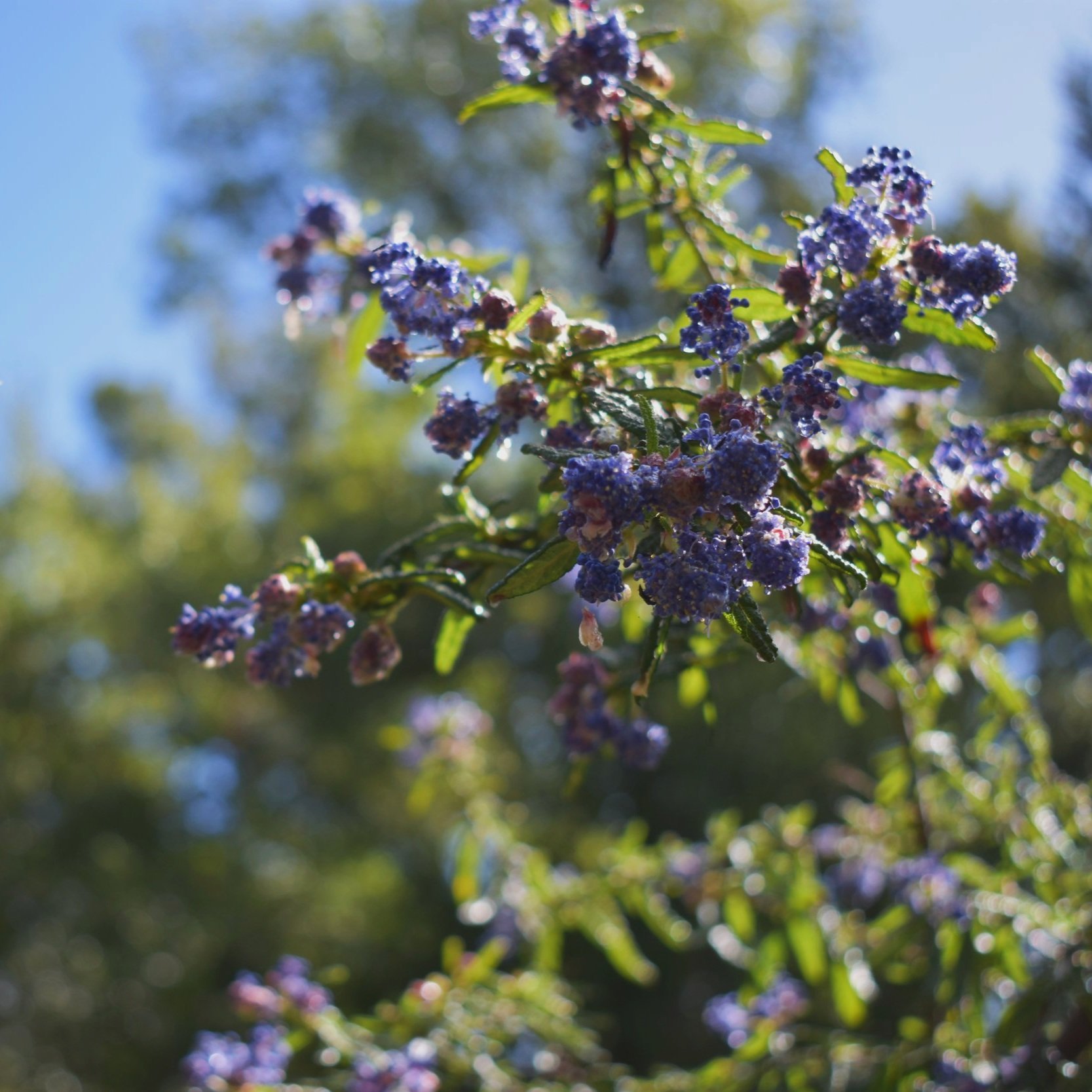
The flowers, while individually tiny, appear in such profusion that they create a solid mass of color. Most species bloom in shades of blue (from pale powder blue to deep indigo), but white and pink varieties also exist. The fragrance attracts an astonishing diversity of pollinators, including native bees, honeybees, butterflies, and beneficial flies.
What Are the Best California Lilac Species for Santa Cruz Gardens?
With so many species and cultivars available, choosing the right Ceanothus can feel overwhelming. San Marcos Growers notes that Ceanothus "range in size from prostrate, mat-forming groundcovers to arborescent shrubs that attain 20 feet in height." Here are some reliable performers for our local conditions, organized by size.
Large Shrubs and Small Trees (8 to 20 feet)
Blue Blossom (Ceanothus thyrsiflorus): This is the species you'll see growing wild throughout Santa Cruz County, from coastal bluffs to mountain slopes. Linda Vista Native Plants notes that Blue Blossom "is the dominant ceanothus on the Pacific side of the Santa Cruz Mountains." It can reach 15 to 20 feet tall and wide, with dark green glossy leaves and pale to medium blue flowers in spring. Blue Blossom tolerates more shade than most Ceanothus and handles coastal conditions well. It's an excellent choice for large spaces where you want a substantial native presence.
Ray Hartman: A popular hybrid that grows 12 to 20 feet tall with medium blue flowers. It's one of the most widely available and reliable Ceanothus for gardens, tolerating a range of conditions including some summer water if drainage is excellent.
Medium Shrubs (4 to 8 feet)
Dark Star: A stunning cultivar with deep cobalt blue flowers and small, dark green leaves. It grows 5 to 6 feet tall and 8 to 10 feet wide, making it perfect for hedges or specimen planting. Dark Star is one of the most intensely colored Ceanothus available.
Julia Phelps: Similar to Dark Star with deep indigo flowers, growing 4 to 7 feet tall. The small, crinkled leaves give it a fine texture, and it's particularly drought-tolerant once established.
Concha: A vigorous grower reaching 6 to 8 feet tall with arching branches covered in dark blue flowers. One of the most reliable and floriferous cultivars for gardens.
Low Groundcovers and Spreading Forms (1 to 3 feet)
Yankee Point (Ceanothus griseus var. horizontalis 'Yankee Point'): An excellent groundcover growing 2 to 3 feet tall and spreading 8 to 10 feet wide. Medium blue flowers cover the plant in spring. Perfect for slopes, banks, or cascading over walls.
Centennial: A low, dense groundcover reaching just 1 to 2 feet tall but spreading 6 to 10 feet. Deep blue flowers and very drought-tolerant once established. Ideal for covering large areas or replacing lawn.
Point Reyes (Ceanothus gloriosus): Native to coastal areas, this groundcover grows 1 to 2 feet tall and spreads 6 to 12 feet. Lavender-blue flowers bloom in spring. It tolerates fog and coastal conditions exceptionally well.
How Do You Grow California Lilac in Santa Cruz County?
When to Plant
Fall (October through December) is the ideal planting time for Ceanothus in Santa Cruz County. Planting during our rainy season allows roots to establish before the stress of summer drought. The winter rains do the watering for you, and by the following summer, your plants will have developed enough root mass to handle dry conditions.
Early spring planting (February through March) can also work, but you'll need to provide supplemental water through the first summer.
Avoid planting in summer. Even with irrigation, the heat and dryness stress new plants, and Ceanothus particularly resents having wet roots during warm weather. Understanding your Santa Cruz microclimate will help you choose the best Ceanothus species and planting location for your specific conditions.
Soil and Drainage Requirements
Good drainage is non-negotiable for California lilac. These plants evolved on dry slopes, chaparral, and rocky soils where water drains quickly. In heavy clay or poorly draining soil, Ceanothus will almost certainly develop root rot and die, often within a few years of planting.
The UC Master Gardeners recommend planting on a low, raised mound where drainage is slow in heavy soil. If you have clay soil, consider these strategies:
Plant on slopes or berms where water naturally drains away
Amend the planting area with generous amounts of gravel or decomposed granite
Choose a naturally well-drained location, even if it means adjusting your original plan
Consider raised beds or planter boxes for smaller cultivars
Ceanothus prefers lean, nutrient-poor soil. Rich garden soil amended with lots of compost can actually cause problems, promoting soft, fast growth that's susceptible to disease. If your soil is already rich and amended, don't add more organic matter when planting.
Planting Instructions
Dig a hole twice as wide as the root ball but no deeper. Ceanothus planted too deeply is prone to crown rot.
Check drainage by filling the hole with water and timing how quickly it drains. If water sits for more than an hour, choose a different location or create a raised planting mound.
Remove the plant from its container and gently loosen any circling roots. Don't break up the root ball excessively.
Set the plant so the top of the root ball is level with or slightly above the surrounding soil. Never bury the crown.
Backfill with the native soil you removed (don't amend with compost for Ceanothus). Firm gently to eliminate air pockets.
Create a watering basin around the plant for the first year, then remove it. You don't want water pooling near established plants.
Mulch lightly with gravel or wood chips, keeping mulch several inches away from the stem to prevent rot.
Watering
Linda Vista Native Plants advises that "after the plant is established, it is best to withhold all supplemental irrigation. Irrigation will shorten the life of a ceanothus."
First year: Water deeply every week or two during dry weather to help roots establish. Reduce frequency as fall rains begin.
Second year: Water deeply once or twice monthly during summer if there's no rain. Many plants can go without supplemental water by the second summer, especially in cooler coastal areas.
Established plants (three years and older): Most Ceanothus species need no supplemental irrigation once established. In fact, summer watering is one of the most common causes of Ceanothus death in gardens. If you must water established plants, do so infrequently and deeply, allowing soil to dry completely between waterings.
The exception: If you've planted Ceanothus near a lawn or other irrigated area, the regular water can cause problems. Either adjust your irrigation to keep water away from the Ceanothus, or relocate the plant.
Fertilizing
Don't fertilize Ceanothus. As nitrogen-fixers, they create their own fertilizer through root nodule bacteria. Additional nitrogen promotes weak, leggy growth and reduces flowering. Even slow-release fertilizers are unnecessary and potentially harmful.
Pruning
Light pruning after flowering helps maintain shape and promotes dense growth. Here's what to know:
Timing: Prune after flowering finishes, typically late spring. This allows new growth to mature and set flower buds for the following year.
Method: Use hand pruners or hedge shears to shape plants lightly. Remove up to one-third of the current season's growth.
Avoid: Never cut into old wood (thick brown stems). Evergreen Ceanothus doesn't regenerate well from old wood, and severe pruning can kill plants or leave them permanently disfigured. Replace severely overgrown plants rather than attempting drastic renovation.
Groundcovers: Generally need no pruning except to remove any dead branches.
What Are Common Ceanothus Problems and Solutions?
Despite their toughness, Ceanothus can struggle in certain conditions. The UC IPM program provides guidance on managing common Ceanothus pests and diseases. Understanding these challenges helps you set your plants up for success.
About Lifespan
Many Ceanothus species are naturally short-lived. UC Master Gardeners put the average life cycle at 10 to 15 years or longer in native habitat. That is not a defect, and it is not the whole story either: excess summer water and unneeded soil amendments are what cut a garden ceanothus short. Plan for eventual replacement, and enjoy the spectacular show while they're thriving.
Why Does California Lilac Matter for Your Garden?
Pollinator Paradise
Few garden plants rival Ceanothus for pollinator activity. During peak bloom a large shrub hums from mid-morning until the light goes. NC State Extension notes that Ceanothus flowers "attract hummingbirds, honey and bumble bees and butterflies." Native bumblebees, mining bees, sweat bees, and carpenter bees all work the flowers alongside honeybees. Butterflies (including painted ladies, swallowtails, and blues), beneficial flies, and even beetles join the feast.
The flowers' fragrance carries on the breeze, drawing pollinators from considerable distances. If you want to create a pollinator garden, Ceanothus should be near the top of your plant list.
Butterfly Host Plant
Several butterfly species use Ceanothus as a larval host plant. California Flora Nursery notes that Ceanothus is "a larval host for many native butterfly species such as the ceanothus silk moth, California tortoiseshell butterfly, and the hedgerow hairstreak." Other documented associates include the echo blue that depend on Ceanothus. The foliage provides food for caterpillars, while the flowers feed adult butterflies.
Wildlife Habitat
Beyond pollinators, Ceanothus provides valuable habitat for other wildlife. The dense branching structure offers nesting sites and cover for birds. NC State Extension notes that seeds are eaten by birds and small mammals. Various songbirds nest in larger Ceanothus species, while the seed capsules provide food in late summer and fall.
The leaf litter beneath Ceanothus creates habitat for beneficial insects, spiders, and other invertebrates that form the base of the food web.
Soil Improvement
As nitrogen-fixers, Ceanothus actively improve soil fertility. The bacteria in their root nodules capture atmospheric nitrogen and convert it to forms that enrich the surrounding soil. The USDA Forest Service monograph highlights their role in soil nitrogen regimes and soil development. This makes them excellent pioneer plants for disturbed or poor-quality sites.
Fire Ecology
In fire-adapted landscapes, Ceanothus plays an important ecological role. The USDA Fire Effects Information System describes Ceanothus species as key components of fire-adapted chaparral, with many species regenerating from soil seed or resprouting after fire. Seeds may lie dormant in the soil for decades, germinating only after fire scarifies them.
While this fire adaptation is ecologically important, it has implications for home landscapes. In fire-prone areas, maintain defensible space around structures and keep Ceanothus appropriately distanced from buildings. See our Fire-Wise Gardening Guide for detailed guidance on plant placement in defensible space zones.
How Do You Plan Companion Planting and Landscape Design?
California lilac combines beautifully with other drought-tolerant natives that share similar growing requirements. If you are exploring native garden design in Santa Cruz, Ceanothus is one of the most versatile foundation plants you can choose.
Native shrub border: Ceanothus + manzanita (Arctostaphylos) + toyon + coffeeberry. This combination provides year-round interest with varied foliage textures, sequential bloom times, and berries for wildlife.
Pollinator garden: Ceanothus + California fuchsia + buckwheat + native sages + sticky monkey flower. Blooms from late winter through fall, providing continuous food for pollinators.
Slope stabilization: Groundcover Ceanothus + native bunch grasses + lupine + California poppy. The deep-rooted Ceanothus anchors the slope while other plants fill in gaps.
Low-water mixed border: Ceanothus + lavender + rosemary + rockrose (Cistus). Mediterranean-climate plants that all thrive with minimal summer water.
Avoid planting Ceanothus with: Water-loving plants like roses, hydrangeas, or vegetables that need regular irrigation. The conflicting water needs make it nearly impossible to keep both happy.
Where Can You Find California Lilac Locally?
Several local sources carry Ceanothus species and cultivars:
Sierra Azul Nursery (Watsonville): Excellent selection of California natives including many Ceanothus species and cultivars. Their demonstration garden showcases plants in landscape settings.
Far West Nursery (Aptos): Carries California natives including many Ceanothus selections.
CNPS Santa Cruz Chapter Plant Sales: The California Native Plant Society holds spring and fall plant sales at Cabrillo College with locally appropriate native species, often including several Ceanothus options.
UCSC Arboretum Plant Sales: Seasonal sales featuring California natives and Mediterranean-climate plants, including Ceanothus.
Dig Gardens (Santa Cruz & Aptos): Curated selection of natives.
San Lorenzo Garden Center (Santa Cruz): General nursery that often carries popular Ceanothus cultivars.
Calscape.org: The California Native Plant Society database helps you identify which Ceanothus species are native to your specific area and provides information on their growing requirements.
Check our Garden Events Calendar for native plant sales, garden tours, and workshops.
Locally you will often find only one or two ceanothus varieties on the bench. If you have a specific selection in mind, our guide to the native plant nurseries worth the drive from Santa Cruz covers where the deeper ceanothus lists are.
Frequently Asked Questions About Growing California Lilac
Why did my California lilac suddenly die after several years of looking healthy?
Sudden death in established Ceanothus almost always indicates root rot, typically caused by overwatering or poor drainage. The plant may look fine until the root system is severely compromised, then collapse quickly. This is especially common when Ceanothus is planted near lawns or other irrigated areas where it receives water it doesn't need. Unfortunately, there's no treatment once root rot is established. For future plantings, ensure excellent drainage and avoid summer irrigation once plants are established.
How long do California lilacs live?
Most Ceanothus species are naturally short-lived, with UC Master Gardeners giving an average life cycle of 10 to 15 years or longer in native habitat. Some gardeners see this as a drawback. It is worth knowing that excessive summer water and soil amendments are the usual reason a garden plant comes in at the short end of that range. Plan for eventual replacement by starting new plants before your existing ones decline, or simply enjoy the spectacular show they provide during their lifespan.
Can I prune my California lilac into a hedge?
Yes, with caveats. Ceanothus responds well to light shearing after flowering, making some cultivars suitable for informal hedges. However, avoid cutting into old wood (the thick brown stems), as evergreen Ceanothus doesn't regenerate well from old wood. Stick to trimming the current season's growth only. Dark Star, Concha, and Julia Phelps all make attractive hedges with regular light pruning.
My California lilac barely flowers. What's wrong?
Lack of flowering usually indicates one of three issues: too much shade (Ceanothus need full sun for best flowering), too much nitrogen (from fertilizer or rich soil, which promotes leaves over flowers), or pruning at the wrong time (which removes flower buds). Ensure your plant gets at least 6 hours of direct sun, stop fertilizing, and prune only immediately after flowering.
Which California lilac is most deer-resistant?
Unfortunately, deer find most Ceanothus species palatable, and no variety is truly deer-proof. In areas with heavy deer pressure, protect young plants with temporary fencing until they're well-established. Larger, well-established plants can tolerate some browsing. If deer are a major problem, consider more deer-resistant natives like manzanita, toyon, or California fuchsia.
Can I grow California lilac in a container?
It's possible with compact varieties, but Ceanothus generally perform better in the ground. Their extensive root systems and dislike of overwatering make container culture challenging. If you want to try, choose a small cultivar like Centennial, use a large container with excellent drainage, and use a fast-draining soil mix with minimal organic matter. Water sparingly and never let the container sit in a saucer of water.
What's the best California lilac for a small garden?
For limited space, look at groundcover types like Yankee Point or Centennial, which spread horizontally rather than growing tall. For a small upright shrub, Dark Star and Julia Phelps stay relatively compact (5 to 7 feet) and can be maintained even smaller with regular light pruning after flowering.
Do California lilacs fix nitrogen like lupines?
Yes. Ceanothus species form symbiotic relationships with nitrogen-fixing bacteria in their root nodules. The partner is a Frankia actinobacterium rather than the rhizobia that legumes host, but the result is the same. It allows them to thrive in nutrient-poor soils and actually improve soil fertility over time. This is also why they don't need (and shouldn't receive) supplemental fertilizer.
Are California lilacs evergreen or deciduous?
Most garden Ceanothus are evergreen, holding their leaves year-round. A smaller number of species and cultivars are deciduous. The distinction matters for pruning: evergreen types don't tolerate hard pruning into old wood, while deciduous types can be cut back more strongly. All the commonly sold cultivars mentioned in this article (Dark Star, Julia Phelps, Ray Hartman, Yankee Point, etc.) are evergreen.
When and how should I prune California lilac?
Prune just after flowering finishes in late spring, and keep it light. Pinch or trim new growth to shape the plant, and remove dead or crossing branches. Avoid cutting into bare wood thicker than about an inch, since ceanothus rarely resprouts from old wood, and skip pruning in wet weather to limit disease.
Free California Lilac Growing Resources
Water-Wise Gardening Guide: Comprehensive strategies for reducing water use in your Santa Cruz garden while keeping plants thriving.
Know Your Microclimate Worksheet: Identify your garden's specific growing conditions to choose the right Ceanothus species for your location.
Fire-Wise Gardening Guide: How to create beautiful, productive gardens that also protect your home, including guidance on plant placement in defensible space zones.
Companion Planting Guide: Learn which plants grow well together for healthier, more productive gardens.
Seasonal Planting Calendar: Month-by-month guide to planting times for Santa Cruz County.
A Blue Wave for Your Garden
Few plants deliver as much impact with as little input as California lilac. These tough, beautiful shrubs ask for well-drained soil and sunshine, then reward you with clouds of fragrant blue flowers, year-round evergreen foliage, and a garden buzzing with pollinators. For more strategies to reduce water use in your landscape, see our guide to water-wise gardening in California.
Choose a spreading groundcover to blanket a slope, a compact shrub to anchor a border, or a large specimen for a focal point. Any of them adds one of California's most spectacular native plants to your landscape.
Plant this fall. Choose a sunny spot with excellent drainage, resist the urge to water and fertilize, and let your Ceanothus do what it does best. By next spring, you'll understand why gardeners throughout California consider this plant indispensable.

| Size / Form | Example Species & Cultivars | Typical Size | Best Uses |
|---|---|---|---|
| Large shrubs / small trees | Blue Blossom (C. thyrsiflorus), ‘Ray Hartman’ | 12 to 20 ft tall and wide | Screen or specimen shrub, native hedgerow, large backdrop plant |
| Medium shrubs | ‘Dark Star’, ‘Julia Phelps’, ‘Concha’ | 4 to 8 ft tall, often wider than tall | Mixed borders, informal hedges, pollinator-focused garden beds |
| Groundcovers / low spreaders | ‘Yankee Point’, ‘Centennial’, ‘Point Reyes’ | 1 to 3 ft tall × 6 to 12 ft wide | Slope stabilization, bank covers, cascading over walls, lawn replacement |
| Microclimate Area | Recommended Ceanothus | Soil / Drainage Notes |
|---|---|---|
| Coastal (Aptos, Capitola, Live Oak, Santa Cruz beaches) | Groundcovers such as ‘Point Reyes’ and ‘Yankee Point’; Blue Blossom | Naturally cool sites with sandy or well-drained soils; tolerant of fog and light salt spray |
| San Lorenzo Valley chaparral (Boulder Creek, Ben Lomond – sunny exposures) | Medium shrubs including ‘Dark Star’, ‘Julia Phelps’, and ‘Concha’ | Hot, dry summers and cool, wet winters mirror native chaparral conditions; excellent for drought-adapted Ceanothus |
| Under the redwoods (Felton, shaded canyons) | Blue Blossom only where 4 to 6 hours of direct sun are available | Avoid deep shade and saturated soils; sufficient sun is required for healthy growth and flowering |
| Inland valleys (Scotts Valley, Soquel hills) | Most species and cultivars | Warmer conditions promote strong bloom; moderate soils support nearly all Ceanothus types |
| Pajaro Valley (Watsonville) | Most species, with attention to site preparation | Use berms or raised planting areas to improve drainage in heavier agricultural soils |
| Problem | Likely Cause | Solution |
|---|---|---|
| Plant dies suddenly after years of looking fine | Chronic overwatering, poor drainage, or root rot pathogens | Avoid summer irrigation once established; plant on slopes or in fast-draining soil; do not replant Ceanothus in the same saturated location |
| Gradual yellowing leaves and branch dieback | Excess summer water; waterlogged roots; heavy clay with poor drainage | Stop watering; improve drainage with berms or raised beds for future plantings; avoid planting near lawns |
| Plant short-lived (10 to 15 years) | Natural lifespan; many Ceanothus are relatively short-lived even under ideal conditions | Plan for replacement every 10 to 20 years; establish new plants before older ones decline |
| Sparse bloom, lots of leaves | Too much shade, excess nitrogen, or pruning at the wrong time | Ensure at least 6 hours of sun; stop fertilizing; prune lightly and only right after flowering |
| Plant collapses after hard pruning | Cutting into old wood on evergreen Ceanothus, which does not regenerate from older stems | Tip-prune only current season’s growth after bloom; replace severely overgrown plants rather than cutting back hard |
| Heavy deer browsing, especially on young plants | Ceanothus foliage is palatable to deer; no truly deer-proof varieties | Protect young plants with cages or fencing until established; combine with more deer-resistant companion plants in high-browse areas |
| Aphids on new growth, sticky honeydew, sooty mold | Spring aphid infestations feeding on soft new shoots | Spray off with a strong jet of water; rely on beneficial insects; use horticultural soap only for severe infestations |
| Poor establishment or early death in heavy clay | Roots suffocating in poorly drained clay; Ceanothus evolved on rocky, fast-draining slopes | Plant on mounds or slopes; incorporate gravel to improve drainage, or choose a different plant for heavy clay areas |
