

Fire-Wise Design for Slopes and Hillsides
Some links in this guide are affiliate links. If you buy through them, we may earn a small commission at no extra cost to you. Read our full disclosure.
Why Does Fire Run Uphill?
If you live on a hillside in Santa Cruz County (and many of us do) you face unique fire challenges. Fire behavior on slopes is dramatically different from fire behavior on flat ground, and standard defensible space guidance doesn't always translate directly to steep terrain.
The basic principle is simple: fire runs uphill. Fast. A fire moving upslope travels many times faster than one on flat ground, generating more heat and creating longer flame lengths. If your home is above a slope, you're in a more vulnerable position than the same home would be on flat land.
Understanding slope effects isn't meant to frighten you. It's meant to inform your fire-wise landscaping decisions. Hillside living is wonderful. It just requires extra attention to fire safety.
How Do Slopes Change Fire Behavior?
Several factors make slopes more dangerous:
Preheating
Fire climbing a slope preheats vegetation above it. Hot air rises, and as the fire burns, it dries and warms the fuels ahead of it. By the time flames reach that vegetation, it ignites more readily.
Faster Spread
Fire moves up slopes far faster than across flat ground. On a 20-40% slope, rate of spread can roughly double or more compared with flat ground, with much longer flames, especially in brush and grass fuels. A fire that might give you an hour's warning on flat ground could reach you in minutes on a steep slope.
Longer Flame Lengths
On slopes, flames angle uphill and become longer. Flame lengths of 20 to 30 feet are common on steep slopes, compared to 4 to 6 feet on flat ground. These longer flames reach higher into vegetation and structures.
Chimney Effect
Narrow draws and canyons create a "chimney effect," funneling fire rapidly upward with intense heat. If your property is above a canyon or draw, this increases your risk significantly.
Downhill Fire Behavior
Fire moving downhill is slower and less intense, but don't ignore downslope areas. Wind can push fire downhill, and embers land both above and below the fire.
| Slope category | Example slope | What changes for fire | Key design focus |
|---|---|---|---|
| Gentle | 0 to 15% | Fire spread is similar to flat ground; standard defensible-space zones are usually adequate | Standard Zone 0 to 2 layout; normal shrub and tree spacing |
| Moderate | 15 to 30% | Faster upslope spread and longer flame lengths; vegetation ignites more easily | Increase shrub and tree spacing by one class; consider extending Zone 2 somewhat downslope |
| Steep | 30 to 45% | Fire can reach homes quickly from below with long flame lengths and high radiant heat | Extend reduced-fuel areas downslope toward 150 to 200 ft where possible; add terraces, retaining walls, and fuel breaks |
| Very steep or canyon edge | Over 45% or above a draw | “Chimney effect” can send fire rapidly upslope with extremely intense heat | Maximize hardscape and non-combustible breaks below structures; minimize vegetation at slope edges; seek site-specific professional guidance |
How Do You Assess Your Slope?
Before designing your fire-wise landscape, understand your terrain:
Slope Percentage
Measure or estimate your slope:
Gentle: 0 to 15%
Moderate: 15 to 30%
Steep: 30 to 45%
Very steep: Over 45%
Steeper slopes require more extensive defensible space.
Position Relative to Slope
Where is your home positioned?
Top of slope (most vulnerable to upslope fire)
Mid-slope (vulnerable from below)
Bottom of slope (less vulnerable to fast-moving fire, but embers still a concern)
On a ridgetop (may be exposed to wind-driven fire from multiple directions)
Surrounding Terrain
What's below and around your home?
Open grassland (fast-moving grass fires)
Brush and chaparral (intense, slow-moving fires)
Forest (variable depending on type and condition)
Canyon or draw (chimney effect risk)
How Much Defensible Space Do Slopes Require?
Standard defensible space guidelines assume relatively flat ground. On slopes, you need to expand these zones, especially on the downhill side. The Fire Safe Council of Santa Cruz County explicitly recommends increasing buffers on steep slopes.
Zone 0 (Ember-Resistant Zone): Expand Downhill
Standard: 0 to 5 feet around the home
On slopes: On the downhill side, aim for 10 to 15 feet of non-combustible Zone-0-type treatment if you have room.
This critical zone needs even more attention because flames from below will reach higher along structures.
Zone 1 (Lean, Clean, and Green Zone): Extend Significantly Downhill
Standard: 5 to 30 feet
On slopes: Extend to 50 to 100 feet downhill, depending on slope steepness.
This is where slope effects matter most. Fire coming from below will gain speed and intensity as it approaches your home. More defensible space on the downhill side gives fire time to slow and drop before reaching your structure.
Zone 2 (Transition Zone): Expand Downhill
Standard: 30 to 100 feet
On slopes: Extend to 150 to 200 feet or more downhill on steep slopes.
On very steep slopes, even 200 feet may not be enough. Consult with your local fire department for site-specific recommendations.
Slope Spacing Guidelines
Some fire professionals suggest adding 25 to 50 feet of extra reduced-fuel zone for each major increase in slope class (for example, from 20-40% to over 40%), but there is no single official formula. CAL FIRE points homeowners to their local fire department or fire protection district, since county defensible space standards can be stricter than the state minimum.
How Should You Manage Vegetation on Slopes?
Slope vegetation requires special attention. CAL FIRE provides specific spacing guidelines that increase with slope steepness.
Fuel Ladders
Fuel ladders (vegetation that allows fire to climb from ground level to tree canopy) are especially dangerous on slopes. Eliminate them by:
Removing low branches from trees (limb up to 10 feet on slopes)
Creating vertical separation between shrubs and trees
Reducing understory vegetation
Removing dead material that bridges ground and canopy
Spacing
Increase spacing between plants on slopes. CAL FIRE's slope-adjusted spacing guidelines:
Shrubs (crown-to-crown spacing):
Under 20% slope: at least 2x shrub height
20-40% slope: 4x shrub height
Over 40% slope: 6x shrub height
Trees (crown-to-crown spacing):
Under 20% slope: 10 feet
20-40% slope: 20 feet
Over 40% slope: 30 feet
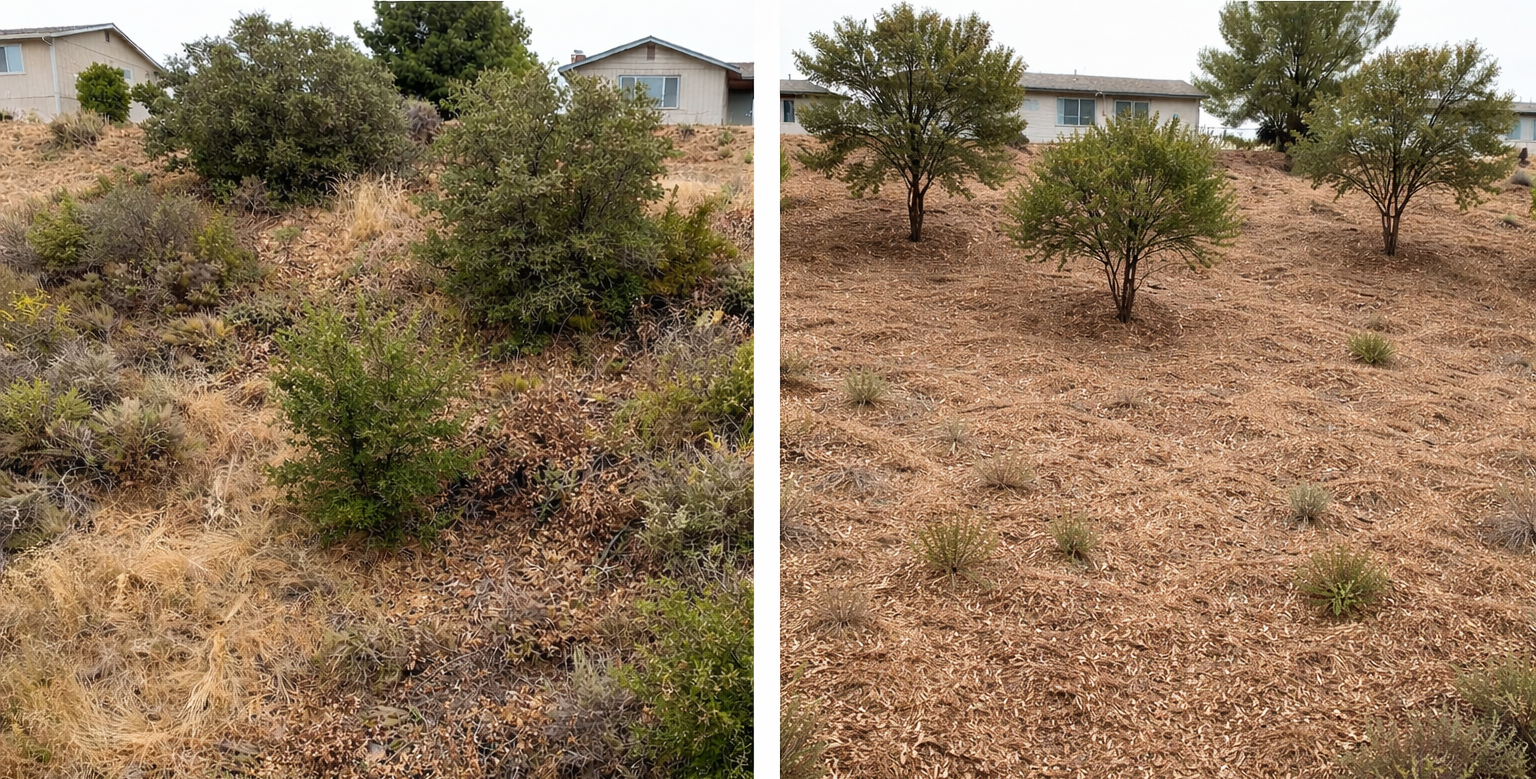
Avoid continuous vegetation on the slope below your home.
Ground Cover
Low-growing vegetation is preferable to tall shrubs on slopes:
Ground covers under 18 inches
Rock gardens and hardscaping
Anchor Points
Remove vegetation from natural fire "anchor points":
Where slopes meet flat areas
At the base of the slope below your home
In draws and drainage channels
How Do You Balance Fire Safety and Erosion Control?
Fire-wise vegetation management on slopes must balance fire safety with erosion control. Local guidance addresses this tension specifically for Santa Cruz County.
The Challenge
Removing vegetation from slopes can lead to erosion, especially during winter rains. Bare slopes can also be fire hazards (dry grass and weeds colonize quickly).
Solutions
Strategic vegetation retention:
Keep fire-resistant vegetation that stabilizes slopes
Native bunch grasses have deep roots and are fire-resistant
Low-growing shrubs can provide erosion control, but choose carefully
Note on coyote brush: Low, young coyote brush can help stabilize slopes, but older, woody plants can be quite combustible. Avoid it within 30 feet of structures and keep any plants on slopes pruned, widely spaced, and renewed before they become woody.
Erosion control structures:
Retain or install retaining walls on steep slopes
Consider terracing for very steep terrain
Use rock and hardscape to stabilize soil
Mulching:
Apply mulch to bare slopes to prevent erosion (but keep mulch away from structures)
Rock mulch is both fire-resistant and erosion-controlling
Replant strategically:
Replace flammable vegetation with fire-resistant, erosion-controlling alternatives
Don't leave slopes bare after clearing
How Can Hardscaping Create Fire Breaks on Slopes?
Create strategic fuel breaks across slopes. Fire-smart landscape guides recommend using hardscape elements as horizontal barriers.
Horizontal Breaks
Paths, driveways, and terraces that run across (perpendicular to) the slope create firebreaks:
Gravel pathways every 20 to 30 feet down the slope
Terraced planting areas with stone or concrete walls
Stone or concrete driveways and parking areas
Strategic Placement
Position hardscape to interrupt fire's uphill path:
Between the bottom of the slope and your home
At natural terrain breaks
Across draws or drainage paths
Materials
Use non-combustible materials:
Gravel and decomposed granite
Stone retaining walls
Concrete or paver terraces
Metal or stone edging
How Do Driveways Factor Into Hillside Fire Safety?
Hillside driveways present special considerations:
Evacuation Route
Your driveway is your escape route:
Keep at least 10 feet of clearance on each side (more on slopes)
Ensure trees don't overhang the drive
Remove vegetation that could burn and block evacuation
Ensure turnarounds are adequate for emergency vehicles
Driveway as Firebreak
A clear driveway creates a fuel break:
Gravel or paved surfaces are non-combustible
Clear vegetation from driveway edges
Consider widening if possible
How Does Slope Position Affect Structure Vulnerability?
Building placement and design affect vulnerability. Home-hardening guidance addresses these concerns specifically.
Position Awareness
Structures at the top of slopes are most vulnerable
Structures on steep slopes face longer flame lengths
Decks and overhangs on the downhill side are especially exposed
Elevated Structures
Many hillside homes have elevated decks, stilts, or exposed foundations:
Enclose under-structure areas with fire-resistant materials
Keep area below structures clear of all vegetation and debris
Screen any openings with 1/8-inch metal mesh
Deck Exposure
Downhill-facing decks are vulnerable to radiant heat and flames from below:
Consider fire-resistant decking materials
Remove all combustibles from deck surfaces during high-risk periods
Enclose under-deck areas completely
When Should You Work with Professionals?
Hillside fire-wise landscaping often benefits from professional input:
Consultations
CAL FIRE and its partners conduct defensible space inspections in State Responsibility Areas, and here in Santa Cruz County the Fire Safe Council of Santa Cruz County runs a free Home Ignition Zone assessment you can request for your own property.
Registered Professional Foresters can assess vegetation and recommend management
Landscape architects can design integrated erosion control and fire-wise landscapes
Geotechnical engineers may be needed for significant slope modifications
When to Call Professionals
Slopes over 30%
Properties above canyons or draws
Major vegetation removal that could affect erosion
Retaining wall construction
Tree removal on steep slopes
What About Special Hillside Situations?
Above a Canyon
If your property is above a canyon or draw:
Extend defensible space significantly on that side
Consider removing all vegetation at the canyon edge
Install hardscape firebreaks
Understand that fire behavior in the canyon will be extreme
Ridgetop Properties
Ridgetops may be exposed to fire from multiple directions:
Create defensible space on all sides
Be aware of wind patterns that could push fire from any direction
Ridgetops may experience higher wind speeds, increasing fire intensity
Below a Road
Roads act as firebreaks, but:
Don't rely solely on the road for protection
Maintain defensible space on your property
Be aware that embers can easily cross roads
Frequently Asked Questions About Fire-Wise Design on Slopes
How much extra defensible space do I need on a steep slope?
There's no single official formula, but general guidance suggests extending your reduced-fuel zones significantly on the downhill side. On moderate slopes (15-30%), consider extending Zone 2 toward 150 feet downhill. On steep slopes (30-45%), aim for 150-200 feet if your property allows. Your local CAL FIRE unit can provide site-specific recommendations based on your exact slope and vegetation.
Is it safe to remove all vegetation from a steep slope?
No. Bare slopes erode quickly, especially during winter rains, and can become colonized by flammable weeds and grasses. Instead, replace flammable vegetation with fire-resistant, deep-rooted alternatives like native bunch grasses or low groundcovers. Use terracing, retaining walls, and rock mulch to stabilize soil while reducing fuel.
What's the chimney effect and why does it matter?
The chimney effect occurs in narrow draws, canyons, and ravines where terrain funnels fire upward like a chimney flue. Hot air and flames accelerate through these features with extreme intensity. If your property is above such terrain, you need significantly expanded defensible space on that side and should consult with fire professionals about site-specific strategies.
How do I create fuel breaks on a slope?
Install horizontal breaks that run perpendicular to the slope direction. Gravel pathways, terraces with stone or concrete walls, and driveways all interrupt fire's uphill path. Position these breaks between the bottom of the slope and your home, at natural terrain changes, and across any draws or drainage channels.
Should spacing between plants be different on slopes?
Yes. CAL FIRE guidelines increase spacing requirements as slopes get steeper. On flat to gentle slopes, shrubs should be spaced at least 2x their height apart. On moderate slopes (20-40%), increase to 4x height. On steep slopes (over 40%), use 6x height spacing. Tree canopies should be 10 feet apart on gentle slopes, 20 feet on moderate slopes, and 30 feet on steep slopes.
My home is at the top of a steep slope. What's most important?
Focus your efforts on the downhill side. Extend your defensible space zones significantly in that direction, since that's where fire will approach with the most speed and intensity. Create hardscape breaks between the slope and your home. Address any decks, overhangs, or elevated foundations on the downhill side, as these are especially vulnerable to flames and radiant heat from below.
Can I use coyote brush for erosion control on slopes?
Use it cautiously and only in Zone 2 or beyond. Young, low-growing coyote brush can help stabilize slopes, but older plants become woody and accumulate dead material that burns intensely. Keep any coyote brush well away from structures (30+ feet), prune regularly, and plan to replace plants before they become fire hazards.
Where can I get site-specific advice for my hillside property?
CAL FIRE and its partners conduct defensible space inspections in State Responsibility Areas, and the Fire Safe Council of Santa Cruz County offers a free Home Ignition Zone assessment you can sign up for. The Santa Cruz County Fire Safe Council provides local guidance and resources. For complex situations involving very steep slopes, canyon edges, or significant erosion concerns, consider consulting a Registered Professional Forester or landscape architect with fire-wise design experience.
Free Fire-Wise Gardening Resources
Know Your Microclimate Worksheet: Understanding your specific site conditions, including slope, helps prioritize fire-wise improvements.
Seasonal Tasks Checklist: Stay on top of fire-wise maintenance tasks throughout the year.
Water-Wise Gardening Guide: Many fire-wise strategies overlap with water conservation.
Additional Resources
Can You Enjoy Hillside Living and Stay Fire-Safe?
Hillside living in Santa Cruz County means living with fire risk. Your local microclimate shapes both your fire exposure and your gardening options. But it also means views, privacy, and connection to the landscape that flat lots can't provide.
Fire-wise landscaping on slopes requires more effort, more space, and more vigilance. It's an ongoing commitment, not a one-time project.
But done well, fire-wise hillside landscaping can be beautiful. Native plants, hardscape terraces, thoughtful design: all of these can create a landscape that's both stunning and safe.
The slope that makes your property special also makes it vulnerable. Respect that, design for it, and you can enjoy hillside living while protecting your home.
