

California Native Plants in a Fire-Wise Santa Cruz Garden
Some links in this guide are affiliate links. If you buy through them, we may earn a small commission at no extra cost to you. Read our full disclosure.
California native plants can be part of a carefully managed landscape, but being native does not make a plant fireproof or a garden safe from wildfire. Begin with the house, the space immediately around it, and the paths that combustible materials create toward it. Choose plants after those priorities are clear.
You can still make room for the red berries of toyon, spring iris flowers or hummingbirds visiting California fuchsia. The useful question is where each plant can grow without crowding the house or creating more maintenance than you can manage. In Santa Cruz County, that means looking closely at your own slope, soil, shade and water supply.
This guide follows the conservative UC ANR recommendation to keep the first five feet around the house and attached decks free of plant fuel. That is a design recommendation, not a determination of the law for your address. Confirm current requirements and implementation dates with your responsible fire authority.
Native plants offer habitat, not a safety guarantee
Choosing locally appropriate plants can support the garden's connection to surrounding ecosystems. Our guide to native garden design in Santa Cruz explores those benefits. Fire planning adds a separate set of questions: how large will the plant become, what dry material will collect in it, and what will be beside it?
The UC ANR Fire Network advises caution with fire-resistant plant lists. Testing is inconsistent, and placement and care strongly affect how a plant contributes to fire risk. A lush canopy can still have dry twigs underneath. A plant's ability to regrow after fire does not mean it will protect a nearby building while it burns.
Likewise, California native is a broad description. A plant from a moist habitat may need irrigation in a hot garden; a dry-summer species may suffer if repeatedly watered. Low water use, ecological value and fire planning can be compatible goals, but one does not prove the others.
Start beside the house and work outward
Use CAL FIRE's defensible-space guidance with the requirements of the fire authority responsible for your address. A planting list cannot establish that a particular property complies. Include decks, outbuildings and attached fences in the review, not just the front wall.
The first 5 feet: leave plant fuel out
Plan this immediate area with noncombustible materials such as gravel or paving. Do not make an exception for a low native groundcover, a watered container or a plant advertised as fire resistant. Keep leaves and other debris from collecting here as the rest of the garden grows.
From 5 to 30 feet: leave room between planting areas
Picture the mature garden rather than the nursery pots. A small coffeeberry can become a much larger shrub, and a spreading groundcover can close a gap you intended to keep open. Arrange manageable planting areas with noncombustible breaks and enough access for cleanup. A path loses that separation if plants grow across it.
From 30 to 100 feet, or the property line: examine the whole fuel pattern
Larger plants may fit farther from structures, but this is not automatic approval for an oak, a hedge or a chaparral planting. Consider slope, nearby vegetation and the space above and below each plant. Get site-specific advice before major clearing or work around established trees.
CAL FIRE's spacing guidance accounts for both horizontal gaps and vertical separation. Required space increases with slope; a planting distance suited to level ground should not be transferred to a steep hillside. Low shrubs beneath tree branches can connect surface fuels to the canopy, even when both plants are native.
Sketch those relationships before shopping. Our budget landscaping guide can help organize the work into manageable steps.
Build a plant shortlist around your site
The following plants offer different forms and garden uses. They are candidates to investigate, not a ranking of fire safety or a set of approved species for each zone. Check the exact species or cultivar, mature dimensions and care needs before planting.
Lower plants and groundcovers
Creeping sage (Salvia sonomensis) can form a low, spreading planting. Its low height does not eliminate woody stems or the need to inspect beneath the foliage. An older regional plant list hosted by UC includes it, but a list entry is not permission to put it beside a structure.
California fuchsia (Epilobium canum) offers tubular flowers in late summer and fall, with hummingbirds among its visitors. UC's summer-native plant guide describes its spreading habit and seasonal care. Dieback leaves stems to manage; it does not make fuel disappear.
Yarrow (Achillea millefolium) has finely divided foliage and flower clusters above it. Look beyond the flowers when you assess a patch: spent stalks and dry material need attention too. Its appearance on regional fire-resistant plant lists does not make every yarrow planting suitable near a home.
Beach strawberry (Fragaria chiloensis) spreads by runners, which can be useful where you want groundcover and can manage its edges. The Orange County Water Smart Gardens plant resource is a regional reference, not Santa Cruz approval to plant it in the first 5 feet. Keep that immediate area free of plant fuel.
Douglas iris (Iris douglasiana) brings upright, sword-shaped leaves and spring flowers. Check the selection and site rather than assuming every iris needs the same exposure. Leave access to remove old foliage from established clumps.
Island alum root (Heuchera maxima) is a herbaceous perennial, not a woody shrub. It is native to the Channel Islands, so its California-native status does not mean it is locally native to Santa Cruz. UC's native plants for shade guide provides useful background. Match it to a suitable garden position and water plan.
Shrubs and small trees
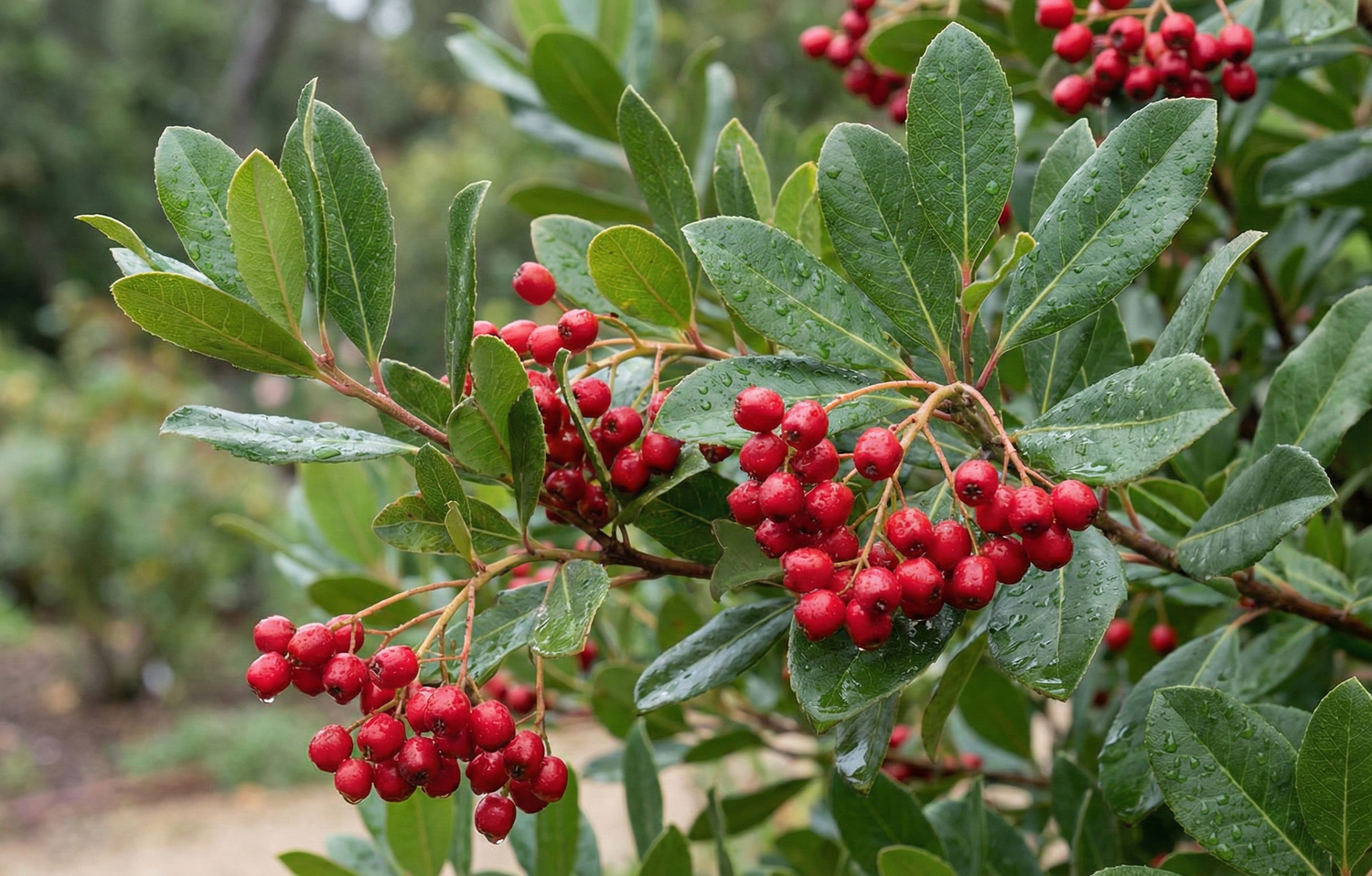
Toyon (Heteromeles arbutifolia) can become a substantial shrub or small tree. Choose a location that accommodates that future size. Its red fruit is a reason to enjoy it, not evidence that it will shield a house from fire.
Coffeeberry (Frangula californica) offers evergreen structure. Check cultivar dimensions carefully; the shape you need should guide selection. Do not plan on repeatedly shearing an oversized shrub to keep it from touching a wall.
Coyote brush (Baccharis pilularis) includes low-growing selections as well as upright forms. A dwarf cultivar still needs inspection for dry interior growth. Fire Safe Marin's coyote brush guidance is a useful reminder to consider condition and placement rather than treating the name as a guarantee.
Western redbud (Cercis occidentalis) offers a deciduous shrub or small-tree form. Plan space for its branches and seasonal cleanup. Leaves falling from a plant move material to the ground; they do not remove it from the landscape.
For horticultural details on several of these shrubs, see UC Sonoma's native hedgerow guide. Use its plant information while designing the spacing your site needs, rather than copying a continuous hedge close to the house.
Larger trees need a longer view
Coast live oak (Quercus agrifolia), California bay laurel (Umbellularia californica) and western sycamore (Platanus racemosa) are substantial landscape decisions. An existing mature tree and a newly proposed tree call for different assessments. Look at canopy size, nearby buildings, the vegetation below and the work needed to maintain access.
Do not choose bay laurel because its foliage looks moist, or assume an oak's ability to survive some fires proves that everything beneath it will be protected. Ask a qualified arborist about tree health and appropriate pruning, and coordinate placement and fuel questions with your fire authority. A generic instruction to remove every branch below 6 or 10 feet is not a complete pruning plan.
What about manzanita, ceanothus and aromatic sages?
These plants often generate conflicting advice. Fire Safe Marin flags manzanitas, while older landscaping lists may recommend particular forms. That disagreement is a reason to examine the exact plant and site, not to substitute another shrub and assume the problem is solved.
Manzanita (Arctostaphylos species) is a diverse group. The US Forest Service fire-ecology reference for common manzanita concerns a particular species; it is not a universal landscape rule for every manzanita. A location beyond 30 feet does not automatically make planting one appropriate.
Ceanothus also varies by species and cultivar. Plan for mature growth, inspect declining branches and seek plant-specific pruning advice. Do not assume every ceanothus dies after a fixed 10-to-15-year interval or that repeated heavy thinning will keep an unsuitable plant healthy.
Chamise (Adenostoma fasciculatum) and aromatic sages such as white sage (Salvia apiana) and black sage (Salvia mellifera) deserve careful placement and assessment of dry material. Their presence in native habitats does not establish suitability beside a home. Nor does being low-growing automatically make creeping sage a safer substitute.
For any of these plants, bring photographs and measurements to the discussion. Show where the branches will reach, what grows underneath and how close the planting comes to structures.
Make maintenance part of the design
A bed that you can reach is easier to care for than one packed from edge to edge. Before adding plants, leave yourself a route to inspect their interiors and remove debris without climbing through the planting.
Check for dry material throughout the season
Look beneath green groundcovers and into the centers of shrubs. Remove accumulated dead stems and debris as needed; once a year may not be enough. Keep material from collecting against fences, under decks or beside the house. Decide where pruning waste will go so cleanup does not simply create another fuel pile.
Prune according to the plant
Keep growth from closing planned gaps, but use species-appropriate techniques and timing. If a plant continually outgrows its location, consider whether replacement is more practical than repeated hard pruning. Large limbs and uncertain tree stability need professional assessment.
UC Marin's landscape maintenance guidance emphasizes care and cleanup. It also cautions against topping trees. Avoid turning routine gardening advice into a severe pruning prescription for every native tree.
Water for plant health, not a promised fire barrier
New plants need an establishment plan, but there is no date when every native becomes independent of irrigation. UC's drought and water-conservation guidance explains that native plants from cooler or moister settings can need water when grown in warmer, drier ones.
Check the root area, drainage and plant condition before adjusting irrigation. Conversely, do not add frequent summer water around an established native oak simply to make it seem less flammable. UC IPM explains how unsuitable watering can promote disease. Get tree-specific advice if an oak is stressed during prolonged drought.
Our California water-wise gardening guide can help with planning. Keep routine irrigation separate from emergency response: UC Marin advises normal irrigation rather than wetting down the property on Red Flag warning days. Never delay evacuation for garden work.
Keep inputs and mulch appropriate
Do not apply fertilizer simply because a plant looks unhappy; investigate light, soil, drainage and water first. Whether feeding is appropriate depends on the plant and circumstances. A blanket claim that fertilizer makes all native growth more flammable is not a useful diagnosis.
Keep combustible mulch out of the immediate area beside structures. Farther away, consider its depth, type and connections to other fuels. A thick layer of organic material can remain a concern even beneath healthy native plants.
Find plants with the right identity and provenance
Use Calscape to investigate native ranges and growing requirements. California native, native to your local area and grown from locally collected seed are different descriptions. Ask the seller which applies to the exact plant you are buying.
Sierra Azul Nursery, Dig Gardens and the UCSC Arboretum & Botanic Garden are starting points for checking current offerings. Confirm stock, opening arrangements and sale details directly rather than relying on a standing calendar. Ask the CNPS Santa Cruz Chapter about its current sales and plant provenance; do not assume every plant at a local sale comes from local seed.
If shopping online, a retailer's native-plant collection still requires checking the species and native range. The category alone does not mean native to California, suitable for Santa Cruz or appropriate for your fire plan.
For broader choices, see our drought-tolerant planting guide. And if appearance is the sticking point, our discussion of native gardens that look cared for offers ways to make a planting feel intentional.
Read plant lists with their limits in mind
A CNPS garden feature can offer design ideas, but one garden's experience is not a controlled test of fire protection. Suzanne Schettler's Central Coast landscaping discussion also describes contradictory plant lists. Follow current primary guidance when older advice conflicts with it.
The regional California plant list may help identify plants to research. It does not certify a species for a zone around your house. Use local advice from the Fire Safe Council of Santa Cruz County alongside the responsible fire authority's requirements.
Frequently asked questions
Are California natives more fire-resistant than other plants?
Native status alone does not establish that comparison. Evaluate the actual plant, its condition and its surroundings. Ecological suitability is a reason to consider natives, but it does not replace defensible-space planning.
Can I keep a manzanita that I love?
That needs a site-specific assessment, especially near structures. Its size, condition and connections to other vegetation matter. Do not assume that pruning or moving a plant beyond a single distance automatically resolves the risk.
What is the best native groundcover for fire safety?
There is no universal winner. Choose a plant that fits the site and can be maintained, then examine dry material, spread and nearby fuels. Low height and green leaves do not make a groundcover noncombustible.
Do established native plants need irrigation?
Some do, depending on species and growing conditions. Others can be harmed by unsuitable summer watering. Use a plant-specific plan rather than a fixed two-year cutoff or extra watering as a wildfire-protection treatment.
Can I plant strawberry or yarrow in Zone 0?
Do not use them as exceptions to an area planned free of combustible vegetation. Put the native planting farther out in a suitable location, and keep the space beside structures free of plant fuel and accumulated debris.
How often should I maintain a native planting?
Inspect it regularly and respond to what you find. Leaf drop, seasonal dieback and growth can change the work required. A once-yearly cleanup or a universal pruning height is not a complete maintenance plan.
Which native tree should I choose?
Start with mature size, growing conditions and available space. Get advice about placement before choosing a species for an assumed fire rating. For existing trees, include health and appropriate care in the assessment.
Where can I find plants grown from local seed?
Ask nurseries and the local CNPS chapter about the source of the specific plants or seed they offer. A local shop address does not establish local genetic origin, and a California-native label covers a much larger area than Santa Cruz County.
Keep useful resources with your garden plan
Browse available garden planning resources, water-wise resources, microclimate resources and seasonal checklists in the Garden Toolkit.
CAL FIRE Defensible Space: current planning and maintenance guidance.
CNPS Fire-Resistant Landscaping: a garden feature to read alongside current safety guidance.
Fire Safe Council of Santa Cruz County: local resources.
Calscape Native Plant Database: plant identity, range and growing requirements.
Regional native plant list: background for research, not a safety certification.
Before adding a new plant, stand where you will see it from the house and picture it fully grown. Leave space to enjoy the flowers, inspect the branches and reach the ground beneath. A planting that fits its place is easier to care for as the seasons change.

