

12 Fast-Growing Vegetables for Impatient California Gardeners
12 Fast-Growing Vegetables for Impatient California Gardeners
According to the UC Master Gardener Program, several common vegetables can go from seed to harvest in as little as 20 to 50 days in California's favorable growing conditions, making them perfect for beginners, succession planting, and filling gaps between slower crops (University of California Agriculture and Natural Resources). If you want results fast, these are the crops that deliver.
I get it. Waiting months for a tomato to ripen tests even the most patient gardener. After 20 years in my Santa Cruz garden, I have learned to pair those slow-and-steady crops with fast growers that give me something to harvest while I wait. These 12 vegetables prove that gardening does not have to mean months of watching and waiting. Some of them will be on your plate before a tomato plant even sets its first flower.
Every crop on this list matures in under 60 days from seed, and several finish in under 30. I have included specific days-to-harvest numbers, the best varieties for speed, and timing notes for California's four main growing zones: Coastal, Inland Valley, Mountain, and Desert.
1. Radishes (20-30 Days)
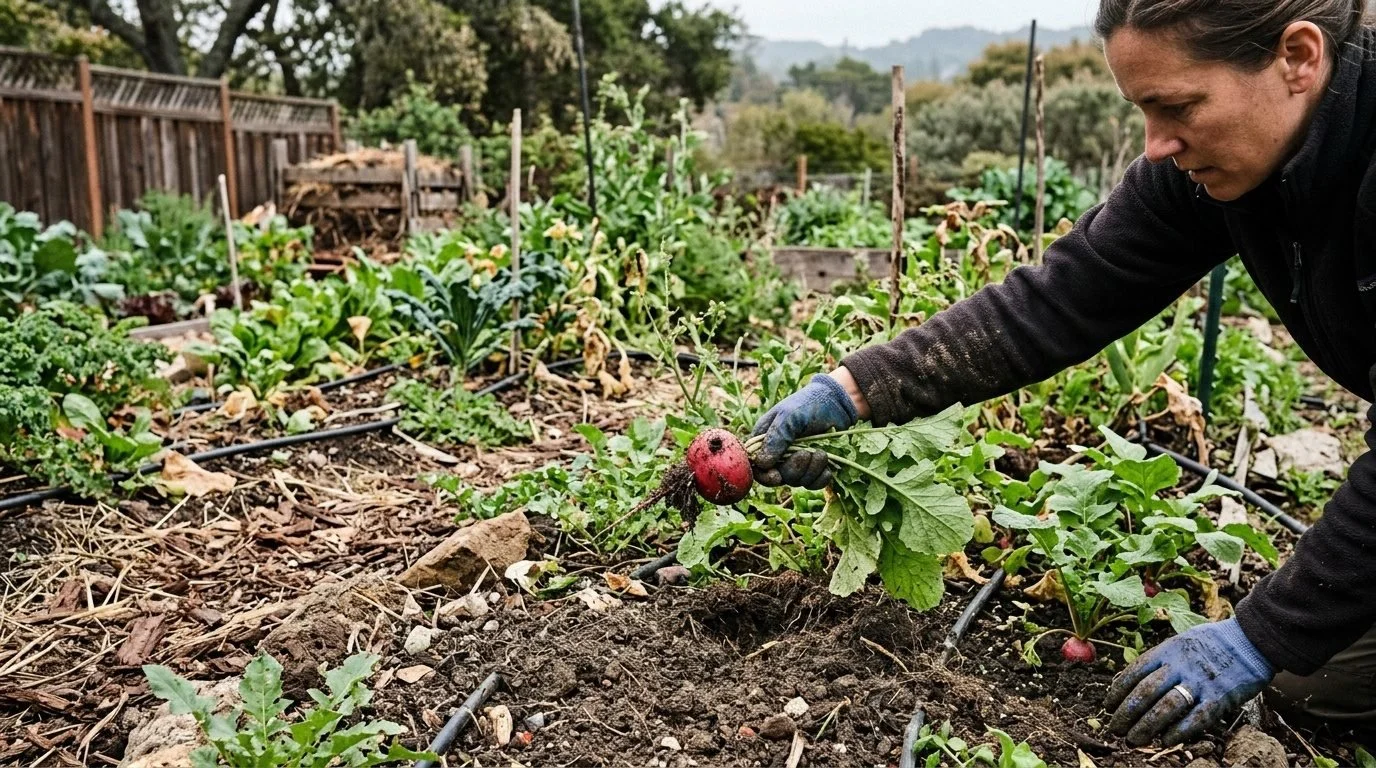
Radishes are the undisputed speed champions of the vegetable garden. Many varieties go from seed to table in just 20 to 25 days, making them the fastest crop you can grow. Radishes are a favorite crop for new gardeners because the results are so quick and satisfying.
Days to harvest: 'Cherry Belle' matures in 22 to 25 days. 'French Breakfast' takes 25 to 28 days. 'Easter Egg' (a mix of colors) finishes in 25 to 30 days. These are among the fastest food crops on earth.
Best varieties for speed: 'Cherry Belle' is the fastest and most reliable spring radish. 'Sora' is heat-tolerant and fast, good for pushing the season. 'White Icicle' takes a few days longer (28 to 30 days) but produces elegant, mild, tapered roots that are excellent sliced thin.
California timing: Plant radishes September through May in coastal and inland zones. They bolt in summer heat, so skip June through August in inland areas. Coastal gardeners with fog cover can sometimes grow them year-round. Mountain gardeners should plant in spring after the last frost and again in early fall.
Succession planting tip: Sow a short row every 10 days for a continuous supply. Because radishes mature so quickly, you can fit 8 to 10 successions into a single season. They also work perfectly as row markers between slower crops like carrots and parsnips. growing root vegetables in California
2. Arugula (21-40 Days)
Arugula is the fastest salad green you can grow. Baby arugula is ready to cut in just 21 days from seed, and mature leaves are harvestable by 35 to 40 days. Arugula is also one of the easiest greens to direct sow, germinating quickly even in cool soil.
Days to harvest: Baby arugula: 21 to 28 days. Mature leaves: 35 to 40 days. Wild arugula ('Sylvetta') takes slightly longer at 40 to 50 days but is a perennial in mild California climates, coming back year after year.
Best varieties for speed: 'Astro' is one of the fastest varieties, with mild flavor and quick germination. 'Rocket' is the standard Italian type and ready as baby greens in about 21 days. 'Surrey' is a cultivated variety with good bolt resistance that extends the harvest window.
California timing: Plant September through April in inland zones. Coastal gardeners can grow arugula nearly year-round, though it bolts quickly in summer warmth. Desert gardeners should plant October through February for the best quality.
Succession planting tip: Sow every 2 to 3 weeks for unbroken harvests. Arugula planted too thickly produces a quick flush of tender baby greens, perfect for salads. Thin plantings produce larger individual leaves with more peppery flavor. Harvest as cut-and-come-again for 3 to 5 cuttings per sowing.
3. Spinach (25-45 Days)
Spinach is a cool-season speed crop that California gardeners can enjoy from fall through spring. Baby spinach leaves are ready in as few as 25 days, and full-sized leaves reach harvest in 40 to 45 days. UC ANR notes that spinach grows best when temperatures are between 40 and 75 degrees F, which is exactly what coastal California delivers for most of the year.
Days to harvest: Baby spinach: 25 to 30 days. Mature leaves: 40 to 45 days. Savoy (crinkly) types take a few days longer than smooth-leaved varieties but have better texture and flavor.
Best varieties for speed: 'Space' is a smooth-leaved variety that matures fast and is easy to wash. 'Corvair' is quick and has excellent bolt resistance. 'Regiment' is a baby-leaf variety bred specifically for fast harvest. 'Bloomsdale Long Standing' takes a few extra days but resists bolting longer than most.
California timing: Plant September through March in inland zones. Coastal gardeners can extend the window from August through April. Mountain and desert gardeners should focus on fall and late winter plantings when temperatures are in the ideal range.
Succession planting tip: Sow every 2 weeks from September through February for a steady supply. Spinach does not transplant well, so always direct sow. In coastal gardens, plant in partial shade during warmer months to prevent premature bolting. Interplant with slower crops like broccoli to use space efficiently. our complete guide to growing greens in California
4. Lettuce (30-55 Days)
Lettuce is a fast, forgiving crop that provides almost instant gratification. Baby lettuce leaves are ready in 30 days, and full heads mature in 45 to 55 days depending on the variety. The California Department of Food and Agriculture calls California the nation's leading producer of head, leaf, and romaine lettuce, and home gardeners benefit from the same climate that makes commercial production so successful.
Days to harvest: Baby leaf lettuce: 30 to 35 days. Loose-leaf varieties: 40 to 45 days. Butterhead: 45 to 55 days. Romaine: 55 to 65 days (this one pushes past our 60-day limit, but baby romaine leaves are ready sooner).
Best varieties for speed: 'Black Seeded Simpson' is one of the fastest loose-leaf types at 40 to 45 days. 'Salad Bowl' (both red and green) matures in 40 days. 'Buttercrunch' is a fast butterhead at 45 to 50 days. For baby leaf production, any loose-leaf mix will give you greens in about 30 days.
California timing: Plant year-round in coastal zones (with some heat protection in July and August). Inland: September through May. Mountain: spring and fall. Desert: October through March. Lettuce bolts and turns bitter above 75 degrees F.
Succession planting tip: Sow a new batch every 2 to 3 weeks. Lettuce is the ideal succession crop because each planting takes up little space, matures quickly, and can be harvested as cut-and-come-again greens for 3 to 5 additional cuttings. Mix red and green varieties for visual interest in salads. growing lettuce in California
5. Green Onions (30-50 Days)
Green onions grow fast and take up almost no space. You can begin snipping green tops in as few as 30 days from seed, and the full scallions are ready in about 50 days. Bunching onions are one of the most space-efficient crops for small gardens, producing in narrow rows or even in gaps between other plants.
Days to harvest: Green tops for snipping: 30 to 35 days. Full scallions: 45 to 50 days. If you start from sets (small bulbs) or transplants, subtract about 2 weeks from these timelines.
Best varieties for speed: 'Evergreen Hardy White' is a reliable, fast-growing bunching type. 'Tokyo Long White' produces mild, slender stalks quickly. 'Guardsman' is a hybrid with fast, uniform growth that is ready in about 40 days from seed.
California timing: Green onions can be planted year-round in coastal and inland California. They tolerate both cool and warm conditions, though they grow fastest when temperatures are between 55 and 75 degrees F. Mountain and desert gardeners should plant in spring and fall.
Succession planting tip: Sow a small patch every 3 weeks for an unbroken supply. You can also start a batch from grocery store green onion root ends planted one inch deep in soil. They will produce new harvestable tops in about 2 weeks, which is the fastest turnaround of any vegetable. growing garlic and onions in California
6. Bush Beans (45-55 Days)
Bush beans are one of the most satisfying fast crops because they produce a substantial harvest, not just a few leaves. A 10-foot row of bush beans can yield 5 to 8 pounds of green beans in just 45 to 55 days from seed. According to the UC Vegetable Research and Information Center, bush beans are among the easiest warm-season crops to direct sow in California gardens.
Days to harvest: 'Provider': 48 to 50 days. 'Blue Lake Bush': 50 to 55 days. 'Contender': 45 to 50 days. 'Jade': 53 to 55 days. These are among the fastest protein-rich crops you can grow at home.
Best varieties for speed: 'Contender' is one of the fastest bush beans at 45 days and tolerates cooler soil temperatures than most. 'Provider' is nearly as fast and has excellent cold tolerance, making it a good choice for early spring planting in coastal areas. 'Blue Lake Bush' takes slightly longer but has the best flavor.
California timing: Plant April through August in coastal zones. Inland: March through September. Mountain: May through July. Desert: February through April, then again September through October. Beans need soil temperatures above 60 degrees F for reliable germination.
Succession planting tip: Make 3 to 4 successive sowings spaced 3 weeks apart for continuous harvests from May through October. Unlike lettuce and greens, beans fix their own nitrogen, so they actually improve your soil as they grow. Rotate bean plantings around the garden to spread the soil-building benefit. our guide to growing beans and peas
7. Turnips (30-55 Days)
Turnips are an overlooked speed crop with a double benefit: you can eat both the roots and the greens. Baby turnips are tender, mild, and ready in just 30 to 35 days. Full-sized roots mature in 45 to 55 days. Turnips are a reliable cool-season crop that fills the gap between summer and winter harvests nicely.
Days to harvest: Baby turnips: 30 to 35 days. Full-sized roots: 45 to 55 days. Turnip greens: harvestable in just 20 to 25 days, even before the roots develop. You can harvest greens while waiting for roots, getting two crops from one planting.
Best varieties for speed: 'Hakurei' is a Japanese salad turnip that matures in just 30 to 35 days, with sweet, crisp, white roots you can eat raw. 'Purple Top White Globe' is the classic American turnip at 45 to 55 days. 'Tokyo Cross' is another fast Asian variety, ready in about 35 days.
California timing: Plant September through March in inland zones. Coastal gardeners can extend to August through April. Desert: October through February. Turnips prefer temperatures between 40 and 75 degrees F and bolt in summer heat.
Succession planting tip: Sow every 3 weeks from early fall through late winter for a continuous supply of baby turnips and greens. 'Hakurei' turnips are so fast and mild that they work as a crunchy snack crop, eaten raw with a little salt right from the garden.
8. Baby Bok Choy (30-45 Days)
Baby bok choy is one of the fastest brassicas you can grow, and it thrives in California's cool-season conditions. Asian greens like bok choy are increasingly popular in California home gardens because they grow quickly, taste great, and handle our mild winters beautifully.
Days to harvest: Baby varieties: 30 to 35 days. Standard bok choy: 40 to 50 days. 'Toy Choi' miniature: 30 days. These numbers make bok choy competitive with lettuce for speed, with the advantage of a sturdier, more substantial harvest.
Best varieties for speed: 'Mei Qing Choi' matures in just 30 to 35 days and has thick, jade-green stems with broad leaves. 'Toy Choi' is a miniature variety ready in about 30 days, perfect for containers. 'Shanghai Green' takes 35 to 40 days and is excellent for stir-fries.
California timing: Plant September through March in most zones. Coastal gardeners can extend to August through April. Bok choy bolts quickly in warm weather, so time plantings for the cool season. In inland areas with mild winters, bok choy produces beautifully from October through February.
Succession planting tip: Sow every 2 to 3 weeks during the cool season. Bok choy can be started indoors and transplanted for an even earlier harvest. It also regrows after cutting if you leave the base intact, giving you an extra harvest without replanting.
9. Kohlrabi (40-55 Days)
Kohlrabi is a fast, unusual crop that deserves more attention from California gardeners. It produces a round, above-ground bulb with sweet, crisp flesh reminiscent of broccoli stems. UC Master Gardeners note that kohlrabi is a fast-growing cool-season brassica, usually ready within about eight weeks, which makes it an excellent fall and spring crop.
Days to harvest: 'Early White Vienna': 45 to 55 days. 'Kolibri' (purple): 40 to 45 days. 'Winner': 45 to 50 days. Harvest when bulbs are 2 to 3 inches in diameter for the best flavor and texture. Larger bulbs become woody and fibrous.
Best varieties for speed: 'Kolibri' is the fastest purple variety and has stunning violet skin with white interior. 'Early White Vienna' is a classic fast-maturing variety. 'Winner' is a modern hybrid with smooth skin and very uniform maturity.
California timing: Plant August through February in coastal and inland zones. Mountain: spring and early fall. Desert: October through January. Kohlrabi handles temperatures between 40 and 75 degrees F and bolts in sustained heat.
Succession planting tip: Sow 2 to 3 times during the cool season, spaced 3 weeks apart. Kohlrabi takes up little horizontal space because the bulb forms above ground. It can be interplanted between taller crops or tucked into gaps in the garden bed. Raw kohlrabi sticks with hummus are a surprisingly addictive garden snack.
10. Mustard Greens (30-50 Days)
Mustard greens are fast, flavorful, and remarkably easy to grow. Baby leaves are ready in about 30 days, and mature plants are harvestable in 40 to 50 days. Mustard greens are also one of the most nutritious greens you can grow, high in vitamins A, C, and K. They thrive in California's cool seasons and can be harvested as cut-and-come-again for multiple pickings.
Days to harvest: Baby greens: 25 to 30 days. Mature leaves: 40 to 50 days. 'Mizuna' (a Japanese mustard): 35 to 40 days. 'Tatsoi': 40 to 45 days. Cut-and-come-again harvesting can begin as soon as leaves are 3 to 4 inches tall.
Best varieties for speed: 'Mizuna' is a mild, feathery Japanese mustard that matures quickly and rarely bolts in cool weather. 'Red Giant' has beautiful burgundy leaves and moderate spiciness. 'Tatsoi' forms flat rosettes of spoon-shaped leaves and handles cold well. 'Golden Frills' is lacy, mild, and gorgeous in salads.
California timing: Plant September through March in most zones. Coastal gardeners can grow mustard greens nearly year-round, though summer heat intensifies the spicy flavor. Desert: October through February. Mustard greens handle light frost without damage.
Succession planting tip: Sow every 2 to 3 weeks for continuous harvests. Mix mustard varieties with lettuce and arugula for a spicy salad blend. Mustard greens add valuable diversity to cool-season gardens that might otherwise be dominated by lettuce and spinach.
11. Beets (Baby at 35-45 Days, Full at 55-60 Days)
Baby beets are ready to harvest as early as 35 days from seed, with golf-ball-sized roots that are tender, sweet, and do not need peeling. Full-sized beets take 55 to 65 days, which pushes our 60-day limit, but the baby harvest option keeps beets firmly in fast-crop territory. UC Master Gardeners of Sacramento County say to harvest beet greens as you thin the seedlings, so the thinnings give you a quick early harvest while the roots develop.
Days to harvest: Beet greens only: 25 to 30 days. Baby beets: 35 to 45 days. Full-sized roots: 55 to 65 days. 'Early Wonder': 48 to 52 days. Pull baby beets when they are 1 to 2 inches in diameter.
Best varieties for speed: 'Early Wonder Tall Top' is one of the fastest beets at 48 days and has excellent greens. 'Boldor' is a golden beet ready in 50 to 55 days with sweet flavor. 'Chioggia' produces those beautiful red-and-white striped rings and matures in 50 to 55 days. 'Bull's Blood' has stunning dark red leaves for salads and produces baby roots quickly.
California timing: Plant year-round in coastal zones (with some shade in summer). Inland: February through April and August through November. Mountain: spring and fall. Desert: October through March. Beets tolerate temperatures from 40 to 80 degrees F.
Succession planting tip: Sow every 3 to 4 weeks for a steady supply of baby beets. Beet "seeds" are actually clusters containing 2 to 4 seeds, so thin seedlings to 3 inches apart after they emerge. Use the thinnings in salads. growing root vegetables in California
12. Cilantro (30-50 Days for Leaf Harvest)
Cilantro grows fast and is one of the most in-demand herbs in California kitchens. According to UC Cooperative Extension, cilantro's outer leaves are ready to harvest about a month after sowing, with the first leaves ready to snip even sooner. The challenge with cilantro is not speed but longevity: it bolts quickly in warm weather. Choosing the right variety and timing your planting for cool seasons keeps the harvest coming.
Days to harvest: First leaf harvest: 30 to 35 days. Full-sized plants: 45 to 50 days. If you let it bolt, coriander seed is ready about 90 days after planting. So you get two crops (leaf herb and seed spice) from one sowing if you are patient.
Best varieties for speed and longevity: 'Santo' is the gold standard slow-bolt cilantro that is fast to leaf out. 'Calypso' produces harvestable leaves quickly and bolts 2 to 3 weeks later than standard types. 'Leisure' is another slow-bolt option with good leaf production. Avoid generic "cilantro" seed packets, which often bolt within days of reaching harvestable size.
California timing: Plant September through March in inland zones for the best results. Coastal gardeners can extend the window to August through April. Summer plantings bolt almost immediately in warm areas. Desert gardeners should plant October through February. Cilantro prefers temperatures between 50 and 70 degrees F.
Succession planting tip: Sow every 2 to 3 weeks from early fall through early spring for continuous leaf harvests. Cilantro self-sows readily if you let some plants go to seed, creating volunteer plants that pop up in the garden on their own schedule. Many California gardeners find that cilantro becomes a near-permanent resident once it has seeded a few times. our guide to growing herbs
How Should I Plan Succession Plantings for Continuous Harvest?
Succession planting is the practice of sowing the same crop multiple times throughout the season so you always have something coming to maturity. UC ANR recommends succession planting as one of the most effective strategies for maximizing harvests from small gardens. With fast-growing crops, this approach is especially powerful.
Start with a simple system: choose 3 or 4 of the fastest crops on this list and sow a short row (3 to 4 feet) of each every 2 to 3 weeks. As one planting matures and is harvested, the next is already growing. A 4-by-8-foot raised bed managed this way can provide salad ingredients year-round in most California zones.
Keep a planting calendar or set reminders on your phone. The biggest mistake with succession planting is forgetting to sow the next round. Write your sowing dates on a garden calendar at the start of each month, and you will never have a gap in your harvest. succession planting basics
What Are the Fastest Crops for Each California Zone?
The speed of any crop depends partly on temperature, sunlight, and your specific growing conditions. Here is a zone-by-zone breakdown of what grows fastest where.
Coastal (Santa Cruz, San Francisco, Monterey): Radishes, arugula, lettuce, and spinach grow year-round. Cool summers mean these crops rarely bolt. Beans and beets do best from May through September when temperatures are warmest.
Inland Valley (Sacramento, San Jose, Fresno): Warm-season speed crops like beans and beets mature fastest here. Cool-season greens grow best from September through April. The key is timing plantings to avoid the intense summer heat that causes bolting.
Mountain (Tahoe, Big Bear, Julian): Shorter growing seasons mean fast crops are essential. Focus on radishes, lettuce, spinach, and turnips in spring and fall. Beans grow quickly during the warm summer months.
Desert (Palm Springs, El Centro, Coachella): Cool-season speed crops shine from October through March. Radishes, greens, and turnips grow beautifully in desert winters. Summers are too hot for most fast crops. understanding California climate zones
Can Beginners Really Get Food from Their Garden in Under a Month?
Yes. If you plant radishes today, you will be eating them in about three and a half weeks. If you plant arugula, you will have baby salad greens in three weeks. These are not exaggerations. These are real, reliable timelines that hold true across California's growing zones when basic conditions (sun, water, decent soil) are met.
For the very fastest start, try this: plant a row of radishes, a patch of arugula, and a few green onion root ends from the grocery store. Within 3 to 4 weeks, you will have the ingredients for a garden-fresh salad with a spicy kick and a crunchy garnish. That first harvest, no matter how small, is what turns curious people into dedicated gardeners.
Frequently Asked Questions
What is the fastest vegetable to grow in California?
Radishes are the fastest vegetable to grow in California, with varieties like 'Cherry Belle' maturing in just 22 to 25 days from seed. According to the UC Master Gardener Program, radishes germinate in 3 to 5 days and grow rapidly in cool weather. Baby arugula is a close second at 21 days to first cutting, and microgreens (harvested as seedlings) can be ready in as little as 7 to 14 days.
Can I grow fast vegetables in summer in California?
It depends on your zone and the crop. Cool-season speed crops like lettuce, spinach, and radishes grow best in cool weather and bolt in summer heat, generally once temperatures climb past about 75 to 80 degrees F. In inland and desert zones, shift to warm-season fast crops like bush beans (45 to 55 days) during summer months. Coastal gardeners with fog cover can often grow cool-season crops year-round with partial shade protection during the warmest weeks.
How do I succession plant in a small garden?
Succession planting in a small garden means sowing small amounts frequently rather than one large planting. UC Master Gardeners recommend sowing a short new row of fast crops every 2 to 3 weeks to keep a steady harvest coming. As you harvest one planting, the next is maturing. Even a single 4-by-4-foot raised bed can provide continuous salad greens using this method. The key is consistency: set a reminder to plant every other week.
Do fast-growing vegetables need different care than slow ones?
Fast-growing vegetables generally need consistent moisture and adequate fertility because they are packing all their growth into a short window. According to UC Cooperative Extension, most fast crops benefit from a pre-planting application of compost and consistent watering throughout their short lives. They are less forgiving of drought stress than slower crops because they have less time to recover. Keep soil evenly moist and weed-free for the best results.
What is the fastest crop I can grow in a container?
Radishes are the fastest container crop, ready in 22 to 25 days in a pot as shallow as 6 inches. Baby lettuce and arugula are ready in about 30 days in any container with drainage. Green onion root ends planted in a pot of soil resprout within days and give you harvestable green tops in a couple of weeks, making them the fastest container crop if you start from scraps rather than seed.
Can I grow these fast vegetables in winter in California?
Yes. Most fast-growing vegetables on this list are cool-season crops that actually prefer California's mild winters. According to UC ANR, radishes, lettuce, arugula, spinach, turnips, bok choy, and cilantro all grow well from October through March in coastal and inland zones. In fact, winter is the ideal planting season for these crops because cool temperatures produce the best flavor and the slowest bolting. Only bush beans require warm weather to germinate and grow.
How do I know when fast-growing vegetables are ready to harvest?
Each crop has clear visual cues. Radishes push their shoulders above the soil when ready. Lettuce and greens are harvestable when leaves reach 3 to 4 inches for baby greens or 6 to 8 inches for full-sized. The best rule for fast crops is to harvest slightly early rather than slightly late, since young leaves and roots have the sweetest flavor. Overmature radishes become pithy, overgrown lettuce turns bitter, and oversized turnips get woody. When in doubt, pick one and taste it.
Ready to start growing food fast in your California garden? Sign up for our free weekly newsletter and get a printable succession planting calendar, seasonal crop guides, and practical tips to keep your garden producing year-round.
