

Growing Southern Highbush Blueberries in the San Lorenzo Valley
A few of the product links in this guide are affiliate links. If you buy through one, Ambitious Harvest may earn a small commission at no extra cost to you, which helps keep these guides free. We only point to gear we would use in our own Santa Cruz garden. As an Amazon Associate, we earn from qualifying purchases. Read our full disclosure.
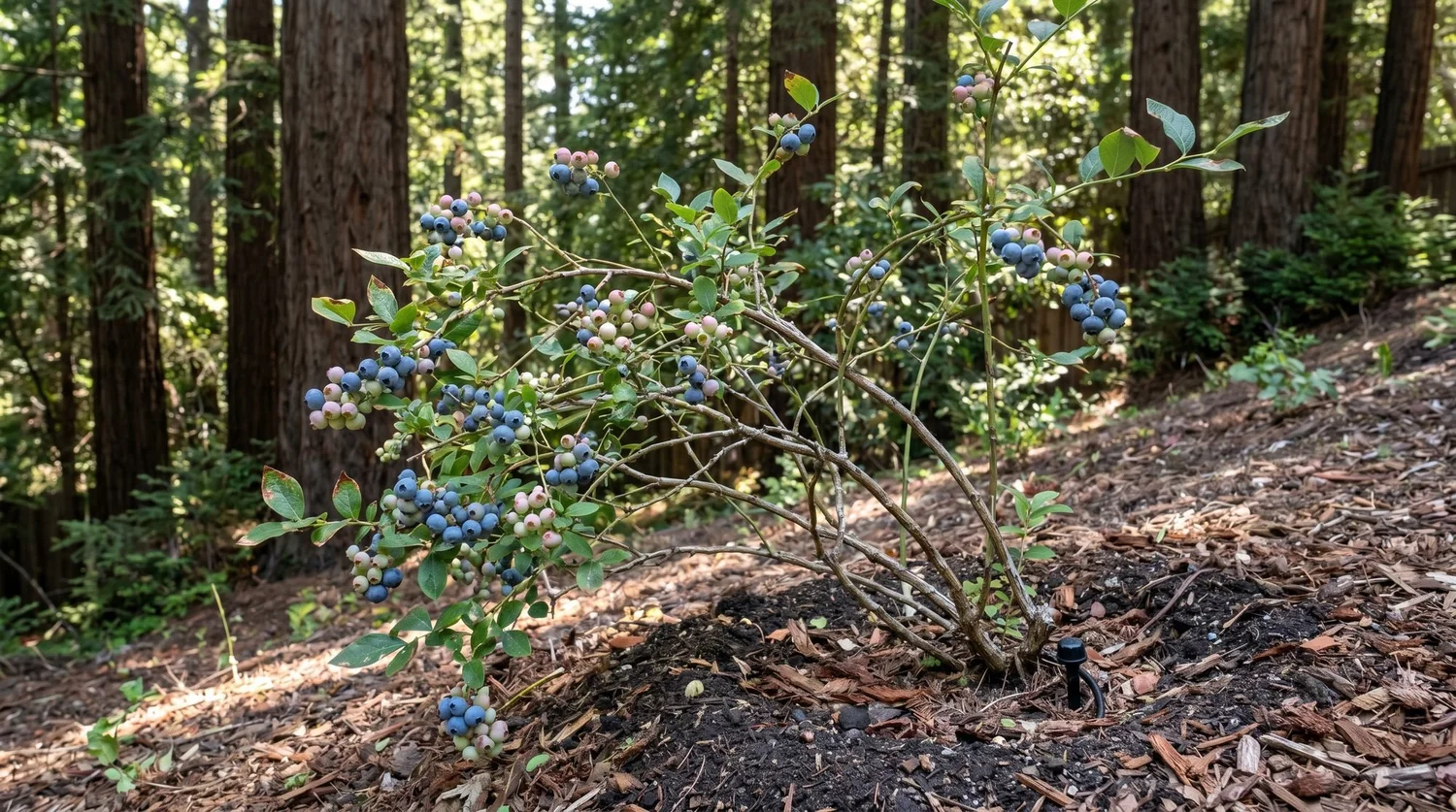
If you garden in Felton, Ben Lomond, or Boulder Creek, you have quietly been handed the best blueberry soil in Santa Cruz County. The acidic redwood ground that frustrates so many other crops is exactly what blueberries want.
Quick verdict: The county's standout blueberry microclimate. Naturally acidic soil, dappled redwood light that blueberries tolerate, and enough winter chill for low-chill Southern Highbush types. You still test and tune your pH, but you start closer to the target than anyone else in the county.
Why the San Lorenzo Valley is built for blueberries
Blueberries are one of the few fruit crops that demand acidic soil, ideally a pH of 4.5 to 5.5, far lower than the near-neutral ground most California vegetables prefer. Across most of the county that means a real soil-correction project. Under the redwoods it often means a head start. Decades of fallen redwood needles and bark break down into a slightly acidic duff, and the forest floor here already leans toward the range blueberries reach for. You should still test before you plant, because canyon soils vary, but many SLV gardeners find they only need to nudge the pH rather than overhaul it. Add the cool, humid air the redwoods hold and you have a setting that suits a shallow-rooted, moisture-loving plant.
For the bigger picture of why our county grows so differently from one valley to the next, see the master explainer below, and the deeper soil and shade notes that come with redwood gardening in particular.
Best low-chill Southern Highbush varieties here
Southern Highbush types are the right family for our mild winters because they fruit on modest winter chill, roughly 150 to 500 chill hours depending on the variety, which the valley reliably delivers. Three proven low-chill performers:
- Sunshine Blue: Compact, semi-evergreen, partly self-fertile, and forgiving of slightly higher pH. The best beginner choice and happy in a half-barrel or a bed.
- Misty: Heavy early producer with sweet berries and pretty pink-tinged flowers. Vigorous and dependable in low-chill coastal California.
- O'Neal: An early-season classic with excellent flavor. Pair it with another Southern Highbush nearby for better fruit set.
Plant two different varieties within about ten feet of each other. Even partly self-fertile types set more and larger fruit with a cross-pollination partner.
Light and the redwood canopy
Blueberries fruit best in full sun, but the SLV trade-off is that full sun is often the one thing you do not have. The good news is that blueberries tolerate dappled and bright partial shade better than most fruit. On a shaded canyon lot, give them the brightest spot you can find, an open gap in the canopy or a south-facing edge, and accept a somewhat lighter but still worthwhile crop. On a sunny ridge above the trees you can grow them in near-full sun, but watch moisture more carefully because exposed ridge sites dry and heat faster. Reading your own light is the whole game here, and the sunny-ridge versus shaded-canyon split is worth understanding before you choose a planting spot.
Soil, water, and frost pockets
Soil: Test first. If your pH already sits near 5.5, a yearly mulch of pine needles or aged bark and an acidic, ammonium-based fertilizer may be all you need. If it reads higher, work in peat moss at planting and apply elemental sulfur to bring it down gradually. The step-by-step method is linked below.
Water: Blueberry roots are shallow and fibrous and never want to fully dry out. Keep them evenly moist with a thick, coarse mulch, and use rainwater or filtered water where you can, since hard tap water slowly raises pH.
Frost: Cold air pools in the valley's canyon bottoms, and a late frost can nip open blossoms. Low-chill Southern Highbush bloom early, so plant on a gentle slope rather than the lowest frost pocket, and be ready to throw frost cloth over plants in bloom on a clear cold night.
Common problems and fixes
- Yellowing leaves with green veins: the pH has crept up and iron is locked out. Re-acidify with sulfur and switch to an acid-loving plant food.
- Weak growth in deep shade: too little light under a closing canopy. Move the plant or a potted plant to a brighter gap.
- Few berries despite healthy leaves: only one variety, or a late frost caught the bloom. Add a pollination partner and protect early flowers.
- Birds stripping ripe fruit: common at the forest edge. Drape bird netting as berries begin to color.
Local tip: Do not undo your own advantage. The acidic redwood duff is the reason this works, so resist the urge to sweeten the soil with lime or to top-dress with hardwood ash. Mulch with what the forest already gives you, pine needles and aged bark, test your pH once a year, and let the valley do the heavy lifting.
Frequently asked questions
Is my redwood soil already acidic enough for blueberries?
Often close, but not always. Many SLV lots test in the right zone or just above it, yet canyon soils vary lot to lot. Always test before planting and adjust only as much as the reading calls for.
Can blueberries fruit in redwood shade?
Yes, in bright dappled or partial shade, though the crop is lighter than in full sun. Give them the brightest gap you have. They tolerate shade better than nearly any other fruit you could plant here.
Do we get enough winter chill in the valley?
For low-chill Southern Highbush, yes. Depending on the variety they need roughly 150 to 500 chill hours, and the valley's cool nights supply that comfortably. Skip the high-chill Northern Highbush types meant for colder regions.
Will a canyon frost ruin my crop?
It can if blossoms open during a cold snap. Plant on a slope rather than the lowest frost pocket and cover plants in bloom with frost cloth on clear, still, cold nights.
Go deeper
- Best blueberry varieties for Santa Cruz
- Acidifying soil for blueberries: a step-by-step guide
- Growing under the redwoods: shade and acidic soil
- Gardening in the San Lorenzo Valley: sunny ridges vs shaded canyons
- Santa Cruz County microclimates explained
- Blueberry problems: yellow leaves, no fruit, and more
