

Succulents for Fire-Wise Landscaping | Protect Your Home Naturally
Some links in this guide are affiliate links. If you buy through them, we may earn a small commission at no extra cost to you. Read our full disclosure.
Succulents for Fire-Wise Landscaping: High-Moisture Plants That Protect Your Home
Succulents are among the most effective fire-resistant landscape plants available to California gardeners because their thick, water-filled leaves resist ignition and slow the spread of fire across the landscape. Succulents hold a great deal of water in their leaves, which is why they turn up in fire-wise planting plans. UC ANR's fire program is careful about how far that goes: all plants can burn under the right conditions regardless of a fire-resistant label, and placement matters more than plant type. For Santa Cruz County homeowners in wildfire-prone areas, a well-designed succulent planting can serve double duty as both a beautiful, low-water garden and a meaningful line of fire defense.
This is not theoretical. California's wildfire risk is growing, and Santa Cruz County has experienced devastating fires in recent memory, including the CZU Lightning Complex in 2020, which burned over 86,000 acres in the Santa Cruz Mountains. Fire-wise landscaping is not just for rural properties. Homes throughout the county, especially in the San Lorenzo Valley, Bonny Doon, and the hillside neighborhoods, benefit from fire-resistant plantings. Succulents offer one of the most practical and attractive approaches.
How Do Succulents Resist Fire?
Understanding why succulents resist fire helps you use them more effectively in your landscape.
Succulents resist fire through a simple mechanism: they are full of water. The thick, fleshy leaves and stems of succulent plants contain specialized water-storage cells that hold large volumes of moisture. When exposed to heat, this water must evaporate before the plant tissue can reach ignition temperature. This takes significantly more energy than igniting a dry, woody plant or dried grass.
UC Agriculture and Natural Resources puts plant placement and maintenance ahead of plant type, and these are the traits usually cited for plants that are slower to ignite:
High moisture content in leaves and stems. Succulents often contain 80 to 95 percent water by weight, far more than most landscape plants.
Low oil and resin content. Unlike plants such as rosemary, juniper, and eucalyptus, succulents contain very little volatile oil. Oils and resins are what cause some plants to burn explosively.
Limited production of dead material. Many succulents retain their leaves (rather than shedding a layer of dry litter), reducing ground-level fuel.
Low, compact growth habit. Groundcover and mounding succulents keep flames low rather than carrying fire upward into tree canopies (a process called "laddering").
It is worth noting that no plant is truly fireproof. In extreme fire conditions (high wind, low humidity, intense radiant heat), any plant will eventually burn. The value of fire-resistant plants is that they slow fire progression, reduce flame length, and give firefighters more time and space to protect structures. CAL FIRE emphasizes that fire-resistant landscaping is one component of a comprehensive defensible space strategy, not a standalone solution.
What Are the Best Succulents for Fire-Wise Landscaping?
Not all succulents are equally effective for fire defense, and some have specific caveats. Here is an assessment of the best options.
Ice Plants (Delosperma, Lampranthus, Drosanthemum)
Ice plants are the classic fire-wise succulent groundcover. Their dense, low-growing mats are packed with moisture and create an effective fire break when planted in broad swaths. Fire departments across California have noted ice plant beds surviving wildfires that destroyed adjacent dry vegetation.
Best species for fire-wise use: - Delosperma cooperi: Non-invasive, cold-hardy, brilliant magenta flowers, 3 to 4 inches tall. Excellent for broad groundcover. - Lampranthus species: Slightly taller (6 to 12 inches), with vivid orange, pink, or purple flowers. Good for slopes. - Drosanthemum floribundum: Fine-textured, low-growing, pink flowers. Effective slope stabilizer.
Critical warning: Do NOT use Carpobrotus edulis (highway ice plant). While it is fire-resistant, it is also a highly invasive species that devastates native plant communities. The California Invasive Plant Council lists it as a high-impact invader. There are plenty of non-invasive alternatives.
Aloe arborescens (Torch Aloe)
Aloe arborescens is one of the most fire-resistant landscape plants you can grow in Santa Cruz County. Its thick, moisture-packed leaves resist ignition, and mature clumps can form substantial barriers 4 to 6 feet tall and 6 to 10 feet across. UC Master Gardeners frequently include Aloe arborescens in fire-wise landscape recommendations.
Beyond fire resistance, Aloe arborescens thrives in our coastal climate, tolerates fog, produces beautiful winter flowers, and needs no supplemental water once established. It is one of the best all-around landscape investments for Santa Cruz gardeners in fire-prone areas.
Dudleya (California Native)
Native Dudleya species are naturally fire-resistant and ideally suited to the rocky, well-drained sites that are common in fire-prone areas of the county. Their high water content, low growth habit, and minimal dead-material accumulation make them effective components of fire-wise plantings. Dudleya farinosa, our local coastal native, is particularly appropriate. For more species suited to our climate, see our guide to the best succulents for coastal California.
Using Dudleya in fire-wise landscaping also supports native plant conservation, an added benefit that non-native succulents cannot match.
Sedum (Stonecrop)
Low-growing Sedum species make excellent fire-resistant groundcovers. Sedum rupestre, S. album, S. spurium, and others create dense, moisture-rich mats that resist ignition. They are especially useful for filling spaces between larger succulents, covering slopes, and replacing flammable bark mulch in fire-wise zones.
Sedum 'Autumn Joy' and other taller species also contribute to fire-wise plantings in middle and background layers, though their dried winter flower heads should be cut back before fire season to reduce fuel.
Sempervivum (Hens and Chicks)
Cold-hardy and compact, Sempervivum works well in fire-wise rock gardens and wall plantings, particularly in the cooler San Lorenzo Valley areas where fire risk may be highest. Their tight rosettes hold moisture well and produce minimal dead material.
Agave: Fire-Resistant, With One Caveat
Agave species are frequently included in fire-wise plant lists, and the living plants themselves are genuinely fire-resistant. A hydrated Agave is extremely difficult to ignite, and its substantial mass creates an effective barrier.
However, there is a significant caveat that many fire-wise guides gloss over: Agave produce tall flower stalks (often 10 to 20 feet tall) that die and dry out after blooming. These dried stalks are essentially poles of dry, flammable material standing in your defensible space. If an Agave flowers and you do not remove the dried stalk, you have created a fire hazard rather than a fire defense.
Additionally, the dried lower leaves of Agave (particularly Agave americana) accumulate around the base of the plant and can serve as fuel. CAL FIRE's defensible space guidelines emphasize removing all dead plant material from fire-wise zones, which means regular cleanup of dead Agave leaves and prompt removal of spent flower stalks.
The recommendation: Use Agave in fire-wise plantings, but commit to maintenance. Remove flower stalks as soon as they finish blooming and begin to dry. Clean dead lower leaves at least annually. Agave attenuata is the best choice because it produces fewer dry, spiny leaves than A. americana and its arching flower stalk is less of a vertical fuel problem.
How Should You Design Succulent Fire Breaks?
Effective fire-wise landscaping follows the "defensible space" model, which divides the area around your home into zones based on distance from the structure. Succulents can play a role in each zone, but they are most valuable in the zones closest to your home.
Zone 0: The Immediate Zone (0 to 5 feet from the structure)
This is the most critical zone, directly adjacent to your home's walls, windows, decks, and eaves. CAL FIRE treats Zone 0, the first five feet around the house, as the ember resistant zone: hardscape such as gravel, pavers, or concrete, no combustible bark or mulch, and no dead or dying plants.
Succulent strategies for Zone 0: - Use succulent groundcovers (Sedum, non-invasive ice plant) as a living carpet directly against the foundation, replacing flammable bark mulch or dry grasses - Plant Dudleya or compact Aloe in raised beds adjacent to walls, with gravel mulch - Avoid any succulent that accumulates dead lower leaves (clean up Agave regularly) - Use mineral mulch (gravel, decomposed granite, crushed rock) between plantings, never wood mulch - Keep succulents well away from vents, windows, and combustible deck materials
Zone 1: The Lean, Clean, and Green Zone (5 to 30 feet from the structure)
Zone 1 should have well-maintained, irrigated (or naturally moist) plantings with space between groups of plants to break up fuel continuity.
Succulent strategies for Zone 1: - Plant Aloe arborescens as a substantial fire-resistant hedge or screen, spaced to allow airflow between clumps - Use broad swaths of succulent groundcover to break up continuous vegetation - Intersperse succulents with other fire-resistant plants (California natives like Dudleya, buckwheat, and sage) - Maintain space between individual plants or groups (at least 3 times the height of the plant) - Remove any dead leaves, flower stalks, or other dry material promptly
Zone 2: The Reduced Fuel Zone (30 to 100 feet from the structure)
Zone 2 allows more relaxed spacing and less intensive management, but fuel loads should still be reduced.
Succulent strategies for Zone 2: - Large Agave or Aloe planted individually as fire-resistant accents within an otherwise managed landscape - Succulent groundcover on slopes facing the home to reduce uphill fire spread - Dudleya and Sedum in rock gardens and retaining walls that create natural fire breaks
Design Principles for Succulent Fire Breaks
Create continuous moisture barriers. The most effective fire-wise succulent plantings are broad, continuous swaths rather than isolated specimens. A 6-foot-wide band of ice plant groundcover provides a meaningful fire break. A single potted Echeveria does not.
Separate fuel sources. Use succulent plantings to create gaps in continuous vegetation. If you have a section of chaparral or ornamental shrubs, a band of low succulent groundcover between that vegetation and your home breaks up the fuel path.
Eliminate ladder fuels. Ladder fuels are plants of progressively increasing height that allow fire to climb from ground level into tree canopies. Design succulent plantings to stay low (under 18 inches) in Zone 0 and Zone 1, preventing fire from laddering up to eaves, trees, or other tall fuels.
Use hardscape and succulents together. Gravel pathways, stone walls, and concrete patios are non-combustible. Combine them with succulent plantings to create a layered defense. A gravel path bordered by Aloe arborescens and backed by a stone retaining wall with Dudleya is both beautiful and effective.
What About Succulents on Fire-Prone Slopes?
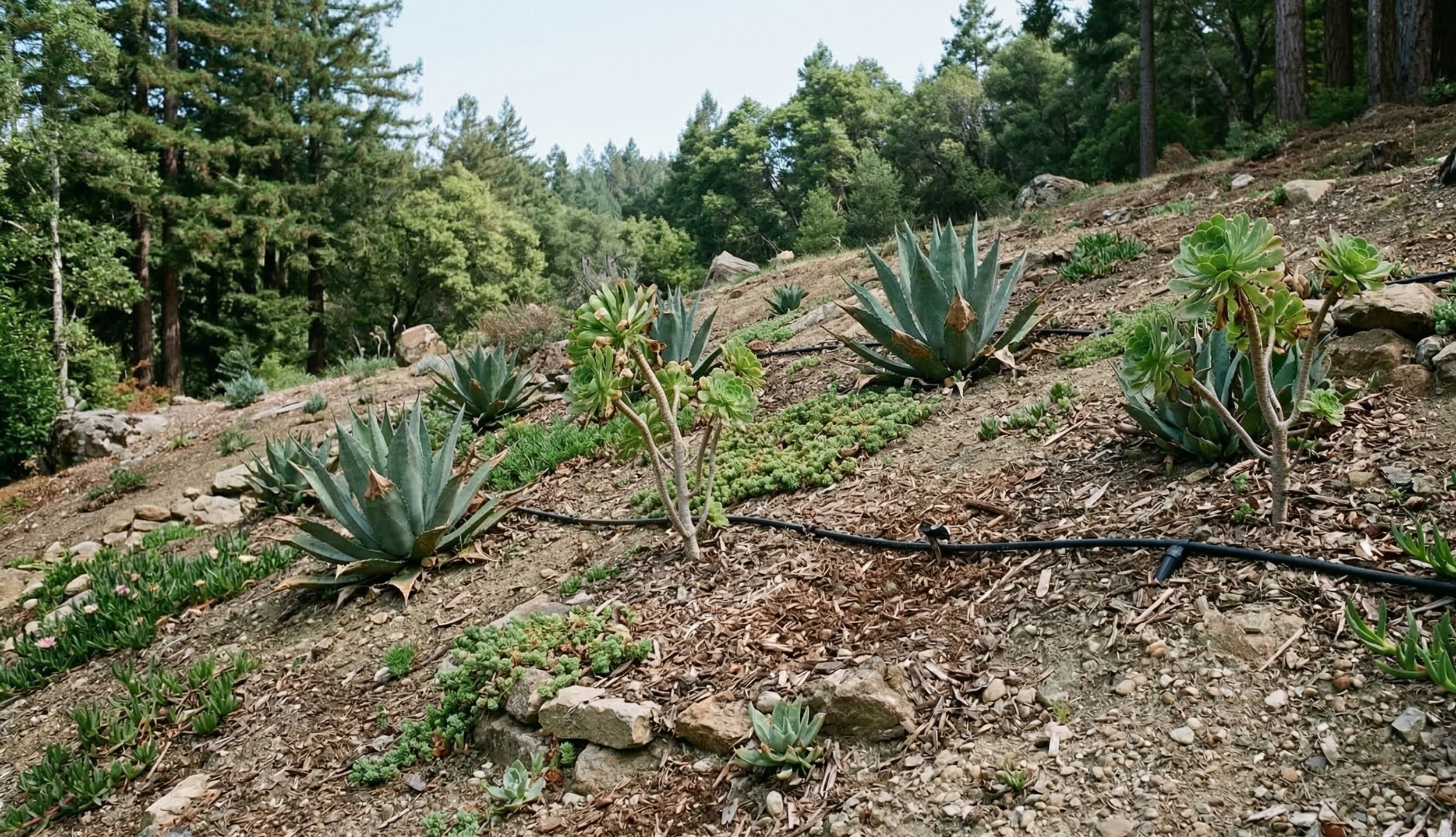
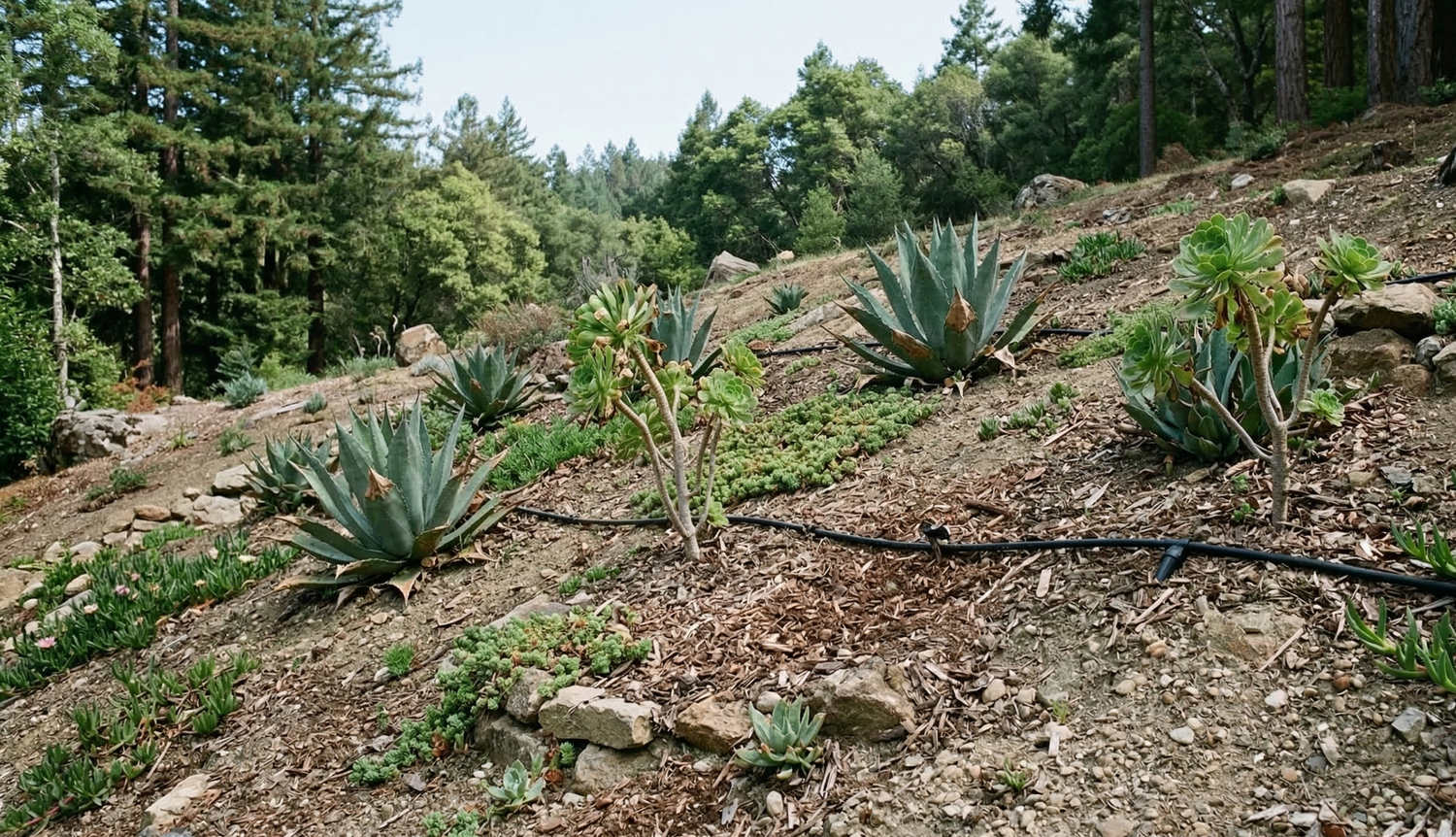
Slopes are among the most fire-vulnerable features of any property because fire travels faster uphill. Convective heat rising from a slope-burning fire preheats vegetation above, causing it to ignite more easily and flames to spread rapidly. A slope between a wildland area and your home is a particularly high-risk feature.
Succulents are excellent slope plants for several reasons:
Their moisture content resists ignition even on a preheated slope
Their shallow, spreading root systems stabilize soil and reduce erosion (a post-fire concern)
Low-growing succulent groundcovers do not produce the tall flames that carry fire into structures
Once established, they need no irrigation, reducing the infrastructure vulnerability of irrigated slope plantings
Best succulents for fire-wise slope planting: - Delosperma cooperi or Lampranthus (broad, fire-resistant groundcover) - Sedum rupestre, S. album, S. spurium (dense, low mats) - Aloe arborescens (larger specimens for mid-slope accent and barrier) - Dudleya species (for rocky, south-facing slopes) - Senecio mandraliscae (blue chalk sticks, spreads to form dense blue-gray groundcover)
What to avoid on slopes: - Ornamental grasses (dry in summer, highly flammable) - Juniper, rosemary, and other oil-rich shrubs - Bark mulch (slides downhill and burns readily) - Carpet-forming ice plant species that are invasive (Carpobrotus edulis)
How Do You Maintain Fire-Wise Succulent Plantings?
Fire-wise landscaping is not a "plant it and forget it" proposition. Even fire-resistant plants require maintenance to remain effective.
Remove dead material. This is the single most important maintenance task. Dead leaves around Agave bases, spent Aloe flower stalks, dried Sedum flower heads, and any other dry plant material should be removed before fire season (see our guide to preparing your garden for fire season) (generally May through November in our area). Dead material is fuel, regardless of how fire-resistant the living plant was.
Manage spacing. As succulents grow and spread, they can fill in gaps that were intentionally designed for fire safety. Thin plantings periodically to maintain space between groups, especially in Zones 0 and 1.
Keep succulents healthy. A stressed, dehydrated succulent is less fire-resistant than a healthy, hydrated one. While most established succulents in Santa Cruz do not need supplemental irrigation, check that plants are not showing signs of severe drought stress during extended dry periods. A deep watering once a month during the driest stretch of summer keeps moisture levels high.
Replace losses promptly. If a succulent dies or a section of groundcover thins out, replace it. Gaps in fire-wise plantings are gaps in your fire defense.
Clean up windblown debris. Succulent beds collect leaves, paper, and other debris blown in by wind. Clear this material regularly during fire season, as it provides the fine fuel that can ignite and carry fire to your home.
Can You Combine Succulents with Other Fire-Wise Plants?
Absolutely. A diverse fire-wise planting is more resilient and more visually interesting than a monoculture.
Good fire-wise companions for succulents:
California native wildflowers: Many are low-growing, seasonally dormant, and produce minimal fuel. Erigeron (seaside daisy), Armeria (sea thrift), and Eschscholzia (California poppy) work well with succulents.
Low-water perennials: Lavender (Lavandula dentata, not L. stoechas, which has higher oil content), Achillea (yarrow), and Centranthus (Jupiter's beard) combine well with succulents in fire-wise plantings.
California buckwheat (Eriogonum fasciculatum): A fire-resistant native that pairs beautifully with Dudleya and Aloe in naturalistic plantings.
Ceanothus (low-growing varieties): Some spreading Ceanothus species are fire-resistant and complement succulents on slopes.
Plants to keep away from succulent fire breaks:
Eucalyptus (highly flammable bark, oil-rich leaves)
Pine (needle litter is extremely flammable)
Juniper (oil-rich, burns intensely)
Rosemary (volatile oils, burns readily when dry)
Ornamental grasses (fine fuel that ignites easily)
Bamboo (burns fast when dry)
Pampas grass (notorious fire hazard)
What Are the Limitations of Succulent Fire-Wise Landscaping?
Succulents are excellent fire-resistant plants, but they are not a silver bullet.
Succulents alone are not enough. Fire-wise landscaping is one component of home protection. It works alongside fire-resistant building materials, ember-resistant vents, cleared gutters, enclosed eaves, and community-wide fuel management. Do not rely on your garden alone to protect your home.
Extreme fire conditions overwhelm any landscaping. In high-wind fire events (like the CZU Complex or many of the fires that have devastated California communities), radiant heat and ember showers can ignite structures regardless of landscaping. Fire-wise plantings improve the odds, but they do not guarantee survival.
Succulents provide limited shade and screening. If you also need shade trees, windbreaks, or privacy screening, succulents cannot fill those roles. You will need to integrate fire-resistant trees and larger shrubs, maintaining defensible space clearances around them.
Not all succulents are low-maintenance in fire zones. Agave, as discussed, requires regular cleanup of dead material. Even Aloe arborescens drops old leaves that should be cleared. Any succulent planting in Zones 0 and 1 needs regular inspection and maintenance to remain effective as fire protection.
Local regulations apply. Santa Cruz County and CalFire have specific defensible space requirements that may dictate plant types, spacing, and maintenance standards. Check with your local fire district for requirements specific to your property, especially if you are in a designated wildland-urban interface (WUI) zone.
Frequently Asked Questions
Are succulents really fire-resistant or is that a myth?
Succulents are genuinely fire-resistant, not a myth. Their high water content makes them very difficult to ignite under normal fire conditions. CAL FIRE publishes no plant list of its own and cautions that fire-safe plant labels are unreliable, pointing homeowners to their county's UC Cooperative Extension office for local advice instead. However, "fire-resistant" does not mean "fireproof." Under extreme conditions, any plant will eventually burn. Succulents slow fire spread and reduce flame intensity, which is their primary value.
How wide should a succulent fire break be to be effective?
CAL FIRE calls the first 30 feet around a structure the lean, clean, and green zone, and asks that the innermost 5 feet be kept to hardscape like gravel, pavers, or concrete with all dead and dying plants removed. A succulent groundcover band at least 6 to 10 feet wide provides meaningful fire resistance. Wider is better. The key is creating a continuous, fuel-free or low-fuel zone rather than relying on a narrow strip that fire can easily jump.
Can I use succulents as a fire break on a steep slope?
Yes, and slopes are one of the most important places to use them. Fire travels faster uphill, so a succulent-covered slope below your home slows fire approach significantly. Use dense groundcover species (Delosperma, Sedum, Lampranthus) for full coverage, and combine with hardscape (stone retaining walls, gravel terraces) for maximum effectiveness. Avoid leaving bare soil, which can erode after fire and cause additional property damage.
Should I remove my Agave because of fire risk from the flower stalks?
No, but you need to manage them actively. The living Agave plant is genuinely fire-resistant. The fire hazard comes specifically from dried flower stalks and accumulated dead leaves. Remove flower stalks as soon as they finish blooming and begin to dry. Clean dead lower leaves at least once a year, ideally before fire season in late spring. With this maintenance, Agave remains a good fire-wise landscape plant.
Is gravel better than living succulents for fire protection right next to my house?
In Zone 0 (the first 5 feet from your structure), gravel or other non-combustible hardscape is the safest choice, according to CAL FIRE guidelines. Low-growing succulents like Sedum or Dudleya with gravel mulch between plants are also acceptable in this zone. The combination of gravel groundcover with scattered fire-resistant succulents provides both safety and beauty. Avoid dense plantings of any kind directly against combustible walls or under eaves.
Do I still need to irrigate fire-wise succulent plantings in summer?
Most established succulents in Santa Cruz County survive summer without irrigation. However, a deeply stressed, dehydrated plant is less fire-resistant than a hydrated one. If you are in a high-risk fire area, a single deep watering once a month during the driest period (July through September) keeps succulent tissue fully hydrated and maximizes fire resistance. This minimal irrigation is far less water than maintaining a traditional landscape.
Protecting your home starts with smart plant choices. Visit our Garden Toolkit for free fire-wise landscaping guides, planting lists, and California-specific resources delivered to your inbox.
