

Lawn Alternatives for a Fire-Wise Santa Cruz Garden
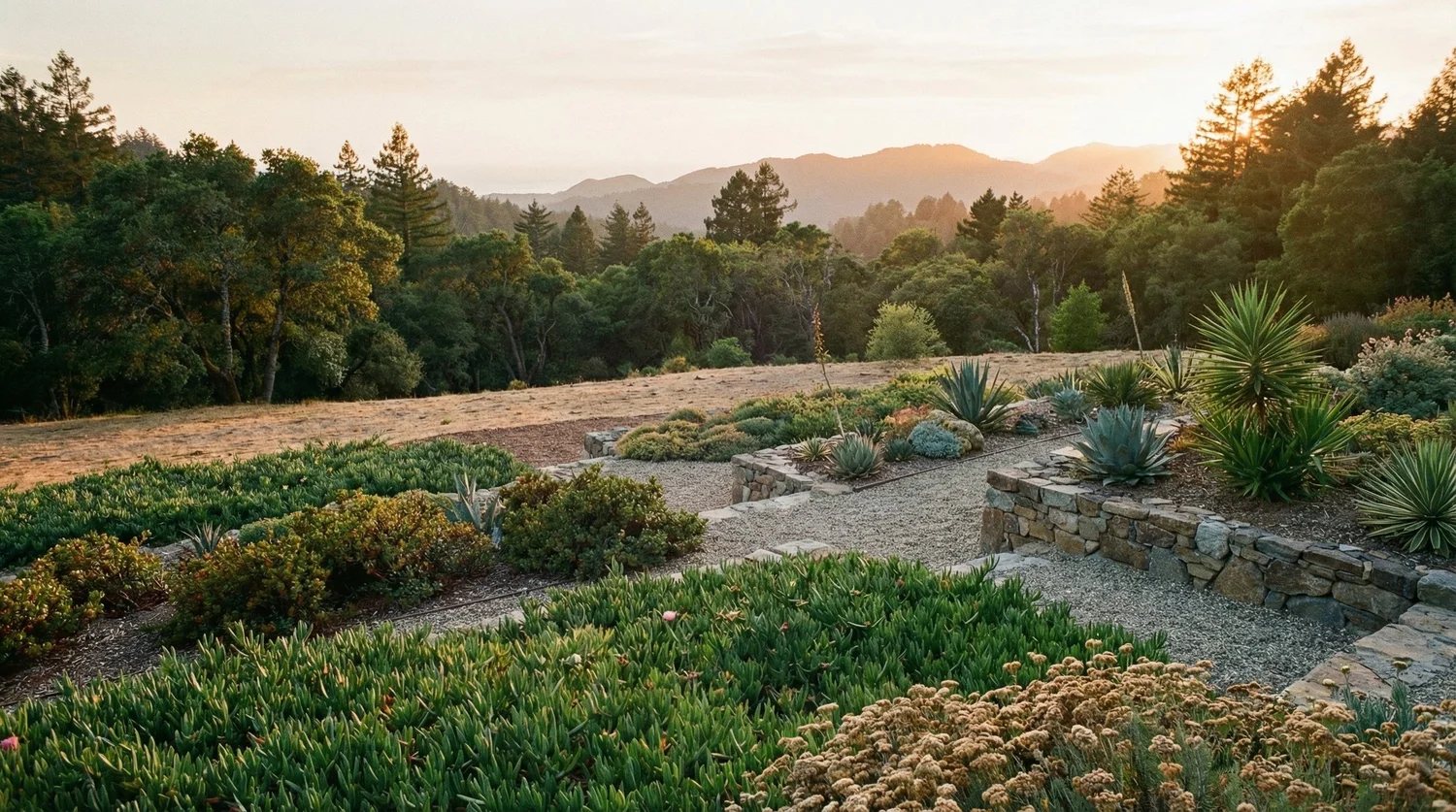
Some links in this guide are affiliate links. If you buy through them, Ambitious Harvest may earn a small commission at no extra cost to you. As an Amazon Associate, we earn from qualifying purchases. Read our full disclosure.
Before replacing a lawn, watch how you use it. The shortcut to the gate, the place the dog runs and the strip nobody ever steps on may need three different solutions. A flowering groundcover could suit the unused strip while a durable path makes more sense for the shortcut.
In Santa Cruz County, water use and wildfire preparation belong in that decision too. A suitable lawn alternative may reduce irrigation and mowing, but replacing grass does not automatically reduce fire risk. For a conservative fire-smart plan, keep the first five feet around the home and attached decks free of vegetation and combustible material, and plan planting areas farther out around their mature growth and maintenance needs.
This plant-free approach is preparation guidance, not a statement of the vegetation rules or compliance dates for every property. Confirm the requirements for your address with your fire authority.
Separate the water question from the fire question
UC landscape-water guidance explains why some non-turf landscapes can use less water than conventional lawns. Actual savings depend on the plants, climate, irrigated area and watering system. A plant labeled low-water may still need substantial attention while establishing, and a dry-summer native may not stay green on the schedule you expected.
Fire planning asks another question: what can burn, and what does it connect to? A green lawn is not a guaranteed firebreak. Neither is a carpet of watered groundcover. Look beneath the living foliage for dry leaves, thatch and weeds, and notice where the planting reaches a fence, a shrub or the house.
The UC ANR Fire Network cautions against relying on fire-resistant plant lists. Dense growth can collect dead material and be difficult to maintain. It does not reliably exclude the air a fire needs. Low height, native origin and succulent leaves are not safety certifications.
Dry grass and other fine fuels respond quickly to changes in humidity, as the National Park Service explains. Their condition matters alongside wind, slope and the way fuels connect. Use current CAL FIRE guidance and local advice to assess maintenance and placement at your own property.
Decide what the replacement must do
Sketch the area before choosing plants. Mark regular walking routes, the immediate noncombustible area around structures, existing trees, slopes and irrigation. A smaller planting area with usable paths may serve you better than replacing every square foot of grass with another living carpet.
- Traffic: distinguish an occasional step from daily play, pets or repeated wheelbarrow use.
- Growing conditions: observe sunlight, drainage and summer drying at the bed itself.
- Maintenance: leave access for weeding and removing dead growth, including beneath spreading plants.
- Fire exposure: assess mature plants and nearby fuels together. A low plant beneath a larger shrub is part of the same arrangement.
- Water: plan establishment care and the longer-term irrigation the chosen plants actually need.
Ready for Wildfire’s landscaping guidance and the UC explanation of Zone 1 defensible space can help with the broader plan. Confirm requirements for your address with the responsible fire authority. A zone boundary is not approval for a particular plant.
Groundcovers worth comparing
These choices have different uses. Treat them as a shortlist for plant research, not a ranking of fire resistance. The UC demonstration-garden lawn alternatives show how walkable groundcovers and taller meadow plantings serve different purposes.
Dymondia: a low surface that takes time to fill
Dymondia margaretae, often sold as silver carpet, has a low, gray-green appearance. UC's demonstration garden describes it as evergreen, durable and slow-spreading, suited to sun or light shade. It can be worth investigating where you want low cover rather than a tall meadow.
Do not budget on a guaranteed date for complete coverage. Plant size, spacing, weeds, soil and watering all affect establishment. Leave a proper path where people repeatedly walk, especially while the new plants are small. Check site suitability before using it in wet or heavily shaded ground.
Sedges: choose the exact species and the look you want
Carex praegracilis and Carex pansa are California-native sedges used in lawn-alternative plantings. A mown appearance and a natural meadow are different maintenance choices. Look at a mature example of the selection you intend to buy rather than assuming every sedge stays as low as turf.
UC's lawn-alternative comparison notes that Carex praegracilis can turn brown away from the coast with minimal summer irrigation. That matters if your reason for choosing it is a green summer appearance. Water use and year-round greenness vary with the Santa Cruz microclimate and the care you provide.
Carex divulsa, commonly sold as Berkeley sedge, is a different, nonnative choice. Its clumping form should not be treated as interchangeable with a spreading native sedge lawn. Confirm the botanical identity, mature size and care of the plants offered by the nursery.
Creeping thyme: a planting beside a path
Creeping thymes can provide low growth and flowers, with considerable variation among species and cultivars. Choose the actual plant for its exposure, drainage and mature form. A fragrant patch beside stepping stones is a different job from a heavily used play lawn.
Inspect woody stems and dry material beneath the foliage as it ages. Aroma alone does not establish a fire rating, and an arbitrary ten-foot setback does not certify thyme as suitable. Use the same placement and maintenance review you would apply to other plants.
Creeping myoporum: spreading cover to assess carefully
Myoporum parvifolium is an Australian groundcover used in California landscapes. Check the species, cultivar, mature spread, cold tolerance and site requirements before committing a large area. A planting that spreads quickly may also need regular edge management.
Do not assume it needs only a monthly watering or that its foliage makes it difficult to ignite. Give it an appropriate location outside the immediate noncombustible area, leave maintenance access and check beneath the canopy for dead material. It should not be a substitute for a walking surface where regular traffic is expected.
Low ceanothus: a spreading shrub, not turf
Ceanothus gloriosus ‘Point Reyes’ offers a different kind of cover: a spreading woody plant with spring flowers. It may suit a planting area where people do not need to walk, subject to the site and the exact selection's needs. Allow for its mature branches and access beneath them.
Do not assign it a safe zone based on distance alone or assume rainfall will meet its needs in every setting. Our guide to fire-wise gardening with California natives discusses how site fit, care and fire planning work together. If browsing the linked native-plant collection, confirm the species and regional origin; that general category is not a verified listing for this ceanothus.
Yarrow and mixed planting areas
Yarrow can be another candidate for an appropriate planting area, with foliage and flower stalks that need their own care. Check the botanical identity if local native planting matters to you. A colorful ornamental selection is not necessarily the same as locally occurring yarrow.
Mixing plants can give the garden more variety, but do it by compatible water needs, growth and available space. A vigorous neighbor may crowd a slower plant rather than help it. Leave intentional gaps and paths instead of building a continuous progression from low groundcover to shrubs and tree branches.
Plan the changeover before removing the lawn
Check rebate rules first
Contact the water provider serving your address before removing turf or buying materials. Ask about current funding, eligibility, inspections and preapproval. For example, Soquel Creek Water District's rebate information directs applicants to each program's requirements. Do not assume a neighboring district's offer applies to your property.
Include lawn removal, disposal, irrigation changes, plants and establishment care in the budget. Starting with a manageable section can help spread the work, but the whole layout should still make sense for access, water and fire preparation.
Choose a removal method for the site
Identify the existing grass and persistent weeds before deciding how to remove them. Physical removal, carefully planned sheet mulching and other methods have different costs and limits. Cardboard and organic mulch are combustible; do not lay them in the immediate five-foot area or connect them to vulnerable structures.
UC IPM’s solarization guidance describes using clear plastic and solar heat. It needs suitable conditions and preparation, and coastal fog or shade can make results less reliable. Do not assume every lawn will be ready to plant after four to six weeks or that a method eliminates every deep-rooted weed.
If considering herbicide, identify the plant to be controlled and follow the product label for the intended site and subsequent planting. An edible herb's presence does not establish a universal rule about every herbicide. Seek qualified advice when uncertain, and keep removal work within your ability to do it safely.
Prepare soil and irrigation for the selected plants
Check drainage, compaction and existing roots. Do not automatically dig compost into every soil at one depth or apply one amendment recipe to every native and nonnative plant. Use a soil test when it will answer a specific question, and check the UC Davis Analytical Laboratory for its current services, sample requirements and fees before sending material.
Arrange watering before planting. The linked DIG raised-bed drip-watering kit is intended for raised-bed layouts; check coverage, pressure and components rather than assuming it suits a broad lawn conversion. A planting designer or irrigation professional can help match the system to the new area.
New plants need monitoring even when the mature plant is described as drought-tolerant. Check the root area and adjust for weather and growth. There is no universal point at one or two years when irrigation can be removed.
Space plants for the result you can maintain
Use species-specific guidance for the actual pot or plug size and mature spread. Closer spacing may fill an area sooner but costs more and can create crowding. Wider spacing leaves more ground to manage during establishment. Keep weeds from competing without promising that complete coverage will end weeding.
Where mulch is appropriate beyond the immediate area, assess its combustibility, depth and connections to other fuels. Composted wood chips can still smolder. A thin layer or older material is not automatically safe beside a structure, and adding mulch should not bury the crowns of spreading plants.
Estimate water savings from your own area
A water-use category is a planning aid, not a meter reading. Reference evapotranspiration, plant demand, rainfall and irrigation efficiency are different quantities. You cannot turn a low-water classification into a guaranteed percentage saving without accounting for the actual site and the lawn it replaces.
For a simple volume comparison, one inch of applied water over one square foot is about 0.623 gallon. If a 1,500-square-foot area receives 10 fewer inches of irrigation over a year, the difference is about 9,345 gallons. That is an illustrative calculation, not a forecast for a particular groundcover. A water bill also depends on your provider's rates and fixed charges.
Record existing irrigation and compare it after establishment, allowing for weather differences and changes elsewhere on the property. Reducing unnecessary watering may be useful whether you retain part of the lawn or replace it.
On slopes, plan for fire and winter runoff together
Do not strip a slope simply to replace one plant with another. Existing roots, runoff, soil and the stability of the ground matter. A groundcover is not a substitute for geotechnical or erosion-control advice where a slope is unstable or work could affect buildings or drainage.
Have a qualified professional assess substantial clearing, grading, retaining work or erosion-control materials. Jute and coir are organic materials, not automatically fire-safe blankets, and no single slope percentage makes one treatment right everywhere.
As plants fill in, keep checking their connections to other vegetation and structures. Our guide to preparing your garden for fire season can help organize seasonal cleanup, while CAL FIRE guidance provides the broader defensible-space framework.
Questions to settle before planting
Will groundcover handle children, pets and daily walking?
Some plants tolerate occasional steps, but that is not the same as repeated play or a busy route to the gate. Look at mature examples, confirm the selection's intended use and keep a durable path where traffic is concentrated. Retaining a smaller useful lawn may be more practical than repeatedly replacing damaged plants.
Does a low groundcover keep rodents away?
No height threshold makes a planting rodent-proof. Gophers live underground, and different rodents use a site in different ways. Identify the animal, monitor activity and use appropriate management; choosing shallow roots is not a reliable solution.
Should I remove plants when fire season arrives?
Assess the actual problem. Remove dry material and address unsuitable placement under current guidance, but do not indiscriminately clear a slope and create an erosion problem. Plan substantial changes ahead of hazardous weather. Normal irrigation supports plant health; extra watering does not turn vegetation into a protective barrier.
Is gravel better than living cover?
They serve different purposes. Suitable noncombustible surfaces belong in the immediate area around structures and can provide paths elsewhere. Living cover can offer planting and habitat benefits farther out where appropriate. Both need attention: gravel collects leaves, while groundcovers grow and shed material. Design drainage, access and vegetation management together.
How can I keep costs manageable?
Measure the area, compare complete costs and start with a section you can maintain through establishment. Dividing suitable plants may eventually provide more starts, but do not count on a fixed multiplication rate or free materials. Confirm rebate approval before work, and include the time needed for weeding and watering.
Visit Your Garden Toolkit for garden-planning resources. For related decisions, see Fire-Wise Fencing and Structures: Preventing Fire Pathways to Your Home, Summer Garden Irrigation for Fire Safety and Understanding Santa Cruz Microclimates.
Begin with the part of the lawn that is doing the least for you. Decide what it should become, where people will walk and how you will care for the new planting. A smaller, well-planned change is easier to learn from than a yard full of plants chosen for a promise on a label.
