

Best Succulents for Coastal California | Fog-Tolerant Varieties
Best Succulents for Coastal California: Cold-Hardy, Fog-Tolerant Varieties That Thrive
A few of the product links in this guide are affiliate links. If you buy through one, Ambitious Harvest may earn a small commission at no extra cost to you, which helps keep these guides free. We only point to gear we would use in our own Santa Cruz garden. As an Amazon Associate, we earn from qualifying purchases. Read our full disclosure.
The best succulents for coastal California are those adapted to maritime climates rather than desert conditions, with Aeonium, Dudleya, Aloe arborescens, Sedum, and Sempervivum consistently outperforming desert species in foggy, salt-exposed gardens. UC Master Gardeners note that coastal gardeners who choose fog-tolerant species over popular desert varieties see dramatically lower plant loss rates, especially during the cool, wet months from November through March.
Many gardeners learn this the hard way. They buy a flat of stunning Echeveria at the garden center, plant them in a coastal bed, and watch them slowly dissolve into mush over winter. The problem is not your gardening skill. It is a mismatch between plant origin and local conditions. Coastal California's combination of summer fog, winter rain, moderate temperatures, and salt air creates an environment that is wonderful for some succulents and lethal for others.
This guide covers the varieties that genuinely thrive on the California coast, not just survive. For foundational care tips, start with our guide to growing succulents in Santa Cruz.
Why Do So Many Popular Succulents Fail on the Coast?
Understanding why certain succulents fail here helps you make better choices. Most of the succulents sold at big-box stores and even some nurseries are desert-adapted species: Echeveria from the Mexican highlands, Crassula from South Africa's dry interior, Haworthia from arid karoo regions. These plants evolved in environments with low humidity, intense sun, and brief, infrequent rainfall.
Coastal California offers the opposite in several key respects. The Santa Cruz coast stays cool and overcast for much of the growing season, with summer fog regularly depositing measurable moisture on leaf surfaces. Relative humidity often exceeds 80 percent in morning hours, even during the dry season. Winter brings 25 to 50 inches of rainfall depending on location, sometimes falling steadily for days.
For a plant evolved to absorb every available drop of water and store it indefinitely, this is too much of a good thing. The cellular structure that makes succulents drought-tolerant (thick leaves packed with water-storage tissue) also makes them vulnerable to rot when external moisture is constant. Fungal pathogens like Phytophthora, Fusarium, and Botrytis thrive in our cool, humid conditions, according to UC Integrated Pest Management Program resources.
The winners on the coast are succulents from similar maritime or semi-maritime climates: the Canary Islands, coastal South Africa, Mediterranean islands, and (best of all) the California coast itself.
Santa Cruz Microclimate Guide
Recommended succulent genera by zone
Direct Oceanfront
Salt spray, constant wind
Dudleya, Aloe arborescens, Agave attenuata, Senecio mandraliscae
Fog Belt (limited sun)
Under 4 hrs direct sun
Aeonium, Aloe maculata, Sedum spurium, Crassula ovata (jade)
Inland Valleys
Warmer, sunnier, less fog
Echeveria, Graptopetalum, Graptoveria + all coastal types
San Lorenzo Valley
Cooler, wetter, partly shaded
Sempervivum, cold-hardy Sedum, Aeonium, Dudleya (raised beds)
South-Facing Walls/Patios
Warm, protected microclimate
Echeveria, Kalanchoe, tender Aloe + all hardy types
What Makes Aeonium the Best Genus for Coastal California?
If you could grow only one type of succulent on the California coast, Aeonium would be the smart choice. Native to the Canary Islands, Madeira, and coastal Morocco, Aeoniums evolved in a climate strikingly similar to ours: foggy, mild, with winter rainfall and dry summers.
Unlike most succulents, Aeoniums are winter growers. They put on active growth from October through May, taking full advantage of our rainy season, then go dormant in summer. This means they work with our climate rather than against it. During dormancy, they may drop lower leaves and look a bit sparse, which is completely normal.
Top Aeonium varieties for coastal California:
Aeonium arboreum: The classic. Grows 2 to 3 feet tall with bright green rosettes on branching stems. Extremely easy, fast-growing, and propagates from stem cuttings in days (see our full guide to propagating succulents). The cultivar 'Zwartkop' (also called 'Schwarzkopf') produces deep purple-black rosettes that are among the most dramatic foliage colors in any garden.
Aeonium haworthii: Compact, bushy plants with blue-green rosettes edged in red. Stays under 2 feet and works well as a mid-ground filler or container specimen. Very fog-tolerant.
Aeonium canariense: Large, flat rosettes up to 12 inches across on short stems. More shade-tolerant than most, making it useful under partial tree canopy.
Aeonium 'Sunburst': Variegated rosettes in cream, green, and pink. Slightly less vigorous than the plain species but still reliable on the coast. Needs some protection from intense afternoon sun to prevent leaf scorch.
Aeonium undulatum: Large, deep green rosettes with a distinctive cupped shape. Particularly robust and long-lived. Often seen in older Santa Cruz gardens where specimens have grown into impressive multi-stemmed shrubs.
Cold hardiness: Most Aeonium tolerate temperatures down to about 25 to 28 degrees Fahrenheit. This is adequate for coastal Santa Cruz but marginal in the colder parts of the San Lorenzo Valley. In frost-prone locations, plant against a south-facing wall or be prepared to cover them on the coldest nights.
Why Is Dudleya the Ultimate Coastal California Succulent?
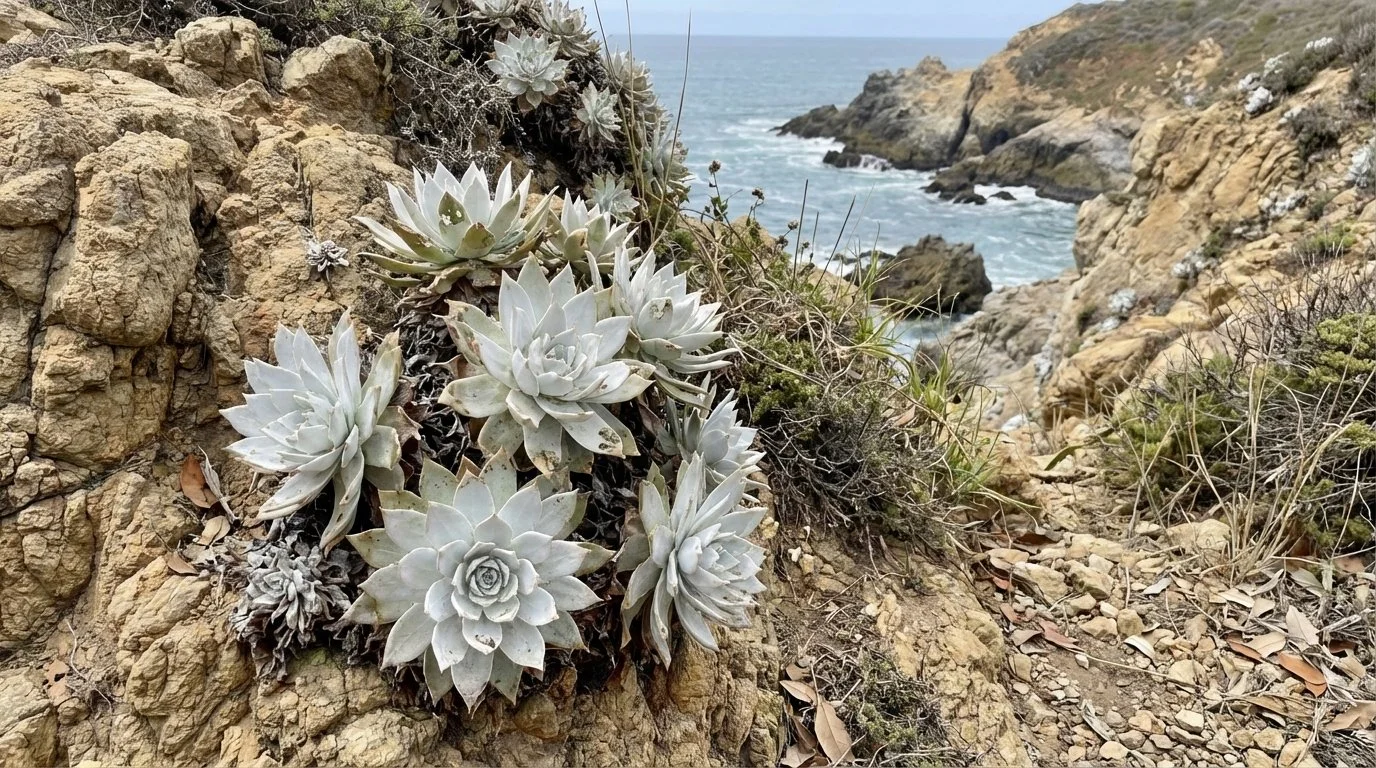
Dudleya is not just a good choice for coastal California. It is the definitive choice, because it actually evolved here. Multiple Dudleya species are native to California's coastal bluffs, including populations in Santa Cruz County. They are literally adapted to fog, salt spray, poor rocky soil, and seasonal drought.
According to the California Native Plant Society, Dudleya includes 47 species and 21 subspecies across southwestern North America, 26 of them native to California, where they grow along coastal cliffs. Several thrive on the immediate coast, growing in crevices on cliff faces where virtually no other succulent could survive.
Top Dudleya species for coastal gardens:
Dudleya farinosa (bluff lettuce): Native along the Santa Cruz County coast. Compact rosettes with a heavy white, powdery coating (farina) that protects against salt and UV. Thrives in rocky, well-drained spots with fog exposure. An excellent choice for rock gardens, wall plantings, and coastal-facing beds.
Dudleya caespitosa (coast dudleya): Forms clusters of green to gray-green rosettes. Found naturally along the Central California coast. More tolerant of garden conditions than some of the cliff-dwelling species.
Dudleya pulverulenta (chalk dudleya): Larger rosettes (up to 18 inches across) with brilliant chalky white farina. Native to Southern California but performs beautifully in Santa Cruz. A showstopper in the landscape.
Dudleya brittonii: Sometimes called the "giant chalk dudleya." Produces rosettes up to 18 inches with the whitest farina of any species. Hardy to about 25 degrees Fahrenheit.
Important note on Dudleya: Never collect Dudleya from the wild. Poaching of native Dudleya populations has become a serious conservation issue in California, and removal of native plants is illegal. Always purchase nursery-propagated plants from reputable sources. For more detail, see our dedicated guide to growing Dudleya.
Which Sedum Species Perform Best on the Coast?
Sedum is the Swiss Army knife of the succulent world: reliable, versatile, and hard to kill. The genus includes hundreds of species ranging from tiny creeping groundcovers to upright perennials reaching 2 feet tall. Many are native to coastal or maritime regions in Europe and Asia, so they transition naturally to California coast conditions.
Best groundcover Sedums for coastal California:
Sedum rupestre (S. reflexum): Blue-green needle-like foliage on spreading stems. Excellent groundcover, tolerates light foot traffic, handles fog and part shade. Grows 4 to 6 inches tall and spreads indefinitely. One of the most reliable choices for filling large areas.
Sedum album: Tiny rounded leaves, very low-growing (2 to 3 inches). Turns reddish in sun. Fills cracks in pathways, walls, and rock gardens. Extremely tough.
Sedum spurium: Available in green, bronze, and deep red cultivars ('Dragon's Blood' is popular). Grows 3 to 6 inches tall, spreads well. Cold-hardy and fog-tolerant.
Sedum sexangulare: Fine-textured, bright green groundcover. Very fast spreading. Works well between stepping stones and in green roof applications.
Sedum oregonense: Native to the Pacific Coast. Naturally adapted to maritime conditions and well-suited to coastal gardens.
Best upright Sedums:
Sedum 'Autumn Joy' (Hylotelephium 'Herbstfreude'): The classic border perennial. Grows 18 to 24 inches with flat flower heads that progress from pink to copper to russet-brown through fall. Loved by butterflies. Dies back in winter, returns reliably in spring.
Sedum spectabile: Similar to 'Autumn Joy,' with pink flowers attractive to pollinators. Multiple cultivars available.
Cold hardiness: Most Sedum species are extremely cold-hardy, many to well below zero degrees Fahrenheit. Cold is never a concern for Sedum in Santa Cruz County.
How Well Do Sempervivum Handle Coastal Conditions?
Sempervivum (hens and chicks) are mountain succulents, native to the Alps and other European mountain ranges. They are extraordinarily cold-hardy (many survive temperatures below minus 30 degrees Fahrenheit) and handle poor, rocky soil with ease.
On the coast, Sempervivum face one challenge: they prefer drier air than our fog belt provides. In consistently humid conditions, they can develop fungal issues on their tightly packed rosettes where moisture gets trapped.
The solution is placement. Sempervivum perform beautifully in coastal California when you give them:
Rock garden pockets with fast drainage
Vertical wall plantings where water runs off quickly
Container plantings under eaves where they are protected from direct rain and fog drip
South-facing slopes with good air movement
In the San Lorenzo Valley and other inland, higher-elevation areas of the county, Sempervivum are among the easiest succulents you can grow. Their extreme cold hardiness means they sail through SLV winters without a thought.
Recommended varieties: Sempervivum tectorum (the classic), S. arachnoideum (cobweb houseleek, with distinctive white webbing between leaf tips), and the many named hybrids available in colors from deep purple to lime green.
What Aloe Species Work on the California Coast?
Not all Aloe species are created equal for coastal conditions. Aloe vera, despite its popularity, is actually a mediocre performer on the fog coast. It prefers warmer, drier conditions and can rot during wet winters if drainage is not perfect.
The coastal champion is Aloe arborescens (torch aloe). This South African species thrives in maritime conditions, tolerates fog, handles temperatures down to about 25 degrees Fahrenheit, and produces spectacular orange-red flower spikes from December through February. It eventually grows into large, dramatic clumps 6 to 10 feet across and 4 to 6 feet tall. You will see massive, decades-old specimens throughout older Santa Cruz neighborhoods, a sign of their longevity here.
UC Master Gardeners recommend Aloe arborescens as one of the top fire-resistant landscape plants for coastal California because of the high water content in its leaves.
Other reliable coastal Aloe species:
Aloe striata (coral aloe): Flat rosettes of broad, smooth leaves with coral-pink edges. Stays compact (under 2 feet). Beautiful orange flowers in spring. Handles fog and mild frost well.
Aloe maculata (soap aloe): Spotted leaves, compact rosettes, orange to red flowers. Very adaptable and cold-hardy to about 20 degrees Fahrenheit.
Aloe brevifolia: Small, compact rosettes of gray-blue leaves. Works well in containers and rock gardens.
Aloe polyphylla (spiral aloe): The collector's choice. Dramatic spiral rosette pattern. Prefers cool conditions (actually dislikes extreme heat), so our coast suits it well, but it demands perfect drainage and resents wet crowns. Best in a sheltered, sloped spot with morning sun.
Cold hardiness note: Aloe arborescens and A. maculata are the most cold-hardy of the commonly available Aloe species. Protect others during hard freezes below 28 degrees.
Can Agave Grow Successfully on the California Coast?
Absolutely, but species selection matters enormously. The genus Agave includes species from bone-dry deserts and species from relatively moist tropical highlands, and their performance on the coast reflects those origins.
Agave attenuata (foxtail agave): This is the coastal Agave. Native to central Mexico's highlands (not desert), it prefers the moderate temperatures and occasional moisture of the coast over extreme heat and aridity. It lacks the sharp terminal spines of most Agave, making it safer near walkways. Grows into handsome rosettes 3 to 4 feet across, eventually producing a dramatic arching flower stalk. Cold-hardy to about 28 to 30 degrees Fahrenheit, which is adequate for most coastal locations but marginal for the colder SLV areas.
Agave americana (century plant): The classic blue-gray Agave. Large (can reach 6 feet across), dramatic, and very tough. Handles coastal fog reasonably well if drainage is excellent. The main issue is its size and sharp spine tips, which can be a hazard. The variegated form 'Marginata' is especially handsome.
Agave parryi: Compact, cold-hardy (to 0 degrees Fahrenheit or below), and beautiful with symmetrical blue-gray rosettes. Prefers somewhat drier conditions than our coast provides, but performs well in raised beds with fast-draining soil and a gravel mulch.
Agave 'Blue Glow': A popular hybrid with compact, neatly symmetrical rosettes edged in red. Moderate size (2 feet across), handles coastal conditions reasonably well.
Caveat about Agave and fire-wise landscaping: While Agave plants themselves are high-moisture and fire-resistant, their dried flower stalks are highly flammable. If you include Agave in a fire-wise planting, remove spent flower stalks promptly. CAL FIRE names no plant species and publishes no plant list, and it cautions that fire-safe labels are unreliable. What it does ask for is the first 5 feet around a structure kept to hardscape, with all dead plant material cleared.
What About Ice Plants for Coastal California?
Ice plants (various genera including Delosperma, Carpobrotus, Drosanthemum, and Lampranthus) deserve mention because they are among the most successful coastal succulents in California. They are also among the most controversial.
Carpobrotus edulis (highway ice plant): This South African species was widely planted along California highways and coastal bluffs for erosion control. It is now recognized as a seriously invasive species that displaces native plants, including native Dudleya. The California Invasive Plant Council lists it as a high-impact invasive. Do not plant Carpobrotus edulis.
Better alternatives:
Delosperma cooperi (hardy ice plant): Non-invasive, cold-hardy, brilliant magenta flowers. Grows 3 to 4 inches tall and spreads as a groundcover. An excellent lawn replacement for sunny, well-drained areas.
Drosanthemum floribundum (rosea ice plant): Fine-textured groundcover with pink flowers. Less aggressive than Carpobrotus. Used successfully for slope stabilization.
Lampranthus species: Shrubby ice plants with vivid orange, pink, or purple flowers. Excellent for coastal slopes and fire-wise plantings. Not invasive.
Native alternatives: Dudleya and native Sedum species fill similar niches without the invasive risk.
How Do You Choose Succulents for Different Coastal Microclimates?
Even within coastal California, conditions vary block by block. Here is a quick guide to matching succulents to specific situations.
Direct oceanfront (salt spray, constant wind): Dudleya (native and adapted), Aloe arborescens, Carpobrotus (use non-invasive species only), Agave attenuata, Senecio mandraliscae.
Fog belt with limited sun (fewer than 4 hours direct sun): Aeonium (most species), Aloe maculata, Sedum spurium, Sempervivum (in raised/drained spots), Crassula ovata (jade plant, surprisingly fog-tolerant if drainage is perfect).
Sunny inland valleys (Watsonville, Aptos, Corralitos): These areas are warmer and receive less fog, opening up more options. Echeveria, Graptopetalum, Graptoveria, and other desert types perform better here. You can also grow a wider range of Agave and Aloe species.
San Lorenzo Valley (cooler, wetter, partly shaded): Sempervivum (top choice), cold-hardy Sedum, Aeonium (in sunnier spots), Dudleya (in well-drained raised beds). Avoid frost-tender species.
South-facing walls and patios: These warm, protected microclimates allow you to push boundaries. Try Echeveria, Kalanchoe, and other species that are marginal in open coastal plantings.
Most of these fog-tolerant varieties are easier to judge in person than online. Our guide to the succulent nurseries worth the drive from Santa Cruz covers where you can see them growing before you buy.
Frequently Asked Questions
Can I grow Echeveria outdoors on the California coast?
You can, but with realistic expectations. Echeveria prefer bright sun and dry air, which coastal fog undermines. In the fog belt, they tend to etiolate (stretch), lose their compact rosette form, and become vulnerable to rot during wet winters. Your best results will come from planting them in containers with excellent drainage, placing them in the sunniest available spot, and moving them under cover during prolonged rain. In sunnier inland areas like Watsonville, Echeveria perform much better.
Will succulents survive frost in Santa Cruz County?
Most landscape succulents handle our typical coastal frosts (low 30s) without damage. Many Sedum and Sempervivum species are hardy to well below zero. Aeonium, Aloe arborescens, and Agave attenuata tolerate temperatures down to about 25 to 28 degrees. The San Lorenzo Valley occasionally sees temperatures in the low 20s, where you should focus on the hardiest species or provide frost cloth protection for borderline varieties.
How do I tell if a succulent at the nursery will handle fog?
Look at the leaves. Succulents with thick, waxy coatings (farina), like Dudleya, tend to shed water well. Species from maritime climates (Aeonium, many Sedum) are generally safe. Avoid species described as needing "full sun and dry conditions" or originating from desert or high-altitude arid regions. Ask nursery staff specifically about fog tolerance, or better yet, visit the UC Santa Cruz Arboretum's Arid Garden to see what thrives in real coastal conditions.
What is the most drought-tolerant succulent for coastal California?
Dudleya species are arguably the most drought-tolerant succulents you can grow here, which makes sense since they evolved on our rain-starved coastal bluffs. Once established, Dudleya farinosa and D. caespitosa survive on rainfall and fog moisture alone, needing zero supplemental irrigation. Agave species are similarly drought-tolerant once their root systems are established, often surviving years of neglect.
Are there any succulents native to Santa Cruz County?
Yes. Dudleya farinosa (bluff lettuce) grows naturally on coastal bluffs in Santa Cruz County, and Dudleya caespitosa (coast dudleya) is found along the Central California coast. Sedum spathulifolium (broadleaf stonecrop) is another California native succulent found in our region. Growing these native species supports local ecosystems and ensures maximum adaptation to our specific conditions. Purchase only nursery-propagated specimens.
Do I need to protect succulents from Santa Cruz's winter rain?
It depends on the species and your soil. Fog-tolerant varieties (Aeonium, Dudleya, Sedum, Aloe arborescens) planted in well-drained soil handle winter rain without intervention. Desert-adapted species (Echeveria, many cacti, some Crassula) may need rain protection during extended wet periods. If your soil is heavy clay, even tolerant species benefit from raised planting or gravel mulch to prevent waterlogging.
Want more California-specific growing guides for your garden? Sign up for our free newsletter at Your Garden Toolkit and get planting calendars, variety guides, and seasonal tips delivered to your inbox.
